 Calc
Lens Power Calculator – Focal Length to Diopters Converter
 Created by Rachel Novak · Senior Editor · All Topics · Last updated: November 2026
Use this free Lens Power Calculator to convert between a lens's focal length and its power in diopters (D) — the unit opticians use on glasses and contact lens prescriptions. Just type the focal length in centimetres.
Every glasses prescription in the world is written in diopters, and the reason is convenience disguised as a definition: the power of a lens is simply one divided by its focal length in metres. A lens that focuses light half a metre away is a +2.00 D lens; one that focuses at 25 cm is +4.00 D. The shorter the focal length, the harder the lens bends light, and the bigger its number. Power is the optician's native currency because it measures the thing they actually care about — bending strength — rather than the distance that results from it.
The sign carries the meaning. Converging lenses — thicker in the middle, the kind in magnifying glasses and reading glasses — have positive focal lengths and positive powers. Diverging lenses — thin in the middle, used to correct short sight — have negative values of both. A prescription of −2.00 D and one of +2.00 D are equally strong lenses doing opposite jobs, and this calculator handles both directions of the conversion with the signs intact.
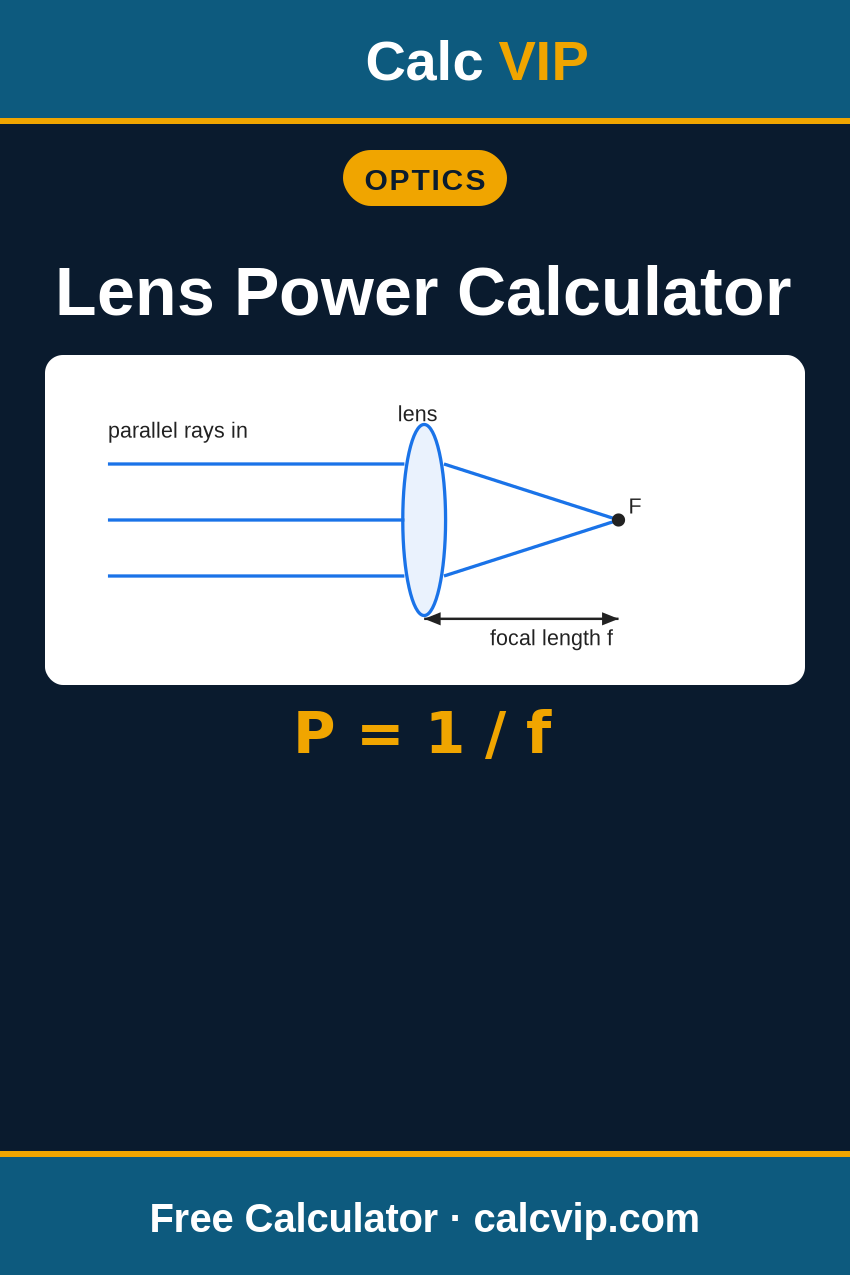
Power also explains a small miracle of the optician's trial case: stack two thin lenses together and their powers simply add, while their focal lengths combine in an awkward reciprocal dance. That additivity, explored below, is why prescriptions can be fine-tuned a quarter-diopter at a time and why the diopter — not the centimetre — rules the eye clinic. The sections that follow unpack the eye's own power, the difference between glasses and contact lens strengths, and how to read a real prescription.
Formula
P = 1 / f, where f is the focal length in metres • P is in diopters (D), and the rearrangement is f = 1 / P
Sign rule: a converging (convex) lens has a positive focal length and positive power; a diverging (concave) lens has a negative focal length and negative power. Because prescriptions and lens data so often quote centimetres, the working form is P = 100 ÷ f(cm) — the factor 100 is just the metres conversion, and forgetting it is the classic way to be wrong by exactly two orders of magnitude. One diopter is a gentle lens (f = 1 m); ten diopters is a strong one (f = 10 cm). Powers of thin lenses in contact add: P = P₁ + P₂, which the companion Combined Lenses Calculator explores in full.
| Symbol | Meaning | Units |
|---|---|---|
| P | lens power — bending strength | diopters (D) = 1/m |
| f | focal length — distance from lens to its focus | m (calculator takes cm) |
| F | focal point — where parallel rays meet (or appear to meet) | a point, not a number |
Why the eye clinic runs on diopters
Think of light arriving at a lens as either spreading out (diverging) or pulling together (converging). Opticians quantify that spread in diopters too — the vergence of light from an object 25 cm away is −4 D, from an object at infinity, 0 D. A lens adds its power to whatever vergence arrives: light leaving a lens has vergence = incoming vergence + lens power. In that arithmetic, focal lengths are useless and powers are everything. It is why an optician can neutralise your eye's error with a stack of trial lenses, adding a quarter-diopter at a time until the chart snaps into focus.
Your eye itself is a lens system of about +60 D total power — one of the strongest optical instruments you own. The front surface of the cornea contributes roughly +43 D of it, because the air-to-cornea step is the biggest index jump light meets on its way in. The crystalline lens inside adds about +20 D and, crucially, can change its power: the ciliary muscle squeezes it rounder to add up to +15 D or so in a young eye, which is the act of focusing up close — accommodation. Presbyopia, the reading-glasses condition of middle age, is simply that adjustable bonus shrinking away.
The numbers also set the scale of prescriptions. A −0.25 D correction is the smallest step normally prescribed, a focal length of −4 m: a whisper of a lens. A −10.00 D prescription (f = −10 cm) is strong myopia. That the whole of clinical vision care plays out between about −20 D and +20 D is a consequence of the eye's own +60 D benchmark: corrections are adjustments of a few percent to a powerful built-in lens.
How to use
- Choose in the dropdown whether you are starting from the focal length or from the power.
- Enter the focal length in centimetres (or the power in diopters). Add a minus sign for a diverging lens — essential, because the sign is half the information.
- Click "Calculate" to see the converted value.
- Cross-check against intuition: +1 D ↔ 100 cm, +4 D ↔ 25 cm, +10 D ↔ 10 cm. If your answer is 100 times bigger or smaller than the conversion feels, a centimetre–metre slip is the likely culprit.
Worked examples
Example 1 — the two directions of the conversion. A converging lens has a focal length of 25 cm.
First convert to metres: 25 cm = 0.25 m.
P = 1 ÷ 0.25 = +4.00 D.
The other way round: a −2.00 D diverging lens has f = 1 ÷ (−2.00) = −0.50 m = −50 cm.
Example 2 — a magnifying glass. A pocket magnifier has f = 10 cm = 0.10 m.
P = 1 ÷ 0.10 = +10.00 D. That is why a short-focal-length magnifier feels so powerful: ten diopters of bending in a lens the size of a coin.
Example 3 — reading glasses. Over-the-counter readers of +1.50 D correspond to f = 1 ÷ 1.50 = 0.667 m = 66.7 cm. Held that far from a page, they would focus sunlight to a point — a reminder that "weak" reading glasses are still serious lenses.
Example 4 — a camera's "nifty fifty". The classic 50 mm camera lens has f = 5.0 cm = 0.050 m.
P = 1 ÷ 0.050 = +20.00 D — stronger than almost any glasses lens, because camera lenses are built to bend light across a sensor just centimetres behind them.
Example 5 — strong short sight. A prescription of −6.00 D means f = 1 ÷ (−6.00) = −0.167 m = −16.7 cm. The minus sign says the lens spreads light as if it came from a virtual focus 16.7 cm in front of the lens — exactly what a strongly myopic eye needs.
Example 6 — the smallest step. The gentlest common prescription increment, +0.25 D, gives f = 1 ÷ 0.25 = 4.00 m = 400 cm. A lens so weak barely bends light at all, yet wearers can tell the difference on the eye chart — a tribute to how finely the visual system notices blur.
Lens power in real life
Reading a prescription. A typical script shows SPH (sphere — this page's power), CYL (cylinder — extra power in one direction only, for astigmatism) and AXIS (the cylinder's orientation, 1–180°). The sphere is the headline number: negative for short sight, positive for long sight.
Contact lenses differ from glasses. A contact lens sits on the cornea; a glasses lens sits about 12 mm in front of it. That gap changes the effective power, so beyond about ±4 D the two prescriptions genuinely differ — the vertex-distance section below works the numbers.
The phoropter's click. The machine an optician flips in front of your eyes ("better one… or two?") steps through lenses in 0.25 D increments. Each click is a focal-length change of centimetres, but it is the quarter-diopter that your visual system is judging.
Magnifiers are sold by power in disguise. A "5×" magnifier is conventionally a lens of about +20 D (f = 5 cm): the trade formula magnification ≈ P ÷ 4 turns diopters into the headline times-number. Jewellers' loupes at 10× run near +40 D.
Intraocular lenses. After cataract surgery, a plastic lens of typically +18 to +22 D is implanted where the natural lens sat. Its power is calculated before surgery from measurements of the eye's length and corneal curvature — biometry is applied lens-power arithmetic.
Camera and phone lenses. Photographers quote millimetres, but the diopter view explains design: a 24 mm wide-angle is +41.7 D, a 200 mm telephoto just +5.00 D. Phones, with sensors millimetres from the lens, use powers in the hundreds of diopters.
Glasses power ≠ contact lens power: vertex distance
A lens's effective power depends on where it sits relative to the eye. Move a lens away from the eye and a converging lens acts stronger, a diverging lens weaker. The conversion, with d the lens-to-cornea distance in metres (typically 0.012 m for glasses), is Fcontact = Fglasses ÷ (1 − d × Fglasses). For a −10.00 D glasses prescription: F = −10.00 ÷ (1 + 0.12) = −8.93 D in contacts. For +10.00 D: F = +10.00 ÷ (1 − 0.12) = +11.36 D. Below about ±4 D the difference is under a quarter-diopter and is ignored; above it, ordering contacts straight from a glasses script guarantees the wrong lenses.
When one lens has two powers: astigmatism
Everything above assumes a spherical lens, with the same power in every direction. An astigmatic eye is shaped more like a rugby ball than a football, so it needs a lens that is stronger in one direction than the other — a cylindrical component. The prescription writes it as a cylinder power and an axis: "−2.00 / −1.50 × 180" means the lens provides −2.00 D in one meridian and −2.00 + (−1.50) = −3.50 D in the perpendicular one. The sphere part still obeys this page's formula in each meridian separately — there are simply two focal lengths, and two line foci instead of a point. It is also why astigmatic lenses must be rotated correctly in the frame: twist the lens and its two powers point the wrong way.
A short history of the diopter
Lenses were traded for centuries by focal length, often in inches — a confusing system in which a "stronger" lens had a smaller number and doubling strength meant halving the figure. The French ophthalmologist Ferdinand Monoyer proposed the diopter in 1872: power as the reciprocal of the focal length in metres. The unit won because it made lens arithmetic additive and clinical: errors of the eye, trial lenses and finished spectacles could all be specified, combined and checked in one currency. The same Monoyer gave ophthalmology its other famous artefact — the letter chart whose rows, read upwards, spell his own name. Every modern prescription, written in quarter-diopter steps, is his system at work.
Accommodation: the power you spend to read
Light from a near object arrives at the eye diverging, and diverging light is negative vergence: print at 25 cm reaches the cornea at −4.00 D. To focus it, the eye must add at least +4.00 D of its own — the accommodation described earlier. A ten-year-old can add about +14 D, pulling the near point in to roughly 7 cm; by age forty the budget has fallen to about +5 D (near point ≈ 20 cm), and by sixty to about +1 D, leaving unaided reading impossible at any comfortable distance. Reading glasses are simply rented accommodation: a +2.00 D add supplies half the demand of a 25 cm page, letting the eye's remaining budget cover the rest. This is why the "add" on a prescription climbs steadily with age while the distance power may barely change.
Quick reference: focal length ↔ power
| Power | Focal length |
|---|---|
| +1.00 D | 100 cm |
| +2.00 D | 50 cm |
| +3.00 D | 33.3 cm |
| +4.00 D | 25 cm |
| +5.00 D | 20 cm |
| +10.00 D | 10 cm |
| +20.00 D | 5 cm |
| −2.00 D | −50 cm (virtual focus) |
The pattern is the whole lesson: equal steps in power are wildly unequal steps in focal length. Going from +1 D to +2 D halves the focal length; going from +19 D to +20 D changes it by barely a quarter of a centimetre — which is why strong lenses are specified, made and checked in diopters, never in centimetres. Keep the table's anchor points in memory — 25 cm ↔ +4 D and 10 cm ↔ +10 D — and you can convert most real lenses in your head, in either direction, without reaching for this calculator at all.
Common mistakes
- Feeding centimetres into P = 1/f. The formula wants metres. Using f = 25 cm directly gives 0.04 "D" instead of +4.00 D — out by exactly 100. Either convert to metres first or use the centimetre form P = 100 ÷ f.
- Dropping the sign. A diverging lens entered as positive produces the focal length of its converging twin. The magnitude may look plausible while the lens described is the exact opposite of the real one.
- Assuming more diopters means a longer focal length. It is backwards: power and focal length are reciprocal. Doubling the power halves the focal length, always.
- Ordering contacts from a glasses prescription. For strong prescriptions the vertex distance changes the effective power by a diopter or more (worked above). The two scripts are related, but they are not interchangeable.
- Adding focal lengths when stacking lenses. Two +4.00 D lenses (25 cm each) in contact make +8.00 D — a 12.5 cm lens, not a 50 cm one. Powers add; focal lengths combine through reciprocals.
FAQ
What is a diopter?
A diopter (D) is simply 1/metre. A 1 D lens focuses light at 1 m, a 2 D lens at 0.5 m, and so on. Shorter focal length means stronger bending, hence more diopters.
Why is my glasses prescription negative?
Short-sighted (myopic) eyes need diverging lenses to push the focus back onto the retina, and diverging lenses have negative power — for example −2.00 D. Long-sighted eyes need positive, converging lenses.
Can I add the powers of two lenses?
Yes — for thin lenses placed in contact, the powers simply add: P = P₁ + P₂. That is how opticians fine-tune a prescription by stacking trial lenses.
How powerful is the human eye?
About +60 D in total — roughly +43 D from the cornea's front surface and +20 D from the internal lens, combined with a small discount because they are separated. It focuses that power across an eyeball only about 24 mm long.
Why do prescriptions change in quarter-diopter steps?
Because 0.25 D is about the smallest difference the average visual system can reliably detect on an eye chart. Finer steps would be unmeasurable in the clinic; coarser steps would leave noticeable blur between options.
What does the "add" number on a prescription mean?
It is extra positive power, added to the distance prescription for reading — typically +0.75 to +3.00 D in bifocals, progressives and varifocals. It replaces the focusing effort (accommodation) that the ageing eye can no longer supply itself.
What is a plano lens?
A lens of zero power — flat in effect, f = ∞. Plano lenses fill sunglasses, safety glasses and the "no correction" option in fashion frames. This calculator's formula shows why: as f grows without limit, P = 1/f shrinks to zero.
Can two eyes need different powers?
Very often — a condition called anisometropia when the difference is large. Each eye is measured and prescribed separately, which is why a prescription always has an R (or OD) line and an L (or OS) line.
How does an optician measure a lens's power?
With a lensmeter (focimeter): the lens is placed on the instrument, which measures where it focuses a target pattern and reads the power directly in diopters, including any cylinder. It verifies a finished pair of glasses in seconds.
Does a stronger prescription mean thicker lenses?
Generally yes for glasses: stronger powers need more strongly curved surfaces, which adds edge thickness (for minus lenses) or centre thickness (for plus). High-index materials bend light more per curve, letting the same power be made thinner — one practical use of refractive index.