Calc
Partial Pressure Calculator – Dalton's Law for Gas Mixtures
 Created by Anna Kowalski · Physics Editor · Heat & Atoms · Last updated: November 2026
Use this free Partial Pressure Calculator to apply Dalton's law to a mixture of up to 3 gases. Enter how many moles of each gas are present and the total pressure — the tool finds each gas's mole fraction and the partial pressure it contributes.
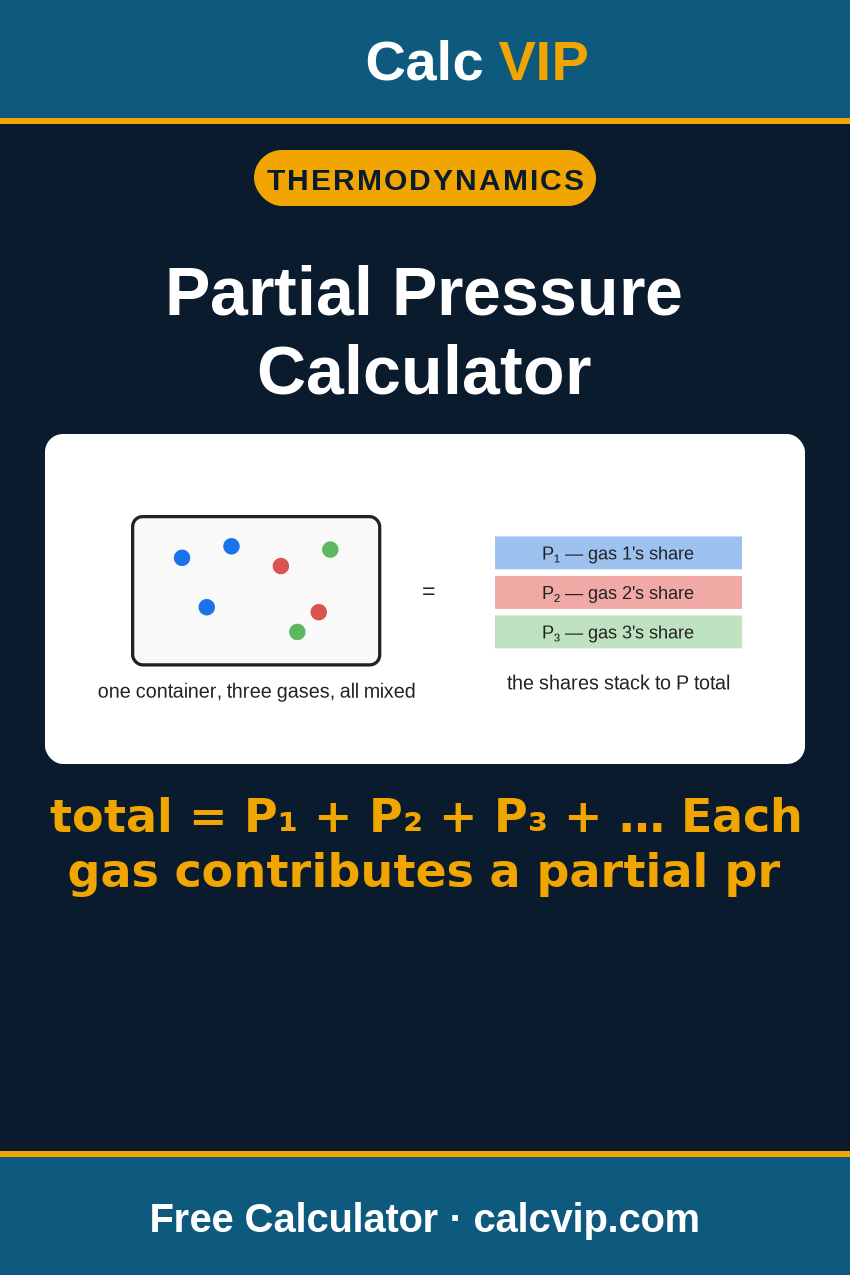
Fill a container with a mixture of gases and a deceptively simple question arises: how much of the pressure on the walls belongs to each gas? Dalton's law of partial pressures, published by John Dalton in 1801, answers with an idea of beautiful economy — each gas contributes exactly the pressure it would exert if it occupied the container alone, and the total is the plain sum of those contributions. The gases, in the ideal picture, simply ignore one another: every molecule collides with the walls on its own account, indifferent to the crowd of strangers around it.
That independence is what makes partial pressure the working variable of respiratory physiology, diving, anaesthesia and atmospheric science. Your lungs do not respond to the percentage of oxygen in the air; they respond to oxygen's partial pressure, the share of the total that oxygen molecules personally deliver. A pilot at altitude and a diver at depth can breathe the same 21% mixture and face opposite dangers — too little oxygen pressure in one case, too much in the other — purely because the total pressure around the mixture has changed. Percentages describe composition; partial pressures describe effect.
The bridge between the two descriptions is the mole fraction, each gas's share of the total moles. Multiply a gas's mole fraction by the total pressure and its partial pressure appears — no property of the gas itself enters, not its mass, not its chemistry, only its head-count share. This calculator performs that split for up to three gases and checks its own work by adding the shares back to the total.
Formula
Dalton's law: Ptotal = P₁ + P₂ + P₃ + … Each gas contributes a partial pressure Pᵢ = xᵢ × Ptotal, where the mole fraction is xᵢ = nᵢ / ntotal — the share of the total moles belonging to that gas. The partial pressure does not depend on what the gas is, only on its mole fraction.
Two equivalent views reinforce the same law. By the ideal gas law applied to one component, Pᵢ = nᵢRT/V — the pressure that gas would exert alone in the volume — and summing those expressions returns PV = nRT for the mixture, which is why Dalton's law and the ideal gas law never disagree. And because mole fraction equals volume fraction for ideal gases mixed at the same T and P (Amagat's picture), a mixture described in percent-by-volume — as breathing gases always are — converts to mole fractions by simply dividing by 100.
| Symbol | Meaning | Units |
|---|---|---|
| Ptotal | total pressure of the mixture | kPa (any pressure unit) |
| Pᵢ | partial pressure of gas i | same unit as P total |
| xᵢ | mole fraction of gas i — its share of the moles | dimensionless, 0 to 1 |
| nᵢ, n total | amount of gas i, and of the whole mixture | mol |
Why gases ignore each other (and when they stop)
The molecular picture makes Dalton's law almost obvious. Pressure is the rain of molecular impacts on the walls. Molecules of gas A strike the walls at a rate set by how many of them there are and how fast they move — and in a dilute mixture, the presence of B and C molecules barely interferes: collisions between molecules are brief and rare compared with the free flight between wall strikes. So A's contribution to the pressure is the same as if B and C were absent, and likewise for each component. Temperature sets the speed for all of them alike; only the counts differ, which is why the pressure shares are exactly the mole shares.
The approximation frays where molecules stop being strangers: at high pressures, where the molecules' own volume and attractions matter, or when gases react chemically — ammonia and hydrogen chloride fume into solid the moment they meet, and no partial-pressure bookkeeping survives the reaction. Dissolving is a gentler exit: a gas over a liquid sheds some molecules into solution until its partial pressure and the dissolved amount balance (Henry's law), which is the same physics viewed from the liquid's side — and the mechanism behind both fizzy drinks and the bends.
The kinetic picture makes Dalton's law almost obvious. Pressure is momentum delivered to the walls, and each species delivers momentum independently — a nitrogen molecule striking the wall neither knows nor cares that oxygen molecules strike it too. Each gas therefore contributes pressure exactly as if the others were absent, at the same temperature and volume, and the total is the sum of the independent contributions. Gibbs sharpened the point: mixing ideal gases changes nothing about each gas's behaviour, only about the entropy of the whole — the gases are strangers sharing a room, each paying its own share of the rent.
How to use
- Enter the amount of gas 1 in moles. Add gases 2 and 3 if present — leave a gas's box blank if you have fewer gases.
- Enter the total pressure of the mixture (the partial pressures come out in the same unit — kPa here, but any pressure unit works).
- Click "Calculate Partial Pressures" to see each mole fraction, each partial pressure, and a check that they add back up to the total.
- Starting from percentages instead? For ideal gases, percent by volume = mole fraction × 100, so a gas that is 21% of the mix has x = 0.21 — enter amounts in that proportion (e.g. 21 and 79) to get the same fractions.
Worked examples
Example 1 — the three-gas cylinder. A cylinder holds 2 mol of oxygen, 6 mol of nitrogen and 2 mol of carbon dioxide at a total pressure of 200 kPa.
ntotal = 2 + 6 + 2 = 10 mol
x(O₂) = 2/10 = 0.2 → P(O₂) = 0.2 × 200 = 40 kPa
x(N₂) = 6/10 = 0.6 → P(N₂) = 0.6 × 200 = 120 kPa
x(CO₂) = 2/10 = 0.2 → P(CO₂) = 0.2 × 200 = 40 kPa
Check: 40 + 120 + 40 = 200 kPa ✓
Example 2 — the air you are breathing. Dry air is about 78% N₂, 21% O₂ and 0.93% Ar by moles, at a sea-level total of 101.325 kPa:
P(N₂) = 0.78 × 101.325 = 79.03 kPa · P(O₂) = 0.21 × 101.325 = 21.28 kPa · P(Ar) = 0.0093 × 101.325 = 0.94 kPa. The remaining sliver — CO₂ at 0.04% contributes just 0.04 kPa — completes the atmosphere's accounts.
Example 3 — equal shares. One mole each of three gases at a total of 300 kPa: each mole fraction is 1/3, so each partial pressure is 100 kPa — regardless of whether the gases are hydrogen or xenon. Head-count is all that matters.
Example 4 — the diver's nitrox. A diver breathes nitrox (32% O₂, 68% N₂) at 30 m depth, where the total pressure is about 400 kPa:
P(O₂) = 0.32 × 400 = 128 kPa · P(N₂) = 0.68 × 400 = 272 kPa. The oxygen partial pressure — over six times its sea-level value — is what dive tables limit, because oxygen itself becomes toxic when its partial pressure climbs too far.
Example 5 — gas collected over water. A gas gathered in an inverted bottle over water at 25 °C shows a total pressure of 101.3 kPa, but water vapour shares the space with its own partial pressure of 3.17 kPa at that temperature.
The dry gas's partial pressure is 101.3 − 3.17 = 98.13 kPa — the correction every school gas-collection experiment must subtract before using the volume.
Example 6 — helium dilution. A trimix cylinder holds 4 mol of helium with 1 mol of oxygen at 500 kPa:
x(He) = 0.8 → P(He) = 400 kPa; x(O₂) = 0.2 → P(O₂) = 100 kPa. Deep divers dilute oxygen with helium precisely to hold P(O₂) in the safe band while the total pressure soars.
Partial pressure in real life
Altitude and the oxygen paradox. Air stays 21% oxygen to great heights, but the total pressure falls — at a 70 kPa mountain station, P(O₂) = 0.21 × 70 = 14.7 kPa, a third below the sea-level 21.28 kPa. Acclimatisation, supplemental oxygen and cabin pressurisation are all partial-pressure management.
Diving and decompression. Nitrogen's partial pressure drives its absorption into blood and tissue (Henry's law); ascend too fast and the falling partial pressure lets it fizz out as bubbles — the bends. Dive computers are, in essence, partial-pressure integrators.
Anaesthesia. Anaesthetic potency tracks the agent's partial pressure in the brain, not its percentage in the machine's dial; the MAC values used by anaesthetists are effectively partial-pressure specifications.
Modified-atmosphere food packaging. The nitrogen–CO₂ blends flushed into food packs are chosen by partial pressure: CO₂'s share suppresses microbes, nitrogen's share keeps the pack from collapsing as the CO₂ dissolves into the food.
Industrial gas mixing. Welding shield gases, calibration standards and semiconductor process gases are blended by partial pressure — fill the cylinder to 40 kPa of one component, top to 200 kPa with the other, and Dalton's law certifies the mixture.
Weather: vapour pressure and humidity. Water vapour's partial pressure against its saturation value at the day's temperature is relative humidity; dew forms when cooling lowers the saturation partial pressure to meet the actual one.
Partial pressure and the body: why fractions are not enough
Gas exchange in the lungs is driven by partial-pressure gradients, full stop. Oxygen diffuses from alveoli to blood because the alveolar P(O₂) exceeds the blood's; carbon dioxide leaves because its gradient points the other way. This is why the same 21% mixture can be medicine or poison depending on total pressure. At Everest's summit (total ≈ 33 kPa), P(O₂) ≈ 0.21 × 33 ≈ 6.9 kPa — a level the body barely tolerates even after acclimatisation. In a hyperbaric chamber at 300 kPa of pure oxygen, P(O₂) = 300 kPa — fourteen times sea-level air's value — which heals stubborn wounds and, pushed further, convulses. Pilots, divers, mountaineers and intensivists all keep the same ledger: track each gas's partial pressure, because that is the quantity the body reads.
Henry's law: partial pressure reaches into liquids
Set a gas over a liquid and the story continues across the surface: the amount that dissolves settles in proportion to the gas's partial pressure above the liquid — Henry's law, c = kP. It is why soda is bottled under several atmospheres of CO₂ partial pressure and sighs when opened (the pressure released, the dissolved gas escapes); why divers' tissues load nitrogen in proportion to depth's partial pressure; and why lakes can hold enough dissolved oxygen for fish — oxygen's modest 21 kPa share of the atmosphere maintains a life-supporting few milligrams per litre. Dalton's law gives the pressure above the surface; Henry's law spends it below. Between them, most of environmental and physiological gas transfer is bookkeeping.
That entropy of mixing has a practical price tag. Separating a mixture means un-mixing it — fighting the entropy increase that mixing provided free — and the minimum work of separation is set by the mole fractions through the same mathematics. Cryogenic air separation, the industry that fills the oxygen and nitrogen tanks of hospitals and steelworks, spends most of its energy budget on exactly this: compressing air so its components can be parted by their boiling points. Dalton's law tells you what each gas contributes while mixed; thermodynamics then bills you for pulling them apart.
Divers put the un-mixing to work in reverse every time a nitrox or trimix cylinder is filled: the partial-pressure blending method adds gases one at a time, reading the tank gauge after each addition, so that each gas's pressure rise equals the partial pressure it must contribute in the final mix. Fill helium to 30 bar, top with oxygen to 51 bar, then air to 200 bar, and Dalton's law — applied at the filling station, gauge in hand — guarantees the fractions the diver's computer will assume at depth.
Quick reference: what's in dry air at sea level (101.325 kPa)
| Gas | Mole fraction | Partial pressure (kPa) |
|---|---|---|
| Nitrogen N₂ | 0.780 | 79.03 |
| Oxygen O₂ | 0.210 | 21.28 |
| Argon Ar | 0.0093 | 0.94 |
| Carbon dioxide CO₂ | 0.0004 | 0.04 |
| All others | ≈ 0.0003 | ≈ 0.03 |
Humidity adds one more tenant: saturated air at 25 °C carries water vapour at 3.17 kPa, which displaces the dry gases proportionally — humid air's oxygen share is a little smaller than the table's, a correction aviators and physiologists both apply.
Common mistakes
- Using mass fractions instead of mole fractions. Pressure shares follow molecule counts, not weights. A 50/50 mix by mass of H₂ and O₂ is nowhere near 50/50 by moles — the light hydrogen dominates the count, and the partial pressures follow the count.
- Forgetting water vapour in collected gases. Gas gathered over water is always wet: subtract the vapour's partial pressure at the collection temperature (3.17 kPa at 25 °C) before treating the remainder as your gas, as Example 5 does.
- Assuming the percentages change with altitude. Air's composition is nearly constant; it is the total pressure — and so every partial pressure — that falls. Altitude problems are total-pressure problems in disguise.
- Letting the mole fractions fail to sum to 1. If your x values add to anything but 1 (within rounding), a component has been dropped or double-counted. The calculator's check line exists precisely to catch this.
- Applying Dalton's law to reacting mixtures. The law presumes the gases coexist without reacting. Mix ammonia with hydrogen chloride and they consume each other into solid ammonium chloride — the bookkeeping must wait until the chemistry finishes.
FAQ
Does it matter which gases are in the mixture?
No — for ideal gases only the mole fractions matter. Two moles of helium and two moles of heavy CO₂ in the same mixture contribute exactly the same partial pressure.
What is the partial pressure of oxygen in air?
Air is about 21% oxygen by moles, so at sea level P(O₂) ≈ 0.21 × 101.3 kPa ≈ 21.3 kPa. This is the pressure your lungs actually "see" for oxygen, which is why it drops on high mountains even though the 21% stays the same.
Why do partial pressures add up to the total?
Each gas's molecules collide with the container walls independently of the others. Pressure is just the combined effect of all those collisions, so the total is the sum of each gas's share.
Is mole fraction the same as percentage by volume?
For ideal gases, yes — equal moles occupy equal volumes at the same T and P, so a gas that is 21% by volume has mole fraction 0.21. That is why breathing-gas percentages convert to partial pressures so directly.
What about percentage by mass?
Different thing entirely. Convert masses to moles first (divide each by its molar mass), then form the fractions. Light gases punch far above their mass share in the mole count.
Can a partial pressure exceed the total pressure?
Never. A partial pressure is a share of the total, bounded by it — reached only in the limit of a pure gas. If a calculation produces one, a fraction or the total has been entered wrongly.
Why do divers limit oxygen's partial pressure?
Above roughly 140–160 kPa, oxygen attacks the central nervous system and can cause convulsions underwater — often fatal. Nitrox and trimix planning is the art of keeping P(O₂) below the limit while depth pushes the total up.
What is vapour pressure in this picture?
A liquid's vapour contributes its own partial pressure above the liquid, capped at the saturation vapour pressure for that temperature. It behaves as one more component in Dalton's sum — and the one that makes collected gases "wet".
Does temperature affect partial pressures?
Indirectly: heat a sealed mixture and the total pressure rises (Gay-Lussac), so every partial pressure rises in the same proportion, the fractions unchanged. The split is temperature-blind; the size of the pie is not.
Who was Dalton?
John Dalton (1766–1844), the English schoolteacher-scientist who also gave us atomic theory. His 1801 law of partial pressures grew from his studies of air and gases — and, some historians note, from his own careful weather diaries.