 Calc
Lens Power Solver – Dioptres from Focal Length & Back (P = 1/f)
 Created by Rachel Novak · Senior Editor · All Topics · Last updated: November 2026
Use this free Lens Power Solver to convert between a lens's focal length and its optical power in dioptres, P = 1/f — solving for whichever one you are missing, with centimetre and metre conversions handled for you.
Ask an optician about a lens and they will not mention its focal length. They will say "plus two" or "minus four-fifty" — because the working unit of practical optics is not the metre but its reciprocal, the dioptre. Power P = 1/f, with f in metres, measures how strongly a lens bends light: the shorter the focal length, the harder the bend, the bigger the number. A feeble reading lens is +1 D; a strong magnifier is +20 D; the human eye in its socket is about +60 D. This calculator converts in both directions and handles the centimetre conversion that is the dioptre's one trap, because the definition insists on metres while the lenses on your nose are conveniently measured in centimetres.
The dioptre won its place for one decisive reason: powers add. Two thin lenses in contact behave as one lens whose power is the plain sum P = P₁ + P₂. Focal lengths do nothing so convenient — combining them demands reciprocal arithmetic every time. An optometrist's trial case is a box of dioptres precisely because a prescription can be assembled by addition at the chairside: try +2.00, add −0.50 of cylinder correction, stack a +0.25 and feel the difference. The same additivity runs through contact-lens conversions, magnifier design and the phoropter's clicking dials. Whenever optics leaves the textbook and becomes a trade, it switches to dioptres.
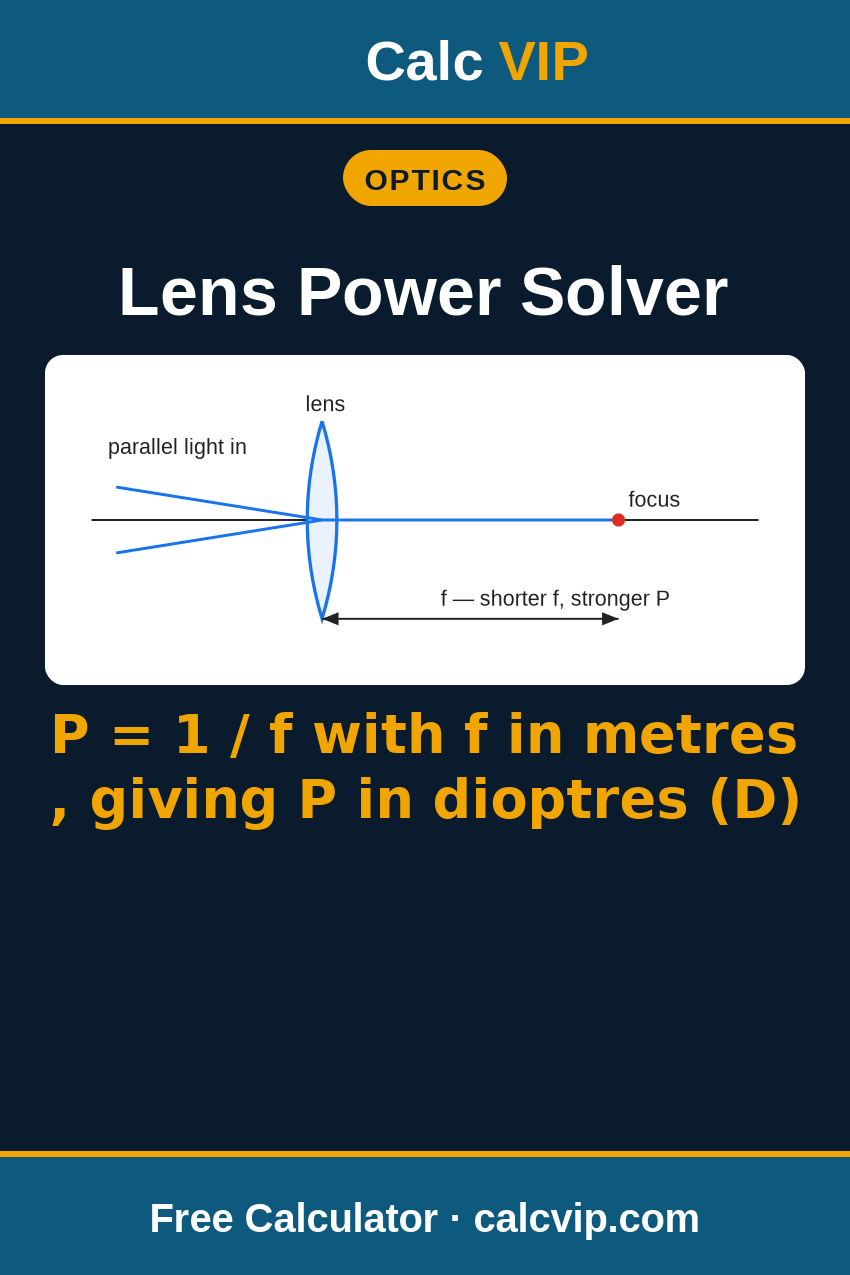
The sign convention carries the lens's identity: positive power converges light and corrects long sight; negative power diverges light and corrects short sight. Zero power — a flat piece of window glass, f infinite — is the neutral point between the two families. This page's solver keeps the signs straight in both directions, reports which family the lens belongs to, and gives the answer in metres and centimetres, because a focal length of −50 cm is a prescription you can picture while −0.5 m is merely correct.
Formula
P = 1 / f with f in metres, giving P in dioptres (D) • f = 1 / P
The sign carries the lens type: a converging (convex) lens has positive f and positive power; a diverging (concave) lens has negative f and negative power. Short focal length means strong power — the lens bends light hard. When the focal length is in centimetres the formula becomes P = 100 ÷ f(cm), the version worth memorising: a 25 cm lens is 100 ÷ 25 = +4 D at a glance. Powers in contact add, P = P₁ + P₂, and the prescription notation writes the sphere power first, then cylinder, each in quarter-dioptre steps (0.25 D) because finer differences are below what the eye can reliably detect. One more relative lives nearby: a magnifier's strength follows from its power directly, since M (image at infinity) = P ÷ 4 with the standard 250 mm near point — a +20 D lens is a 5× magnifier.
| Symbol | Meaning | Units |
|---|---|---|
| P | optical power — strength of the lens | dioptres (D) = m⁻¹ |
| f | focal length (+ converging, − diverging) | m (or cm) |
| P₁, P₂ | powers of lenses in contact — they add | D |
Why opticians think in dioptres, not focal lengths
Imagine prescribing in focal lengths. A patient needs the combined effect of a +2 D distance correction and a +1.5 D reading addition. In dioptres the reading prescription is 2 + 1.5 = +3.5 D, done. In focal lengths the same problem reads: combine f = 50 cm with f = 66.7 cm — answer, 1 ÷ (1/0.5 + 1/0.667) = 28.6 cm — reciprocal gymnastics for a question asked a hundred times a day. The dioptre converts a harmonic relationship into an arithmetic one, and trades live on arithmetic. There is a deeper reason too: what the eye cares about is vergence — how strongly light is converging or diverging when it arrives — and vergence is measured in dioptres at every plane. A lens's power is exactly the vergence it adds. Prescribing is bookkeeping of vergence from the spectacle plane to the retina, and the dioptre is its natural currency from start to finish.
The eye itself is the home example. Its total power is about +60 D, of which the cornea contributes roughly +43 D — not because it is lens-shaped, but because the air-to-cornea surface is the eye's biggest refractive-index step — and the crystalline lens adds a variable +17 to +20 D or so, squeezing to focus near objects. The equivalent focal length of the whole eye is 1 ÷ 60 = 16.7 mm in air terms. When an optician writes −2.00 D, they are stating that the eye has about 2 dioptres too much power for its length (or is 2 dioptres too long for its power), and the spectacle lens donates the missing −2 D of vergence so the sum lands the focus on the retina. Every number in this paragraph is this page's one-line formula, run at the scale of a human head.
How to use
- Pick the mode: power from focal length, or focal length from power.
- For focal length, enter the value and choose cm or m; use a negative value for a diverging (concave) lens. Camera lenses quoted in millimetres should be divided by 10 and entered as centimetres.
- For power, enter the dioptres — negative for a diverging lens, exactly as a prescription is written.
- Click "Calculate" to get the converted value, stated in both metres and centimetres for focal lengths, with the lens family (converging or diverging) identified.
Worked examples
Example 1 — the textbook pair. A converging lens has f = 25 cm = 0.25 m. P = 1 ÷ 0.25 = +4 D. A diverging lens prescribed at P = −2 D has f = 1 ÷ (−2) = −0.5 m = −50 cm. These two are the same fact read in opposite directions, and between them they cover the majority of real spectacle prescriptions, which mostly live between −6 D and +4 D.
Example 2 — reading glasses off the rack. Drugstore readers are sold by power: +1.5 D is a common strength. Its focal length is f = 1 ÷ 1.5 = 0.667 m = 66.7 cm — hold the glasses about two-thirds of a metre above a page in sunlight and the bright spot forms at that distance. The rack's whole range, +1.00 to +3.50 D, spans focal lengths from 100 cm down to 28.6 cm.
Example 3 — camera lenses are strong medicine. A 50 mm camera lens has f = 0.05 m, so P = 1 ÷ 0.05 = +20 D — five times stronger than typical reading glasses, which surprises people until they remember the camera focuses sunlight to a point in centimetres. A 200 mm telephoto is +5 D and a 24 mm wide-angle is +41.7 D: in dioptre terms, wide-angle lenses are the brutes of the camera bag, bending light hardest of all.
Example 4 — adding powers in the trial frame. A patient sees best with a +2.00 D lens, then a −0.50 D lens is stacked in front of it. The combination is P = 2 + (−0.5) = +1.5 D, a single lens of f = 66.7 cm. No reciprocals, no calculator — the optician does this aloud. It is the dioptre's whole reason for existing, demonstrated in one line.
Example 5 — the quarter-dioptre step. Prescriptions change in 0.25 D steps. A lens of +0.25 D has f = 1 ÷ 0.25 = 4 m — so weak it barely bends light at all, yet a quarter-step is about the smallest difference a typical eye can appreciate in a trial. At the strong end the same 0.25 D is proportionally tiny: between +20.00 and +20.25 D the focal length moves only from 5.00 cm to 4.94 cm. Equal dioptre steps are equal vergence steps, not equal focal-length steps — the reciprocal sees to that.
Example 6 — from power to magnifier. A loupe lens measures f = 5 cm, so P = 100 ÷ 5 = +20 D. Its magnifying power at the standard near point is M = P ÷ 4 = 5× with the image at infinity (or 6× at the near point). Jewellers quoting a "10× loupe" are holding a +40 D lens of f = 2.5 cm — dioptres let you convert their marketing back into glass.
Lens power in real life
Spectacle prescriptions. The numbers on your prescription — sphere, cylinder, axis — are dioptres and degrees. The sphere is this page's P; everything else refines it. Knowing P = 1/f turns an opaque prescription into a lens you can reason about: −4 D is a diverging lens of f = −25 cm.
Contact lens conversion. A spectacle lens sits about 12 mm from the eye; a contact lens sits on it. The same eye therefore needs slightly different powers in the two forms, and the conversion is vergence arithmetic in dioptres — negligible below about ±4 D, essential above it.
Intraocular lenses. After cataract surgery an artificial lens is implanted, typically around +18 to +22 D, chosen from measurements of the eye's length and corneal power. The calculation that selects it — and the refractive surprise when it is off by a dioptre — is this formula practised at surgical stakes.
Camera and projector design. Lens designers specify elements in dioptres because a compound lens is, to first order, a sum of surface powers. The strong positive and negative elements inside a camera lens nearly cancel — a +20 D objective is a battlefield of +60 D and −40 D glass adding to a civilised total.
Reading and low-vision aids. High-add reading glasses and stand magnifiers for low vision are prescribed in dioptres (+8, +12, +20 D), because the addition to the patient's own focus is what matters and additions are dioptre arithmetic.
Laser and telescope optics. Weak long-focus lenses for beam shaping are catalogued in dioptres too — a +0.5 D lens (f = 2 m) is a standard beam expander component. The unit scales from the eye to the observatory without changing its meaning.
Surface power: where a lens's dioptres actually come from
A lens bends light at its two surfaces, and each surface has its own power, P = (n₂ − n₁) ÷ r, with r the surface's radius of curvature in metres. A single glass surface of radius 10 cm in air has P = (1.50 − 1.00) ÷ 0.10 = +5 D — one modest surface already equals a strong reading lens, which is why the cornea, a single surface of radius about 7.8 mm working across the air–tissue index step, supplies some +43 D of the eye's power. A biconvex lens adds its two surface powers (with a small correction for thickness), and the lensmaker's equation is just that addition written out. This view explains manufacturing tolerances: grind a surface a fraction of a millimetre too flat and its power drops measurably, because power is curvature divided into the index step. It also explains why the same lens is weaker in water — the index step at each surface shrinks — a fact divers discover when their masks need the air gap to keep the eye's optics honest.
Quick reference: focal length ↔ power
| Focal length | Power | Typical use |
|---|---|---|
| 100 cm | +1 D | weakest reading glasses |
| 50 cm | +2 D | reading glasses |
| 40 cm | +2.5 D | stronger readers |
| 25 cm | +4 D | strong prescription / hand magnifier |
| 20 cm | +5 D | 200 mm camera lens |
| 10 cm | +10 D | loupe territory |
| 5 cm | +20 D | 50 mm camera lens / 5× magnifier |
| 2 cm | +50 D | microscope objective class |
| −50 cm | −2 D | mild short-sight correction |
| −25 cm | −4 D | moderate short-sight correction |
The pattern to internalise is the reciprocal's squeeze: from 100 cm to 50 cm buys one extra dioptre; from 10 cm to 5 cm buys ten. Equal steps in power are wildly unequal steps in focal length — and vice versa — which is why professionals abandoned focal length for prescribing and never looked back.
Common mistakes
- Using centimetres in P = 1/f directly. The dioptre is defined per metre. f = 25 cm must enter as 0.25 m (or use P = 100/f(cm)); entering 25 gives P = 0.04 D, a hundredfold understatement — the single most common dioptre error.
- Dropping the sign. −2 D and +2 D are opposite lenses for opposite eyes. The sign is not bookkeeping decoration; it is the difference between correcting short sight and correcting long sight.
- Adding focal lengths when combining lenses. Lenses in contact add by power, not by focal length. Two +4 D lenses (f = 25 cm each) in contact make +8 D (f = 12.5 cm), not a 50 cm lens.
- Assuming equal dioptre steps mean equal focal steps. From +1 D to +2 D the focal length halves (100 → 50 cm); from +19 D to +20 D it moves 2.6 mm. Prescription changes feel different at different strengths for exactly this reason.
- Confusing lens power with magnifying power. They are related — M ≈ P/4 at the standard near point — but they are not the same number. A +20 D lens is a 5× magnifier, not a 20× one; loupe marketing occasionally hopes you will not check.
FAQ
Why must the focal length be in metres?
The dioptre is defined as one reciprocal metre (1 D = 1 m⁻¹). Using centimetres directly would make every power 100 times too big — a classic exam trap this calculator avoids by converting for you.
How do powers combine for two lenses in contact?
They simply add: P = P₁ + P₂. That is why opticians prefer dioptres — stacking a +2 D and a −0.5 D lens gives +1.5 D without any reciprocal arithmetic.
What does a prescription of −2.00 D mean?
A diverging lens of power −2 dioptres, focal length −50 cm, used to correct short sight (myopia): it spreads parallel light slightly so the eye's own lens can focus it on the retina.
Why do prescriptions use quarter-dioptre steps?
Because 0.25 D is about the smallest change the average eye can reliably detect in a trial, and manufacturing to finer steps would add cost without benefit. Between +0.25 D (f = 4 m) and the strongest common prescriptions, the whole of practical optometry fits into a few dozen quarter-steps each way.
What is the power of a flat glass window?
Zero dioptres: its surfaces are flat (r = ∞), its focal length is infinite, and P = 1/∞ = 0. It neither converges nor diverges light — though a window's two surfaces do each reflect their Fresnel 4%, which is a different story told on another page of this site.
Can a lens have a power like +60 D?
Yes — your eye does. Short focal length means high power: +60 D corresponds to f ≈ 16.7 mm. Microscope objectives and the optics of endoscopes routinely work at tens of dioptres; at the other extreme, telescope correctors may be a fraction of a dioptre spread over a metre of glass.
Why is my contact lens power different from my glasses power?
Distance. A spectacle lens sits ~12 mm in front of the cornea, so its vergence changes slightly on the way to the eye; a contact lens applies its power at the cornea itself. The conversion matters above about ±4 D: a −8 D spectacle prescription typically becomes about −7.5 D in contacts. Opticians compute it with vergence arithmetic in dioptres — this formula, applied at two planes.
What does the "add" on a prescription mean?
The reading addition: extra positive power, in dioptres, added to the distance prescription for near work in bifocals and progressives. A distance prescription of −1 D with an add of +2 D gives a reading power of +1 D through the lower segment — powers adding, as always.
How strong can spectacle prescriptions get?
Routine prescriptions run to about ±10 D; beyond that, lenses grow thick, heavy and aberration-prone, and contact lenses or surgery are usually preferred. At −20 D the focal length is −5 cm — a lens so strongly curved it resembles a glass marble's slice, which is its own argument for the alternatives.
Is a dioptre the same everywhere in the world?
Yes — it is simply the SI-derived unit m⁻¹ applied to vergence, defined identically everywhere, which is why a prescription written in Tokyo can be filled in Toronto. The focal length it encodes needs no translation either, but the dioptre is the form every optical laboratory on Earth is tooled to work in.