 Calc
Lensmaker's Equation Calculator – Focal Length from Radius of Curvature
 Created by Rachel Novak · Senior Editor · All Topics · Last updated: November 2026
Use this free Lensmaker's Equation Calculator to find the focal length of a lens from the shape of its surfaces — the refractive index of the glass and the radius of curvature of each face. Choose a biconvex lens or a plano-convex lens to get started.
Every other lens calculator starts with a focal length somebody else measured. This one starts where lenses actually begin: at the grinding wheel. A lens is two curved surfaces and a piece of glass, and the lensmaker's equation is the recipe that turns those raw ingredients — the refractive index n and the two radii of curvature R₁ and R₂ — into the focal length the finished lens will have. It is the equation lens designers have used, in essence, since the nineteenth century, and it still sits underneath the computer optimisation that shapes modern camera lenses.
The structure of the formula teaches the physics at a glance. The factor (n − 1) is the material's contribution: how much contrast there is between the glass and the air around it. The bracket (1/R₁ − 1/R₂) is the geometry's contribution: how strongly the two surfaces curve, and in which senses. Multiply them and you get the lens's power in diopters directly, 1/f. Double the curvature and you double the power; swap glass for a higher-index material and the same shape bends light harder. Shape and substance, cleanly separated.
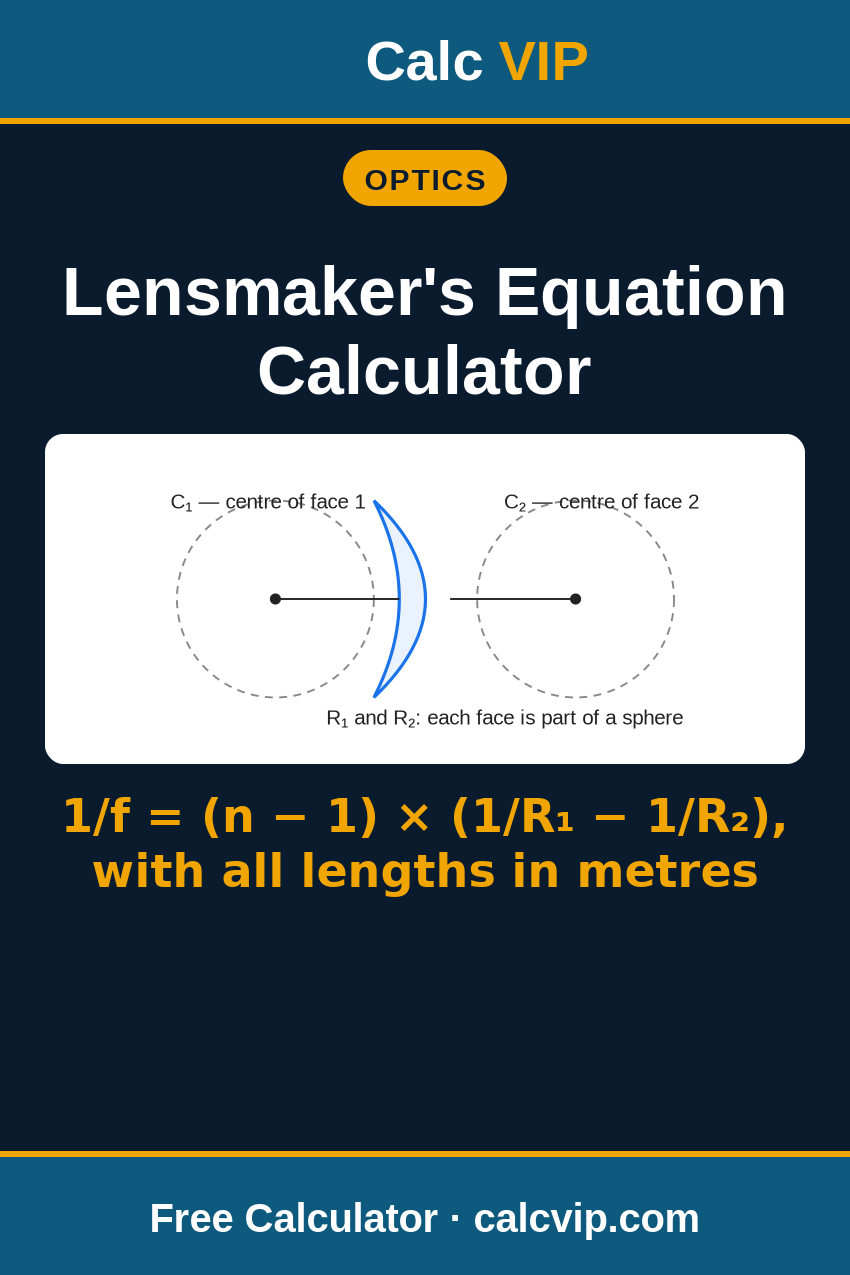
This calculator handles the two classic teaching shapes — the symmetric biconvex lens and the plano-convex lens with one flat face — using radii entered as positive sizes, the way a workshop would specify them. The pages below explain the sign convention hiding underneath, what happens when the lens works underwater instead of in air, why spectacle lenses are bent into meniscus shapes, and how the same equation scales from a magnifier to a lighthouse.
Formula
Lensmaker's equation: 1/f = (n − 1) × (1/R₁ − 1/R₂), with all lengths in metres — the left-hand side is the power P in diopters.
Sign convention (the full version): light travels left to right, and a radius is positive if the centre of that surface's sphere lies to the right of the surface. For a biconvex lens that means R₁ is positive and R₂ is negative — so if you enter both radii as positive sizes (as this calculator asks), the two terms add up: 1/f = (n − 1)(1/R₁ + 1/R₂). For a plano-convex lens the flat face has R = ∞, its term is zero, and only the curved face contributes. In a different surrounding medium, replace n by the relative index nlens ÷ nmedium — the underwater example below shows how much that matters.
| Symbol | Meaning | Units |
|---|---|---|
| f | focal length of the finished lens | m |
| P = 1/f | lens power | diopters (D) |
| n | refractive index of the lens material | no units |
| R₁ | radius of curvature of the first (left) face | m (calculator takes cm) |
| R₂ | radius of curvature of the second (right) face | m (calculator takes cm) |
A lens is two refractions, not one
It is tempting to picture the lens bending light somewhere in its middle, but the bending happens exactly twice: once entering, once leaving. Each curved surface has its own power, given by the surface formula (n₂ − n₁) ÷ R — the index step across the surface divided by its radius. For a glass surface in air with R = 20 cm, that is (1.50 − 1.00) ÷ 0.20 = +2.50 D per surface. A biconvex lens with two such faces stacks them: +2.50 + 2.50 = +5.00 D, f = 20 cm — the manifest example, rebuilt from its surfaces. The lensmaker's equation is nothing but these two surface powers added, with the geometry signs keeping the books.
This surface view explains lens shapes that otherwise look arbitrary. A meniscus lens — the crescent shape of spectacle lenses — pairs a strong positive front surface with a slightly weaker negative back surface: the difference of the two is the prescription, while the bent overall shape hugs the eye and behaves better for sideways glances. A plano-convex lens puts all its power in one surface, which is why it focuses at twice the focal length of the same-radius biconvex. And a biconcave lens, both surfaces flaring outward, has two negative surface powers and spreads light — shape is destiny, computed surface by surface.
It also explains why the material factor is (n − 1) and not n. Each surface's power is proportional to the index step across it. In air (n ≈ 1.00) the step into glass is n − 1; a hypothetical material with n = 1.00 would present no step at all, and a lens ground from it — any shape, any curvature — would bend nothing. Lenses are made of contrast.
How to use
- Pick the lens shape: biconvex (both faces curve outwards) or plano-convex (one flat face, one curved).
- Enter the refractive index of the material — about 1.50 for ordinary glass, 1.52 for crown glass, higher for flint or high-index spectacle material.
- Enter the radius of curvature of each curved face in centimetres. Radius means the sphere's radius, not the lens's diameter: a gently curved face has a large R, a strongly curved face a small one. For plano-convex, only the curved face needs a value.
- Click "Calculate Focal Length" to get f and the power P.
- Check plausibility with the symmetric shortcut: for a biconvex lens with R₁ = R₂ = R in glass of n = 1.50, the answer must come out f = R exactly.
Worked examples
Example 1 — the classic biconvex, and its plano-convex twin. A biconvex glass lens (n = 1.50) has both faces curved with radius 20 cm.
1/f = (1.50 − 1) × (1/0.20 + 1/0.20) = 0.50 × 10 = 5.0
f = 1 ÷ 5.0 = 0.20 m = 20 cm, so the power is P = +5.00 D.
Make one face flat instead (plano-convex) and the same glass gives f = 40 cm — half the bending, twice the focal length.
Example 2 — an asymmetric biconvex. Glass n = 1.50, R₁ = 10 cm, R₂ = 30 cm.
1/f = 0.50 × (1/0.10 + 1/0.30) = 0.50 × (10.00 + 3.33) = 6.67
f = 1 ÷ 6.67 = 0.15 m = 15 cm, P = +6.67 D. The strongly curved face contributes 5.00 D of surface power, the gentle one 1.67 D — the sum is the lens.
Example 3 — crown glass, gentler curves. n = 1.52, R₁ = R₂ = 25 cm.
1/f = 0.52 × (1/0.25 + 1/0.25) = 0.52 × 8.00 = 4.16
f = 24.0 cm, P = +4.16 D. A slightly better material with slightly flatter curves lands near the classic Example 1 lens by a different route — the designer's trade-off in one line.
Example 4 — the same shape in diamond. n = 2.42, R₁ = R₂ = 20 cm.
1/f = 1.42 × (5.00 + 5.00) = 14.20
f = 1 ÷ 14.20 = 0.070 m = 7.0 cm, P = +14.20 D. Nobody grinds diamond lenses, but the arithmetic shows the material factor's muscle: identical geometry, nearly three times the power.
Example 5 — plano-convex with a tight curve. n = 1.50, curved face R = 15 cm, other face flat.
1/f = 0.50 × (1/0.15 + 0) = 3.33
f = 30 cm, P = +3.33 D. One surface doing all the work needs twice the curvature of each face of the equivalent biconvex.
Example 6 — the Example 1 lens, underwater. Immersed in water (n = 1.33), the relative index is 1.50 ÷ 1.33 = 1.128.
1/f = 0.128 × (5.00 + 5.00) = 1.28
f = 1 ÷ 1.28 = 0.78 m = 78 cm — the 20 cm lens has become a feeble 78 cm lens, because the index step at each surface shrank from 0.50 to 0.17. (The calculator assumes air; this is the hand calculation for other media.) It is also why your eyes, whose corneas evolved for air, see so blurrily underwater without goggles.
The lensmaker's equation in real life
Spectacle lens manufacture. A surfacing laboratory grinds the back surface of a lens blank to order. Given the blank's front curve and the target prescription, the lensmaker's equation — in its surface-power form — dictates exactly what back curve to cut. Every pair of glasses is this calculation, executed by a generator wheel.
High-index spectacle lenses. For a strong prescription, raising n from 1.50 to 1.67 lets the same power be reached with flatter curves — f = R ÷ (2(n − 1)) means the required curvature falls by a quarter. The lenses come out thinner, flatter and lighter, which is the entire selling point of high-index materials.
Camera lens elements. A camera lens is a committee of elements, each designed with this equation and its aberrations in mind: strong positive crown elements, weaker negative flint elements to cancel colour error, meniscus elements to control distortion. The computer optimises, but every element's starting point is a lensmaker calculation.
Fresnel lenses. A lighthouse lens needs the curvature of a huge biconvex lens without its tonnes of glass. The Fresnel design keeps each annulus of surface at the lensmaker-prescribed angle but collapses the thickness into steps — the same radii, flattened. Solar concentrators and overhead-projector lenses use the identical trick.
The lens clock. An optician's lens clock (geneva gauge) presses three pins onto a surface and reads its power in diopters directly — it is a mechanical spherometer pre-computed with the lensmaker's equation for a standard index of 1.53. Unknown lens? Measure both surfaces, add the surface powers, and the prescription is identified.
Contact lenses. A contact lens is a meniscus whose front and back radii differ by fractions of a millimetre; the back radius (base curve, typically 8.3–9.0 mm) is chosen to fit the cornea, and the front radius is then set by the lensmaker's equation to deliver the prescribed power across a lens only about 0.1 mm thick at its centre.
Why spectacle lenses are meniscus-shaped
If focal length were all that mattered, glasses would be biconvex or plano-convex. They are almost always meniscus — one face convex, one concave — for two reasons the bare equation hides. First, oblique astigmatism: when you glance sideways through a biconvex lens, its effective power in that direction drifts, blurring peripheral vision; bending the lens into a meniscus (a "best-form" design) keeps the power steadier across gaze angles. Second, the eye rotates behind the lens, so a lens curved roughly concentrically with the eye's rotation centre presents a more constant geometry. The lensmaker's equation still fixes the difference the two surfaces must make — the meniscus simply distributes that difference between a strong front surface and a nearly-as-strong back one, buying optical quality and cosmetics with shape.
Quick reference: symmetric biconvex lenses, f = R ÷ (2(n − 1))
| Lens (R₁ = R₂ = R) | Focal length | Power |
|---|---|---|
| glass n = 1.50, R = 10 cm | 10 cm | +10.00 D |
| glass n = 1.50, R = 20 cm | 20 cm | +5.00 D |
| glass n = 1.50, R = 50 cm | 50 cm | +2.00 D |
| crown n = 1.52, R = 25 cm | 24.0 cm | +4.16 D |
| high-index n = 1.67, R = 20 cm | 14.9 cm | +6.70 D |
| diamond n = 2.42, R = 20 cm | 7.0 cm | +14.20 D |
The n = 1.50 row hides a memorable coincidence: with the factor 2(n − 1) equal to exactly 1, a symmetric glass biconvex lens has f = R — focal length equals the radius you ground. It is the quickest sanity check in lens work, and the one this calculator's Example 1 demonstrates.
Common mistakes
- Entering the diameter instead of the radius. The R in the equation is the radius of the sphere each face belongs to — measured with a spherometer, not across the lens blank. Halving or doubling R by confusion scales the power by the same factor, in the wrong direction.
- Mixing sign conventions. The full equation has (1/R₁ − 1/R₂) because R₂ of a biconvex lens is negative under the "centre to the right" rule. Entering both radii as signed values into a calculator that expects positive sizes (or vice versa) makes the terms cancel instead of add — a lens that vanishes on paper.
- Forgetting the units conversion for power. Radii in centimetres give 1/f in "per centimetre"; the power in diopters is 100 times that. Radii in metres throughout keeps the diopter honest.
- Giving a flat face R = 0. A flat surface is a sphere of infinite radius, contributing 1/R = 0. Entering zero makes the term explode instead of vanish — the one input where "nothing" must be written as infinity.
- Assuming the answer survives a change of medium. The equation's n is relative to the surroundings. The same lens in water loses most of its power (Example 6) — a fact that matters for underwater cameras, aquarium viewing panels and your own unaided eyes in the pool.
FAQ
Why does the refractive index matter so much?
The (n − 1) factor is the lens's "bending strength per unit of curvature". Diamond (n = 2.42) would make a much stronger lens than glass of the same shape, while a lens with n = 1 would not bend light at all.
What if the lens sits in water instead of air?
The full equation uses the relative index (n_lens ÷ n_medium). In water the contrast is smaller, so the same lens becomes weaker — its focal length gets longer.
Does a thicker lens change the result?
This is the thin-lens version of the equation, which ignores the lens thickness. For most everyday lenses the thickness is small compared with the radii, so the result is accurate enough; very thick lenses need an extra thickness term.
What radius do I grind for a +5.00 D glass lens?
Work backwards: +5.00 D means f = 20 cm. For a symmetric biconvex in n = 1.50 glass, f = R, so grind both faces to R = 20 cm. In crown glass (1.52) the same power needs R = 2 × 0.52 × 20 ≈ 20.8 cm — slightly flatter, because the material helps more.
Can a lens with a concave face still converge light?
Yes — a meniscus. What matters is the sum of the surface powers. A front surface of +8.00 D paired with a back surface of −5.00 D gives a +3.00 D converging lens, even though one face curves "the wrong way". Most spectacle lenses are exactly this.
Why does the equation ignore the lens's thickness?
It is the thin-lens approximation: it pretends both refractions happen at one plane. When the thickness is small compared with the radii — true for spectacle and most camera elements — the error is a fraction of a percent. Thick systems like microscope objectives add a thickness term and track the principal planes instead.
Does the colour of light change the focal length?
Slightly, because n depends on wavelength (dispersion). Blue light, seeing a higher n, focuses a little closer than red light in the same lens — longitudinal chromatic aberration. It is small (of the order of a percent of f) but visible as colour fringing, and it is why good objectives pair two glasses to cancel it.
How are the radii of a real lens measured?
With a spherometer or lens clock: three fixed pins and a central probe measure the sag (depth) of the curve across a known span, and R follows from geometry. Lens clocks are pre-scaled to read surface power in diopters directly, assuming the standard index 1.53.
What happens if R₁ and R₂ are equal in a meniscus?
With the proper signs, equal-magnitude radii in a meniscus arrangement make the two surface powers cancel: 1/f = 0 and the "lens" is a curved sheet of glass with no power — a protective window, not a lens. Power lives in the difference between the surfaces.
Is a bigger lens (wider) a stronger lens?
No. Diameter appears nowhere in the equation. A 5 cm and a 10 cm lens with the same radii and material have identical focal lengths; the wider one simply collects more light and covers a larger field. Aperture and power are separate design choices.