 Calc
Magnification Calculator – m = hᵢ/hₒ and m = v/u
 Created by Rachel Novak · Senior Editor · All Topics · Last updated: November 2026
Use this free Magnification Calculator to find how much bigger (or smaller) an image is compared with the object. You can work it out from the heights of the image and object, or from their distances from a lens or mirror.
Magnification is the simplest possible summary of what an optical instrument has done: it is the ratio of the image's size to the object's size. A magnification of 2 means the image is twice the object's height; 0.5 means half; 1 means unchanged. Because it is one length divided by another, the units cancel and magnification is a pure number — which is why it can be printed on the side of a microscope or a pair of binoculars and mean the same thing in every country and every laboratory.
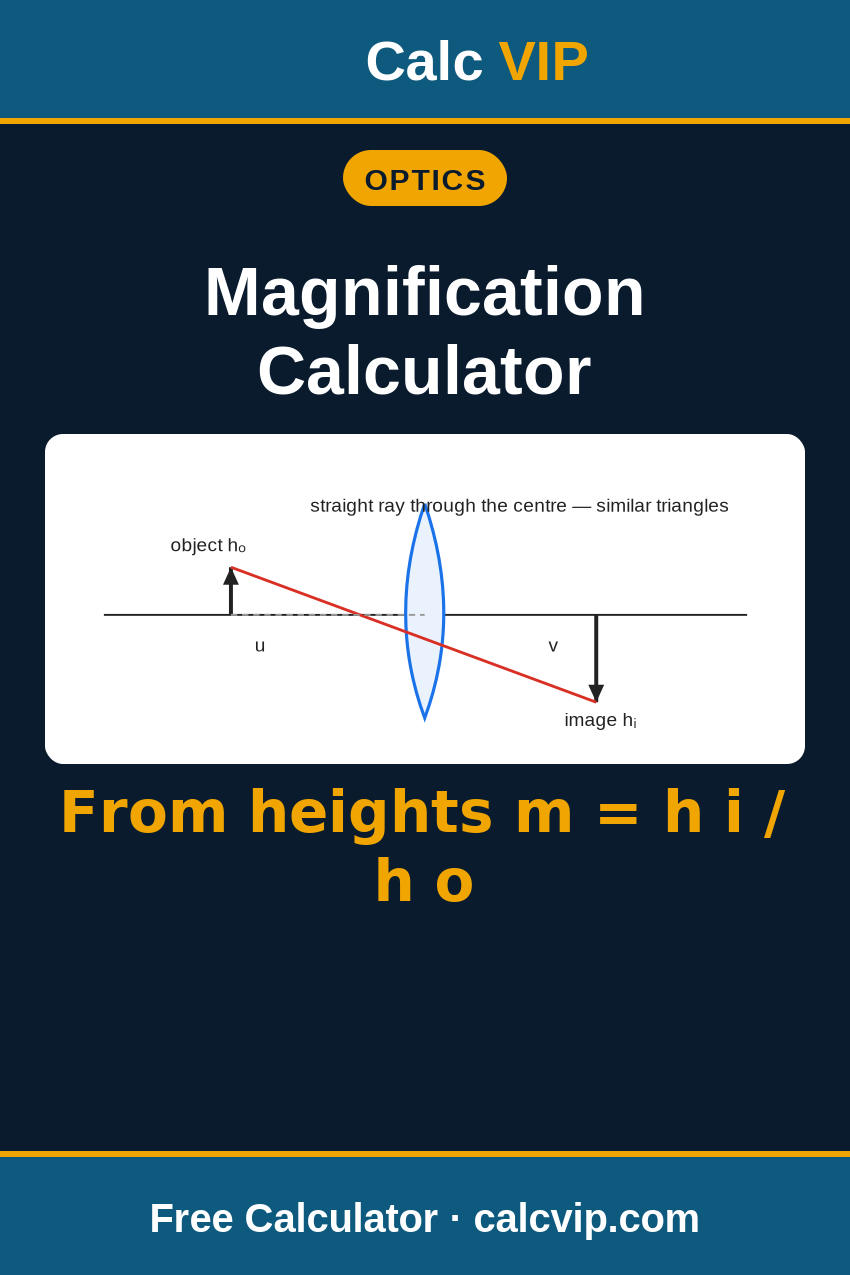
There are two equally good ways to get at the number, and this calculator offers both. If you can measure the object and its image directly — a specimen and its projected picture, a building and its photograph — divide the heights. If instead you know the geometry of the setup, the distances of object and image from the lens or mirror, divide those. The two routes always agree, and the reason they agree is a neat piece of geometry explained below: the ray that passes through the centre of a lens goes straight, so the object and image form two similar triangles with the lens at their shared tip.
Magnification is also where everyday language misleads. A camera, the instrument most people use most, almost always has a magnification far below 1 — it shrinks the world dramatically to fit it on a sensor. A projector does the opposite. A microscope chains two magnifications together to reach hundreds. And the "×" figures on binoculars and magnifying glasses turn out to be a slightly different quantity — angular magnification — which this page will untangle from the linear kind the calculator computes, so you know exactly which number you are holding.
Formula
From heights m = hi / ho • From distances m = v / u • magnification has no units — it is a ratio. m > 1 means magnified, m < 1 means diminished, m = 1 means same size.
The formulas rearrange to answer the questions people actually ask. Want the image height from a known magnification? hi = m × ho — an object 6 cm tall imaged at m = 0.25 gives an image of 6 × 0.25 = 1.5 cm. Want to know how tall the object must have been? ho = hi / m. Working with distances, the image distance for a target magnification is v = m × u — to project at m = 5 with the slide 8 cm from the lens, the screen must stand at 5 × 8 = 40 cm — and the object distance is u = v / m. One warning belongs with all four: heights and distances must each be in the same units before dividing, because the cancellation of units only works when they match.
| Symbol | Meaning | Units |
|---|---|---|
| m | magnification (linear) | none — a ratio, written × |
| ho | height of the object | cm or mm |
| hi | height of the image | same units as ho |
| u | object distance from lens or mirror | cm |
| v | image distance from lens or mirror | same units as u |
Why the two formulas always agree
Draw the one ray that never bends: the ray from the tip of the object that passes through the exact centre of the lens. At the centre the lens's two surfaces are parallel, like a thin sheet of window glass, so the ray emerges on the same straight line it entered on. That single straight line is the hypotenuse of two triangles — a small one on the object side, with height ho and base u, and a larger one on the image side, with height hi and base v. Because the triangles are similar, their height-to-base ratios are equal: hi/ho = v/u. That is the whole proof, and it explains the deep link between size and position in optics: an image is bigger than its object precisely when it is further from the lens than the object is. Move the object closer (u shrinks) and the lens equation pushes the image further away (v grows) — and the magnification, being v/u, grows twice over, from both changes at once. This is why projector focus is so sensitive near the focal point.
One consequence catches people out: this m is a linear magnification — it compares lengths. Areas scale with its square. An image magnified 3× linearly covers 3² = 9 times the area, and since the same total light is now spread over nine times the area, each part of it is nine times dimmer. That is why huge projected images look washed out unless the room is dark and the projector bright, and why camera sensors struggle for light when forming very small images of bright scenes is never the problem — spreading light thin is. Magnification is never free: you pay for size with brightness.
How to use
- Pick a method: use heights if you can measure the object and its image, or distances if you know where the object and image sit relative to the lens or mirror.
- Enter the two values in the same units (both in cm, for example).
- Click "Calculate Magnification" — a result of 2 means the image is twice as tall as the object.
- Sanity-check the result against the setup: for a single lens or mirror, an image further from the lens than the object must be magnified, and one closer must be diminished. If your number says otherwise, a value has been entered the wrong way round.
Worked examples
Example 1 — heights, checked by distances. An object 4 cm tall forms an image 8 cm tall.
m = hi / ho = 8 ÷ 4 = 2 — the image is twice the height of the object.
The same image found from distances: an object 15 cm from a lens forms an image 30 cm away, so m = v / u = 30 ÷ 15 = 2. Both methods agree — as the similar-triangles argument promised.
Example 2 — a projector. A slide 2 cm tall is projected onto a screen as an image 200 cm tall: m = 200 ÷ 2 = 100. Check by distances: with the slide 10 cm from the lens and the screen 1,000 cm (10 m) away, m = 1,000 ÷ 10 = 100 again. Cinema projection is this same calculation with bigger numbers.
Example 3 — a camera portrait. A person 180 cm tall is photographed, and their image on the sensor is 2.4 cm tall: m = 2.4 ÷ 180 = 0.0133. The camera has shrunk the person to about one seventy-fifth of life size — a useful reminder that "magnification" below 1 is not a failure of the instrument but its entire purpose.
Example 4 — a microscope specimen. A specimen 0.02 mm across appears 4 mm across under the microscope: m = 4 ÷ 0.02 = 200 — two hundred times. Note that the units (mm here) cancel exactly as centimetres did; only consistency matters.
Example 5 — designing for a target size. You want a 3 cm tall diagram projected 4× life size onto a wall. The image must be hi = 4 × 3 = 12 cm tall, and with the slide 12 cm from the lens the screen belongs at v = m × u = 4 × 12 = 48 cm. The formulas run backwards just as happily as forwards, which is how projection setups are planned rather than discovered by trial and error.
Magnification in real life
Microscopes. A compound microscope multiplies two magnifications: an objective of 40× and an eyepiece of 10× give 40 × 10 = 400× overall. School microscopes typically offer 40× to 400×; research instruments reach about 1,500× before physics intervenes (see empty magnification below).
Cameras. Nearly all photography lives at m < 1: landscapes at thousandths, portraits around 0.01–0.05, and true "macro" photography defined as m ≥ 1, life-size on the sensor — which is why macro lenses are special.
Projectors and screens. Home projectors work around m = 50–150. The trade-off from the concept section rules here: doubling the image size quarters the brightness per unit area, so screen size, lamp power and room darkness are chosen together.
Magnifying lamps and loupes. The ring-lit magnifiers used by electronics technicians and jewellers are rated 2×–5× in the angular sense explained below — enough to make solder joints and hallmarks comfortable without the distortion that stronger simple lenses bring.
Phone zoom. A phone's "2× zoom" switches to a longer focal length lens and roughly doubles the image size on the sensor — a genuine optical magnification change. "Digital zoom" beyond that merely crops and enlarges pixels: the picture grows, but no new detail arrives, which is the phone version of empty magnification.
Photocopiers and scanners. The zoom setting on a copier is this calculator's m in disguise: 100% is m = 1, 200% is m = 2 (and four times the paper area per image), and the common 71% reduction is chosen because it shrinks A3 to A4 — areas halve when lengths scale by 1/√2 ≈ 0.71.
Linear or angular? The two kinds of magnification
The calculator on this page computes linear magnification: image size divided by object size, for images formed on screens and sensors. But the number printed on binoculars ("8×") and magnifying glasses ("5×") is angular magnification: how much bigger the object appears — how much larger an angle it fills in your vision — compared with viewing it unaided at the standard near distance of 25 cm. A simple magnifier's angular magnification is roughly 25 ÷ f (with f in cm): a 5 cm lens gives about 5×, a 10 cm lens about 2.5×. Binoculars' 8× means a distant object appears as if eight times closer. The two quantities are cousins, not twins: linear magnification needs an image you can measure with a ruler, while angular magnification describes the view through an instrument where the final image may be virtual and unmeasurable. Confusing them is harmless at the kitchen table and costly in a laboratory report.
Quick reference: typical magnifications
| Instrument / situation | Typical m | Kind |
|---|---|---|
| phone camera, person at 3 m | ≈ 0.001–0.01 | linear |
| camera portrait | ≈ 0.01–0.05 | linear |
| macro photography | 1–5 | linear |
| home projector | 50–150 | linear |
| school microscope | 40–400 | combined (linear) |
| hand magnifier | 2–5 | angular |
| binoculars | 7–10 | angular |
The table's lesson is that "magnification" spans five orders of magnitude in ordinary life, from a thousandth in a landscape photograph to hundreds under a microscope — and that the biggest numbers are not automatically the most useful, as the next section explains.
Print sizes make the area rule tangible. Enlarging a standard 10 × 15 cm photograph at m = 2 gives a 20 × 30 cm print — twice as wide, twice as tall, and four times the area, so four times the paper and roughly four times the ink or processing cost. At m = 3 the print is 30 × 45 cm with nine times the area. Printers and photographers think in these squared numbers instinctively; students meeting magnification for the first time should too, because the same square law governs brightness, cost and graininess in every enlargement.
Empty magnification: when bigger stops being better
Every imaging system has a resolution limit — a finest detail it can distinguish — set by the wavelength of light and the quality and size of its optics. Enlarging an image beyond the point where that finest detail is comfortably visible adds size without adding information: microscopists call it empty magnification. It is why optical microscopes top out near 1,500× (beyond that, samples blur rather than sharpen), why digital zoom disappoints, and why astronomers prize a telescope's light-gathering aperture above its headline magnification. The honest question is never "how big?" but "how much detail?" — magnification is the means, resolution the end.
Electron microscopes show the escape route: they image with electrons, whose effective wavelength is thousands of times smaller than light's, so their resolution limit sits far finer and useful magnifications reach into the hundreds of thousands. The magnification formula itself never changes — image divided by object — but the detail available to magnify is transformed. It is the clearest proof that magnification and resolution are separate ideas that merely travel together.
Common mistakes
- Inverting the ratio. Magnification is image ÷ object, not object ÷ image. A camera image of 2.4 cm from a 180 cm person is m = 0.0133, not 75 — though 75 is the (also useful) "times smaller" figure.
- Mixing units. Heights of 4 mm and 2 cm must be reconciled first: 20 mm ÷ 4 mm = 5, not 2 ÷ 4 = 0.5. The units cancel only when they are the same.
- Confusing linear with area magnification. A "3× bigger" print is 3× in each direction and 9× in area — and needs roughly 9× the paper and ink.
- Reading orientation into m. The size ratio alone does not say whether the image is upright or inverted; that comes from the setup (real images from a single lens or mirror are inverted), not from the number.
- Assuming more magnification is always better. Beyond the resolution limit you get empty magnification — a larger, softer picture with no extra detail.
FAQ
Does magnification have units?
No. It is a ratio of two lengths measured in the same units, so the units cancel out. A magnification of 0.5 means the image is half the height of the object.
Can magnification be negative?
In some sign conventions a negative magnification is used to show the image is inverted (upside down). Here we give the size ratio as a positive number and simply note that real images formed by a single lens or mirror are inverted.
What magnification does a typical magnifying glass give?
A common magnifying glass gives about 2× to 5×. Microscopes combine two lenses to reach hundreds of times, and telescopes are usually described by magnifications of 50× and above.
Is magnification the same as zoom?
Related but not identical. Zoom describes a lens whose focal length — and hence its magnification of a scene — can be varied continuously. A "3× zoom" means the longest focal length is three times the shortest, not that the image is magnified 3× compared with reality.
What does "8×" on binoculars mean?
Angular magnification: a distant object appears eight times larger in angle — as if it were eight times closer. The second number on binoculars (8×42) is the objective lens diameter in millimetres, which governs brightness, not magnification.
How is a microscope's total magnification worked out?
Multiply the objective's magnification by the eyepiece's: a 40× objective with a 10× eyepiece gives 400×. The objectives are usually engraved with their value, and swapping either lens changes the total accordingly.
If I move the screen further away, does the magnification grow?
Not by itself — the image simply blurs, because for a fixed object position the lens forms its image at one definite distance. To get a bigger projected image you must also refocus, moving the lens closer to the object (towards f), which pushes the true image plane further out and raises m = v/u genuinely.
Why are camera images so small?
Because the sensor is small — a few centimetres at most — and the whole scene must fit on it. The lens is designed to shrink the world: distant objects image close to the focal point, so m ≈ f/u is tiny whenever u is measured in metres and f in millimetres.
Does magnification tell me how bright the image will be?
Indirectly, yes: for a given object brightness, the image's brightness per unit area falls as m² grows, because the same light is spread over m² times the area. It is why giant projections need dark rooms and why microscope lamps are so intense.
Can magnification be exactly 1 without a photocopier?
Yes: a lens with the object at 2F images at 2F with m = 1, and a plane (flat) mirror gives m = 1 for every object — your bathroom mirror image is exactly life-size, which is why mirrors are honest judges of fit.