 Calc
Magnifying Glass Calculator – Magnification at Near Point & Infinity
 Created by Rachel Novak · Senior Editor · All Topics · Last updated: November 2026
Use this free Magnifying Glass Calculator to find the magnification of a simple magnifier from its focal length — showing both standard values: the image formed at the near point (250 mm) and the relaxed-eye image at infinity.
A magnifying glass does not enlarge anything. The print stays exactly its size; what the lens changes is where your eye is allowed to stand. Unaided, your eye can focus no closer than its near point — conventionally 250 mm — and an object's apparent size is set by the angle it subtends from that distance. Slip a converging lens in front of the page and the object can be brought to within a focal length of the lens while its image is thrown out to a comfortable distance, subtending a much larger angle. Magnification, for a visual instrument, is the ratio of those angles — and this calculator gives it in the two standard forms, for the image thrown to the near point and for the image thrown to infinity.
The two formulas differ by exactly one, and that one is worth understanding. With the object at the focal point, the emergent rays are parallel, the image is at infinity, and the relaxed eye sees it magnified by M = 250/f. Nudge the object slightly closer and the image pulls in from infinity to the near point, gaining a little extra angular size — the eye now works at its closest focus, and the magnification becomes M = 1 + 250/f. Manufacturers quote one or the other (the infinity figure is the more conservative, and the commoner convention for loupes), which is why two honest sellers can rate the same lens differently. This calculator shows both, side by side, so the comparison is never rigged.
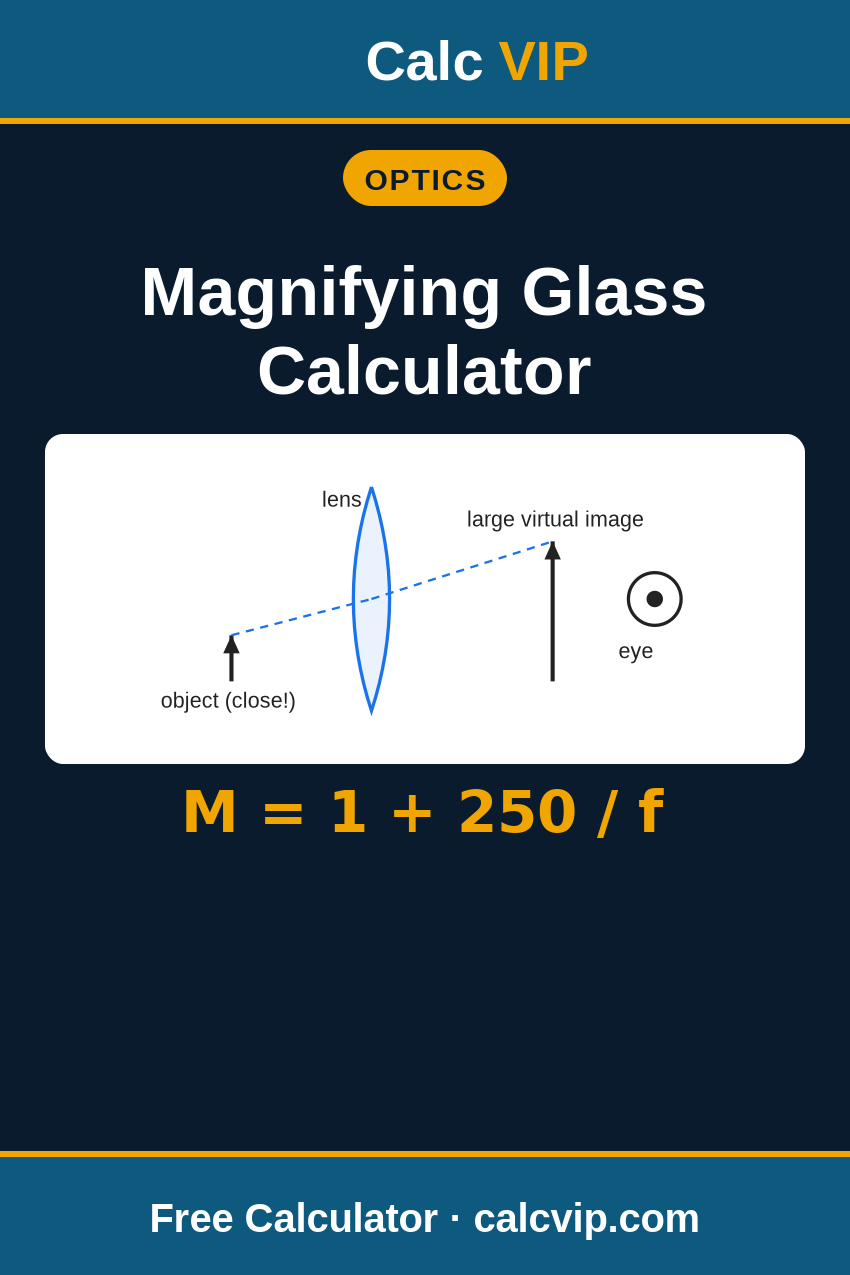
Everything is anchored to that 250 mm near point — the standard "least distance of distinct vision" for a young adult eye. It is a convention, not a property of your particular eyes: children focus closer, older eyes further, and the same lens genuinely magnifies more for a child than for a grandparent. The standard exists so that ratings can be compared between lenses, and this page uses it throughout, with the age-dependence of the near point treated honestly in the sections below. Feed in a focal length in millimetres and the two ratings fall out immediately.
Formula
Image at the near point: M = 1 + 250 / f • image at infinity: M = 250 / f (f in mm)
The 250 mm is the standard near point — the closest distance a healthy eye can focus comfortably. A magnifier wins by letting you hold the object closer than that while still seeing it sharp; the shorter the focal length, the stronger the magnification. Both formulas rearrange for shopping: f = 250 ÷ M (infinity rating) or f = 250 ÷ (M − 1) (near-point rating) tells you the focal length behind any advertised magnification. And since power P = 1000/f(mm) dioptres, the infinity rating is simply M = P ÷ 4 — a +20 D lens is a 5× magnifier — which lets spectacle and loupe numbers be converted into each other at sight. The angular definition underneath everything: M is the angle the image subtends at the eye divided by the angle the object would subtend at 250 mm unaided.
| Symbol | Meaning | Units |
|---|---|---|
| M | angular magnification of the magnifier | × (times) |
| f | focal length of the magnifying lens | mm |
| D (near point) | least distance of distinct vision, standard value | 250 mm |
| P | lens power — M(∞) = P/4 | dioptres (D) |
Angular size: what "magnification" really counts
Hold a coin at arm's length and it covers the Moon; the coin did not grow — its angular size did. Vision runs on angles, and every visual instrument is an angle amplifier. The unaided eye's best effort is to bring the object to the near point, where an object of height h subtends about h/250 (in radians, small-angle approximation). Through the magnifier with the image at infinity, the same object at the focal point subtends h/f. The ratio of the two angles is 250/f — the formula, with its meaning exposed: magnification is how many times wider the lens lets the object spread across your retina compared with your closest unaided look. Nothing about the object changes; the lens is a permit to stand closer, and the formula prices the permit in units of the near point.
This is also why magnification figures for visual instruments cannot be divorced from the observer. Move the standard near point and every rating moves with it: a child whose near point is 100 mm gains less from the same lens (her unaided view is already large), while an older reader whose near point has drifted to 500 mm gains more — for that reader the honest rating of an f = 50 mm lens is not 250/50 = 5× but 500/50 = 10× relative to their own unaided best. Manufacturers must pick one number, so they pick 250 mm; this calculator follows the standard, and the depth section below shows how to re-rate a lens for your own eyes.
How to use
- Enter the focal length of the magnifying lens in millimetres. If it is not marked, estimate it: hold the lens above a page in bright light and raise it until the light focuses to the smallest spot on the page — that height is roughly f. Or convert from power: f(mm) = 1000 ÷ P.
- Click "Calculate Magnification" to see both magnification values.
- Use the near-point value for the maximum power (image at 250 mm, eye working hardest), and the infinity value for relaxed, long-duration viewing with the object at the focal point.
- When comparing products, check which convention each seller quotes — a "6×" near-point lens and a "5×" infinity lens may be the very same piece of glass, as Example 1 shows.
Worked examples
Example 1 — the standard hand magnifier. A magnifier has focal length f = 50 mm. Image at near point: M = 1 + (250 ÷ 50) = 1 + 5 = 6×. Image at infinity: M = 250 ÷ 50 = 5×. One lens, two honest ratings, differing by the famous +1 — and a warning label for every shopper: the seller quoting 6× and the seller quoting 5× may be describing identical glass, the first at the near point, the second at infinity.
Example 2 — a jeweller's loupe. A loupe of f = 25 mm gives M = 1 + 250/25 = 11× at the near point and 250/25 = 10× at infinity. The trade's beloved "10× triplet" is rated on the infinity convention. At f = 25 mm the lens must sit within a couple of centimetres of both the stone and the eye — the working distance is the price of the power, and it is why loupes are technique as much as tool.
Example 3 — a reading magnifier. A page-sized reading lens of f = 100 mm gives M = 1 + 2.5 = 3.5× at the near point and 2.5× at infinity. Modest numbers, deliberately: a long focal length keeps the lens far from the page, admits both eyes and a natural reading posture, and covers a whole column of text. For reading, field of view and comfort beat raw power — the formula explains the design choice quantitatively.
Example 4 — checking an advertisement. A "10×" magnifier is advertised with no convention stated. If the claim is the infinity rating, f = 250 ÷ 10 = 25 mm. If it is the near-point rating, f = 250 ÷ 9 = 27.8 mm. Measure the focal length (sun-spot method) and you can tell which claim was made — or whether the claim survives measurement at all. This calculator plus a sunny windowsill is a complete consumer-protection kit.
Example 5 — a stamp collector's glass. At f = 75 mm: M = 1 + 250/75 = 4.33× near point, 3.33× infinity. Enough to read perforations and spot plate flaws, with a field wide enough to take in a whole commemorative issue at once. Philatelists settled on 3–5× generations ago; the formula shows they were optimising the same trade-off as Example 3.
Example 6 — the strong pocket loupe. At f = 40 mm: M = 1 + 6.25 = 7.25× and 6.25×. Push further to f = 20 mm and the ratings reach 13.5×/12.5× — but the lens is now a small, deeply curved button that must nearly touch the specimen, its field shrunk to a coin's width and its edges swimming with distortion. The formula will cheerfully rate any f you enter; the optics of a single lens set the practical ceiling near 10–15×, beyond which the compound microscope takes over.
Magnifying glasses in real life
Reading and low vision. The commonest magnifier on Earth is the reading glass, prescribed or off the rack. For low-vision patients, clinicians prescribe by required magnification computed exactly this way — from the patient's own near point and the print size they need to reach — then verify with the real lens.
Jewellery and watchmaking. The loupe is the bench tool of both trades: 10× is the gemmological standard (the rating at which inclusions are graded), and watchmakers work at 4–7× for the field and working distance. Both are this formula at f = 25–60 mm.
Electronics inspection. Solder joints and hairline PCB cracks are inspected at 3–10×. Bench magnifiers trade power for the long focal length that leaves room for a soldering iron — Example 3's compromise, industrialised with ring lights.
Philately, numismatics and print. Stamp and coin collectors authenticate at modest magnifications; printers and engravers check registration and dot structure with linen testers — folding magnifiers of known f whose ratings come straight off this page.
Field biology. A hand lens (the botanist's name for the same instrument) at 10× and 20× is standard field kit for mosses, insects and rock grains. Geology hammers come with a lens in the kit because a rock's story is written at magnifier scale.
Forensics and documents. Forged signatures, altered cheques and erased entries are examined first at magnifier scale before any laboratory instrument is invoked — the humble lens is the triage tool of questioned-document work.
The near point is yours, not the textbook's
The 250 mm in the formulas is a treaty, not a measurement. A ten-year-old focuses at about 70–100 mm; a twenty-year-old at roughly 100–120 mm in practice (250 mm is the comfortable standard, not the absolute limit); by age fifty the near point has typically drifted to 400 mm or beyond, which is the entire reason reading glasses exist. Re-rating a lens for your own eyes is easy: replace 250 with your near point in millimetres. A reader with a 500 mm near point using the f = 50 mm lens gets M = 500/50 = 10× at infinity relative to their own unaided view — the lens is genuinely twice as helpful to them as the box claims. Conversely, a child with a 100 mm near point gets only 100/50 = 2× of real benefit from the same glass. Magnification is a relationship between a lens and an eye; the standard number is just the relationship evaluated at the standard eye, and this calculator's two outputs are the signposts for adjusting it to the eyes you actually own.
Quick reference: focal length to magnification
| Focal length f | M (near point) | M (infinity) | Lens power |
|---|---|---|---|
| 250 mm | 2× | 1× | +4 D |
| 125 mm | 3× | 2× | +8 D |
| 100 mm | 3.5× | 2.5× | +10 D |
| 62.5 mm | 5× | 4× | +16 D |
| 50 mm | 6× | 5× | +20 D |
| 41.7 mm | 7× | 6× | +24 D |
| 31.25 mm | 9× | 8× | +32 D |
| 25 mm | 11× | 10× | +40 D |
The two rating columns never differ by more than the single +1 — which is exactly why the convention matters at low powers (2× versus 1× is a doubling of the claim) and fades at high powers (11× versus 10× is marketing noise). The power column ties the table back to the optician's world: every magnifier is a spectacle lens that escaped.
Common mistakes
- Comparing ratings quoted on different conventions. A 6× (near point) lens and a 5× (infinity) lens can be identical glass — Example 1. Always convert a claim back to focal length with f = 250/M or 250/(M−1) before comparing prices.
- Entering f in centimetres. The formulas expect millimetres. f = 5 cm entered as "5" instead of 50 returns a fantastic 51× for a lens that really gives 6×. The unit is printed on the input label for a reason.
- Holding the lens far from the eye. The ratings assume the lens is close to the eye and the object near the focal point. A magnifier held at arm's length over the page delivers a fraction of its rated power — the geometry of angles collapses. Bring the lens to your eye, then bring the page up to the lens.
- Expecting a bigger lens to magnify more. Diameter buys field of view, not power. A dinner-plate f = 100 mm lens and a thimble of the same f both rate 3.5×; the plate simply shows more of the page at once.
- Chasing extreme single-lens magnifications. Beyond about 10–15×, a single lens's aberrations, tiny field and millimetric working distance defeat the purpose. Sellers quoting 30× or 50× for a single pocket lens are quoting the formula, not a usable image — the honest tool at that power is a compound microscope.
FAQ
Why are there two different magnification formulas?
They describe two ways to use the same lens. Holding the object just inside the focal point puts the virtual image at your near point and squeezes out one extra unit of magnification; holding it exactly at the focal point sends the image to infinity, which is more comfortable for long reading.
Why can't I just use an extremely short focal length for huge magnification?
A very short f means a tiny, strongly curved lens that must sit almost on top of the object, with a small field of view and strong distortion at the edges. Beyond about 10–15×, a compound microscope is far more practical.
Is the 250 mm near point the same for everyone?
No — it is the standard reference value for a young adult eye. Children can focus closer, and the near point moves outward with age (which is why reading glasses become necessary), but manufacturers rate magnifiers against 250 mm so the numbers are comparable.
How do I measure a magnifier's focal length without instruments?
On a bright day, hold the lens above a sheet of paper facing a window or the sun (never look through it at the sun) and adjust the height until the light concentrates into the smallest, brightest spot: that height is approximately f. Measure it in millimetres and this calculator returns both ratings. For accuracy, image a distant window instead of the sun and measure to the sharp image.
Why does the image go blurry when I move the object too close?
The formulas assume the object sits at or just inside the focal point, so the virtual image lands where the eye can focus. Push the object much closer and the virtual image comes nearer than your near point — beyond your eye's focusing range — and blurs. There is a correct working distance for every magnifier, and it is approximately f.
What is a "triplet" loupe, and why does it cost more?
Three lens elements cemented together, designed so their aberrations cancel: the image stays sharp and colour-true to the edge of the field. The magnification formula is unchanged — a triplet and a singlet of the same f rate identically — but the usable field at that magnification is far larger. Gemmology insists on triplets for grading work.
Can I combine two magnifiers for more power?
Stacking lenses adds their powers (dioptres add), so two f = 50 mm lenses (+20 D each) in contact act as +40 D — f = 25 mm, an 11×/10× loupe. The penalties are the usual ones: more reflections, more aberration, less working distance. It works in a pinch and demonstrates why power, not focal length, is the additive quantity.
Why do stand magnifiers rate lower than hand lenses of the same glass?
A stand fixes the lens-to-page distance, usually at or inside f, and the eye's distance is set by the stand's height. The geometry rarely achieves the full near-point rating, so honest makers quote the lower, as-used figure. The lens is the same; the permitted posture is not.
Does a magnifier help someone with very poor vision more than the rating says?
Often, yes. The rating is measured against the standard 250 mm near point, but a low-vision reader's unaided near point may be far worse — or their usable acuity limited by contrast rather than distance. Relative to their own unaided view, the benefit can exceed the printed ×, which is why low-vision clinics assess with the patient's own eyes rather than the box's number (see the depth section above).
What magnification do I need to read a phone screen or medicine label?
Comfortably, 2–4× covers most small print for normally sighted readers — an f of 62.5–125 mm, with a wide field. Needing more than about 6× for ordinary print is a sign to have your eyes examined: the lens may be compensating for a prescription change that glasses would fix better.