 Calc
Mass Spectrometer Calculator – Ion Mass m = qB²r²/(2V) in kg & Atomic Mass Units
 Created by Thomas Becker · Physics Writer · Electricity & Magnetism · Last updated: November 2026
Use this free Mass Spectrometer Calculator to find the mass of an ion from the radius of its curved path in a magnetic field, using m = qB²r² ÷ (2V) — and get the answer in kilograms and atomic mass units.
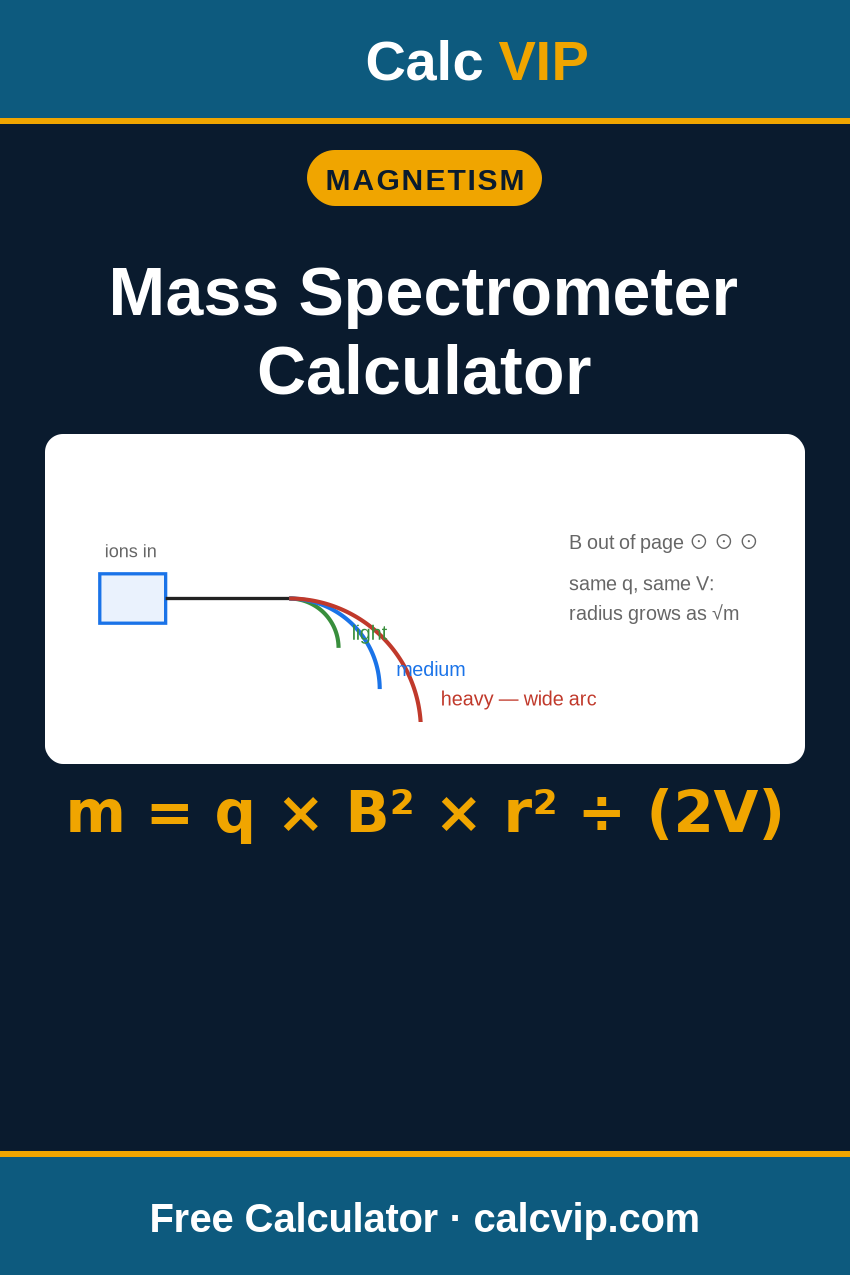
A mass spectrometer is a weighing machine for individual atoms. It cannot put an ion on a balance — a single atom's mass is around 10⁻²⁵ kg, far below any scale — so instead it weighs by trajectory. Ionise the sample, accelerate every ion through the same voltage so each carries a known energy, then fire the beam into a magnetic field. The field bends each ion into a semicircle whose radius depends on its mass: heavy ions plough on in wide arcs, light ones curl tightly. Measure where an ion lands and you have measured its mass. The pattern of landing positions — the mass spectrum — is a fingerprint of everything in the sample, isotope by isotope.
The calculator's formula, m = qB²r²/(2V), is two simpler results fused. The accelerating voltage fixes the speed through energy: ½mv² = qV. The magnetic field fixes the radius through circular motion: r = mv/(qB). Eliminate the speed between them and the mass falls out in terms of four measurable things — charge, field, radius, voltage — with no need to time the ion or clock its velocity. Note the radius appears squared: a 10% error in reading r becomes a 21% error in m, which is why spectrometer design obsesses over sharp beams and precisely known fields, and why the instrument rewards careful measurement like no other on this site.
Two practical conventions frame everything that follows. First, spectra are plotted against the mass-to-charge ratio, m/q (usually written m/z), because the trajectory cannot tell a heavy doubly charged ion from a lighter singly charged one — Example 3 below shows the degeneracy with real numbers. Second, masses are quoted in atomic mass units (u), where 1 u = 1.6605 × 10⁻²⁷ kg is a twelfth of a carbon-12 atom, so that a reading of "54.27 u" can be matched against the periodic table at a glance. This calculator reports both kilograms and u, plus the ion's speed as a consistency check.
Formula
m = q × B² × r² ÷ (2V) • m = ion mass (kg), q = ion charge (C), B = magnetic field strength (T), r = radius of the semicircular path (m), V = accelerating voltage (V). The two ingredients are the energy relation ½mv² = qV and the magnetic radius r = mv ÷ (qB); solving the second for v and substituting into the first gives the working formula. Rearrangements serve the instrument designer: r = √(2Vm ÷ q) ÷ B predicts where a known mass will land, B = √(2Vm ÷ q) ÷ r finds the field a target radius needs, and V = qB²r² ÷ (2m) the voltage. Convert with m (in u) = m (in kg) ÷ 1.6605 × 10⁻²⁷.
| Symbol | Meaning | Units |
|---|---|---|
| m | mass of one ion | kg, or atomic mass units (u) |
| q | ion charge = (charge state) × 1.602 × 10⁻¹⁹ C | coulombs (C) |
| B | magnetic field strength in the analyser region | teslas (T) |
| r | radius of the ion's semicircular path (half the entry-to-detector distance) | metres (m) |
| V | accelerating voltage the ion fell through | volts (V) |
| v | ion speed in the field = qBr ÷ m | m/s |
Two steps, one weighing: how the formula is built
Step one is pure energy bookkeeping. An ion starting near rest and falling through a potential difference V converts electrical potential energy qV into kinetic energy ½mv². Every singly charged ion leaves the accelerator with the same energy — but not the same speed: a heavy ion ambles out slowly, a light one darts. Step two is the magnetic force, F = qvB, which is always perpendicular to the motion and so bends the ion into a circle without speeding it up or slowing it down. Setting that force equal to the centripetal requirement, qvB = mv²/r, gives r = mv/(qB): for a given field, radius is a direct readout of momentum. The spectrometer's trick is that it knows the energy from step one, and energy plus momentum together determine mass uniquely — m = p²/(2E) in disguise — which is exactly what eliminating v between the two equations accomplishes.
The geometry matters as much as the algebra. In the classic sector instrument drawn above, ions enter the field through a slit, fly a semicircle, and strike a detector at a distance 2r from the entry — so the measured quantity on the bench is really the diameter, and the radius that enters this formula is half of it (the single most common slip in student calculations; see Common mistakes). Modern instruments vary the game — time-of-flight tubes clock the speed directly, quadrupole filters pass one m/z at a time, orbitraps weigh by oscillation frequency — but the magnetic sector remains the textbook instrument because its physics is exactly this page: two equations, one elimination, a mass.
How to use
- Enter the ion charge q in coulombs. The box is pre-filled with e = 1.602e-19 for a singly charged ion; double it (3.204e-19) for a 2+ ion, and so on.
- Enter the analyser field B in teslas.
- Enter the path radius r in metres — remembering it is the radius: if your instrument reports the entry-to-detector distance, halve it first.
- Enter the accelerating voltage V and click "Calculate" for the mass in kg and u, plus the ion's speed.
- Match the u value against the periodic table or a molecular weight. A result like 54.27 u points at iron's neighbourhood (⁵⁶Fe is the common isotope; the small gap flags measurement rounding), while fractional values near whole numbers usually mean the radius reading needs one more decimal place.
Worked examples
Example 1 — an unknown metal ion. A singly charged ion (q = 1.602 × 10⁻¹⁹ C) is accelerated through V = 5000 V and follows a path of radius r = 0.15 m in a field B = 0.5 T.
m = qB²r² ÷ (2V) = (1.602 × 10⁻¹⁹ × 0.25 × 0.0225) ÷ 10000 = 9.011 × 10⁻²⁶ kg.
In atomic mass units: 9.011 × 10⁻²⁶ ÷ 1.6605 × 10⁻²⁷ = 54.27 u — close to an iron ion (⁵⁶Fe⁺ would curve very slightly wider). Its speed was v = qBr ÷ m = 1.333 × 10⁵ m/s.
Example 2 — checking carbon-12. A carbon ion, q = e, is accelerated through V = 2000 V in B = 0.2 T, and lands at a measured radius r = 0.1115 m.
m = (1.602 × 10⁻¹⁹ × 0.04 × 0.01243) ÷ 4000 = 1.992 × 10⁻²⁶ kg = 11.99 u.
Within measurement rounding of exactly 12 u — as it must be, since the atomic mass unit is defined by this very isotope. Instruments are calibrated on such known masses before unknowns are trusted.
Example 3 — the doubly charged impostor. Repeat Example 1 with a doubly charged ion, q = 3.204 × 10⁻¹⁹ C, same B, r and V.
m = (3.204 × 10⁻¹⁹ × 0.25 × 0.0225) ÷ 10000 = 1.802 × 10⁻²⁵ kg = 108.5 u.
A 108.5 u ion carrying two charges lands exactly where a singly charged 54.27 u ion lands, because the trajectory reads m/q, not m. Spectra are therefore labelled m/z, and a peak at 54.27 might be either species — context and isotope patterns decide.
Example 4 — separating uranium isotopes. Uranium ions (q = e) are accelerated through V = 1000 V into B = 1 T. Where do ²³⁵U⁺ and ²³⁸U⁺ land?
r = √(2Vm ÷ q) ÷ B: for ²³⁵U (m = 235 u), r = 0.06980 m; for ²³⁸U, r = 0.07024 m.
The beams land just 0.44 mm apart — separable with fine slits, but barely. This whisker of a gap is why isotope enrichment by mass spectrometry (the wartime calutrons) needed enormous magnets and endless patience, and why centrifuges do the job today.
Example 5 — weighing a proton. A proton beam (q = e) accelerated through V = 1000 V in a modest B = 0.1 T curves at r = 0.0457 m.
m = (1.602 × 10⁻¹⁹ × 0.01 × 0.002088) ÷ 2000 = 1.673 × 10⁻²⁷ kg = 1.007 u.
The lightest nucleus weighs in correctly — and at a radius a school laboratory magnet can manage, which is why proton and hydrogen spectra anchor so many teaching experiments.
Example 6 — neon's twin isotopes. Neon ions (q = e) at V = 3000 V in B = 0.3 T: ²⁰Ne lands at r = 0.1176 m. A second line appears at r = 0.1233 m.
m = (1.602 × 10⁻¹⁹ × 0.09 × 0.015203) ÷ 6000 = 3.653 × 10⁻²⁶ kg = 22.00 u — ²²Ne.
The two lines, 5.7 mm apart, and their relative brightness are exactly how neon's isotopic abundances (roughly 90% ²⁰Ne, 10% ²²Ne) were first established.
Mass spectrometry in real life
Drug testing and forensics. A blood or urine sample's spectrum identifies substances by their molecular masses and fragment patterns — the evidence standard in anti-doping laboratories and forensic toxicology, sensitive to traces far below chemical tests.
Dating rocks and artefacts. Isotope ratios measured by mass spectrometry power radiometric dating: uranium-lead ratios age the oldest Earth minerals and Moon rocks, while carbon-14 instruments count the surviving ¹⁴C atoms in ancient wood and bone directly by mass.
Proteomics and medicine. Modern instruments weigh whole proteins and their fragments, identifying them from mass fingerprints — used to type bacteria in hospital labs within minutes and to hunt biomarkers for disease in blood samples.
Space missions. Compact mass spectrometers fly on probes and rovers, sniffing planetary atmospheres and analysing scooped soil. The same qB²r²/(2V) physics (and its time-of-flight cousins) reported the composition of Mars's air and comet dust.
Semiconductor and materials purity. Trace contamination at parts-per-billion ruins chips and alloys; mass spectrometry of sputtered samples certifies purity levels no chemical method can reach, element by element, isotope by isotope.
Environmental tracing. Pollutants carry isotopic signatures from their sources. Matching lead, strontium or carbon isotope ratios in water, soil or food to their origins — oil-spill attribution, food-fraud detection, ivory provenance — is mass spectrometry doing detective work.
Resolution: how close can two masses be?
An instrument's worth is its resolving power, R = m ÷ Δm — the mass divided by the smallest mass difference it can separate. Because r grows only as √m, heavy neighbours crowd together: the radius gap between masses m and m + 1 shrinks as m rises, which is why Example 4's uranium pair (Δm = 3 at m ≈ 236) sits 0.44 mm apart while Example 6's neon pair (Δm = 2 at m ≈ 21) enjoys 5.7 mm. Teaching instruments resolve tens; analytical sector machines reach R ≈ 10,000; research instruments exceed 100,000, enough to separate molecules that share a nominal mass but differ in composition — the difference between a drug and its near-identical metabolite. When a calculation gives two radii closer than your detector's slit width, the honest conclusion is that this instrument cannot tell those ions apart, whatever the formula says. Resolution is also why the field B is pushed as high as magnets allow: doubling B halves every radius, but it doubles the separation between neighbouring masses too, buying discrimination that no amount of careful reading can substitute for.
Quick reference: where common ions land
| Ion (singly charged) | m/z (u) | Radius at V = 5000 V, B = 0.5 T |
|---|---|---|
| H⁺ (proton) | 1 | 0.0204 m |
| He⁺ | 4 | 0.0407 m |
| C⁺ | 12 | 0.0705 m |
| N₂⁺ | 28 | 0.1077 m |
| O₂⁺ | 32 | 0.1152 m |
| CO₂⁺ | 44 | 0.1351 m |
| Fe⁺ | 56 | 0.1524 m |
The √m pattern is visible down the radius column: quadrupling the mass (1 → 4 u) only doubles the radius (0.0204 → 0.0407 m). Detector real estate buys less and less separation as masses grow — the fundamental reason high-mass work migrates to time-of-flight and orbital-trap instruments.
Common mistakes
- Entering the diameter as r. Sector instruments measure the entry-to-detector distance, which is 2r. Using it unhalved quadruples the computed mass (r is squared) — the costliest slip available on this page.
- Forgetting the charge state. q must be the ion's total charge: 2e for a 2+ ion. Leaving q = e for a doubly charged sample halves the reported mass and invents a phantom lighter element.
- Reading the answer in kg as u. The calculator prints both, six orders of magnitude apart in exponent. A mass of 9 × 10⁻²⁶ is kilograms; the same ion is 54.27 u. Quote the unit with the number.
- Sloppy radius, squared error. Because m ∝ r², a 5% radius error becomes a 10% mass error. Measure r to as many figures as the instrument allows — it is the squared term that decides the answer's quality.
- Assuming every peak is a different element. Peaks are m/z values: fragments, molecules and multiply charged ions all appear. The 28 peak in air is N₂⁺, not silicon; interpretation needs chemistry as well as physics.
FAQ
How does a mass spectrometer identify substances?
Each mass follows its own radius, so ions land at different positions on the detector. The pattern of positions and intensities is a fingerprint of the masses present — used to identify everything from isotopes in rock samples to drugs in a blood sample.
What if the ion is doubly charged?
Then q = 2e, and the formula uses that larger charge. In practice a doubly charged ion of mass 56 u lands where a singly charged 28 u ion would, so spectra are plotted against the mass-to-charge ratio m/q.
Why must the ions all start with the same energy?
The method assumes every ion was accelerated through the same voltage V, so they all carry energy qV. If their starting energies differed, the radius would no longer reveal the mass uniquely. Real instruments add a velocity selector (v = E/B) in front to enforce this.
Why does the radius grow only as the square root of mass?
Because the accelerating voltage gives every ion the same energy, heavier ions move slower (v ∝ 1/√m), and radius r = mv/(qB) trades that slower speed against the larger mass: r ∝ m × (1/√m) = √m. Double the mass and the radius grows by only 41%.
What field and voltage do real instruments use?
Teaching and analytical sector machines typically run B between 0.1 and 1.5 T (permanent magnets at the low end, electromagnets above) and accelerating voltages from a few hundred volts to about 10 kV — exactly the ranges in this page's examples and table.
Can this method weigh neutral atoms or molecules?
No — the field only grips charge. Samples must first be ionised (by electron bombardment, laser, plasma or electrospray, depending on the material). The weighing begins only once every particle carries a known charge.
How is a mass spectrometer calibrated?
With known masses: a reference compound producing peaks at certified m/z values (Example 2's carbon-12 is the ultimate anchor, since the unit u is defined through it). Measured radii of the standards pin down the instrument's effective B and V, after which unknowns are read off.
What is the difference between mass and m/z?
Mass is the ion's actual mass; m/z is mass divided by charge state, the quantity the trajectory responds to. They coincide for singly charged ions, which is why beginners conflate them — and why Example 3's doubly charged ion surprises everyone the first time.
Why do the ions need a vacuum?
An ion crossing the analyser must not collide with air molecules on the way: a single collision changes its energy and direction and blurs its landing position. Spectrometers therefore run at high vacuum — the beam path must be emptier than the upper atmosphere.
Are magnetic-sector instruments still used?
Yes, where their strengths matter: isotope-ratio machines for geology and forensics, and high-resolution double-focusing instruments. Time-of-flight and quadrupole designs dominate routine work for speed and cost, but the sector's physics — this page's formula — remains the reference against which the field is taught.