 Calc
Pendulum Length Solver – String Length for a Wanted Period
 Created by James Carter · Physics Writer · Forces & Motion · Last updated: November 2026
Use this free Pendulum Length Solver to design a pendulum with exactly the period you want — for a clock, a metronome or a physics experiment. Enter the target period and it rearranges T = 2π√(L/g) to find the string length.
Most pendulum questions run forwards: given a length, find the tick. Design runs backwards. You know the period you need — one second for a clock, two seconds for a demonstration, a slow stately swing for a lobby sculpture — and the unknown is the length that delivers it. This solver inverts the most famous formula in oscillation physics, turning T = 2π√(L/g) into L = gT²/(4π²), and answers the builder's question directly: how long?
The inversion exposes the formula's personality. Length grows with the square of the period: double the tick and the pendulum quadruples. That single fact explains the architecture of timekeeping — why a seconds pendulum is a convenient metre, why a two-second pendulum is a four-metre monster fit only for cathedral towers, and why nobody builds a ten-second pendulum at all (24.85 m, as the examples show). It also explains the rating nut on a clock: trimming the period by a hair means trimming the length by twice the percentage, a gearing the squared law provides for free.
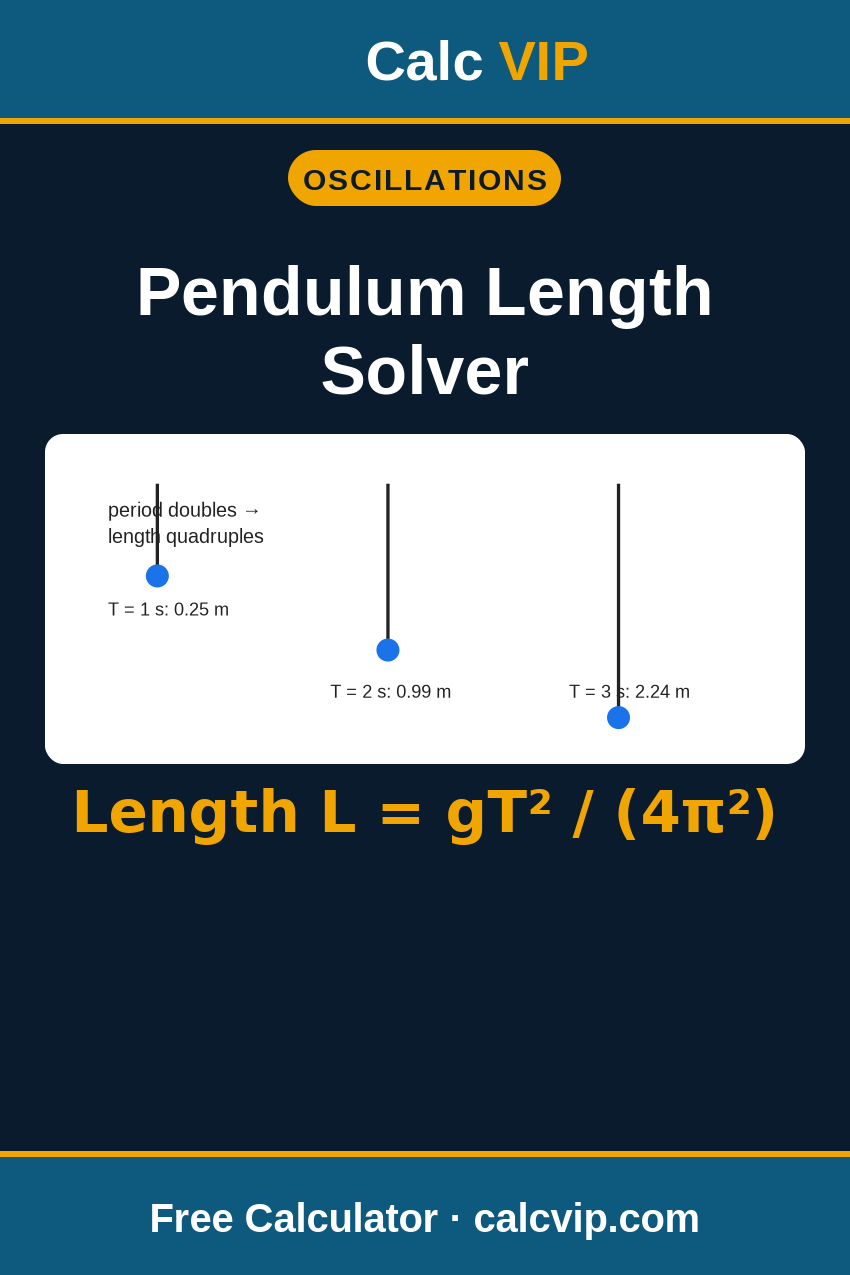
Everything else about the pendulum stays mercifully absent. The bob's mass does not appear — choose it for visibility and air resistance, not timing. The amplitude does not appear — swing it modestly and the length alone keeps the time. One input, one output, and a buildable answer: that is the whole charm of designing with the inverted formula.
Formula
Length L = gT² / (4π²) • L in metres (m), T in seconds (s), g in m/s² (9.81 on Earth)
The constant 4π² ≈ 39.48 makes a memorable rule: L ≈ T²/4 on Earth, since g/(4π²) = 0.2485 ≈ ¼. A 2-second pendulum is about a metre; a 1-second pendulum about a quarter metre; the approximation is good to 0.6% and ideal for mental estimates. On another world, replace g: L = gworldT²/(4π²), so the same target period needs a length scaled by that world's gravity — one sixth as long on the Moon. If your design constraint is a frequency rather than a period, T = 1/f first. And remember the length is measured to the bob's centre of mass, not to the string's end or the bob's top.
| Symbol | Meaning | Units |
|---|---|---|
| L | pendulum length, pivot to bob centre | m |
| T | target period | s |
| g | gravitational field strength (9.81 Earth) | m/s² |
| 4π² | numerical constant ≈ 39.48 | — |
The squared law and the architecture of clocks
Because L grows as T², pendulum clocks sort themselves into natural sizes. The seconds pendulum (T = 2 s, one second per swing each way) at 0.994 m became the longcase "grandfather" clock — a piece of furniture dimensioned by physics. Halve the period to 1 s and the length collapses to 0.248 m: the wall regulator and the school demonstration model. Halve again to 0.5 s and 6.2 cm remains — mantel-clock territory, where a rod that short is impractical and designers switch to the physical pendulum's tricks (a compact rod with a heavy bob low down) or abandon pendulums for balance wheels.
At the other extreme the square law builds monuments. Foucault's 1851 demonstration pendulum in the Panthéon hung 67 m — its period, 2π√(67/9.81) ≈ 16.4 s, slow enough for crowds to watch the swing plane rotate. Modern lobby pendulums of 10–20 m tick every 6–9 s, their slowness the entire aesthetic. Between the mantel and the monument, every pendulum ever hung is the squared law made visible: read a clock's size and you have read its period, within a square root.
The squared law also governs adjustment. A clock losing 1% of its rate needs its period shortened by 1%, hence its length by 2% — for a metre pendulum, a 2 cm lift of the bob, which is why rating nuts have fine threads and patient owners. Conversely the law forgives rough construction: a 1% error in cutting the length costs only 0.5% in period, trimmable at the nut. Few design formulas are this courteous.
There is a practical moral for experimenters: because length is so leveraged, the cheapest precision in a pendulum experiment is a longer pendulum. Timing a 2.2 m pendulum's fifty swings spreads stopwatch error across 150 seconds of motion; the same error on a 25 cm pendulum crowds into 50 seconds. When an exam or a lab lets you choose, solve for the longest length the room allows and let the squared law buy you extra measurement accuracy for free, every single time you run the experiment.
How to use
- Decide the period you need and enter it in seconds (for a clock that ticks each second, the period is 2 s — one full swing there and back).
- Enter g for your location or world (9.81 for Earth as standard).
- Click to get L in metres; build the pendulum with that length measured from the pivot to the centre of the bob.
- Leave a little adjustment: a threaded bob or sliding weight covering ±2% of length lets you trim the finished clock to rate.
Worked examples
Example 1 — the seconds pendulum. Target T = 2 s, g = 9.81 m/s²:
L = gT²/(4π²) = 9.81 × 4 / 39.48 = 0.99 m (99.4 cm) — the length inside every traditional longcase clock.
Example 2 — a one-second period. T = 1 s: L = 9.81 × 1 / 39.48 = 0.248 m (24.8 cm). Quarter the period target of Example 1, quarter the length — the squared law in its simplest dress.
Example 3 — a brisk half-second. T = 0.5 s: L = 9.81 × 0.25 / 39.48 = 0.062 m — 6.2 cm. Pendulums this short are finicky about where the pivot truly is; designers this small usually switch to a rigid rod (a physical pendulum) whose length is unambiguous.
Example 4 — a stately 1.5 seconds. T = 1.5 s: L = 9.81 × 2.25 / 39.48 = 0.559 m. A comfortable size for a wall clock with a visible, unhurried swing.
Example 5 — a three-second demonstration pendulum. T = 3 s: L = 9.81 × 9 / 39.48 = 2.236 m — ceiling height in most rooms, which is why lecture-theatre pendulums hang in stairwells.
Example 6 — seconds on the Moon, and the impractical ten. For T = 2 s on the Moon (g = 1.62): L = 1.62 × 4/39.48 = 0.164 m — a lunar seconds pendulum is a desk toy. Back on Earth, T = 10 s demands L = 9.81 × 100/39.48 = 24.85 m: taller than a six-storey building, the squared law's veto on slow pendulums.
Designing pendulums in real life
Clockmaking. The solver's home ground. Every pendulum clock begins as a target period — 2 s for longcase, 1 s or less for wall and mantel — and the length follows from the formula before a single piece of brass is cut.
Metronomes. A mechanical metronome is an inverted physical pendulum whose sliding weight repositions its centre of mass, effectively re-solving this equation for each tempo. The marked tempos (40–208 beats per minute) are the squared law rendered as a scale of notches.
Kinetic sculpture. Lobby and museum pendulums are designed period-first: an artist wanting a meditative 8-second swing needs L = 9.81 × 64/39.48 ≈ 15.9 m, and the building is then designed around the answer.
Seismometer periods. A horizontal seismometer's boom is tuned to a target period (often 10–30 s of effective period) by geometry equivalent to choosing an enormous L — achieved with hinges and springs rather than an actual 25–225 m string, precisely because the solver shows the literal version is impossible.
Playground swings. Want a gentler swing for small children? Period rises with chain length: 2 m chains give T = 2.84 s, a slow, forgiving rhythm; 1 m chains give 2.01 s and a livelier ride. Councils unwittingly specify periods when they specify chains.
Science kits and exams. "Design a pendulum that beats seconds" is a perennial practical-exam task; the intended solution is this page — 0.994 m, measured to the bob's centre, swung small, timed over fifty swings.
Building tips the formula assumes you know
Measure to the centre of the bob. The single most common construction error. A 5 cm bob on a string cut to the full L adds 2.5 cm of effective length — a 1.25% period error on a metre pendulum, roughly 18 minutes a day on a clock. Cut the string short by the bob's radius.
Keep the swing small. The solver inherits the small-angle promise: below about 10° the period matches the design to ~0.2%; at 30° it runs about 1.7% long. Design the escapement or the push to keep amplitude modest and constant.
Mind the string's own mass and stretch. A heavy cord is a physical pendulum in disguise, and an elastic one lengthens under the bob's weight — both shift the effective L from the measured one. Thin, inextensible line and a dense bob keep the simple formula honest; precision clocks use a rigid rod and fold its mass into a physical-pendulum correction.
Temperature moves L. A steel rod grows by about 12 parts per million per °C; a 10 °C seasonal swing changes L by 0.012% and the rate by half that — small, but the reason serious clocks used wood rods, then invar, then gridiron compensation. Your solver answer is the length at the temperature you build at.
Choose the bob for the job, not the timing. Since mass cancels, the bob is chosen on secondary virtues: dense (lead, brass) for a small, wind-proof package with a crisp centre; large and light only where visibility matters more than rate, as in lecture demonstrations where the audience must see the swing from the back row. A spherical bob makes the centre unambiguous; a lenticular (lens-shaped) clock bob slips through air with less drag and looks the part. Whatever you choose, weigh it after machining if the rod's own mass matters — in a physical-pendulum correction the bob-to-rod mass ratio decides how much of the ideal formula survives.
The seconds pendulum nearly defined the metre
The 0.994 m answer carries a famous historical near-miss. When revolutionary France set out to define the metre, one leading proposal was the length of the seconds pendulum at 45° latitude — a standard any nation could reproduce with a clock and patience. The proposal lost, narrowly, to the meridian-based definition, partly because g varies with location (the pendulum definition smuggles geography into a supposedly universal unit) and partly because the seconds pendulum's length depends on the second, itself defined by Earth's rotation — a circle of definitions. The metre became a fraction of the Earth's meridian instead, and the seconds pendulum kept only its clocks.
The episode left a useful intuition: a metre-long pendulum ticking seconds feels inevitable, but the near-equality is coincidence stacked on convention — the second from Babylonian base-60 astronomy, the metre from a Paris meridian survey. On the Moon the "natural" unit would be 0.164 m. The solver's job is precisely to cut through such coincidences: whatever your planet, your latitude and your target period, it returns the length that physics — not history — demands.
When the simple answer needs corrections
The inverted formula assumes a massless, inextensible string, a point bob, small swings and vacuum. Real builds violate each slightly, and good designers correct in a known order of importance. First, the bob's size: use its centre, as stressed above — this is a percent-level effect and always worth modelling. Second, the support's mass: a rigid rod instead of string converts the problem to the physical pendulum, where the solved quantity is the equivalent length Leq = I/(md) — for a uniform rod about its end, build the rod 1.5 times the solved length. Third, amplitude: budget the (1 + θ₀²/16) factor if the swing must exceed ~15°. Fourth, buoyancy and air: a light bob in air effectively weighs less by the displaced air's weight, lengthening the period as if g were reduced by the density ratio ρair/ρbob — negligible for brass (0.014%), a real effect for wooden bobs, and the reason vacuum chambers house the finest pendulum clocks.
None of this diminishes the solver. It is the correct first answer — the length around which all corrections are small refinements — and for the overwhelming majority of clocks, demonstrations and instruments, it is the only answer ever needed. Design proceeds exactly as this page does: solve the ideal, then trim the real.
Quick reference: period to length on Earth (g = 9.81)
| Target period T | Length L | Typical use |
|---|---|---|
| 0.5 s | 0.062 m | mantel mechanisms |
| 1.0 s | 0.248 m | wall regulators |
| 1.5 s | 0.559 m | wall clocks |
| 2.0 s | 0.994 m | seconds pendulum, longcase clocks |
| 2.5 s | 1.553 m | tall regulators |
| 3.0 s | 2.236 m | demonstrations |
| 4.0 s | 3.976 m | tower clocks |
| 5.0 s | 6.212 m | lobby pendulums |
| 10.0 s | 24.85 m | monuments only |
Read the table through the L ≈ T²/4 rule and every row checks mentally: 9/4 = 2.25 against the computed 2.236; 100/4 = 25 against 24.85. The quarter rule's small shortfall is g/(4π²) being 0.2485 rather than exactly 0.25.
Common mistakes
- Confusing period with tick interval. A clock that ticks every second has a 2-second period (tick at each end of the swing). Designing with T = 1 s builds a clock that ticks twice too fast.
- Measuring to the wrong point on the bob. L ends at the bob's centre of mass. Measuring to the top of a large bob under-builds the length and the clock runs fast.
- Scaling length linearly. Twice the period needs four times the length. Linear thinking under-builds every long pendulum and over-builds every short one.
- Ignoring g's location. A clock built and regulated in the mountains (g lower by ~0.1%) runs slow at sea level unless re-trimmed; precision moves re-solve with the local g.
- Forgetting the swing amplitude. The solved length delivers the target period only for small swings. A vigorously swung demonstration pendulum runs visibly slow against its design.
FAQ
What length gives a 1-second period?
About 0.25 m on Earth (0.248 m). Length scales with T², so half the period needs one quarter of the length: 0.99 / 4 ≈ 0.25 m.
Does the bob's weight affect the length needed?
No. The formula contains only T and g; a heavier bob needs the same string length for the same period.
Can I build a pendulum with a 10-second period?
You would need L = 9.81 × 100 / 39.48 ≈ 24.85 m — taller than most buildings, which is why very slow pendulums are impractical.
How long is a seconds pendulum?
About 0.994 m on Earth — a period of 2 seconds, so it beats once per second in each direction.
How accurate is the L ≈ T²/4 shortcut?
Within 0.6% on Earth, because g/(4π²) = 0.2485. Fine for estimates and first cuts; use the full solver value for the final build, then trim with the rating nut.
What length gives a period of exactly 2 s on the Moon?
0.164 m — the length scales with g, and the Moon's gravity is about one sixth of Earth's.
My built pendulum runs slow. What do I adjust?
Shorten it: raise the bob. The period error percentage is half the length error percentage, so a clock 1% slow needs its length reduced by 2%.
Can I solve for frequency instead?
Convert first: T = 1/f. A 0.5 Hz oscillator has T = 2 s and needs 0.994 m; the solver works in period throughout.
Does the formula work for a rigid rod pendulum?
Not directly — a rod is a physical pendulum whose effective length is I/(md) (⅔ of its length for a rod pivoted at its end). Solve for the effective length here, then convert.
How long for a period of one minute?
L = 9.81 × 3600/39.48 ≈ 895 m. Nobody builds it — a delightful proof that the pendulum era had a natural size limit, and that slower rhythms belong to other mechanisms.