 Calc
SHM Velocity Calculator – Maximum Speed & Acceleration in SHM
 Created by James Carter · Physics Writer · Forces & Motion · Last updated: November 2026
Use this free SHM Velocity Calculator to find the maximum speed and maximum acceleration of anything in simple harmonic motion — a mass on a spring, a pendulum bob or a vibrating string — from its amplitude and period (or frequency).
Simple harmonic motion has a split personality. The oscillator dawdles at the extremes of its swing, where it must stop and turn around, and hurries through the middle, where nothing holds it back. Two numbers capture the extremes of that behaviour: vmax, the peak speed reached at the centre, and amax, the peak acceleration endured at the turning points. This calculator finds both from the amplitude A and the period T — the two quantities you can usually measure with a ruler and a stopwatch.
The bridge between them is the angular frequency ω = 2π/T, the oscillator's tempo expressed in radians per second. Multiply the amplitude by ω once and you get the peak speed; multiply by ω again and you get the peak acceleration. That innocent-looking squaring is why fast oscillators are violent: halve the period and the peak speed doubles, but the peak acceleration quadruples. A tuning fork's prong, moving a fraction of a millimetre, sustains accelerations of hundreds of g — numbers no macroscopic machine could survive — purely because its ω is enormous.
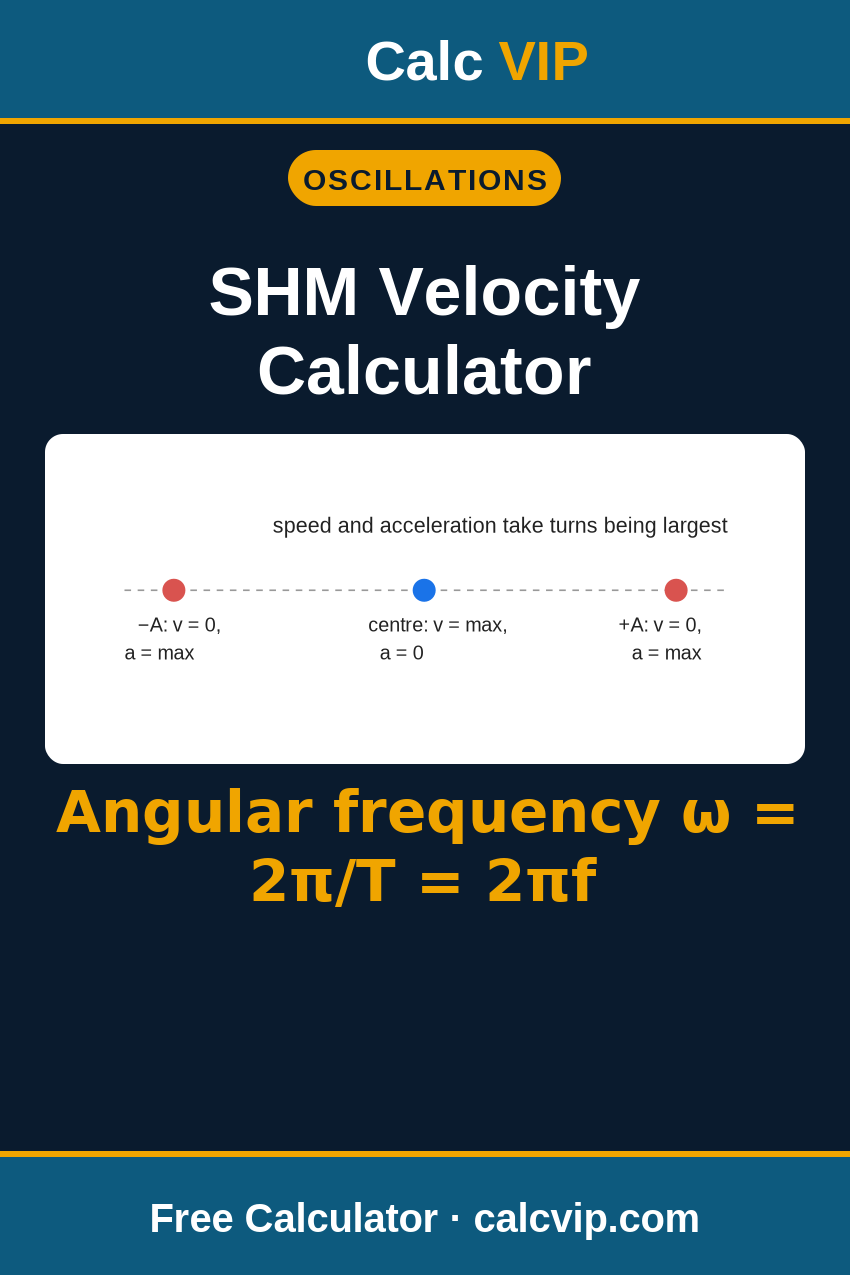
Knowing vmax and amax is how engineers decide whether a vibration is harmless or destructive. Speed sets kinetic energy, noise and wear; acceleration sets force, and force is what bends brackets, loosens bolts and cracks solder joints. Whether you are rating a loudspeaker, a washing machine's spin cycle or a skyscraper's sway, these two maxima are the figures that go in the report.
Formula
Angular frequency ω = 2π/T = 2πf • maximum speed vmax = Aω • maximum acceleration amax = Aω² • A in metres (m), T in seconds (s), ω in rad/s
At any instant, not just the extremes, the trio x = A cos(ωt + φ), v = −Aω sin(ωt + φ), a = −ω²x describes the motion completely — the SHM Displacement Calculator evaluates exactly those. Two consequences are worth memorising. First, a = −ω²x: acceleration is always proportional to displacement and oppositely directed, which is the defining signature of SHM. Second, the speed at any position is v = ω√(A² − x²), so if you know where the oscillator is, you know how fast it is moving — at x = A/√2, for instance, the speed is vmax/√2 ≈ 0.71 vmax. Given a frequency instead of a period, use ω = 2πf throughout.
| Symbol | Meaning | Units |
|---|---|---|
| A | amplitude — greatest displacement from centre | m |
| T | period — time for one full cycle | s |
| f | frequency, f = 1/T | Hz |
| ω | angular frequency, ω = 2π/T | rad/s |
| vmax | peak speed, at the centre: vmax = Aω | m/s |
| amax | peak acceleration, at the extremes: amax = Aω² | m/s² |
Why speed peaks where acceleration vanishes
It feels paradoxical the first time: the oscillator moves fastest exactly where its acceleration is zero, and accelerates hardest exactly where it is momentarily stopped. The force picture dissolves the paradox. In SHM the restoring force is proportional to displacement, F = −kx, so at the centre there is no displacement, no force, and nothing to change the velocity — the speed there is whatever the earlier acceleration built it up to, namely the maximum. At the extremes the spring is stretched furthest, the force is greatest, and the acceleration peaks; but the mass has just spent all its speed climbing out there, so velocity is zero. Speed and acceleration are quarter of a cycle out of step, forever trading the lead.
The energy picture says the same thing in a second language. Total energy is fixed at ½kA². At the extremes it is all potential, so kinetic energy — hence speed — is zero. At the centre it is all kinetic, and setting ½mvmax² = ½kA² gives vmax = A√(k/m) = Aω, the calculator's formula arriving by a completely independent route. When two different arguments land on the same result, you can trust it.
The practical moral: if you want to measure vmax, watch the centre crossing — a photogate at the equilibrium point catches the peak. If you want amax, the turning points are where accelerometers earn their keep, and where the mounting hardware feels the full force m·amax. Designing for the average motion instead of these peaks is how vibrating machinery surprises its owners.
For a pendulum the same maxima wear a gravitational face. The tangential acceleration at the extremes is g sin θmax ≈ g × (A/L) for small swings, where A is the arc amplitude and L the length. Example 2's bob, on its roughly metre-long string, peaks at 9.81 × 0.2 / 0.99 ≈ 1.98 m/s² — the formula route and the gravity route agreeing, as two views of one motion should.
How to use
- Enter the amplitude A in metres — the distance from the centre to a turning point, not the full peak-to-peak travel (halve that if it is what you measured).
- Enter the period T in seconds, or the frequency if the calculator offers it (f = 1/T).
- Click to get ω, vmax and amax.
- To feel amax, divide by 9.81: the answer in "g" is the language vibration engineers and test labs speak.
Worked examples
Example 1 — the reference oscillator. A = 0.1 m, T = 0.5 s:
ω = 2π / 0.5 = 12.57 rad/s; vmax = Aω = 0.1 × 12.57 = 1.26 m/s; amax = Aω² = 0.1 × 157.91 = 15.79 m/s² — about 1.6 g at each turning point.
Example 2 — a pendulum bob. A long pendulum swings with arc amplitude 0.2 m and period 2 s: ω = π = 3.14 rad/s; vmax = 0.2 × 3.14 = 0.63 m/s through the bottom; amax = 0.2 × 9.87 = 1.97 m/s² at the ends of the swing — gentle, stately motion, as a grandfather clock should be.
Example 3 — a loudspeaker cone. A woofer cone moves A = 1 mm at 100 Hz (T = 0.01 s): ω = 628.32 rad/s; vmax = 0.001 × 628.32 = 0.63 m/s; amax = 0.001 × 394,784 = 394.78 m/s² ≈ 40 g. A millimetre of travel, forty gravities of acceleration — the ω² lever at work.
Example 4 — a swaying tower. A tall building's top sways A = 0.3 m with T = 5 s: ω = 1.26 rad/s; vmax = 0.38 m/s; amax = 0.47 m/s², about 0.05 g. Small as it sounds, occupants feel accelerations near this level, which is why tower designers budget for them explicitly.
Example 5 — a tuning fork. The prong tip of a 440 Hz fork moves about A = 0.5 mm: ω = 2,764.60 rad/s; vmax = 0.0005 × 2,764.60 = 1.38 m/s; amax = 0.0005 × 7,643,024 ≈ 3,821.51 m/s² — roughly 390 g, sustained thousands of times per second by a sliver of steel.
Example 6 — an engine piston. A piston with 8 cm stroke (A = 0.04 m from centre) at 1,200 rpm has T = 0.05 s: ω = 125.66 rad/s; vmax = 5.03 m/s; amax = 631.65 m/s² ≈ 64 g — the force behind every connecting-rod calculation in engine design.
Peak speeds and accelerations in real life
Loudspeaker design. A driver's datasheet quotes Xmax, its linear travel limit. Combine it with the lowest frequency it must reproduce and this calculator predicts the cone's peak acceleration — the force the voice coil must supply — which sizes the magnet and amplifier long before anything is built.
Vibration testing of electronics. Products are shaken on tables rated by peak acceleration in g. A phone that must survive 20 g at 50 Hz can only be allowed an amplitude of a/g… a = Aω² gives A = 196.2 / (2π×50)² ≈ 2 mm — the test engineer's first calculation.
Earthquake engineering. Ground motion in a quake is specified by peak ground acceleration. A building responds roughly like an oscillator with its own period; comparing the ground's amax with the structure's capacity is the heart of seismic design codes.
Washing-machine spin cycles. An unbalanced load offset by a few millimetres at 1,400 rpm generates peak accelerations that walk the machine across the floor. The amplitude here is the load's eccentricity, and the ω² term is why doubling spin speed quadruples the violence.
Hard drives and precision instruments. A disk platter's heads fly nanometres above the surface; external vibration with even modest amax can crash them. Isolation mounts are chosen so the transmitted acceleration stays within a budget computed exactly this way.
Human tolerance. Elevators, fairground rides and pilot training all budget jerk and acceleration in g. A ride swinging with A = 2 m and T = 3 s peaks at a = 2 × (2π/3)² ≈ 8.77 m/s² — just under 1 g of added acceleration, thrilling but tolerable.
The quarter-cycle relay: reading x, v and a together
Plot the three quantities against time and a relay race appears. Displacement starts at its peak; velocity starts at zero, peaks a quarter cycle later as the mass crosses the centre; acceleration starts at its (negative) peak and crosses zero with the displacement. Each curve is the previous one shifted by exactly a quarter period — 90° of phase. Velocity leads displacement by 90°; acceleration leads velocity by 90° and so opposes displacement by 180°, which is just a = −ω²x drawn as a picture. Once this relay is in your head, most SHM exam questions answer themselves: "when is the speed greatest?" — a quarter cycle after the displacement peaks; "when is the force greatest?" — with the acceleration, at the extremes.
The relay also explains resonance's timing rule. To pump energy into an oscillator most efficiently, push in the direction of motion while it moves — in phase with the velocity, not the displacement. A child on a swing is pushed at the top of the arc yet the push does its work as she sweeps through the middle; get the phase wrong by half a cycle and the same pushes brake the swing instead. Every resonant system, from a radio tuner to a laser, is this quarter-cycle bookkeeping wearing different clothes.
Measuring the maxima in practice
Each maximum has its natural instrument. Peak speed is best caught at the centre crossing: a photogate's beam, broken by a flag of known width on the oscillator, times the fastest instant directly, and v = flag width ÷ interruption time is vmax with no model assumed. Peak acceleration belongs to accelerometers — MEMS chips smaller than a fingernail that ride the oscillator and report a(t) continuously; their trace should peak at the turning points and cross zero at the centre, and any asymmetry in the trace betrays friction or a non-Hookean spring. Strobe photography and slow-motion phone video split the difference: film the motion, read positions frame by frame, and both maxima emerge from the differences — the same data the SHM Displacement Calculator predicts point by point.
A cheap cross-check ties the instruments together: measure A with a ruler, T with a stopwatch, and compare the predicted maxima with the photogate and accelerometer readings. Agreement within a few percent validates the whole SHM model for that system; systematic shortfalls point to damping or to amplitude read peak-to-peak by mistake — the two perennial culprits.
When the motion is not quite SHM
Real oscillators deviate, and the deviations show up in the maxima first. A pendulum swung wide keeps vmax close to the small-angle prediction but its period stretches, so amax falls below Aω² computed from the small-angle ω. A spring driven beyond Hooke's law stiffens at the extremes, sharpening the acceleration peaks into spikes the pure formulas underestimate. Friction flattens everything: maxima decay from cycle to cycle, so quote them with the cycle number. The calculator's values are the ideal-SHM benchmark — the reference against which these real-world departures are measured, and usually accurate to a few percent for modest amplitudes and light damping. Treat any large disagreement not as a failure of the formulas but as information: the size and direction of the gap diagnose which idealisation — perfect spring, point mass, no friction — your system has outgrown.
Quick reference: A = 0.1 m at various periods
| Period T | vmax | amax | amax in g |
|---|---|---|---|
| 0.25 s | 2.51 m/s | 63.17 m/s² | 6.4 g |
| 0.50 s | 1.26 m/s | 15.79 m/s² | 1.6 g |
| 1.00 s | 0.63 m/s | 3.95 m/s² | 0.40 g |
| 2.00 s | 0.31 m/s | 0.99 m/s² | 0.10 g |
| 4.00 s | 0.16 m/s | 0.25 m/s² | 0.025 g |
March down the table and the scaling laws stare back: each doubling of T halves vmax and quarters amax. It is the quantitative reason slow oscillators — pendulums, towers, ships rolling — are gentle, and fast ones — forks, cones, pistons — are fierce, at identical amplitudes.
Common mistakes
- Using peak-to-peak travel as A. Amplitude is centre-to-extreme. Entering the full 20 cm swing of a mass as A = 0.2 instead of 0.1 doubles both answers.
- Forgetting the square in amax. amax = Aω², not Aω. The slip understates acceleration by a factor of ω — at ω = 100 rad/s, a hundredfold understatement.
- Plugging frequency in as ω. ω = 2πf, not f. Using f directly shrinks vmax by 2π and amax by nearly 40.
- Expecting peak speed at the extremes. The speed is zero at the turning points; the peak is at the centre. Likewise acceleration is zero at the centre, not maximal.
- Reporting m/s² when the audience thinks in g. Divide by 9.81 for g. A test spec of "10 g" is 98.1 m/s² — confusing the two wrecks vibration tests.
FAQ
Where is the acceleration zero?
At the centre (equilibrium position) the acceleration is zero — but that is exactly where the speed is at its maximum.
What if I double the amplitude?
Both vmax and amax double, because each is directly proportional to A.
Does a shorter period mean faster motion?
Yes. Halving T doubles ω, so vmax doubles and amax becomes four times larger.
How fast is the oscillator moving halfway out to the extreme?
At x = A/2, v = ω√(A² − A²/4) = 0.87 vmax — still 87% of peak speed. SHM spends its time near full speed and only dawdles very close to the turning points.
Can I get vmax from energy instead?
Yes: vmax = √(2E/m). With E = ½kA² for a spring this becomes A√(k/m) = Aω — the same answer, as it must be.
Why do engineers quote acceleration in g?
Because force per unit mass is what damages things, and g is a universally felt yardstick: 1 g is the acceleration your body is built for, so "40 g" instantly communicates violence in a way "392 m/s²" does not.
What is jerk, and does this calculator cover it?
Jerk is the rate of change of acceleration; in SHM its maximum is Aω³. It matters for ride comfort and cam design, but vmax and amax answer most practical questions.
Does damping change these maxima?
Light damping trims both slightly and shrinks them cycle by cycle as the amplitude decays. The formulas give the first-cycle peaks accurately for any lightly damped system.
Is the average speed just vmax/2?
No — the average of |v| over a cycle is (2/π) vmax ≈ 0.64 vmax, because the motion lingers at high speed near the centre. The average of v itself is zero: it comes back.
How large can amax get in practice?
Ultrasonic tools at 20 kHz with micrometre amplitudes reach Aω² ≈ 10⁻⁶ × (1.26 × 10⁵)² ≈ 1.6 × 10⁴ m/s² — over 1,600 g — which is how they cut and weld with a vibrating tip.