 Calc
Physical Pendulum Calculator – Period of a Rod or Rigid Body
 Created by James Carter · Physics Writer · Forces & Motion · Last updated: November 2026
Use this free Physical Pendulum Calculator to find the period of a real swinging object — a rod, a bat or a swinging sign — where the mass is spread out, using T = 2π√(I/(mgd)). A one-click preset handles the common case of a uniform rod pivoted about one end.
The simple pendulum of textbooks — a point mass on a weightless string — is a fiction that real swinging things only approximate. A cricket bat, a wrecking ball's chain, a cathedral lamp, a playground swing with a child aboard: all spread their mass along their length, and the spreading changes the period. The physical (or compound) pendulum formula on this page handles the real case. It needs three honest quantities: the object's moment of inertia I about the pivot, its mass m, and d, the distance from the pivot to its centre of mass.
The formula's anatomy is instructive. Gravity supplies the restoring torque, proportional to mgd — the further the centre of mass hangs below the pivot, the stronger the pull back to vertical. Inertia resists, through I. The period is the negotiation between them, T = 2π√(I/(mgd)), and the simple pendulum turns out to be the special case where all the mass sits at one point: I = mL² and d = L collapse the formula to 2π√(L/g). Nothing is wasted — the general formula contains the school one.
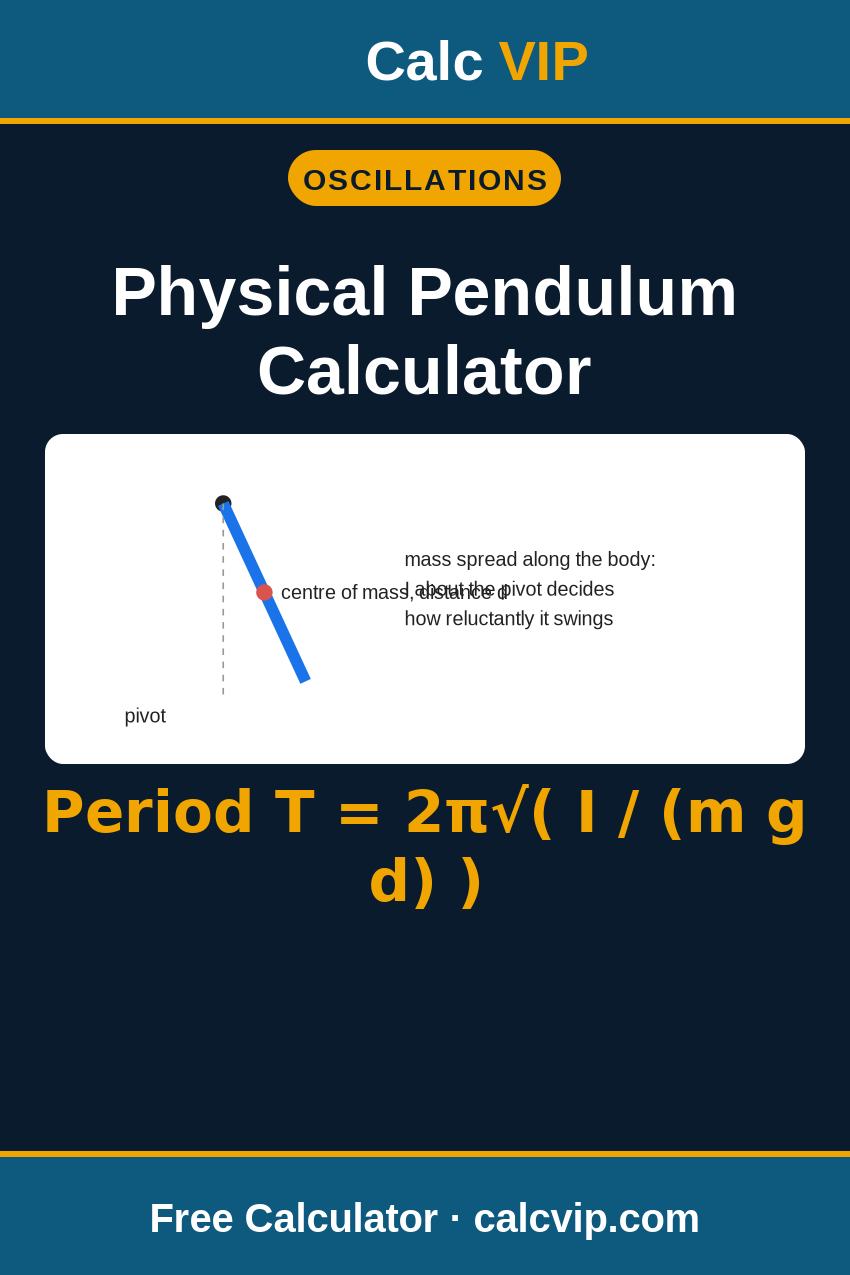
Real objects swing a little faster than a simple pendulum of their full length, because their mass, spread upward toward the pivot, contributes less inertia per unit of restoring torque. The rod about its end is the emblem: its period equals that of a simple pendulum only two thirds as long. That "equivalent length" idea — every physical pendulum hides a simple pendulum inside it — is the key to measuring with swinging objects, from Kater's reversible pendulum to the gravimeters that map the Earth's interior.
Formula
Period T = 2π√( I / (m g d) ) • I in kg·m², m in kg, g in m/s², d in metres (m)
The moment of inertia about the pivot usually comes from the parallel axis theorem: I = Icm + md², adding the centre-of-mass value to the transfer term. For a uniform rod about one end this gives I = (1/12)mL² + m(L/2)² = (1/3)mL² with d = L/2, and the period simplifies to T = 2π√(2L/(3g)) — note the mass cancelling entirely. Every physical pendulum also owns an equivalent simple-pendulum length, Leq = I/(md), the distance from pivot to the centre of oscillation: strike the object there and the pivot feels no kick, a fact sword-makers and bat designers have exploited for centuries under the name "sweet spot".
| Symbol | Meaning | Units |
|---|---|---|
| T | period of small oscillations | s |
| I | moment of inertia about the pivot | kg·m² |
| m | total mass of the swinging body | kg |
| d | pivot-to-centre-of-mass distance | m |
| g | gravitational field strength | m/s² |
| Leq | equivalent simple-pendulum length, I/(md) | m |
Torque against inertia: why the spread of mass matters
A swinging body is a tug of war. Gravity pulls on every particle, but the leverage differs: particles far below the pivot contribute strong restoring torque, particles near the pivot barely any. Inertia tallies the same particles with the opposite weighting — resistance grows with the square of distance from the pivot. The centre of mass distance d summarises gravity's side; the moment of inertia I summarises inertia's. Spread the same mass further from the pivot and both grow, but I grows faster (distance squared beats distance), so the period lengthens. Concentrate the mass at the bottom — a heavy bob on a light rod — and the system approaches the simple pendulum, the fastest-swinging configuration for a given overall length... or rather, the reference against which spread-out bodies run slow per unit length yet fast per unit of their own full length, as the rod's two-thirds rule shows.
The small-angle bargain applies here too. The restoring torque is really −mgd sin θ, and the formula replaces sin θ with θ. At a 10° swing amplitude the error is about 0.1%; at 30° it approaches 2%; a physical pendulum swung wide, like a playground swing pumped high, visibly dawdles at the extremes. Precision timing — Kater's pendulum measuring g to parts per million — works at a few degrees of amplitude and corrects even for that.
There is a pivot position that minimises the period. Write I = m(kg² + d²) with kg the radius of gyration about the centre of mass; then T² ∝ (kg² + d²)/d, which is smallest when d = kg. Pivot a metre rod at 0.289 m from its centre (kg = L/√12) and it ticks in about 1.52 s — faster than the same rod about its end (1.64 s) despite the shorter d, because the inertia falls faster than the torque. This minimum is the working principle behind the reversible pendulum's elegance.
How to use
- For a uniform rod about one end, use the preset: it fills I = (1/3)mL² and d = L/2 for you.
- For any other body, enter I about the pivot (via Icm + md² if needed), the mass m, and the pivot-to-centre-of-mass distance d.
- Click to get the small-swing period in seconds.
- Cross-check with the equivalent length: a simple pendulum of length I/(md) must return the same T — the Pendulum Length Solver runs that check in reverse.
Worked examples
Example 1 — the metre rod about its end. Rod L = 1 m, m = 2 kg, pivoted about one end:
I = (1/3)mL² = 0.67 kg·m², d = 0.5 m. T = 2π√(0.67 / (2 × 9.81 × 0.5)) = 2π√(0.0680) = 1.64 s — noticeably quicker than the 2.01 s of a simple pendulum a metre long.
Example 2 — the half-metre rod. L = 0.5 m about its end: T = 2π√(2L/(3g)) = 2π√(1/29.43) = 1.16 s. Halving the rod does not halve the period — the square root sees to that (1.64/√2 ≈ 1.16).
Example 3 — a ring about its rim. A hoop of radius 0.3 m hung on a peg through its rim: I = 2mR² (parallel axis on Icm = mR²), d = R. T = 2π√(2R/g) = 2π√(0.6/9.81) = 1.55 s — the mass cancels again, and the hoop matches a simple pendulum of length 2R = 0.6 m.
Example 4 — a disc about its rim. A disc of radius 0.2 m pivoted at its edge: I = ½mR² + mR² = 1.5mR², d = R. T = 2π√(1.5R/g) = 2π√(0.3/9.81) = 1.10 s. The disc's centrally concentrated mass makes it the fastest of these three shapes at similar size.
Example 5 — a hanging sign. A uniform signboard 0.6 m tall hung from its top edge behaves like the rod: T = 2π√(2 × 0.6/(3 × 9.81)) = 1.27 s. Gusts of wind excite it near this period — sign designers check it against the local gust spectrum.
Example 6 — the two-metre rod. L = 2 m about its end: T = 2π√(4/29.43)... precisely, 2π√(2L/(3g)) = 2π√(0.1359) = 2.32 s, against 2.84 s for a simple pendulum of the full 2 m. The two-thirds rule scales: the rod always matches a simple pendulum of ⅔ its length, here 1.33 m.
Physical pendulums in real life
Kater's pendulum and the measurement of g. A reversible bar with two knife-edge pivots, adjusted until the period is identical about both: then the pivot separation equals Leq and g follows from T and a length measurement alone. For a century this was the most accurate way to measure gravity, and it is pure physical-pendulum theory.
Sports equipment. A bat's or racket's swing weight is its moment of inertia about the hands' pivot; its natural period against gravity governs how it feels through the swing. Manufacturers tune I by redistributing mass — moving it outward slows the swing, inward quickens it.
Playground swings. Child plus swing seat is a compound pendulum whose pivot is the top bar and whose d sits near the child's hips. Pumping works by moving the centre of mass — raising d's effectiveness at the right phase — a physical pendulum being re-tuned in real time.
Seismometers and gravimeters. A horizontal boom on a hinge is a physical pendulum whose very long period (achieved with d nearly balanced) makes it exquisitely sensitive to ground tilt and acceleration — the ancestor of the instruments that record earthquakes.
Clock pendulums. Real clock pendulums are rods with lenticular bobs — physical pendulums whose rating nut adjusts d (and hence Leq) to trim the rate. Temperature-compensating grids of brass and steel rods keep d fixed as the metal expands.
Ship stability. A rolling ship is a giant physical pendulum whose period, set by its radius of gyration and metacentric height, sailors feel in their legs: too short a period means a stiff, jerky roll; too long, a wallowing, dangerous one.
The centre of oscillation and the sweet spot
Every physical pendulum conceals a special point. Strike the body at the centre of oscillation — the point at distance Leq = I/(md) from the pivot — and the pivot experiences no reaction jolt at all; strike anywhere else and the pivot is kicked. Batsmen call the corresponding point on a bat the sweet spot: ball meets bat there and the hands feel no sting, because the pivot (the hands) sits at the conjugate point. Swordsmiths placed the centre of percussion just so centuries before the formula existed. The conjugacy is symmetric and deep: pivot and centre of oscillation can swap roles — hang the body from its centre of oscillation and the old pivot becomes the new centre, with the same period. Kater's pendulum is nothing but this symmetry, instrumented.
For the metre rod, Leq = ⅔ m from the pivot — two thirds down the rod is where its simple-pendulum twin concentrates all the mass. For the ring it is the bottom of the hoop (2R from the peg, straight through the centre); for the disc, 1.5R. Once you see swinging objects through Leq, the zoo of shapes collapses into one number each.
The conjugacy has a laboratory dividend: because pivot and centre of oscillation are interchangeable, a body timed from two different pivots yields two equations in the two unknowns I and d — letting experimenters measure a moment of inertia without ever knowing where the centre of mass is. It is the same trick, inverted, by which Kater extracted g without knowing his bar's internal mass distribution at all, however irregular it happened to be in practice.
The swinging leg: a physical pendulum you carry everywhere
Your leg, swinging freely from the hip, is a physical pendulum — roughly a tapered rod about 0.9 m long. Modelled crudely as a uniform rod it would tick at T = 2π√(2 × 0.9/(3 × 9.81)) ≈ 1.55 s, taking about 0.78 s for the forward swing that is one step. Real legs beat this estimate comfortably, because their mass is concentrated toward the hip — the heavy thigh near the pivot, the light foot far away — which trims I relative to mgd and quickens the swing. That is not an accident of anatomy but an economy: the leg's mass distribution is close to the one that minimises the energy cost of swinging it at your natural cadence.
The consequences ripple outward. Comfortable walking speed is largely the speed at which steps fall at the leg's natural half-period, letting gravity do the swinging for free; hurry beyond it and muscles must drive the leg faster than it wants to go, which is one reason rushed walking tires so disproportionately. Prosthetic legs are tuned by exactly this page's arithmetic — match the prosthesis's I and d to the sound leg's, and the gait symmetrises; mismatch them and the wearer fights a pendulum that disagrees with their other side forty times a minute. Even animal locomotion scales by it: a horse's long, slender leg and an elephant's columnar one are physical pendulums whose periods set the animals' preferred walking rhythms.
Quick reference: uniform rod about one end
| Rod length L | Period T | Equivalent simple length |
|---|---|---|
| 0.25 m | 0.82 s | 0.167 m |
| 0.50 m | 1.16 s | 0.333 m |
| 0.75 m | 1.42 s | 0.500 m |
| 1.00 m | 1.64 s | 0.667 m |
| 1.50 m | 2.01 s | 1.000 m |
| 2.00 m | 2.32 s | 1.333 m |
The middle column is just the simple-pendulum period of the right-hand column — verify any row with T = 2π√(Leq/g) and the physical pendulum's mystery dissolves into the school formula.
Common mistakes
- Using I about the centre of mass. The formula wants I about the pivot. Forgetting the +md² transfer term understates I — for the rod it would give (1/12)mL² instead of (1/3)mL², and a period short by a factor of 2.
- Measuring d to the wrong point. d runs from the pivot to the centre of mass, not to the far end and not to the geometric centre of a non-uniform body. A loaded bat's d is not at its midpoint.
- Expecting mass to matter for the rod. In the rod preset m cancels; doubling the rod's mass changes nothing. Mass matters only when it changes the shape of the distribution.
- Swinging too wide. The formula is the small-angle limit. Beyond ~20° the measured period creeps above the prediction — an amplitude effect, not a calculation error.
- Treating a chain or rope as rigid. A flexible hanger stores the mass wherever it hangs but adds its own distributed I and can flex; the rigid-body formula then only approximates the true motion.
FAQ
How is this different from a simple pendulum?
A simple pendulum assumes all the mass sits at one point (the bob). A physical pendulum spreads the mass out, which is why the moment of inertia I appears in the formula.
Does the mass change the rod's period?
For the rod preset, no: m appears in both I and the denominator mgd, so it cancels. Only the length (and g) matter.
What is the "centre of oscillation"?
It is the length Leq = I/(md) of the simple pendulum with the same period — about ⅔ of the rod's length for a rod about its end.
How do I find I for an awkward shape?
Look up Icm for the nearest standard shape and add md²; or measure it — hang the object as a pendulum, time it, and run this formula backwards: I = mgdT²/(4π²).
Why does the rod beat a same-length simple pendulum?
Its mass is spread upward, closer to the pivot, where it contributes little inertia; the equivalent length is only ⅔L, so the period is √(⅔) ≈ 0.82 of the simple pendulum's.
Does the pivot have to be at the end?
No — any pivot works with its own I and d. Pivoting a rod at its centre gives d = 0 and no oscillation at all: the formula's infinite period is the correct obituary.
What is Kater's pendulum?
A reversible physical pendulum with two pivots adjusted to give equal periods; the pivot separation then equals Leq, yielding g from a period and a length — historically the most precise route to g.
How accurate is the small-angle formula?
Within about 0.1% for swings under 10°, about 2% at 30°. Precision work swings small or applies the same amplitude correction used for simple pendulums.
Can a physical pendulum measure g at a new location?
Yes — that is its classic job. With I, m and d known from geometry, g = 4π²I/(mdT²) follows from a single timing.
Why do bats and rackets quote "swing weight"?
Swing weight is I about the grip pivot in commercial dress. It predicts the pendulum feel of the implement — this calculator's I, marketed.