 Calc
Pendulum Planet Calculator – Period on Moon, Mars & Jupiter
 Created by James Carter · Physics Writer · Forces & Motion · Last updated: November 2026
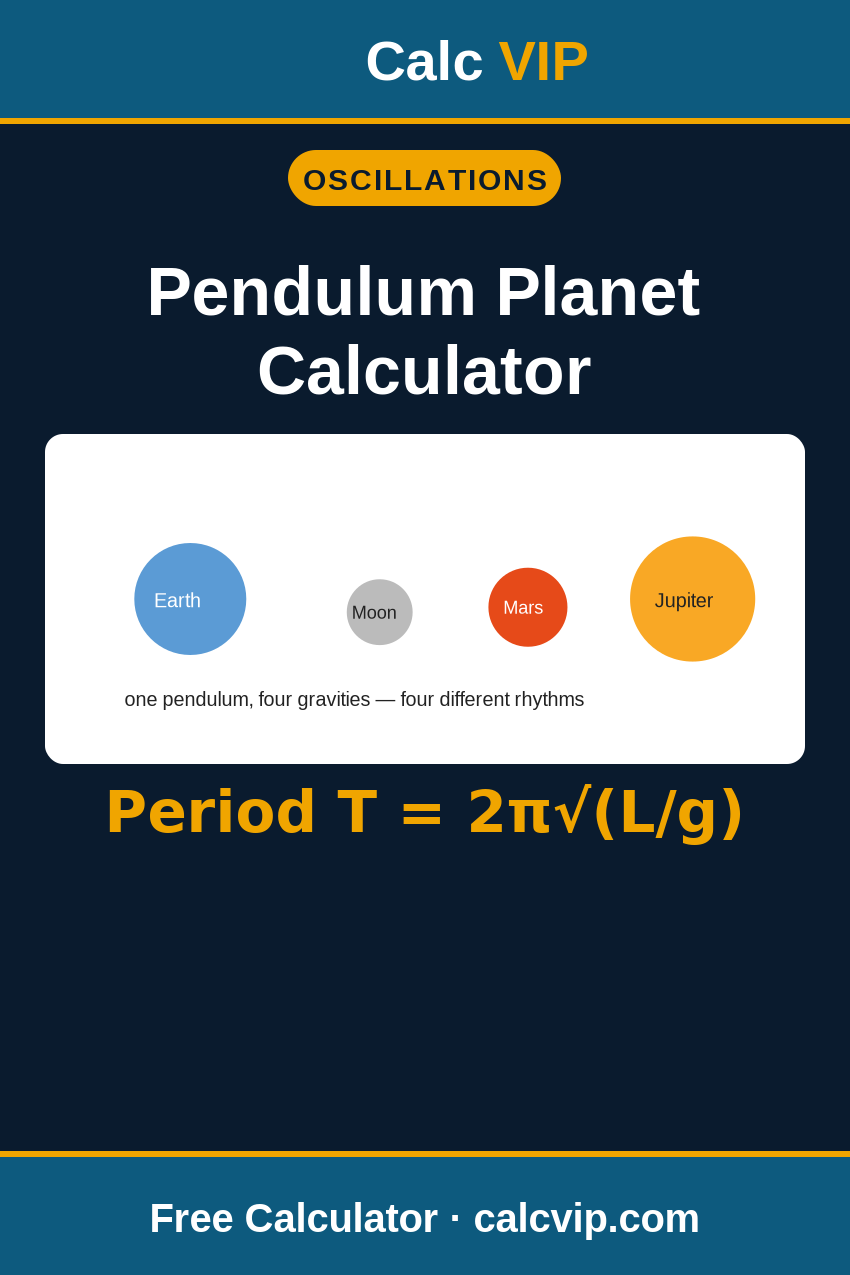
Use this free Pendulum Planet Calculator to see how the same pendulum would swing on other worlds. Pick a planet — Earth, Moon, Mars or Jupiter — and the period changes because each world has a different surface gravity.
A pendulum is a gravity meter disguised as a toy. Its period, T = 2π√(L/g), contains exactly one property of its location — g — so carrying the same pendulum from world to world turns it into a comparative probe of entire planets. This calculator performs that thought experiment honestly: same length, same bob, same small swing; only the planet changes. The results are quietly astonishing. The stately two-second tick of a metre pendulum on Earth becomes a dreamy five-second sway on the Moon and a brisk one-and-a-quarter seconds on Jupiter.
Surface gravity varies because worlds differ in both mass and size: g = GM/R². The Moon has about 1/81 of Earth's mass squeezed into about 1/4 of its radius, landing at roughly one sixth of Earth's g. Jupiter packs 318 Earth masses into 11 Earth radii and still only reaches about 2.5 times Earth's surface gravity — its bulk works against it. Mars, smaller and lighter on both counts, settles near 0.38 g. Each period this calculator returns is those two planetary numbers, mass and radius, speaking through a swinging string.
The dependence runs the other way for working scientists: time a pendulum and you have measured g, and mapping g across a world maps its interior. Pendulum surveys traced ore bodies and oil domes in the 20th century; orbiting pendulum-equivalents — tracked satellites — now map the gravity fields of the Moon and Mars from above. The humble swing remains one of physics' most informative motions, on every world it can be swung.
Formula
Period T = 2π√(L/g) • frequency f = 1/T • with g the surface gravity of the chosen world; L in metres, T in seconds
Only g changes between worlds, so periods scale with a simple ratio: Tworld = TEarth × √(gEarth/gworld). The Moon's ratio is √(9.81/1.62) = 2.46 — every pendulum there takes 2.46 times longer per swing, whatever its length. Jupiter's is √(9.81/24.79) = 0.63. The g values themselves come from g = GM/R²: double a planet's mass at fixed size and g doubles; double its radius at fixed mass and g quarters. Gas giants complicate "surface" — their g is quoted at the 1-bar pressure level, the closest thing Jupiter has to a surface to stand a pendulum on.
| Symbol | Meaning | Units |
|---|---|---|
| T | period of the pendulum on the chosen world | s |
| L | pendulum length (pivot to bob centre) | m |
| g | surface gravity of the world | m/s² |
| f | frequency, f = 1/T | Hz |
| G, M, R | gravitational constant, planet mass, planet radius (g = GM/R²) | SI |
Why gravity sets the tempo
A pendulum's restoring force is gravity itself, pulling the bob back toward the bottom of its arc. Stronger gravity hauls it back harder, accelerating it through a shorter period; weaker gravity lets it linger. The bob's own mass cancels — it appears in both the inertia and the weight — which is why the formula carries L and g alone. There is no equivalent cancellation for the planet: its mass and radius survive inside g, and the period becomes a remote measurement of them. A swing timed on the Moon's surface in 1969 would, by itself, have confirmed the Moon's surface gravity to a percent.
Notice what does not change between worlds: the geometry. The bob still traces the same arc, the small-angle rule still applies (the approximation depends on the swing angle, not on g), and the period still refuses to depend on amplitude for modest swings. Physics is the same everywhere; only the local value of g — one measured constant per world — retunes the instrument. That universality is exactly why pendulum comparisons are meaningful: the differences in the table below are pure planetary data, uncontaminated by any change in the apparatus.
One Earth-bound subtlety travels with the formula: g itself varies slightly over any planet — with latitude (rotation flattens the world and flings the equator outward), with altitude, and with the density of rock beneath. Earth's g runs from about 9.78 m/s² at the equator to 9.83 at the poles, a 0.5% spread that precision pendulum clocks historically detected when carried between observatories — the first hint that the Earth bulges. The calculator's per-world values are the standard averages; treat the third decimal as geography-dependent.
How to use
- Enter the pendulum length L in metres.
- Choose the world — Earth, Moon, Mars or Jupiter — to load its surface gravity.
- Click to get the period and frequency on that world.
- Compare worlds by ratio: T scales as 1/√g, so the Moon-to-Earth ratio is 2.46 for every length you try.
Worked examples
Example 1 — a metre pendulum on the Moon. L = 1 m, g = 1.62 m/s²:
T = 2π√(1 / 1.62) = 4.94 s, f = 0.20 Hz. A grandfather clock shipped to a lunar base would tick with funereal slowness unless its pendulum were shortened to about 16 cm.
Example 2 — the same pendulum at home. L = 1 m on Earth (g = 9.81): T = 2π√(1/9.81) = 2.01 s, f = 0.50 Hz — the near-seconds pendulum (half-period 1 s) that defined an era of clockmaking.
Example 3 — Mars. L = 1 m, g = 3.71 m/s²: T = 2π√(1/3.71) = 3.26 s. The Mars/Earth period ratio is √(9.81/3.71) = 1.63 — a pendulum clock on Mars loses about 9 hours a day, as the next example quantifies.
Example 4 — Jupiter. L = 1 m, g = 24.79 m/s²: T = 2π√(1/24.79) = 1.26 s, f = 0.79 Hz. Even 318 Earth masses only quicken the tick by a factor of 0.63 — Jupiter's enormous radius dilutes its surface pull.
Example 5 — a short pendulum on the Moon. L = 0.25 m (Earth's one-second length) on the Moon: T = 2π√(0.25/1.62) = 2.47 s. The quarter-metre pendulum that ticks seconds in London takes nearly two and a half seconds per swing in lunar gravity.
Example 6 — an Earth clock stranded on Mars. A clock regulated on Earth has L = 0.994 m (T = 2.00 s). On Mars: T = 2π√(0.994/3.71) = 3.25 s per swing, so each nominal 2-second tick consumes 3.25 real seconds. In one Earth day the clock advances only 86,400 × 2/3.25 ≈ 53,100 s — it reads about 14.8 hours when a full day has passed. Early Mars mission planners genuinely worried about clock rates; the sols of Mars are timed by electronics now.
Pendulums across the solar system in real life
Apollo gravimetry. Astronaut-deployed gravimeters and tracked lunar orbiters refined the Moon's g map, revealing mascons — mass concentrations under the lunar seas — that still perturb spacecraft orbits. The pendulum principle, timing under gravity, underlies every one of those measurements.
Designing for Mars. Any mechanism relying on gravity-fed timing, swinging or settling behaves 1.63 times slower on Mars. Engineers simulate it by tilting rigs and off-loading weight, because no Earth laboratory can dial g down — the calculator's ratios are the design brief.
Gas-giant weather. Nothing can stand on Jupiter, but a pendulum's period there is still measurable physics: a probe descending through the Jovian atmosphere swings its instruments at rates set by the local g, which varies with depth as the mass below grows.
Timekeeping history. The seconds pendulum's length was once proposed as the definition of the metre — until surveys showed g varies with latitude, making the "standard" pendulum longer in Paris than at the equator. That failure taught metrology that gravity is local, a lesson this page demonstrates per planet.
Playground physics on other worlds. A swing on the Moon with 2 m chains would period at 2π√(2/1.62) ≈ 6.98 s — a majestic, slow ride; on Jupiter the same swing would hustle at 1.78 s. Children's play, retuned by planetary mass.
Exoplanet inference. For exoplanets we measure mass (from stellar wobble) and radius (from transits) and compute g = GM/R² — the same g this calculator consumes. A "1.4 g super-Earth" headline is this formula, run on a world no pendulum will ever visit.
What if there is no gravity at all?
Take the pendulum to a freely falling space station and the formula gives its strangest correct answer: with effective g = 0, T = 2π√(L/0) → infinity. The pendulum does not swing slowly; it does not swing. Nudge the bob and it simply drifts in a straight line (or circles the pivot if you swing it fast enough for the string's tension to act as a centripetal force — a different motion entirely, the conical pendulum, whose period depends on rotation speed rather than gravity). Astronauts confirm the intuition: aboard the ISS, pendulums are dead. It is the cleanest demonstration that the pendulum is not a clockwork mechanism but a gravity instrument — remove the field and the instrument reads infinity.
Partial gravity returns partial behaviour in exact proportion: on a world with g = 2.45 m/s² (a quarter of Earth's), every period doubles. Mission designers for the Moon (0.17 g) and Mars (0.38 g) use the √ scaling constantly, because mechanisms tested on Earth — swinging booms, sloshing fuel, settling dust — all retime themselves by 1/√g on arrival.
Einstein's equivalence principle adds a final twist: acceleration impersonates gravity perfectly. A pendulum in a rocket accelerating at 9.81 m/s² through empty space ticks at exactly its Earth period, and one in a braking train leans and retimes as if the world had tilted. The calculator cannot tell a planet from a rocket — feed it the effective g and it answers for both, which is precisely the point Einstein built a theory on. It is also why astronauts training in accelerating aircraft can rehearse lunar pendulum behaviour for a few seconds without ever leaving the sky.
The first world tour of a pendulum
Long before spacecraft, the pendulum was humanity's instrument for weighing the Earth piece by piece. In 1672 the astronomer Jean Richer carried a regulated clock from Paris to Cayenne, near the equator, and found it losing over two minutes a day: the pendulum swung slower because g is weaker at the equator, where the spinning Earth bulges outward and centrifugal effect lifts against gravity. Newton seized on the result — it confirmed his prediction that the Earth is an oblate spheroid, fatter at the equator. Through the 18th and 19th centuries, pendulum expeditions crisscrossed the oceans, timing swings on remote islands to map the planet's figure and interior; the data underpin geodesy to this day.
The modern descendant of those expeditions is the satellite gravity mission: pairs of spacecraft chasing each other around the Earth, their separation oscillating as they pass over mass anomalies — pendulums the size of orbits. The lesson Richer's clock taught scales directly to this page: wherever g changes, every pendulum retimes itself, and the retiming is data. The difference between worlds in the table is the same phenomenon Richer found between two cities, written at planetary scale.
Standing on a spinning world: effective g
The g a pendulum feels is not quite the g of GM/R². A rotating planet flings its equator outward, subtracting a centrifugal term that reaches 0.034 m/s² at Earth's equator — about 0.35% of g — and zero at the poles. It is why Earth's effective g spans 9.78 to 9.83 m/s², and why the same pendulum ticks measurably faster in Reykjavik than in Quito. Fast rotators exaggerate the effect: Jupiter's 10-hour day subtracts roughly 2 m/s² at its equator, so a Jovian pendulum's period depends noticeably on its latitude — a refinement the calculator folds into its single standard value.
Tides add a whisper on top: the Moon's pull modulates Earth's local g by about one part in ten million through the day, far below stopwatch notice but well within the reach of modern gravimeters, which log the solid Earth rising and falling under the same force that moves the oceans. The pendulum formula absorbs all of it silently — feed it the local effective g and it returns the local truth.
Quick reference: a 1 m pendulum on eight worlds
| World | g (m/s²) | Period T | Frequency f |
|---|---|---|---|
| Mercury | 3.70 | 3.27 s | 0.31 Hz |
| Venus | 8.87 | 2.11 s | 0.47 Hz |
| Earth | 9.81 | 2.01 s | 0.50 Hz |
| Moon | 1.62 | 4.94 s | 0.20 Hz |
| Mars | 3.71 | 3.26 s | 0.31 Hz |
| Jupiter | 24.79 | 1.26 s | 0.79 Hz |
| Saturn | 10.44 | 1.94 s | 0.51 Hz |
| Neptune | 11.15 | 1.88 s | 0.53 Hz |
Two surprises hide in the table. Venus, nearly Earth's twin, keeps nearly Earth's tick (2.11 s) — its g is only 10% lower. And Mercury and Mars, utterly different worlds, agree to a hundredth of a second (3.27 vs 3.26 s) because their surface gravities coincide almost exactly — a pendulum cannot tell them apart.
Common mistakes
- Scaling period linearly with g. T follows 1/√g: a quarter of Earth's gravity doubles the period, it does not quadruple it.
- Assuming bigger planet means bigger g. Saturn is 95 Earth masses yet its surface gravity is barely above Earth's (10.44) — radius dilutes mass. Always use g, not size, in the formula.
- Using weightlessness as "low g". Orbit is free fall: effective g for a pendulum is zero and the period is infinite, not merely long. The calculator's worlds are surfaces, where standing still is possible.
- Expecting the bob's mass to matter. It cancels on every world. A steel bob and a cork bob of the same length swing together on the Moon exactly as Galileo promised on Earth.
- Taking g as exact. Each world's g varies with location (equator vs poles, highlands vs basins) by tenths of a percent or more; the table values are standard averages for comparison, not local survey data.
FAQ
Why does the pendulum slow down on the Moon?
The Moon's gravity is about one sixth of Earth's, so the restoring pull on the bob is weaker and each swing takes longer — T grows as 1/√g.
Would a pendulum clock work on Mars?
It would run slow: with g = 3.71 m/s² the period is about 1.63 times longer than on Earth, so the clock would lose time unless its length were shortened.
What happens in free fall (g = 0)?
The period becomes infinite — with no gravity there is no restoring force and the pendulum does not swing at all.
Which planet gives the fastest tick?
Of the worlds tabulated, Jupiter: 1.26 s for a metre pendulum. Neptune and Saturn follow; the rocky worlds are all slower than Earth except Venus, which nearly matches it.
How long must a Moon pendulum be to tick seconds (T = 2 s)?
L = gT²/(4π²) = 1.62 × 4/39.48 ≈ 0.164 m — about 16 cm, one sixth of the Earth length, mirroring the gravity ratio.
Does the pendulum's period depend on the bob's material?
No. Mass and composition cancel; only L and g remain. (Air buoyancy and drag differ by material in an atmosphere, but those are small corrections, and most of these worlds offer little air to argue with.)
Why is Jupiter's g "only" 24.79 despite its huge mass?
Because g = GM/R² and Jupiter's radius is 11 times Earth's: 318 times the mass divided by 121 times the radius-squared gives about 2.5 times Earth's g.
Could a pendulum measure g on an exoplanet?
In principle yes — land, swing, time, invert the formula. In practice we infer exoplanet g from mass and radius measured astronomically, no landing required.
What g should I use for a pendulum on a mountain on Earth?
Slightly less than 9.81: g falls by about 0.03% per kilometre of altitude, and local rock density shifts it further. Precision work measures the local value rather than assuming the standard.
Would a Foucault pendulum work on the Moon?
Yes — its swing plane would rotate with the Moon's rotation, completing a cycle in one lunar day (about 27.3 Earth days at the pole): the same physics, on the Moon's slower clock.