 Calc
Spring–Mass Period Calculator – T = 2π√(m/k) Oscillation Time
 Created by James Carter · Physics Writer · Forces & Motion · Last updated: November 2026
Use this free Spring–Mass Period Calculator to find how long one full oscillation of a mass on a spring takes, using T = 2π√(m/k). Enter the mass and the spring constant to get the period and frequency.
Hang a mass on a spring, pull it down and let go, and it bounces with a metronome's regularity. The time for one complete bounce — down, up, and back to the start — is the period T, and this calculator finds it from the only two things that control it: the mass m doing the bouncing and the spring constant k measuring the spring's stiffness. Nothing else matters. Not how far you pulled it, not where on Earth you are, not whether the spring hangs vertically or slides horizontally. Two numbers in, the rhythm out.
The formula's shape rewards a moment's thought. The period grows with the square root of the mass: quadruple the load and the bounce takes twice as long, not four times. It shrinks with the square root of the stiffness: a spring four times stiffer halves the period. Square roots are nature's compromises — they are why a truck's suspension and a watch's balance spring can share one equation while living at opposite ends of the timescale, and why estimating an unknown period is forgiving: even a rough guess at m or k lands T within a whisker.
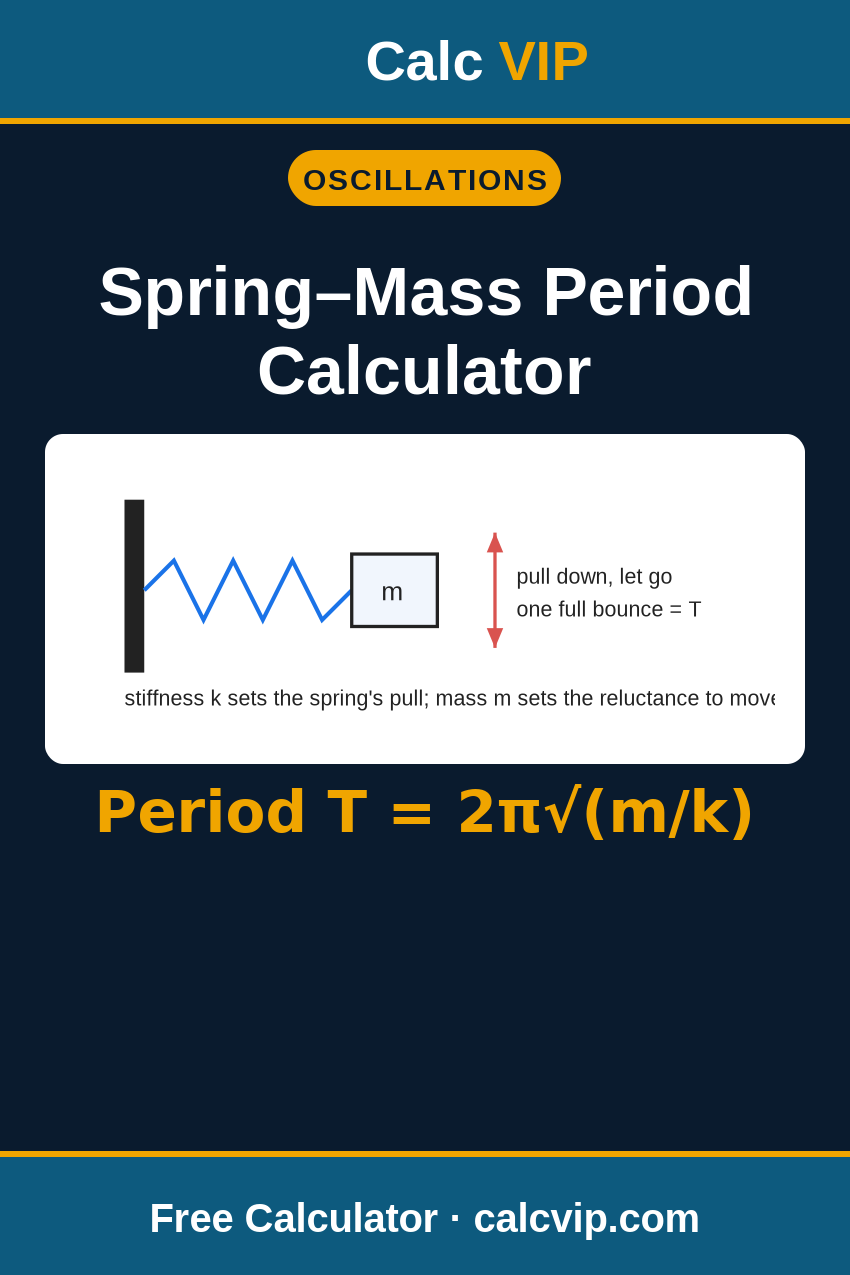
This is also the friendliest oscillator in physics because its period ignores amplitude. Pull the mass 2 cm or 20 cm and, for an ideal spring, the bounce takes exactly the same time — the larger swing simply travels faster to compensate. That property, called isochronism, is what makes spring oscillators useful as timekeepers and vibration isolators, and it is the benchmark against which every other oscillator on this site — pendulums, physical pendulums, LC circuits — is compared.
Formula
Period T = 2π√(m/k) • frequency f = 1/T = (1/2π)√(k/m) • T in seconds (s), m in kilograms (kg), k in newtons per metre (N/m), f in hertz (Hz)
The same relation rearranges to solve for whichever quantity is missing: k = 4π²m/T² finds the stiffness from a timed bounce (the job of the Spring Constant Solver), and m = kT²/(4π²) finds an unknown mass from a known spring — a trick sensitive enough to "weigh" objects by timing them. The angular frequency hiding inside the formula is ω = √(k/m) = 2π/T, measured in radians per second; it is the natural language of the SHM pages on this site. A useful memory anchor: with m and k in ordinary lab sizes the product under the root is small, so most bench-top spring oscillators have periods between a tenth of a second and a few seconds.
| Symbol | Meaning | Units |
|---|---|---|
| T | period — time for one complete oscillation | s |
| f | frequency — oscillations per second, f = 1/T | Hz |
| m | mass attached to the spring | kg |
| k | spring constant — force per unit extension | N/m |
| ω | angular frequency, ω = √(k/m) = 2πf | rad/s |
Why the period cannot depend on amplitude
A spring's restoring force is proportional to displacement: stretch it twice as far and it pulls back twice as hard (Hooke's law, F = −kx). That single proportionality shapes everything. Double the amplitude and the mass has twice as far to travel — but at every point of the journey the force, hence the acceleration, is also twice as large, so it travels the extra distance in exactly the same time. The two effects cancel perfectly, leaving T = 2π√(m/k) with no amplitude term. Physicists call motion with this property simple harmonic motion, and the spring–mass system is its purest example.
The cancellation is also a warning label. It holds only while the spring obeys Hooke's law. Stretch a real spring far enough and its coils begin to straighten permanently, the force law bends, and the period starts to drift with amplitude. Stay within the spring's comfortable range — the range where extensions are proportional to loads — and the formula is effectively exact. It is the same bargain a pendulum makes, except the pendulum's version (small swings only) is an approximation, while the ideal spring's is exact.
One more subtlety hides in m: the spring itself has mass. A real spring's coils move too — the end coil travels the full distance, the fixed end not at all — and the standard correction adds one third of the spring's own mass to the load: meff = m + mspring/3. For a heavy slinky on a light load this can shift the period by several percent, and precision labs include it automatically.
Watch the energy while it bounces and the period makes intuitive sense. At the extremes the mass is momentarily still and all the energy is stored in the stretched spring; at the centre the spring is at its natural length and all the energy is kinetic. The total never changes (in the ideal case) — it simply trades back and forth twice per cycle. A heavier mass trades the same energy more slowly because its inertia resists every change of speed; a stiffer spring trades it faster because its stronger force hurries the mass through each exchange. The SHM Energy Calculator on this site dissects that trade position by position.
How to use
- Enter the mass attached to the spring, in kilograms (500 g is 0.5 kg).
- Enter the spring constant k in newtons per metre — if you do not know it, find it with the Spring Constant Solver by timing a bounce, or from the static stretch: k = mg/x for a hanging load.
- Click "Calculate Period" to get the period in seconds and the frequency in hertz.
- Sanity-check the result: a period far outside 0.05–10 s for a bench spring usually means grams were entered as kilograms, the commonest slip with this formula.
Worked examples
Example 1 — the standard lab spring. A mass of 0.5 kg on a spring with k = 50 N/m:
T = 2π√(0.5 / 50) = 2π√(0.01) = 0.63 s, and f = 1 / 0.63 ≈ 1.59 Hz — the mass bounces about 1.6 times every second.
Example 2 — a car suspension corner. One corner of a car rests about 300 kg on a coil spring of k = 20,000 N/m: T = 2π√(300 / 20,000) = 2π√(0.015) = 0.77 s, so f ≈ 1.30 Hz. Suspension engineers aim almost exactly here: much faster and the ride feels harsh, much slower and the car wallows like a boat.
Example 3 — a light mass on a stiff spring. m = 0.25 kg, k = 100 N/m: T = 2π√(0.0025) = 2π × 0.05 = 0.31 s, f ≈ 3.18 Hz. Ten bounces take barely three seconds — time 20 of them and divide, or your stopwatch reaction time swamps the measurement.
Example 4 — a person on a bungee cord. Treat the stretched cord as a spring of k ≈ 100 N/m carrying 70 kg: T = 2π√(70 / 100) = 2π√(0.7) = 5.26 s. That slow, dreamy five-second bobbing at the bottom of a bungee jump is this formula with a very soft spring and a large mass.
Example 5 — quadrupling the mass. Raise Example 1's load to 2 kg on the same 50 N/m spring: T = 2π√(2 / 50) = 2π√(0.04) = 1.26 s — exactly double the original 0.63 s, the square-root law in action: four times the mass, twice the period.
Example 6 — a fast, small oscillator. A 0.05 kg mass on a stiff k = 200 N/m spring: T = 2π√(0.00025) = 0.10 s, f ≈ 10.07 Hz. At ten bounces a second you are leaving stopwatch territory — this is the regime of vibration sensors and phone buzz motors.
Spring–mass periods in real life
Car suspensions. The 1–1.5 Hz bounce frequency of a car body is chosen deliberately: it sits below the frequencies of most road roughness the tyres transmit, yet above the ~0.2 Hz that provokes motion sickness. Every spring rate in the industry is picked with T = 2π√(m/k) open on the desk.
Vibration isolation. To protect a sensitive instrument from floor vibration, mount it on soft springs whose natural frequency is far below the disturbance. The mount then cannot follow the fast shaking, and the instrument floats — the same principle isolates electron microscopes, record players and entire recording studios.
Weighing things in space. Aboard the space station there is no weight, but there is still mass — and astronauts measure theirs by sitting in a spring chair and timing the bounce. With k known, m = kT²/(4π²) gives body mass to a fraction of a kilogram, no gravity required.
Watch balance springs. A mechanical watch's balance wheel on its hairspring is a rotational cousin of this oscillator, beating at 3–5 Hz — up to 36,000 ticks an hour — with the period set by the wheel's inertia and the spring's stiffness exactly as here.
Door closers and pogo sticks. The rhythmic return of a sprung door and the bounce cadence of a pogo stick are both tuned by matching k to the expected mass; a stick sprung for a child bottoms out under an adult because the period and travel were designed around a smaller m.
Seismometers. A seismometer is a mass on a very soft spring with a period of many seconds. When an earthquake shakes the frame, the sluggish mass stays nearly still while the ground moves around it — the relative motion is the earthquake record.
Vertical springs: where does the mass rest?
Hang the mass and gravity stretches the spring to a new equilibrium, lower than the unstretched position by x0 = mg/k. For Example 1's numbers that sag is 0.5 × 9.81 ÷ 50 = 0.098 m — about 10 cm. Students often expect this to change the period; it does not. Around the new equilibrium the extra stretch from gravity is exactly cancelled by the extra spring force, and the oscillation about that point obeys the same T = 2π√(m/k). The sag is still useful: measuring it is the easiest way to find an unknown k, because k = mg/x0 needs only a ruler and a known mass.
Combine the two measurements and the spring becomes a gravimeter. Time the bounce to get k/m from the period, measure the sag to get mg/k, and the two together pin down g itself — a classic school determination of gravitational acceleration that needs no free-fall apparatus and no fast timing, just patience and a metre rule.
The reference circle: where the cosine and the 2π come from
Why does 2π appear in a formula about a bouncing mass? Because oscillation is rotation in disguise. Imagine a point travelling steadily around a circle of radius A at angular speed ω. Watch only its shadow on a diameter — its projection — and the shadow swings back and forth in perfect simple harmonic motion, fastest through the middle, lingering at the extremes, exactly like the mass on the spring. One full trip around the circle (2π radians) is one full bounce, so the period is T = 2π/ω, and matching the shadow's acceleration to the spring's −(k/m)x forces ω = √(k/m). The 2π is simply the angle of a complete turn, arriving in the formula because every oscillation is secretly a cycle.
This picture is more than a mnemonic. It explains the phase language used across this site: two oscillators "in phase" are two points at the same angle on the circle; a quarter-period delay is a 90° lag; the SHM Displacement Calculator's φ is nothing but the starting angle. It also predicts the velocity profile without any calculus: the shadow's speed is the circle point's speed, Aω, scaled by how directly it moves along the diameter — maximum at the centre, zero at the turning points, the result the SHM Velocity Calculator is built on.
Quick reference: period for k = 100 N/m
| Mass m | Period T | Frequency f |
|---|---|---|
| 0.10 kg | 0.20 s | 5.03 Hz |
| 0.25 kg | 0.31 s | 3.18 Hz |
| 0.50 kg | 0.44 s | 2.25 Hz |
| 1.00 kg | 0.63 s | 1.59 Hz |
| 2.00 kg | 0.89 s | 1.13 Hz |
Read the table by ratios: every quadrupling of mass (0.25 → 1.00 kg) doubles the period, and every doubling of k would halve every entry — the square-root law lets you rescale the whole table in your head.
Resonance: small pushes, perfectly timed
Push a swinging mass once per period, exactly in time with its natural bounce, and even tiny pushes accumulate: the amplitude grows cycle by cycle. That is resonance, and the frequency at which it happens is the f this calculator returns. Engineers design around it in both directions — exploiting it in musical instruments and radio receivers, avoiding it in bridges, buildings and machine mounts, where a periodic force near the natural frequency can shake a structure apart. It is also why the period formula matters far beyond the lab bench: knowing T tells you precisely which disturbance frequencies a system will amplify and which it will shrug off. A mount whose natural frequency sits well below the machinery's vibration frequency isolates; one that coincides with it destroys.
Common mistakes
- Entering grams as kilograms. A 500 g mass is 0.5 kg. Skipping the conversion inflates T by √1000 ≈ 32 times — the single commonest error with this calculator.
- Expecting amplitude to matter. Pulling the mass further before release changes the speed and the energy, not the period. If your measured period grows with amplitude, the spring is being overstretched beyond Hooke's law.
- Using the spring's stretched length as an input. Length appears nowhere in the formula — only m and k. A longer spring usually has a smaller k, which is the only way length sneaks in.
- Ignoring the spring's own mass. With a heavy spring and a light load, add a third of the spring's mass to m, or the predicted period comes out too short.
- Confusing period and frequency. T is seconds per bounce; f is bounces per second. They are reciprocals — reporting 1.59 when you mean 0.63 swaps them entirely.
FAQ
Does the stretch (amplitude) change the period?
No. For an ideal spring the period depends only on m and k, not on how far the mass is pulled before release.
What happens if I quadruple the mass?
The period doubles, because T grows with √m: √(4m) = 2√m.
Does gravity change the period of a vertical spring?
No. Gravity only shifts the resting (equilibrium) position; the period is still 2π√(m/k).
How do I find k if I don't know it?
Two easy ways: hang a known mass and divide its weight by the extra stretch (k = mg/x), or time the bounce and use the Spring Constant Solver, k = 4π²m/T².
What if the spring is very light compared with the load?
Then the basic formula is fine. The spring's own mass only matters when it is a noticeable fraction of the load — add one third of it to m as a correction.
Can this formula time a bouncing ball or a bungee jumper?
Approximately, while the cord stays taut and springy. A bungee cord behaves like a soft spring during the taut part of the bounce, giving periods of several seconds; once the cord goes slack the motion is free fall, not SHM.
Why does the mass eventually stop bouncing?
Air resistance and internal friction in the spring drain a little energy each cycle — damping. The amplitude shrinks steadily, but for light damping the period stays very close to 2π√(m/k).
What period does a typical school lab spring give?
With k around 20–50 N/m and loads of 0.1–0.5 kg, periods land between about 0.3 s and 1 s — comfortable for stopwatch timing over 10–20 oscillations.
Does temperature change the period?
Slightly. Steel softens as it warms, so k falls by roughly 0.02% per degree Celsius and the period creeps up; precision clocks compensate for it, school experiments can ignore it.
Is the formula different on the Moon?
No. T = 2π√(m/k) contains no g at all — unlike a pendulum, a spring oscillator keeps the same period on any planet, which is why spring clocks work in space.