 Calc
Springs Combination Calculator – Series & Parallel Equivalent k
 Created by James Carter · Physics Writer · Forces & Motion · Last updated: November 2026
Use this free Springs Combination Calculator to find the equivalent spring constant when two springs are joined in series (end to end) or in parallel (side by side) — the two arrangements give surprisingly different stiffness.
A single spring rarely matches the job exactly. The catalogue offers 100 N/m and 200 N/m; the design wants something softer than both, or stiffer than either. Joining springs solves it — in two opposite ways. Link them end to end and the pair stretches more than either alone: the combination is softer than the softest member. Bolt them side by side so they share the load, and the pair resists harder than either: the combination is stiffer than the stiffest member. This calculator evaluates both arrangements for any pair, so the choice becomes a number rather than a guess.
The two rules are elegantly opposite. In parallel, spring constants simply add: k = k₁ + k₂. In series, the reciprocals add: 1/k = 1/k₁ + 1/k₂, giving k = k₁k₂/(k₁ + k₂). Students of electronics will recognise the pattern with a twist — series springs behave like parallel resistors, and parallel springs like series resistors. The analogy runs deeper than the formulas: in series the force is common and the extensions add; in parallel the extension is common and the forces add, just as current and voltage swap roles between resistor networks.
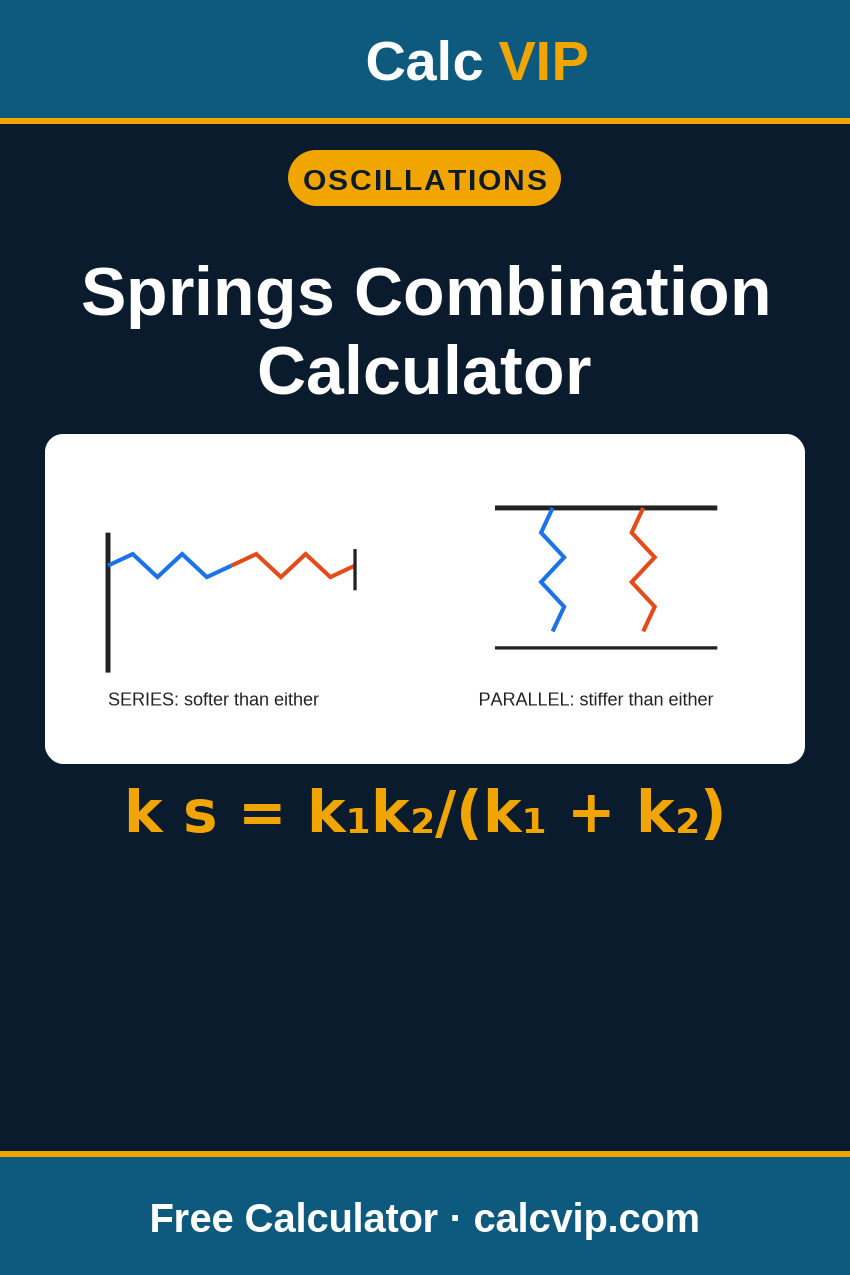
Engineers combine springs deliberately everywhere: nested valve springs in engines, doubled suspension springs, soft-series stacks that protect delicate instruments from shock. Each design is an exercise in these two rules, sometimes extended to three or more springs, sometimes mixing series and parallel groups. Master the pair, as this page does, and the networks follow by grouping.
Formula
Series 1/ks = 1/k₁ + 1/k₂ → ks = k₁k₂/(k₁ + k₂) • Parallel kp = k₁ + k₂ • k in newtons per metre (N/m)
The series formula is the "product over sum" — always smaller than the smaller spring constant, and dominated by the soft member: pair 10 N/m with 1,000 N/m and the series result is 9.9 N/m, the stiff spring contributing almost nothing but length. For n springs the rules generalise directly: series reciprocals all add (1/k = Σ1/kᵢ), parallel constants all add (k = Σkᵢ). Identical springs make memorable special cases: n in series give k/n; n in parallel give nk. Extensions follow Hooke's law per spring, xᵢ = F/kᵢ, and in series the total stretch is the sum of the individual stretches under the common force.
| Symbol | Meaning | Units |
|---|---|---|
| k₁, k₂ | the two spring constants | N/m |
| ks | effective constant, series (end to end) | N/m |
| kp | effective constant, parallel (side by side) | N/m |
| x₁, x₂ | extension of each spring | m |
Why the rules point in opposite directions
Series first. Hang a weight from two springs joined end to end: the full force passes through both — each spring feels the entire load, exactly as if it were alone. The top spring stretches by F/k₁ and the bottom by F/k₂, and the weight descends by the sum. Total extension per unit force is 1/k₁ + 1/k₂, so the pair's effective 1/k is the sum of reciprocals — and since extensions only ever add, the combination is softer than either spring. Two springs in series is really one longer spring: doubling a spring's length doubles the number of coils sharing the stretch, halving its stiffness, and the formula's k/2 for identical springs is that intuition in algebra.
Parallel is the mirror image. Two springs side by side, attached to the same plates, must extend by the same amount; the load divides between them in proportion to their stiffnesses, the stiffer spring shouldering more. Total force for a given extension is (k₁ + k₂)x, so the constants add — and the pair is stiffer than either member. Where series lengthens, parallel widens: it is the difference between a longer rope and a thicker one.
The energy view ties the pair together. In series, the soft spring stores most of the energy (Uᵢ = F²/2kᵢ under the common force — smaller k, larger share). In parallel, the stiff spring stores most (Uᵢ = ½kᵢx² under the common extension). Knowing where the energy lives predicts which spring is working hardest, which will fatigue first, and which one's failure would matter — the questions that turn a formula into a design tool.
The limiting cases sanity-check both rules. Let k₂ grow without bound (a rigid link): the series result tends to k₁ — a chain with one rigid link is just the other spring — while the parallel result grows without bound, since a rigid member in parallel carries everything. Let k₂ shrink to zero (a broken or absent spring): series collapses to zero, because a chain is only as stiff as its missing link, while parallel falls back to k₁ alone. Every formula on this page interpolates between those four obvious endpoints, which is the surest sign the algebra is honest.
How to use
- Enter the two spring constants k₁ and k₂ in N/m.
- Read both results: the series (end-to-end) and parallel (side-by-side) effective constants.
- Sanity-check with the bounds: the series answer must be below the smaller k; the parallel answer above the larger k.
- For three or more springs, combine two first, then combine the result with the next, grouping series and parallel stages separately.
Worked examples
Example 1 — 100 and 200 N/m. k₁ = 100 N/m, k₂ = 200 N/m:
Series: k = (100 × 200)/(100 + 200) = 20,000/300 = 66.67 N/m. Parallel: k = 100 + 200 = 300 N/m. The same two springs span a 4.5× stiffness range depending only on how you join them.
Example 2 — identical springs, 80 and 80. Series: (80 × 80)/160 = 40 N/m — exactly half, as the "longer spring" picture promises. Parallel: 160 N/m — exactly double.
Example 3 — 30 and 60 N/m. Series: (30 × 60)/90 = 20 N/m, softer than the 30 N/m member alone. Parallel: 90 N/m.
Example 4 — strong pair, 200 and 200. Series: 100 N/m; parallel: 400 N/m. Doubling identical springs in parallel is the standard trick for doubling a suspension's rate without redesigning the spring.
Example 5 — mismatched pair, 10 and 1,000 N/m. Series: (10 × 1,000)/1,010 = 9.90 N/m — the soft spring rules; the stiff one adds barely 1% of give. Parallel: 1,010 N/m — now the stiff spring rules. In any unequal combination, one spring is essentially the answer and the other a correction.
Example 6 — extensions and load sharing. Take Example 1's pair. In series under a 100 N load: total extension x = 100/66.67 = 1.5 m, made of x₁ = 100/100 = 1.0 m in the soft spring and x₂ = 100/200 = 0.5 m in the stiff one. In parallel stretched 1 m: total force = 300 N, split as 100 N through the soft spring and 200 N through the stiff — forces divide in proportion to k, extensions in inverse proportion. These two divisions are the whole mechanics of combined springs.
Combined springs in real life
Engine valve springs. High-performance engines nest two springs — one inside the other, both compressed between the same plates: parallel addition. The pair gives a high combined rate in a compact space, and the two springs' different natural frequencies suppress the surge that would let a single spring bounce a valve open at speed.
Vehicle suspensions. A main coil spring with a helper spring stacked on top is a series pair: soft combined rate over small bumps (the helper absorbs them), then the helper coils bind solid and the rate jumps to the main spring alone — a two-stage rate from two rules on this page.
Mattresses and sofas. Pocket springs act in parallel by the thousand — press anywhere and the local group shares the load, stiffness adding across the springs engaged. The zoned firmness of premium mattresses is parallel addition, geographically arranged.
Shock protection. Delicate instruments ship on stacks of soft springs and foam in series: every layer adds its give, the reciprocal sum sinking the effective rate until a dropped crate's deceleration stays survivable.
Spring balances and force gauges. Interchangeable spring pairs let one gauge body cover several ranges — a stiff parallel pair for kilograms, a soft single (or series pair) for grams — the combination rules as a range switch.
Trampolines and bungee assemblies. Dozens of springs in parallel around a trampoline frame add to a large total k while each spring works well inside its own limit; bungee cords bundled in parallel tune a jump's stiffness the same way, cord by cord.
Networks: mixing series and parallel
Real assemblies mix the two, and the method is patient grouping: collapse the clearest pair first, replace it by its equivalent single spring, and repeat. Suppose two 100 N/m springs sit in parallel, and that pair is stacked in series on a 50 N/m spring. The parallel pair gives 200 N/m; the series combination with 50 gives (200 × 50)/250 = 40 N/m overall. The order of operations follows the physical layout, not algebraic convenience — draw the load path, and combine along it: springs sharing the same two endpoints are parallel; springs carrying the same force in a chain are series.
One subtlety rewards attention: in a series chain the common force can over-stretch the softest link long before the combination reaches its nominal travel. The 10 N/m spring of Example 5 takes 99% of the series extension — in a real stack it would coil-bind or yield while its partner barely moved. Combination design therefore checks each member's individual extension, not just the total, which is why this page's Example 6 splits the numbers out.
Networks also appear disguised. A leaf spring is a stack of plates acting partly in parallel; a rubber mount bonded between plates behaves like many tiny springs in parallel across its area and in series through its thickness — which is why such mounts are stiff in compression (large parallel area) yet soft in shear (long series path). Once the two rules are internalised, half the elastic hardware in a machine shop resolves into one or the other arrangement, and the other half into a grouping of the two — which is to say, into this page applied twice, patiently, step by careful step, from the load path outward all the way to the final number.
Cutting a spring: the series rule run backwards
The series formula has a party trick. A spring is a chain of coils, each coil a tiny series element; cut a spring in half and each half — half the coils — is twice as stiff: khalf = 2k. Cut it into thirds and each piece is 3k. The reciprocal rule explains why: the original's compliance 1/k was the sum of its pieces' compliances, so equal pieces each carry compliance 1/(nk)... in ordinary language, stretch is shared among coils, and fewer coils means less sharing. Mechanics exploit this constantly: a too-soft spring cannot be stiffened by cutting (the rate rises but the travel shrinks proportionally), while a too-stiff long spring can be sectioned into matched stiffer units.
The reverse operation — joining two springs permanently into one longer unit — is how extra-soft, long-travel springs are improvised in the field when no catalogue part exists. The series formula predicts the result exactly, provided the joint itself is rigid; a flexible coupling adds a third, unwanted series element whose compliance quietly joins the sum.
Preload, slack and other real-world wrinkles
The clean rules assume both springs engage from zero load and stay linear. Real assemblies add wrinkles worth a designer's paragraph each. Preload: parallel springs are often installed pre-compressed so they push from the first micron of travel; preload shifts the force but not the combined stiffness — the rules govern slopes, and slopes are unaffected by offsets. Slack: a parallel spring shorter than its partner engages late, giving a two-slope response (soft, then stiff) that suspension designers exploit deliberately and gauge designers curse accidentally. Coil bind: in series, the soft member may close solid, at which point it leaves the sum and the stiffness jumps to the remaining spring — the helper-spring trick of the applications section is coil bind, weaponised.
Rate variation: many real springs are progressive — their k rises as coils close. Combinations of progressive springs still obey the instantaneous rules with the tangent stiffness at the current compression, but the equivalent k then depends on load, and this calculator's constant answer describes one chosen operating point. For design work at a single working load that is exactly what is needed; for full-travel simulation, the combination must be re-evaluated point by point along the stroke.
Quick reference: common pairs
| k₁ (N/m) | k₂ (N/m) | Series | Parallel |
|---|---|---|---|
| 50 | 50 | 25 | 100 |
| 80 | 80 | 40 | 160 |
| 100 | 200 | 66.67 | 300 |
| 120 | 180 | 72 | 300 |
| 200 | 300 | 120 | 500 |
| 10 | 1000 | 9.90 | 1010 |
The two columns never cross: for any pair, series ≤ the smaller k ≤ the larger k ≤ parallel, with equality only when one spring is rigid or absent. If a computed result violates that ordering, the wrong rule was applied.
Common mistakes
- Applying the resistor rules directly. Springs invert the analogy: series springs use the "parallel resistor" formula. Memorizing by mechanism — same force → extensions add; same extension → forces add — never misleads.
- Expecting series to stiffen. Joining end to end always softens: the result is below the softer member, guaranteed. If your series answer exceeds min(k₁, k₂), the arithmetic is wrong.
- Ignoring the soft link's travel. In series the soft spring takes most of the extension and can bind or yield while the total still looks modest. Check members individually.
- Unequal lengths in parallel. The parallel rule assumes both springs engage together over the same extension. If one is slack at rest it joins late, and the stiffness is piecewise — k₁ alone, then k₁ + k₂.
- Mixing compression and tension carelessly. The formulas hold for both, but a tension-only spring (with closed, hooked ends) may go slack in a compression stack. The maths assumes both springs stay engaged throughout.
FAQ
Why is the series combination always softer?
In series the same force stretches both springs, so the total extension adds up — more stretch for the same force means a smaller effective k.
Two identical springs of 80 N/m — what do I get?
Series: 40 N/m (half). Parallel: 160 N/m (double). Equal springs make the pattern easy to remember.
Is this the same rule as electrical resistors?
It is the opposite way round: springs in series combine like resistors in parallel, and springs in parallel combine like resistors in series.
Can I combine three springs?
Yes: combine two into an equivalent, then combine that with the third using the same rule (for all-series, 1/k = 1/k₁ + 1/k₂ + 1/k₃; for all-parallel, just add all three).
Which spring stretches most in series?
The softest one: extensions split in inverse proportion to k (xᵢ = F/kᵢ under the common force). In Example 6 the 100 N/m spring took twice the stretch of the 200 N/m one.
Which spring carries most force in parallel?
The stiffest: forces split in direct proportion to k. A 200 N/m spring beside a 100 N/m spring carries two thirds of the total load.
Does the order of springs in series matter?
No — the reciprocal sum is commutative, and physically the chain stretches the same whichever spring is on top. (In parallel, position matters only for load distribution geometry, not for k.)
What if one spring is much stiffer than the other?
Then it barely participates in series (the soft spring is the answer, Example 5: 9.90 from a 10) and dominates in parallel (1,010 from the 1,000). Mismatched pairs are effectively single springs with a small correction.
Do these rules work for compression springs and rubber bands?
For any linear elastic element obeying F = kx, yes — including rubber bands within their roughly linear range and gas struts approximated as springs. Nonlinear elements need the tangent stiffness at the working point.
How does combining springs affect oscillation frequency?
Through k alone: f = (1/2π)√(keff/m). The 100 + 200 N/m pair carrying a 1 kg mass oscillates at 1.30 Hz in series (k = 66.67) and 2.76 Hz in parallel (k = 300) — the arrangement alone retunes the oscillator by more than a factor of two.