 Calc
Resistivity Calculator – R = ρL/A Resistance, Length & Area Solver
 Created by Michael Chen · Electronics Specialist · Last updated: November 2026
Use this free Resistivity Calculator based on R = ρL/A. Find a wire's resistance from its material, length and thickness — or solve for resistivity, length or cross-sectional area instead. Resistivity values are tiny, so scientific notation like 1.68e-8 is accepted.
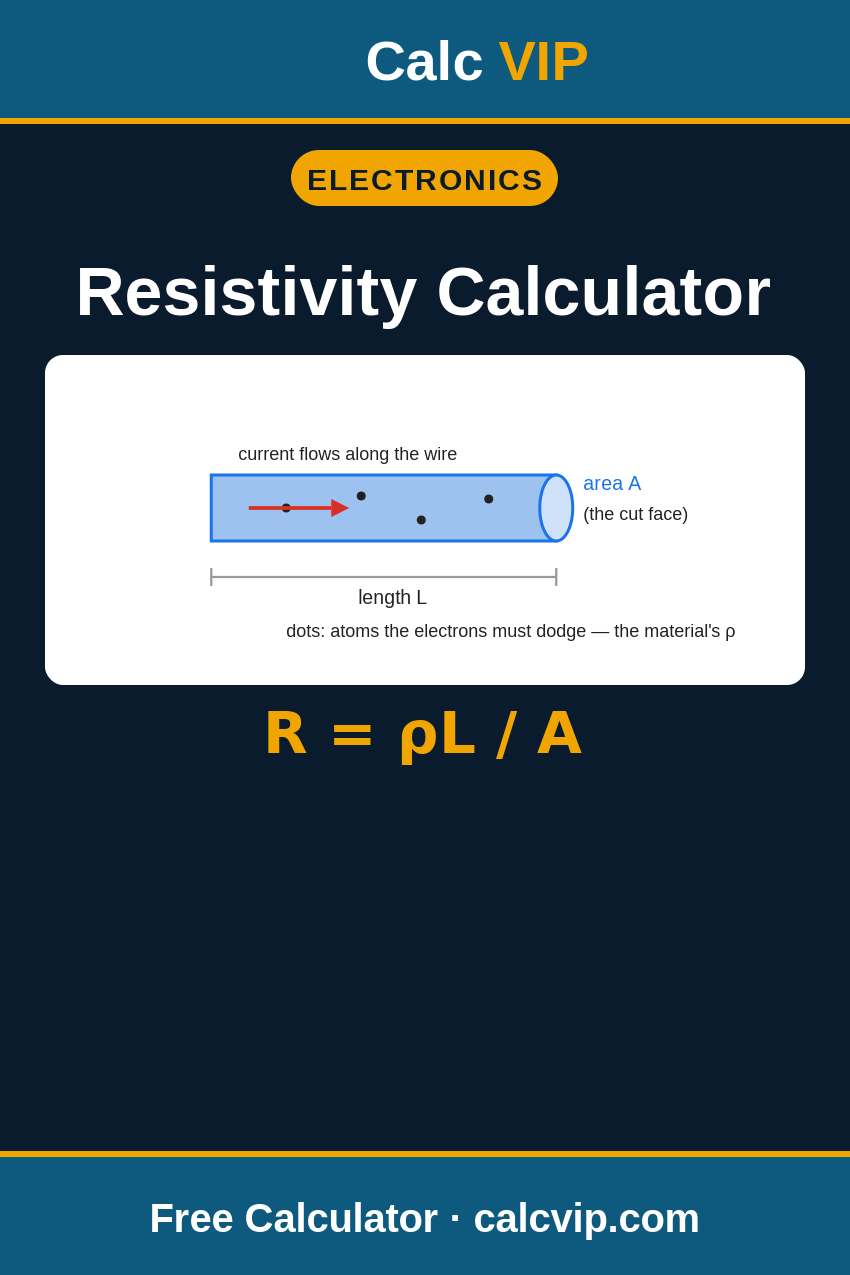
Resistance belongs to an object; resistivity belongs to a material. Stretch a copper wire longer and its resistance grows; melt it down and recast it thicker and the resistance falls — yet through every reshaping the copper-ness of copper, its resistivity ρ, stays fixed. Resistivity is the resistance a standard specimen of the material would have: the resistance between opposite faces of a one-metre cube of it, expressed in ohm·metres. The formula R = ρL/A then translates that material property into the resistance of any actual piece of it, of any length and girth.
No other common physical property spans such a range. Silver, the champion conductor, sits at 1.59 × 10⁻⁸ Ω·m; copper is a hair behind; the heating-element alloy nichrome is some sixty times worse; and insulators such as glass reach 10¹⁰ Ω·m and beyond — a spread of more than twenty orders of magnitude between the best conductor and the best insulator. That vast ladder is the menu from which all electrical design chooses: the same physics that makes copper the default wire makes nichrome the default heater and glass the default separator.
One more variable rides along: temperature. For metals, resistivity climbs as temperature rises — atoms vibrate harder and obstruct the electron flow more — so table values are quoted at 20 °C and a hot wire genuinely resists more than the same wire cold. This calculator works the relation in all four directions: resistance from material and dimensions, or resistivity, length or area from the other three — the four questions that cable sizing, element design and materials testing ask every day.
Formula
Resistance = Resistivity × Length ÷ Area → R = ρL / A • ρ = RA / L • L = RA / ρ • A = ρL / R
One relation, four questions — the calculator's four modes. The shape of the formula is a summary of the physics: resistance grows in direct proportion to length (more material to traverse) and shrinks in inverse proportion to area (more room to flow). Units demand respect: length in metres, area in square metres — and since wire areas arrive in square millimetres, the conversion 1 mm² = 1 × 10⁻⁶ m² is the step where most errors are born. Resistivity itself is in ohm·metres (Ω·m), a unit that looks odd until you see it is just ohms × metres² ÷ metres — the formula's own bookkeeping.
| Symbol | Meaning | Units |
|---|---|---|
| R | resistance of the actual piece of material | ohms (Ω) |
| ρ | resistivity — the material's own opposition, geometry removed | ohm·metres (Ω·m) |
| L | length along the current's path | metres (m) |
| A | cross-sectional area facing the flow | square metres (m²) |
Why length doubles and area halves: a tale of two connections
The formula's two proportions have a satisfying explanation in the language of the earlier pages of this series. Imagine a wire as a row of identical cubes of material. Doubling the length strings two cubes end to end — resistors in series — and series resistances add, so the resistance doubles. Doubling the cross-section places two cubes side by side — resistors in parallel — and parallel combinations halve, so the resistance halves. Every wire is a crowd of microscopic series and parallel connections, and R = ρL/A is the census of that crowd: L counts the series ranks, A counts the parallel files.
The atomic picture underneath is collision. Electrons drifting through the metal scatter off atoms; a longer wire offers more ranks of atoms to scatter from, a wider wire offers more parallel lanes so each electron's journey is less obstructed. Resistivity distils the material's contribution to the scattering — how crowded and how agitated its atoms are — which is why it rises with temperature for metals: hotter atoms swing wider and block more lanes. Semiconductors break the pattern (heat frees more charge carriers, so their resistivity falls), a difference that is exploited in the thermistors used as temperature sensors.
How to use
- Choose what you want to find: resistance, resistivity, length or area.
- Enter the three values you know — the labels change to match your choice. Scientific notation like 1.68e-8 is accepted, and is the sane way to type resistivities.
- Click "Calculate". Remember area must be in square metres: 1 mm² = 1 × 10⁻⁶ m², so a 2.5 mm² cable is 2.5e-6.
- Cross-check against the material table below: a computed copper resistance that implies a wildly different ρ means a unit slipped somewhere.
Worked examples
Example 1 — a copper wire. A copper wire is 10 m long with a cross-sectional area of 1 mm² (1 × 10⁻⁶ m²). Copper's resistivity is ρ = 1.68 × 10⁻⁸ Ω·m.
R = ρL ÷ A = (1.68 × 10⁻⁸ × 10) ÷ (1 × 10⁻⁶) = 0.168 Ω. Small — but at 20 A this innocent-looking wire would drop 3.36 V and waste 67 W as heat, which is why cable sizing is a safety calculation, not a formality.
Example 2 — aluminium cable. An aluminium conductor (ρ = 2.65 × 10⁻⁸ Ω·m) runs 100 m with an area of 2.5 mm² (2.5 × 10⁻⁶ m²).
R = (2.65 × 10⁻⁸ × 100) ÷ (2.5 × 10⁻⁶) = 1.06 Ω. Aluminium's resistivity is about 58% higher than copper's, so an aluminium cable needs roughly 58% more cross-section to match a copper one's resistance — the trade it makes for being far lighter and cheaper.
Example 3 — identifying a material. A wire of length 50 m and area 0.5 mm² (0.5 × 10⁻⁶ m²) measures 5 Ω. What is it made of?
ρ = RA ÷ L = (5 × 0.5 × 10⁻⁶) ÷ 50 = 5 × 10⁻⁸ Ω·m — close to constantan (about 4.9 × 10⁻⁸ Ω·m), an alloy used for precision resistors precisely because its resistivity barely moves with temperature.
Example 4 — how much cable in the drum? A drum of copper cable (area 4 mm² = 4 × 10⁻⁶ m²) measures 0.5 Ω end to end.
L = RA ÷ ρ = (0.5 × 4 × 10⁻⁶) ÷ (1.68 × 10⁻⁸) = 119 m. Electricians genuinely measure cable length this way — a resistance reading is a tape measure for wire still on the drum.
Example 5 — a heating element. A nichrome element (ρ = 1.1 × 10⁻⁶ Ω·m) is 10 m of wire with area 0.5 mm² (0.5 × 10⁻⁶ m²).
R = (1.1 × 10⁻⁶ × 10) ÷ (0.5 × 10⁻⁶) = 22 Ω. On 230 V it delivers P = V² ÷ R = 230² ÷ 22 = about 2,400 W — a two-bar electric fire, designed backwards from this formula: choose the watts, and the length and thickness of nichrome are decided.
Example 6 — the power of doubling the diameter. A copper wire 20 m long and 1 mm² in area has R = (1.68 × 10⁻⁸ × 20) ÷ (1 × 10⁻⁶) = 0.336 Ω.
Double its diameter and the area quadruples to 4 mm², so R falls to (1.68 × 10⁻⁸ × 20) ÷ (4 × 10⁻⁶) = 0.084 Ω — a quarter, not a half. Area grows with the square of diameter, a fact that surprises everyone once and that cable designers exploit daily.
Resistivity in real life
Sizing the cables in a house. Every wiring regulation is this formula enforced: a circuit's expected current and run length set a maximum tolerable resistance (to limit voltage drop and heating), and the formula returns the minimum copper area. Lighting circuits get away with 1.5 mm²; showers and cookers demand 6 or 10 mm².
Heating elements. A heater designer wants resistance, so chooses a high-ρ alloy — nichrome, about sixty-five times copper's resistivity — that also survives red heat without oxidising away. Example 5 is the genuine design calculation for every kettle, toaster and hair dryer element ever wound.
Long-distance power lines. Transmission engineers fight ρL/A over hundreds of kilometres: high voltage keeps current (and so I²R loss) down, aluminium keeps the towers' burden light, and the conductors are bundled to fake a larger area. The formula is the economics of the grid written small.
Fuses. A fuse wire is a deliberate weak specimen: short, thin, and made of a low-melting alloy, so its resistance concentrates heating at exactly the spot designed to melt first when current exceeds the rating. Geometry and material chosen by this page's relation.
Strain gauges. Glue a fine wire grid to a bridge or a wing and stretch it: the wire lengthens (L up) and thins (A down), so its resistance rises measurably with strain. The formula converts a resistance reading into a measurement of how much a structure flexes — aircraft and civil engineers read loads this way.
Temperature sensing. A platinum resistance thermometer is a coil whose resistance is measured precisely and converted back through the metal's known ρ-versus-temperature behaviour. It is among the most accurate thermometers in science — resistivity, read backwards, as a thermometer.
Quick reference: resistivity of common materials (at 20 °C)
| Material | ρ (Ω·m) | Typical role |
|---|---|---|
| silver | 1.59 × 10⁻⁸ | specialist contacts, high-end audio |
| copper | 1.68 × 10⁻⁸ | house wiring, motors, cables |
| gold | 2.44 × 10⁻⁸ | connector coatings (it never tarnishes) |
| aluminium | 2.65 × 10⁻⁸ | overhead power lines |
| tungsten | 5.6 × 10⁻⁸ | lamp filaments |
| iron | 9.7 × 10⁻⁸ | structural metal, poor conductor |
| nichrome | 1.1 × 10⁻⁶ | heating elements |
| germanium | about 0.47 | early semiconductors |
| glass | 10¹⁰ – 10¹⁴ | insulators |
Keep this table open beside the calculator: it is both a design menu and a lie detector — a computed ρ that lands nowhere near any plausible material means the inputs, not the physics, need attention.
Hot wires and the vanishing point: temperature and superconductors
For metals, resistivity rises roughly in proportion to absolute temperature's everyday range — copper gains about 0.4% per degree Celsius near room temperature. The effect compounds dramatically in a lamp filament: tungsten at its working temperature of some 2,800 K has more than ten times its cold resistivity, which is why a bulb's running current (computed from hot resistance) is far lower than the switch-on surge the cold filament briefly allows. At the opposite extreme, cool certain materials below a critical temperature and resistivity does not merely shrink — it vanishes entirely. A superconductor's ρ is exactly zero, so a current started in a superconducting ring circulates for years without fading: the formula's limiting case, and the working principle of MRI magnets and maglev trains.
Voltage drop: where this formula earns its living
Every metre of cable in a circuit is a small resistor in series with the load, and it keeps a share of the voltage for itself. The share is V = IR with R from this page — and the catch that beginners miss is that the current makes a round trip, so the length in the formula is twice the distance to the load. Take a 30 m extension run feeding a 10 A load on 1.5 mm² copper: the loop is 60 m of wire, R = (1.68 × 10⁻⁸ × 60) ÷ (1.5 × 10⁻⁶) = 0.672 Ω, and the drop is 10 × 0.672 = 6.72 V — about 3% of a 230 V supply, gone to warming the cable. Regulations in many countries cap voltage drop at around 5% precisely because loads starve and motors overheat beyond it.
It is also why a power tool at the far end of a long, thin lead runs weakly and hot: its motor is fed the supply minus the cable's toll, and it strains at the reduced voltage. The remedies all live inside the formula: shorten L (move the supply), enlarge A (thicker cable), or cut I (a higher-voltage tool, or a load that draws less). Solar installers sizing the run from panels to inverter, electricians feeding an outbuilding, and engineers of electric vehicles all perform this exact negotiation — the resistivity formula is less a school exercise than a daily professional instrument, and the calculator's four modes are its four working questions.
Common mistakes
- Confusing resistance with resistivity. Resistance describes one object; resistivity describes the stuff it is made of. Two copper wires of different sizes have different R but identical ρ — mixing the two scrambles every mode of the calculator.
- Forgetting the mm² conversion. Entering 1 mm² as "1" instead of 1 × 10⁻⁶ understates the resistance a millionfold. This is the most destructive slip in the topic — check every area for its × 10⁻⁶.
- Using diameter where area belongs. The formula wants cross-sectional area, A = π × (d/2)². Feeding in the diameter itself, or forgetting that doubling d quadruples A, corrupts the answer geometrically (Example 6).
- Applying 20 °C values to hot conductors. A motor winding or filament at working temperature can have double or ten times its table resistance. Designs that ignore temperature under-predict resistance exactly where heat matters most.
- Assuming thickest is always best. Beyond the point where voltage drop and heating are acceptable, extra copper buys nothing but cost and weight — which is why aircraft and overhead lines choose aluminium and accept its higher ρ.
FAQ
What is the resistivity of copper?
About 1.68 × 10⁻⁸ Ω·m at room temperature — one of the lowest of any common metal, which is why copper is used for wiring. Silver is slightly lower (1.59 × 10⁻⁸ Ω·m); iron is much higher (about 9.7 × 10⁻⁸ Ω·m).
Why does a thicker wire have less resistance?
A bigger cross-sectional area gives the electrons more room to flow — like a wider pipe carrying water more easily. Doubling the area halves the resistance, while doubling the length doubles it.
Does resistivity depend on temperature?
Yes. For metals, resistivity rises as temperature rises, so a hot wire has more resistance than the same wire cold. The values quoted in tables are usually for 20 °C.
What are the units of resistivity?
Ohm·metres (Ω·m). They fall out of the formula: ρ = RA/L, so ohms × square metres ÷ metres. A material with ρ = 1 Ω·m would give a one-metre cube a resistance of one ohm between opposite faces.
If silver conducts better, why is everything copper?
Cost and sufficiency. Silver beats copper by only about 6% in resistivity but costs many times more; copper is the economic optimum for wiring, and silver is reserved for special contacts and coatings where its edge — and its resistance to tarnish — justify it.
Does resistivity depend on the size or shape of the sample?
No — that is its whole point. Resistivity is a property of the material and its temperature alone. Size and shape enter only through L and A when the object's resistance is computed.
What is conductivity?
The reciprocal of resistivity, σ = 1/ρ, measured in siemens per metre (S/m). Copper's conductivity is about 6 × 10⁷ S/m. Engineers of motors and generators often speak in conductivity; it is the same material quality read from the welcoming side.
Why are overhead power lines aluminium, not copper?
Weight and price. Aluminium's resistivity is higher, so the conductor is made thicker to compensate — and even then it weighs about half what an equal-resistance copper line would weigh, sagging less between towers. A steel core usually supplies the strength.
Can resistivity ever be zero?
Yes — in superconductors below their critical temperature, resistivity vanishes exactly and currents persist indefinitely without a driving voltage. The effect powers MRI scanners and maglev trains, at the price of deep refrigeration.
Why does the calculator accept values like 1.68e-8?
Because resistivities and areas are inconveniently small in plain decimals — 0.0000000168 invites counting errors. Scientific notation (1.68e-8) is the standard way to type them, and the calculator parses it directly.