 Calc
String Wave Power Calculator – Average Power of a Wave on a String
 Created by David Okafor · Physics Writer · Waves & Light · Last updated: November 2026
Use this free String Wave Power Calculator to find the average power carried by a sinusoidal wave travelling along a stretched string — the energy per second the wave delivers, which is what makes a guitar string audible and what a wave machine must supply. Enter the string's mass per unit length, the frequency, the amplitude and the wave speed.
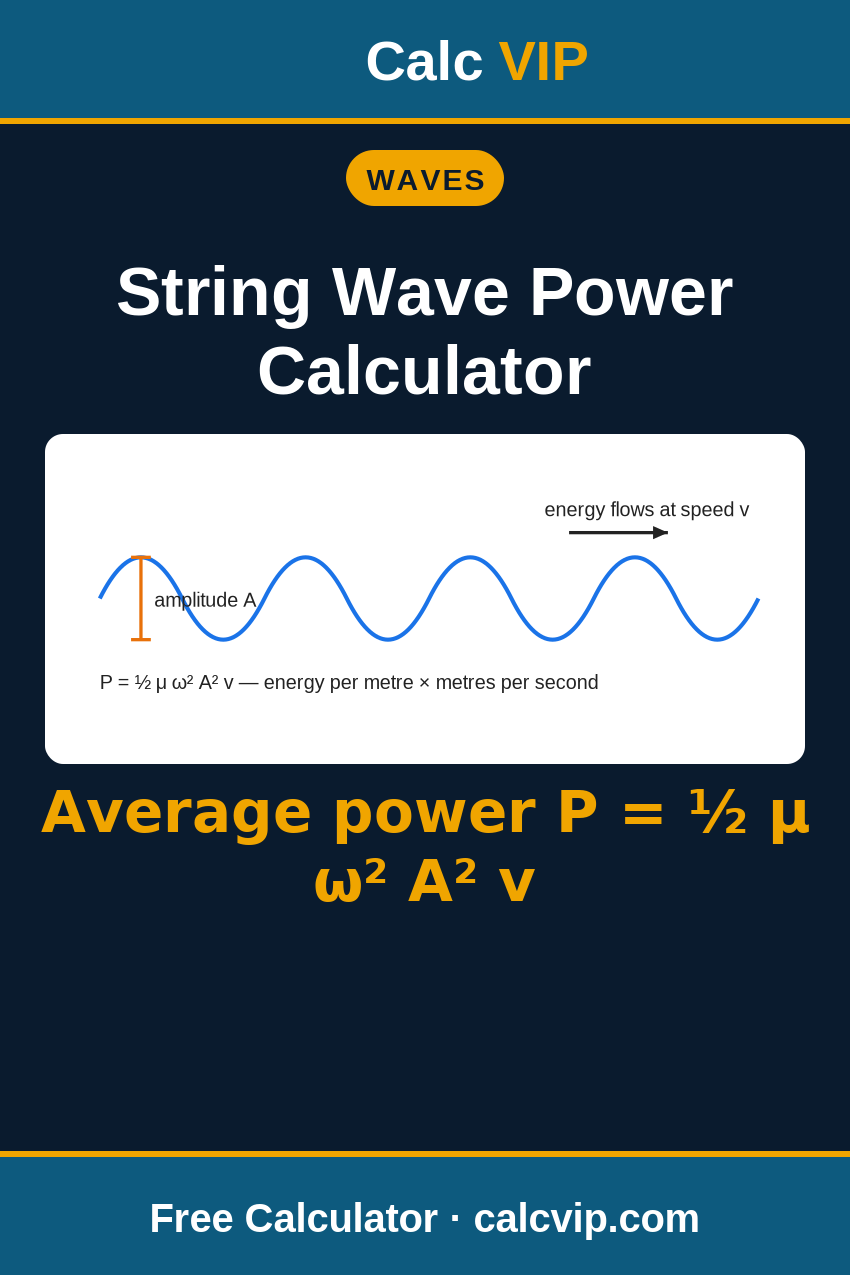
A wave on a string is energy on the move. Every element of the string oscillates in simple harmonic motion, and the energy of that motion — kinetic as it whips through the centre, elastic as it stretches at the extremes — is handed along the string at the wave speed. The average power is the rate of that hand-off: P = ½ μ ω² A² v. It is the number a wave-machine motor must supply, the number that drains a plucked string's vibration into the instrument body, and the reason a loud high note tires a string — and a singer's amplified rig — so much faster than a quiet low one.
Read the formula's exponents, because they are the whole personality of the quantity: power grows with the square of amplitude and the square of angular frequency, but only linearly with μ and with v. Double the amplitude and the wave carries four times the power. Double the frequency — same amplitude, same string — and again the power quadruples, because each element of string is being shaken twice as fast and with twice the peak speed. Linear in v: a faster wave delivers its energy density past your checkpoint more often. This calculator evaluates the full expression and reports ω alongside, so you can see which factor is doing the work in your case.
One modelling note: the formula describes a single sinusoidal travelling wave on an ideal string. A real plucked string is a standing wave — two travelling waves passing through each other — and carries no net power along itself; the power calculated here is what one of those component waves transports, and it is the right measure of how much energy the string exchanges with the bridge, the air and your fingertip each cycle. The depth section unpacks that distinction.
Formula
Average power P = ½ μ ω² A² v, where the angular frequency ω = 2πf.
The structure is transparent once you see where it comes from. A length of string in the wave carries an average energy per unit length of ½ μ ω² A² (half kinetic, half elastic, on average); that energy advances at the wave speed v; so the power crossing any point is energy-per-metre × metres-per-second. Rearranged: the amplitude a given power budget allows is A = √( 2P / (μ ω² v) ), and the energy per metre is P/v. The string's mechanical impedance Z = √(Tμ) = μv gives the equivalent form P = ½ Z ω² A², favoured by engineers because Z is the quantity that must be matched at junctions — bridge, nut, another string — for power to transfer instead of reflecting. Units: μ in kg/m, f in hertz (ω in rad/s), A in metres, v in m/s, P in watts.
| Symbol | Meaning | Units |
|---|---|---|
| P | average power carried by the wave | watts (W) |
| μ | mass per unit length of the string | kg/m |
| ω = 2πf | angular frequency | rad/s |
| A | amplitude (peak displacement) | metres (m) |
| v | wave speed on the string, √(T/μ) | m/s |
Where the ½ μ ω² A² comes from
Take one short element of the string, mass μ per metre, swinging transversely as y = A sin(kx − ωt). Its transverse speed peaks at ωA, so its kinetic energy per metre peaks at ½ μ (ωA)² and averages half that over a cycle: ¼ μ ω² A². The elastic share — the work stored in the string's slight stretching as it tilts — averages exactly the same, ¼ μ ω² A², a beautiful equipartition that holds for every harmonic wave on a string. Total average energy density: ½ μ ω² A² per metre. Multiply by the speed at which the pattern advances and the power formula is inevitable. For the reference example of this page, the energy density is ½ × 0.01 × (314.16)² × (0.005)² = 0.0123 J/m — about a hundredth of a joule stored in each metre of string — and delivered past any checkpoint at 100 m/s it gives exactly 0.0123 × 100 = 1.23 W, the result Example 1 computes directly.
The impedance view adds engineering insight. Z = μv = √(Tμ) for the example is 0.01 × 100 = 1 kg/s (one "mechanical ohm", in effect). At a junction between two strings of different impedance, the fraction of power transmitted is 4Z₁Z₂/(Z₁+Z₂)² — unity only when the impedances match. A guitar's bridge is deliberately a mismatch: most of the wave's power reflects back into the string (sustaining the note), while a small, controlled leak drives the soundboard. This calculator gives the power sloshing inside the string; the instrument's loudness is that power times the leak fraction times the soundboard's efficiency — a chain of small percentages that ends in the milliwatts of actual sound.
How to use
- Enter the string's mass per unit length μ in kilograms per metre (weigh a known length of the string and divide — or take μ from the String Frequency Solver's solve-for-μ mode).
- Enter the frequency f of the wave in hertz and the amplitude A in metres (note: 5 mm = 0.005 m — the classic slip is entering millimetres).
- Enter the speed v of the wave on the string in metres per second (from tension: v = √(T/μ)).
- Click "Calculate Average Power" to see ω and the average power in watts — the energy the wave carries past any point each second.
Worked examples
Example 1 — the reference wave. A wave travels on a string with μ = 0.01 kg/m, at f = 50 Hz with amplitude A = 0.005 m and speed v = 100 m/s.
ω = 2π × 50 = 314.16 rad/s.
P = ½ × 0.01 × (314.16)² × (0.005)² × 100 = 1.23 W.
Example 2 — a plucked guitar string. Take the A string of the String Frequency Solver's first example: μ = 0.005 kg/m, v = 141.42 m/s, sounding its fundamental f = 110 Hz with a strong pluck amplitude of A = 0.001 m (1 mm). ω = 2π × 110 = 691.15 rad/s, and P = ½ × 0.005 × (691.15)² × (0.001)² × 141.42 = 0.17 W. A sixth of a watt shuttles back and forth inside the string; the audience hears milliwatts of it — the rest is reflected at the bridge, recycled, and slowly spent as heat and sound over the note's decay.
Example 3 — the two squares, demonstrated. Start from Example 1. Double only the amplitude (A = 0.01 m): P = 4.93 W — exactly four times 1.23. Restore A and double only the frequency (f = 100 Hz, ω = 628.32 rad/s): P = 4.93 W again. The symmetry is the formula's signature — ω² and A² are interchangeable levers — and it is why a wave machine's motor labours identically whether you ask it for twice the swing or twice the rate.
Example 4 — the demonstration rope. A classroom wave rope: μ = 0.05 kg/m, shaken at f = 2 Hz with a generous amplitude A = 0.1 m, wave speed v = 10 m/s. ω = 12.57 rad/s; P = ½ × 0.05 × (12.57)² × (0.1)² × 10 = 0.39 W. Less than half a watt — yet the teacher's arm, supplying it through an inefficient coupling of muscle to rope, tires quickly. Power at the wave is not power at the shoulder.
Example 5 — a piano string at full cry. A piano A4 string: μ = 0.006 kg/m, f = 440 Hz, v = 352 m/s, vibrating with amplitude A = 0.0005 m (half a millimetre) just after the hammer strike. ω = 2764.60 rad/s; P = ½ × 0.006 × (2764.60)² × (0.0005)² × 352 = 2.02 W. Two watts of mechanical power in a wire thinner than a paperclip — the hammer delivers it in a few milliseconds, which is why piano hammers hit hard and why the note's first instant is its loudest.
Example 6 — a heavy rope in slow motion. A mooring-line demonstration: μ = 0.5 kg/m, f = 0.5 Hz, A = 0.3 m, v = 20 m/s. ω = 3.14 rad/s; P = ½ × 0.5 × (3.14)² × (0.3)² × 20 = 4.44 W. Slow, huge and lazy beats fast and small: the A² of a 30 cm swing outweighs the ω² of frequencies ten times higher, a scaling every designer of wave-energy machines exploits.
String wave power in real life
Wave machines and demonstration tanks. The motor driving a rope wave machine or a long spring must supply at least this power continuously, plus friction. Example 4's 0.39 W is the floor for the classroom rope; scale the amplitude for a dramatic display and the A² law bills you fourfold per doubling.
Instrument loudness and sustain. A string's stored energy is its power divided by the rate at which energy leaks away. The guitar of Example 2 holds about 0.17 W of travelling-wave power in each direction's flow; the tiny fraction converted to sound per cycle is why a note can ring for seconds from a store of energy measured in millijoules.
Power transmission along lines — and its failures. Overhead power lines in wind can develop travelling and standing waves ("galloping") whose mechanical power follows this formula with the cable's μ, the wind-driven amplitude and the wave speed √(T/μ). Utilities fit dampers whose whole job is to absorb that power before amplitudes grow destructive.
Musical acoustics research. Measuring the power a bow delivers to a violin string — via this formula, from the string's μ, the Helmholtz motion's amplitude and frequency — quantifies bow force and speed trade-offs that players describe only as "grip" and "bite".
Wave energy concepts. Every oscillating wave-energy converter is, at heart, this calculation with water's numbers: power proportional to amplitude squared and to a frequency factor. The string is the one-dimensional teaching model of an industry.
Haptic and robotic cables. Engineers modelling vibrations in towed sonar arrays, tethered drones and elevator cables use the same expression to predict how much vibrational power travels down the line towards sensitive equipment — and where to put the dampers that must absorb it.
Standing waves: power that goes nowhere, on purpose
Superpose two identical travelling waves in opposite directions and the string settles into a standing wave: nodes that never move, antinodes swinging at 2A. Each component wave still carries its P = ½ μ ω² A² v — but in opposite directions, so the net transport is zero. Energy is not absent; it is stored, sloshing between kinetic form at the centre-crossing instant and elastic form at the extremes, twice per cycle. That storage is the whole point of a musical string: the pluck deposits energy once, and the standing wave keeps it local, leaking it slowly to the bridge and air so the note sustains. The travelling-wave power of this calculator is then best read as the size of the internal traffic — the rate at which energy streams past each point in each direction — which sets how fast the note would drain if one end were opened to a perfect absorber. Instruments are engineered to be very imperfect absorbers.
Quick reference: power against frequency and amplitude (μ = 0.01 kg/m, v = 100 m/s)
| Case | f | A | Power |
|---|---|---|---|
| reference (Ex. 1) | 50 Hz | 5 mm | 1.23 W |
| amplitude halved | 50 Hz | 2.5 mm | 0.31 W |
| amplitude doubled | 50 Hz | 10 mm | 4.93 W |
| frequency doubled | 100 Hz | 5 mm | 4.93 W |
| frequency halved | 25 Hz | 5 mm | 0.31 W |
The table is the formula's personality in five rows: the squares rule everything. A designer who needs four times the power can buy it with twice the amplitude or twice the frequency — and pays for it, respectively, in string stress or in the speed at which everything must move.
Common mistakes
- Entering the amplitude in millimetres. A is in metres: 5 mm is 0.005. Entering "5" inflates A by 1000 and the power — through A² — by a million. This is the single most common error with this formula.
- Using f where ω belongs. The formula needs ω = 2πf. Substituting f directly understates the power by (2π)² ≈ 39.5 times. The calculator computes ω for you and prints it — check it is roughly 6.28 × your f.
- Taking the amplitude as peak-to-peak. A is the peak displacement from equilibrium — half the peak-to-peak swing. Doubling A by this confusion quadruples the computed power.
- Assuming power is proportional to amplitude. It is proportional to A² (and to ω²). Any estimate that scales power linearly with either will be wrong by the same factor it was scaled by.
- Treating a standing wave's net power as this P. On a real instrument string the two travelling components cancel in transport; P here is the one-way flow. Loudness depends on the small leaked fraction, not on P directly — a high-P string on a badly coupled body is a quiet instrument.
FAQ
Why does the power depend on the square of the amplitude?
Each piece of string moves in simple harmonic motion, and its energy is proportional to A². Doubling the amplitude makes every part of the string move twice as fast, so it carries four times the energy — and four times the power.
Does a higher frequency carry more power?
Yes, strongly. Power is proportional to ω², so doubling the frequency (at the same amplitude and speed) multiplies the power by four. This is why high-pitched, loud sounds need much more energy than low rumbles.
What if I know the tension instead of the wave speed?
The speed on a string is v = √(T/μ). Work out v from the tension T and μ first, then enter that speed here. A tighter string carries the wave faster, so it also delivers the energy faster.
How much energy does the reference wave carry per metre?
Energy per metre = P/v = 1.23/100 ≈ 0.0123 J/m — about a hundredth of a joule in each metre of string, half kinetic and half elastic on average, endlessly recycled as the wave passes. (The concept section's derivation gives the same figure from ½ μ ω² A² directly.)
Why does the power not depend on the string's length?
Because power is a flow, not a store: it counts energy crossing a point per second, and a longer string simply holds proportionally more total energy at the same flow. Length enters the total energy (energy per metre × L) and the decay time, not P itself.
What amplitude would carry 1 W on the reference string at 50 Hz?
From A = √(2P/(μ ω² v)): √(2/(0.01 × 98,696 × 100)) = √(2.03 × 10⁻⁵) ≈ 0.0045 m — about 4.5 mm. The calculator's Example 1 (5 mm, 1.23 W) brackets it consistently, as the A² law requires: (5/4.5)² ≈ 1.23.
Does a tighter string carry more power?
At fixed μ, f and A, raising the tension raises v = √(T/μ), and P grows in proportion to v. But in a real instrument raising the tension also raises f (the string's pitch) unless μ or L changes too — the variables are chained together by the frequency formula, which is why this calculator takes v as a direct input.
Can the power be negative?
The formula returns the magnitude of the flow; the sign is a direction convention. A wave travelling the other way carries the same P in the opposite direction — which is precisely the standing-wave bookkeeping of the depth section, where the two flows cancel.
How does this relate to the intensity of the sound the string makes?
Only a small fraction of the string's internal power becomes sound; that fraction, spread over the sphere around the instrument by the inverse square law, is the sound's intensity. A guitar radiating 1 mW of sound gives, at 1 m, about 8 × 10⁻⁵ W/m² — roughly 79 dB — from a string whose internal traffic was 0.17 W. Instruments are inefficient, and thank goodness: a perfectly efficient guitar would be unbearably loud and its notes would die instantly.
What if the wave is not a pure sine wave?
Decompose it: each harmonic component carries its own Pn = ½ μ ωn² An² v, and the total is the sum. Because of the ω² weighting, a small high harmonic can carry a surprising share of the power — one reason bright, harmonic-rich plucks decay differently from mellow ones.