 Calc
Wave Period Calculator – Period, Frequency & Angular Frequency
 Created by David Okafor · Physics Writer · Waves & Light · Last updated: November 2026
Use this free Wave Period Calculator to convert between a wave's period, frequency and angular frequency. Work from the frequency, or from the wavelength and wave speed — the calculator gives you all three quantities.
Every wave keeps time, and the period is its unit of time: the duration of exactly one complete cycle — crest to crest, tick to tock, one full swing and return. Where wavelength measures a wave in space (how long one cycle is), the period measures it in time (how long one cycle takes), and the two are joined by the wave's speed. Period and frequency are the same information read in opposite directions: frequency counts cycles per second, the period times seconds per cycle, and each is the reciprocal of the other. It is the simplest relationship on this page — T = 1/f — and one of the most used in all of physics.
The third quantity the calculator returns, angular frequency ω, looks like a complication but is a profound convenience. It measures the wave's phase in radians per second — how fast the cycle's angle sweeps around a circle rather than how many cycles pass. Because the mathematics of oscillation is written in sines and cosines, and those functions eat angles, ω = 2πf appears wherever waves are analysed seriously: in AC circuit theory, in the wave equation, in quantum mechanics. Fluency in converting between f, T and ω is a small skill that unlocks a large library.
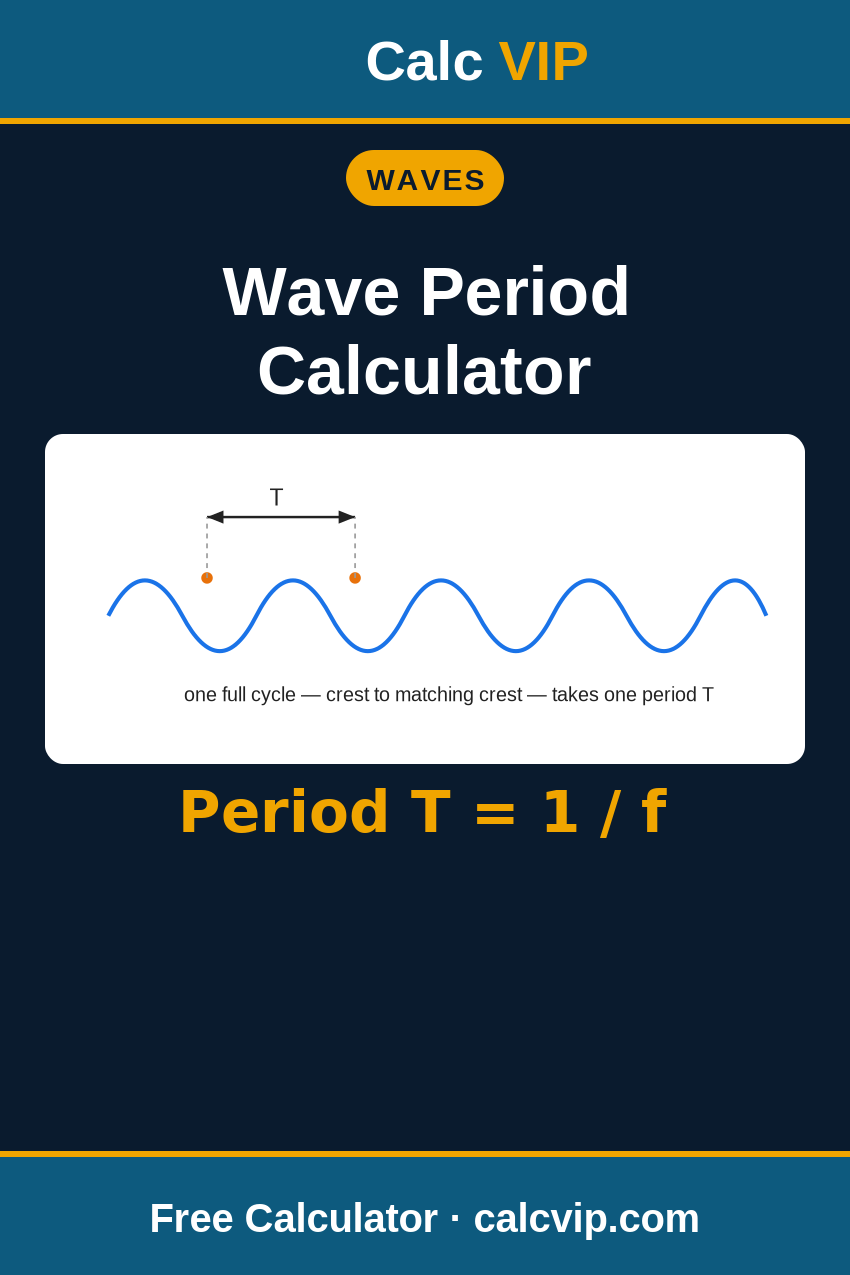
The ranges involved are as extreme as waves themselves. The period of a microwave in your oven is a fraction of a nanosecond; the period of an ocean swell is a leisurely eight seconds; the "wave" of the seasons has a period of a year. This calculator accepts the two common starting points — a frequency, or a wavelength together with the wave speed (from which the frequency follows as f = v/λ) — and returns the complete set: period, frequency and angular frequency, ready for whichever formula you are feeding.
Formula
Period T = 1 / f • from wavelength and speed: T = λ / v • angular frequency ω = 2πf = 2π / T (rad/s)
Three doors into the same room. If you know the frequency, invert it: T = 1/f. If you know the wave's spatial size and speed, the period is the time the wave takes to travel one wavelength: T = λ/v — which is the same statement, since f = v/λ. Angular frequency then follows from either: one cycle is 2π radians of phase, so ω = 2π/T = 2πf. Unit discipline is the whole game here: frequencies in hertz give periods in seconds, but real waves often arrive wearing prefixes — a period of 0.00227 s is better quoted as 2.27 ms, and a frequency of 2,450,000,000 Hz as 2.45 GHz. The calculator reports plain seconds and radians per second; dressing them in prefixes is left to you, and the quick-reference table below shows the scales side by side.
| Symbol | Meaning | Units |
|---|---|---|
| T | period — time for one complete cycle | seconds (s) |
| f | frequency — cycles per second, f = 1/T | hertz (Hz) |
| ω | angular frequency — phase sweep rate, ω = 2πf | radians per second (rad/s) |
| λ | wavelength — length of one cycle in space | m |
| v | wave speed, v = fλ = λ/T | m/s |
Period and wavelength: the same wave, timed and measured
Stand at one point with a stopwatch and a wave shows you its period: the interval between one crest's arrival and the next. Take a snapshot with a ruler instead and the same wave shows you its wavelength: the distance between that crest and the next. Neither is more fundamental; they are the wave's cycle expressed against time and against space, and the speed is the exchange rate between the two currencies, v = λ/T. This is why the calculator's second mode works: given λ and v, the time for the wave to advance by one of its own wavelengths is forced to be λ/v, and that time is the period by definition. Every wave problem is quietly a choice of which face of the cycle you are looking at.
The period has one further virtue the wavelength lacks: it survives journeys. When a wave crosses into a new medium — light into glass, sound into water — its speed changes and its wavelength rescales to match, but the period (like the frequency) stays exactly what the source set, because crests cannot be created or destroyed at the boundary: they arrive at the same rate they were emitted. A wave's period is thus its passport identity, unchanged by travel, while its wavelength is a local costume fitted by each medium it enters. Instruments that must identify a wave anywhere — spectrometers, tuners, radio receivers — all key on frequency and period for precisely this reason.
How to use
- Choose what you know: the frequency, or the wavelength together with the wave speed.
- Enter the value(s) and click "Calculate Period".
- You get the period in seconds, the frequency in hertz, and the angular frequency ω in radians per second.
- For very small or large answers, restate them with a prefix — milliseconds, microseconds, kilohertz, gigahertz — using the quick-reference table as a guide to the customary scales.
Worked examples
Example 1 — five cycles a second. A wave has a frequency of 5 Hz.
T = 1 / 5 = 0.2 s per cycle, and ω = 2π × 5 = 31.42 rad/s.
The same answer comes from a wavelength of 2 m and a speed of 10 m/s: f = 10 / 2 = 5 Hz, so T = 0.2 s.
Example 2 — the mains. Household electricity alternates at 50 Hz: T = 1 / 50 = 0.02 s — 20 milliseconds per cycle — and ω = 2π × 50 = 314.16 rad/s. That 20 ms is a unit engineers live by: flicker, hum, motor speeds and camera shutter quirks all trace back to the mains period (16.67 ms in 60 Hz countries).
Example 3 — a heartbeat as a wave. A resting heart beats 72 times a minute: f = 72 / 60 = 1.2 Hz, so each beat's period is T = 1 / 1.2 = 0.83 s. Cardiologists read the same number off an ECG trace as the spacing between R peaks — a wave period measured on a chest instead of in a laboratory.
Example 4 — concert pitch. The note A4 at 440 Hz has period T = 1 / 440 = 0.00227 s = 2.27 ms, and ω = 2π × 440 = 2,764.6 rad/s. Every cycle of the most famous note in music is over in about two and a quarter thousandths of a second — the ear resolves timing on scales your conscious mind cannot approach.
Example 5 — ocean swell, from wavelength and speed. A swell has wavelength 100 m and travels at 12.5 m/s. Its frequency is f = 12.5 / 100 = 0.125 Hz, and its period is T = λ/v = 100 / 12.5 = 8 s. Surfers and harbour masters quote swell by period, not frequency — "eight-second swell" is this calculation, spoken aloud.
Example 6 — the microwave oven. Oven radiation runs at 2.45 GHz = 2.45 × 10⁹ Hz. Its period is T = 1 / (2.45 × 10⁹) = 4.08 × 10⁻¹⁰ s — four tenths of a nanosecond — and ω = 2π × 2.45 × 10⁹ = 1.54 × 10¹⁰ rad/s. Twelve orders of magnitude separate this period from the swell's, and the same three formulas cover both without blinking.
Periods in real life
Power grids. The 50 or 60 Hz mains period (20 ms or 16.67 ms) times everything from fluorescent flicker to the design of transformers and the hum in audio equipment — and grid operators defend the frequency, hence the period, to fractions of a percent.
Medicine. Heart rate, breathing rate and brain rhythms are all reported as frequencies but measured as periods — the gap between beats or waves. An EEG's alpha rhythm, for instance, is a period of about 0.1 s wearing the label "10 Hz".
Surf and sea forecasts. Wave period is the forecaster's key number: long-period swell (12 s and up) has travelled far and arrives powerful and organised, while short-period chop is local and messy. The period is a wave's biography.
Clocks and pendulums. A pendulum's period is set by its length, not its swing size — the insight that made accurate clocks possible. The famous "seconds pendulum" has a period of exactly 2 s (one second each way) and is about a metre long.
Music and rhythm. Tempo is a period in disguise: 60 beats per minute is a period of 1 s per beat, 120 BPM is 0.5 s. Musicians count in BPM; physicists would write the same thing as T — one vocabulary, two tribes.
Seismology. Earthquake waves are characterised by their periods, from the sharp seconds of local tremors to the minutes-long free oscillations of the whole planet after the greatest quakes — the Earth itself, ringing like a bell, with periods this calculator's formula still describes.
Quick reference: familiar frequencies and their periods
| Wave | Frequency | Period | ω (rad/s) |
|---|---|---|---|
| ocean swell | 0.125 Hz | 8 s | 0.79 |
| resting heartbeat | 1.2 Hz | 0.83 s | 7.54 |
| mains electricity | 50 Hz | 0.02 s | 314.16 |
| concert A | 440 Hz | 2.27 ms | 2,764.6 |
| FM radio | 100 MHz | 10 ns | 6.28 × 10⁸ |
| microwave oven | 2.45 GHz | 0.41 ns | 1.54 × 10¹⁰ |
Read the ω column as a warning and a promise: it is always 2π (about 6.28) times the frequency. Forgetting that factor is the most common slip in wave calculations — and remembering it is most of what "angular frequency" ever asks of you.
Freezing a wave: strobes, sampling and aliasing
The period is also the key to a family of measurement tricks built on looking at a wave only at chosen instants. A stroboscope flashes at a rate close to a rotating or vibrating object's frequency; when the flash rate matches the cycle rate exactly, every flash catches the object at the same phase and it appears frozen — the principle behind strobe tuners for turntables and the dramatic slow-motion water-droplet photographs that are really single-phase portraits. Electronic sampling generalises the idea: to reconstruct a wave faithfully you must sample it more than twice per period (the Nyquist rule), at intervals shorter than T/2. Sample too slowly and the wave impersonates a different, slower one — aliasing — which is why wagon wheels appear to crawl backwards on film: the camera's frame rate undersamples the spokes' true period and the viewer's brain believes the impostor. Whenever a periodic signal looks suspiciously slow and stately on a screen, suspect that its real period is far shorter than its sampled portrait claims.
How instruments actually measure a period
Two philosophies compete in the instrument cabinet, and choosing between them is an exercise in this page's reciprocal. An oscilloscope displays the wave against a calibrated time axis, so the period is read straight off the screen — count the divisions one cycle spans, multiply by the time-per-division setting. A frequency counter does the opposite: it counts whole cycles arriving inside a precise gate time (one second, say) and reports the count as the frequency, computing the period, if asked, as the reciprocal. For slow waves the counter's philosophy inverts for accuracy: at 5 Hz a one-second gate might catch 4 or 6 cycles, a 20% error, so precision instruments switch to timing a single period (or ten) against a fast internal clock and reciprocating — measuring T to get f. The lesson generalises beyond electronics: measure whichever of the reciprocal pair is larger and easier, and let T = 1/f do the rest. That is precisely why this calculator accepts both doors.
Common mistakes
- Inverting the wrong way. T = 1/f, not T = f. A 5 Hz wave has a period of 0.2 s; answering "5 s" swaps the reciprocal and inflates the time by a factor of 25.
- Confusing period with wavelength. Both describe "one cycle", but the period is measured in seconds and the wavelength in metres. A question asking how long a wave takes wants T; how long it is wants λ. The word "long" is the trap.
- Dropping the 2π in angular frequency. ω = 2πf, not f. Writing ω = 50 for mains electricity understates the phase rate sixfold and wrecks every AC formula downstream. If a value labelled rad/s equals the value in Hz, the 2π has gone missing.
- Mangling prefixes. A period of 0.02 s is 20 ms; a frequency of 2.45 GHz is 2.45 × 10⁹ Hz, not 2.45. Convert prefixes into plain numbers before touching the formulas, and re-apply them to the answer at the end.
- Expecting the period to change with amplitude or medium. For ordinary waves the period is fixed by the source's frequency alone: louder, larger or slower-medium waves keep the same T (their wavelength adjusts instead). Answers that rescale T at a boundary have confused it with λ.
FAQ
What is the difference between period and frequency?
The period is the time taken for one complete wave cycle (in seconds); the frequency is how many cycles pass each second (in hertz). They are reciprocals: T = 1/f and f = 1/T.
What is angular frequency used for?
Angular frequency ω = 2πf measures how fast the wave's phase rotates, in radians per second. It appears throughout the maths of oscillations, AC circuits and wave equations because it makes the formulas simpler.
Does the period depend on the wave's amplitude?
For simple waves and small oscillations, no — the period depends on the frequency (or on λ and v), not on how big the wave is.
What is the period of 60 Hz mains electricity?
T = 1/60 = 0.0167 s — 16.67 ms per cycle, with ω = 2π × 60 = 376.99 rad/s. North American equipment is built around this number just as 50 Hz equipment is built around 20 ms; mixing the two standards is a classic source of hum and flicker.
How do I measure a period with a stopwatch?
Never time one cycle — your reaction time swamps it. Time ten or twenty cycles (ten swings of a pendulum, ten flashes of a strobe) and divide by the count. The same divide-the-train trick used for echo timing works for every periodic phenomenon.
Does the period change when a wave enters a new medium?
No. The frequency and period are set by the source and cannot change at a boundary, because crests arrive at exactly the rate they are emitted. What changes is the speed, and the wavelength rescales to λ = v × T in the new medium — the period is the traveller's passport, the wavelength its local costume.
What are phase and phase angle?
Phase is where a wave currently sits within its cycle, measured as an angle: 0 at a crest's start, π/2 a quarter-cycle in, π at the halfway point, 2π at the cycle's end. Angular frequency is simply the rate at which that angle advances — phase = ωt — which is why ω is measured in radians per second.
Why do scientists prefer ω when f is simpler?
Because the equations of oscillation are built from sines and cosines of angles. Writing a wave as sin(ωt) instead of sin(2πft) removes a 2π from every derivative, resonance condition and circuit formula that follows. The small upfront conversion buys simpler mathematics everywhere downstream.
What is the period of the Earth's rotation, in these terms?
One cycle per day: T = 86,400 s, corresponding to f = 1.16 × 10⁻⁵ Hz and ω = 7.27 × 10⁻⁵ rad/s — the last of these is a genuinely useful number in geophysics and satellite work. The calculator's formulas are indifferent to scale; days and nanoseconds are all the same to a reciprocal.
Can a wave have a period but no wavelength, or the reverse?
A travelling wave always has both — they are joined by v = λ/T. Standing waves complicate the picture (their pattern does not travel, though every point still oscillates with a period), and pure oscillations like a pendulum's swing have a period with no wavelength at all, because nothing propagates. The period is the more basic of the pair.