 Calc
Wave Speed in a Medium Calculator – Speed of Sound in Air, Water & Steel with Wavelength
 Created by David Okafor · Physics Writer · Waves & Light · Last updated: November 2026
Use this free Wave Speed in a Medium Calculator to look up how fast sound travels in common materials — air, water and steel — and instantly find the wavelength of any frequency in that medium.
Sound does not have a speed. It has many — one for every material it passes through. In air at room temperature it ambles along at 343 m/s; in water it hurries at 1,480 m/s; in steel it races at 5,960 m/s, seventeen times faster than in air. This calculator pairs those medium speeds with the wave equation λ = v/f, so you can find the wavelength of any frequency in air, water or steel — or in any material whose sound speed you type in yourself. The wavelength is what changes when a wave crosses from one medium to another, and it governs how the wave behaves: what it can image, what it bends around, and what reflects it.
The pattern behind the speeds surprises most people: sound travels faster in denser materials. The resolution is that stiffness matters more than density. A sound wave is a relay of pushes between neighbouring particles; in a stiff material the pushes are transmitted by strong, taut interatomic springs that snap back fast, while in a gas the particles must physically drift across gaps before colliding. Steel's springs are so stiff that they overwhelm its density penalty; air's loose, gappy structure makes it one of the slowest common media despite being the lightest. The exact rule — speed grows with the square root of stiffness divided by density — is explored in the depth section below, where it reproduces the menu's water value almost exactly.
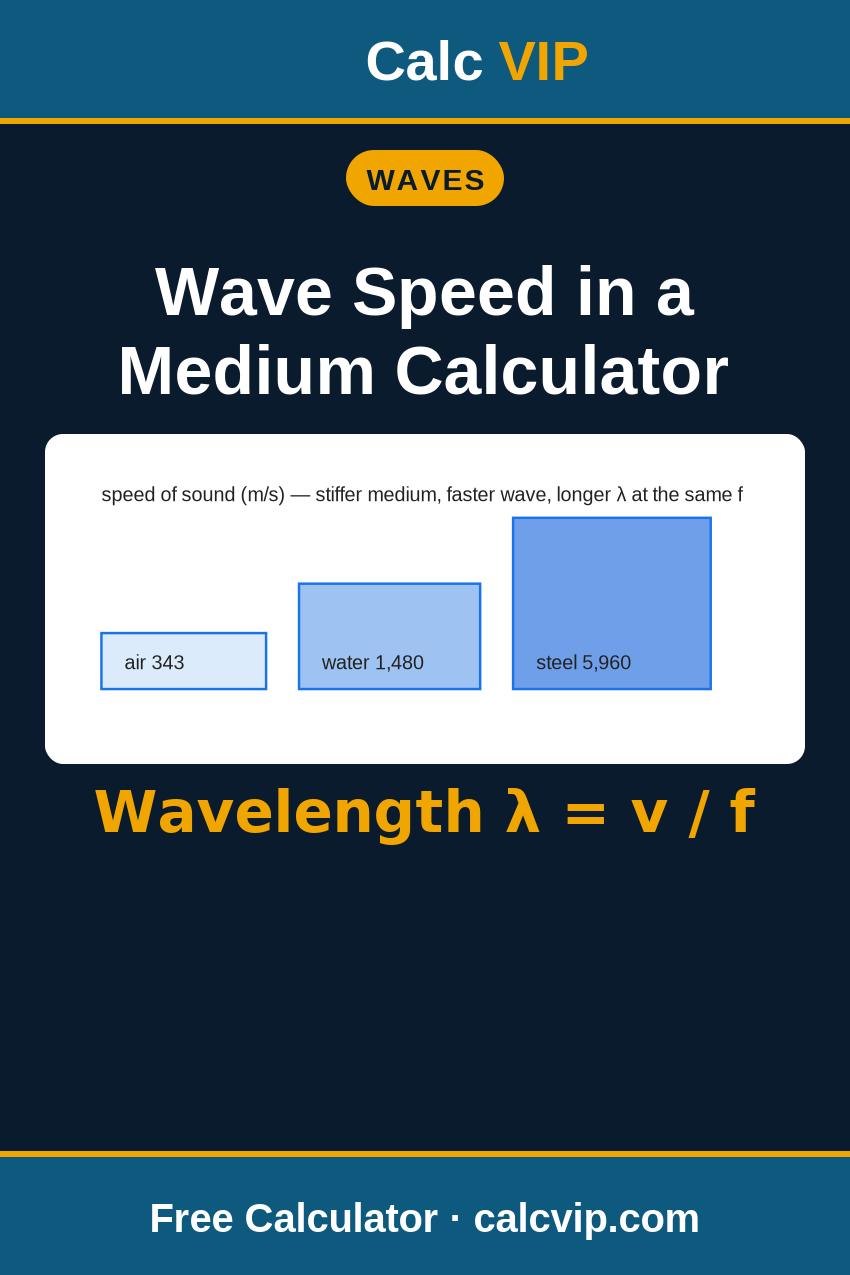
Through every change of medium, one quantity refuses to budge: the frequency. The source vibrates at its own rate — a tuning fork at 440 Hz, a sonar transducer at 40 kHz — and the wave arriving at a boundary cannot pile up or go missing, so the same number of waves per second must leave the boundary in the new medium. With f fixed and v changed, λ = v/f absorbs the whole difference: a 440 Hz note has a wavelength of 0.78 m in air but 3.36 m in water and 13.5 m in steel. Instruments, imaging systems and ears all live with those rescaled wavelengths; this calculator makes the rescaling a two-click job.
Formula
Wavelength λ = v / f • the speed v is a property of the medium; the frequency f is set by the source and does not change when the wave enters a new medium • for fluids, v = √(B/ρ) (B = bulk modulus, ρ = density); for a solid rod, v = √(E/ρ) (E = Young's modulus)
The calculator's job is the first formula; the other two explain where its menu speeds come from. Both say the same thing: the speed is set by a contest between stiffness (the numerator — how violently the material pushes back when squeezed) and inertia (the denominator — how much mass must be moved). Air loses the contest because its bulk modulus is tiny (about 1.4 × 10⁵ Pa); water's is 2.2 × 10⁹ Pa, fifteen thousand times larger, against a density only about 830 times larger — stiffness wins by a landslide, and the speed quadruples. Steel's Young's modulus of 2 × 10¹¹ Pa against a density of 7,850 kg/m³ gives a rod speed near 5,050 m/s, with the 5,960 m/s in the menu being the value for longitudinal waves in bulk steel, where the surrounding material adds constraint. Whichever value a menu offers, λ = v/f then converts it, at your frequency, into the working wavelength.
| Symbol | Meaning | Units |
|---|---|---|
| v | speed of sound in the chosen medium | m/s |
| f | frequency — set by the source, unchanged across media | hertz (Hz) |
| λ | wavelength in that medium | m |
| B, E | bulk modulus (fluids) / Young's modulus (solids) | pascals (Pa) |
| ρ | density of the medium | kg/m³ |
Crossing a boundary: what changes, what cannot
Picture a 740 Hz sonar ping travelling through water (λ = 2 m) that reaches a steel hull. Inside the steel the wave must still oscillate 740 times a second — the hull's surface is being driven at 740 Hz, and it cannot respond at any other rate. But steel carries the disturbance at 5,960 m/s, so the wave inside stretches to λ = 5,960/740 = 8.05 m. Frequency is the wave's identity, preserved at every border; wavelength is its local costume, re-tailored by each medium. The same logic, run in reverse, is why a diver hears a boat's engine as the same pitch the crew hears — muffled and redirected, but at the emitted frequency — while every wavelength-dependent effect (which objects scatter it, which cavities resonate with it) is utterly different underwater.
The boundary also splits the wave's energy: part reflects, part transmits, and the split is governed by how different the media's acoustic impedances (density × speed) are. Air and water differ so enormously that about 99.9% of sound energy striking the surface from either side reflects — the surface of a lake is nearly a perfect mirror for sound, which is why shouting across water carries to a swimmer's ears above the surface but barely reaches a diver below. Steel in water matches better, tissue to tissue better still — which is why medical ultrasound needs coupling gel: it evicts the air film whose impedance mismatch would otherwise reflect the entire pulse before it entered the body.
How to use
- Choose a medium from the list — air at 0 °C or 20 °C, water, or steel — or pick "Custom speed" and type a value of your own (1,540 m/s for soft tissue, 1,530 m/s for seawater, about 3,400 m/s for wood along the grain).
- Enter the frequency of the wave in hertz.
- Click "Calculate Wavelength" to see the speed used and the wavelength in that medium.
- Compare media: rerun the same frequency in air and in water to see the wavelength stretch by the ratio of the speeds — the single most instructive experiment this calculator offers.
Worked examples
Example 1 — the sonar ping. A sonar ping of 740 Hz travels through water, where v = 1,480 m/s.
λ = 1,480 / 740 = 2 m.
The same 740 Hz note in air would have a wavelength of only 343 / 740 = 0.46 m.
Example 2 — a tone in steel. A 1,000 Hz vibration travels along steel.
λ = 5,960 / 1,000 = 5.96 m — a wavelength longer than a car, for a pitch that in air spans a third of a metre. Railway tracks carry such waves for kilometres, which is why putting an ear to a rail (in fiction, at least) reveals a distant train.
Example 3 — cold air. Concert A, 440 Hz, in air at 0 °C (v = 331 m/s):
λ = 331 / 440 = 0.75 m, against 0.78 m at 20 °C. The calculator's two air entries exist for exactly this comparison: temperature is the one medium property that changes with the weather.
Example 4 — the medical scanner. A 5 MHz imaging pulse in soft tissue (custom speed 1,540 m/s):
λ = 1,540 / 5,000,000 = 3.08 × 10⁻⁴ m = 0.31 mm. The wavelength sets the scanner's resolution scale — structures of a millimetre are several wavelengths across and image cleanly.
Example 5 — an earthquake wave. A seismic wave of 1 Hz crosses rock at a custom speed of about 6,000 m/s.
λ = 6,000 / 1 = 6,000 m = 6 km. Earthquake wavelengths are measured in kilometres, which is why seismic waves are felt coherently across whole cities rather than at points.
Example 6 — one note, three media. A 256 Hz tuning fork's note in each medium:
Air: λ = 343 / 256 = 1.34 m. Water: λ = 1,480 / 256 = 5.78 m. Steel: λ = 5,960 / 256 = 23.28 m.
One frequency, three wavelengths spanning a factor of seventeen — the calculator's whole argument in a single row of divisions.
Medium speeds in real life
Sonar design. A sonar's frequency is chosen from the wavelength it needs: to detect a 2 m object the wavelength should be no larger than the target, so in water (1,480 m/s) the frequency should be at least about 740 Hz — Example 1 is a real design calculation, and longer-range sets go lower and accept coarser images.
Medical imaging. Scanner frequencies of 2–15 MHz are wavelength choices: at 1,540 m/s they give λ from 0.77 mm down to 0.10 mm, trading penetration (lower f travels further) against resolution (higher f sees finer detail).
Listening through walls and ground. Sound couples from air into building materials and back, changing wavelength at every layer; geophones and listening devices exploit the fast speeds in solids — a vibration in a steel pipe announces itself at the far end 5,960 m later each second, long before the airborne sound arrives.
Whale and dolphin communication. Underwater, low-frequency whale calls (20 Hz, λ = 74 m in water) travel ocean basins because long waves absorb slowly; dolphins' echolocation clicks (100 kHz, λ = 1.48 cm) trade that range for centimetre detail. Both are λ = v/f strategies.
Ultrasonic cleaning and welding. Cleaning baths work around 40 kHz in water (λ = 3.7 cm), where the wavelength matches the scale of the cavitation bubbles that scrub the parts; plastic welders use similar frequencies in solids to concentrate vibration energy at a joint.
Musical instruments, again. The same note has a different wavelength inside the instrument's material than in air — a steel piano string carries its 440 Hz at a wavelength of metres along the string's own wave speed. Instrument acoustics is a permanent negotiation between media.
Where the speeds come from: stiffness against density
The square-root rules in the Formula section repay a worked test. For water: bulk modulus B = 2.2 × 10⁹ Pa, density ρ = 1,000 kg/m³, so v = √(2.2 × 10⁹ / 1,000) = √(2.2 × 10⁶) = 1,483 m/s — within 0.2% of the menu's 1,480 m/s, from two handbook constants and one square root. For a steel rod: E = 2.0 × 10¹¹ Pa, ρ = 7,850 kg/m³, v = √(2.0 × 10¹¹ / 7,850) ≈ 5,050 m/s; the menu's higher 5,960 m/s is the bulk longitudinal speed, where the material is constrained on all sides and effectively stiffer. For air the same idea uses v = √(γP/ρ) and lands on 331 m/s at 0 °C — and since pressure and density scale together, the speed depends on temperature alone, which is why the calculator's air entries are labelled by temperature and nothing else. Diamond, the stiffest common material, tops the table near 12,000 m/s; lead, dense and soft, manages only about 1,200 m/s along a rod — slower than water. Density alone never decides; the ratio does.
Quick reference: wavelength of a 1,000 Hz tone
| Medium | Speed v | λ at 1,000 Hz |
|---|---|---|
| air at 20 °C | 343 m/s | 0.343 m |
| water | 1,480 m/s | 1.48 m |
| steel | 5,960 m/s | 5.96 m |
| aluminium | 6,320 m/s | 6.32 m |
At 1,000 Hz the wavelength in metres is just the speed divided by a thousand — a numerical coincidence that makes this frequency a handy mental benchmark for any medium whose speed you learn.
The ocean's sound channel: when the medium bends the wave
In the real ocean the speed is not one number but a profile. From the surface down, falling temperature drags the speed down with it; below roughly a kilometre the temperature steadies near freezing and rising pressure takes over, pushing the speed back up. The result is a speed minimum at about 1,000 m depth — typically near 1,480 m/s against 1,520 m/s or more at a tropical surface — and a minimum traps sound the way a valley traps a ball: rays bending towards the slow layer from above and below are returned to it, and can travel thousands of kilometres inside the channel with little loss. Whales appear to exploit this SOFAR channel for their long calls, navies hid listening arrays in it during the Cold War, and the echo times of pulses sent through it are now used to take the temperature of whole ocean basins. It is the boundary rule of this page, applied continuously: wherever the speed changes, the wavelength and the path adjust — and given a gradient everywhere, the wave's whole journey becomes one long negotiation with the medium.
Common mistakes
- Carrying the wavelength across a boundary. The wavelength never survives a change of medium — the frequency does. Recompute λ = v/f with the new medium's speed, every time.
- Assuming denser means slower. Steel is 7,850 times denser than air and carries sound 17 times faster. Stiffness, not density, runs this table; check the ratio before guessing.
- Using the speed of sound in air for an underwater problem. 343 versus 1,480 m/s is a factor of 4.3 — the difference between a wavelength of 0.46 m and 2 m in Example 1. The medium menu is the calculation.
- Forgetting that solids carry several wave types. The menu's steel value is for longitudinal (compressional) waves. Shear waves in steel travel near 3,200 m/s and surface waves slower still — flaw detectors specify which type they time.
- Treating the tissue value as universal. 1,540 m/s is an average for soft tissue; fat is nearer 1,450 m/s and bone above 3,000 m/s. Precision imaging work states the assumed speed alongside every wavelength and depth.
FAQ
What stays the same when a wave changes medium?
The frequency. It is fixed by the source, so when the speed changes the wavelength must change to match (λ = v/f).
Why is sound faster in steel than in air?
Steel is much stiffer, so a push on one atom is passed to the next almost instantly. Although steel is denser, its stiffness wins, giving a speed of about 5,960 m/s.
Does the speed of sound in air depend on the pitch?
Hardly at all — all audible frequencies travel at about the same speed in air, which is why music from a distant band stays in time instead of smearing out.
What is the speed of sound in seawater?
About 1,530 m/s — slightly faster than fresh water's 1,480 m/s, because the dissolved salts raise the stiffness more than the density. It also varies with temperature and depth, which is why sonar operators measure the local value. Enter 1,530 as a custom speed.
Why can't sound travel through a vacuum?
Sound is a relay between particles; a vacuum has no particles to relay. There is no medium, no speed and no wavelength — the one environment where this calculator has nothing to compute.
Does humidity change the wavelength in air?
Slightly: moist air is a little less dense and carries sound up to about 0.3% faster, stretching wavelengths by the same fraction. It is a refinement beneath the temperature effect, which the air entries already capture.
What is the fastest sound speed known?
Diamond carries sound at about 12,000 m/s, thanks to its extreme stiffness and low density. Theoretical work puts the ultimate limit for any material near 36,000 m/s — a bound set by fundamental constants, approached by nothing ordinary.
Why do underwater sounds seem to come from everywhere at once?
Your directional hearing compares arrival times at the two ears, calibrated for 343 m/s. At 1,480 m/s the time differences shrink fourfold and the wavelengths around your head stretch, so the brain's localisation fails — a wavelength problem, experienced from inside.
Can I use this for light in different media?
The same logic applies: light's frequency is fixed by the source, its speed in a medium is c/n, and its wavelength shrinks to λ/n. The calculator is built for sound speeds, but entering a custom speed of 2.26 × 10⁸ m/s (light in water) with an optical frequency gives the in-medium wavelength correctly.
Why is there no single "speed of sound in wood"?
Wood is anisotropic — its stiffness differs along and across the grain, so sound travels at roughly 3,300–5,000 m/s along the grain and far slower across it. Any single number would be a fib; the custom-speed box is the honest way to handle it.