 Calc
Wave Speed Calculator – v = f × λ Wave Speed from Frequency & Wavelength
 Created by David Okafor · Physics Writer · Waves & Light · Last updated: November 2026
Use this free Wave Speed Calculator to find how fast a wave travels using the wave equation v = f × λ. Just enter the frequency and wavelength to get the wave speed.
The wave equation is the closest thing wave physics has to a universal law. Sound in air, light in space, ripples on a pond, vibrations in a guitar string, seismic waves through the Earth — all of them obey v = f × λ, the statement that a wave's speed equals its frequency multiplied by its wavelength. Three quantities, one multiplication, and it works for every wave ever measured. This calculator applies it in the forward direction: give it how often the wave oscillates and how long each oscillation is, and it tells you how fast the pattern travels.
The equation is not a definition imposed from outside; it falls out of what the words mean. A wave of frequency f launches f complete waves every second. Each of those waves occupies a length λ of the road ahead. So in one second, the wave train extends over f × λ of road — which is exactly what "speed" means. Once you see the equation as bookkeeping rather than magic, its rearrangements become obvious too, and its most important lesson stands out: of the three quantities, the speed is the one the medium chooses, the frequency is the one the source chooses, and the wavelength is the negotiator that adjusts so the equation holds.
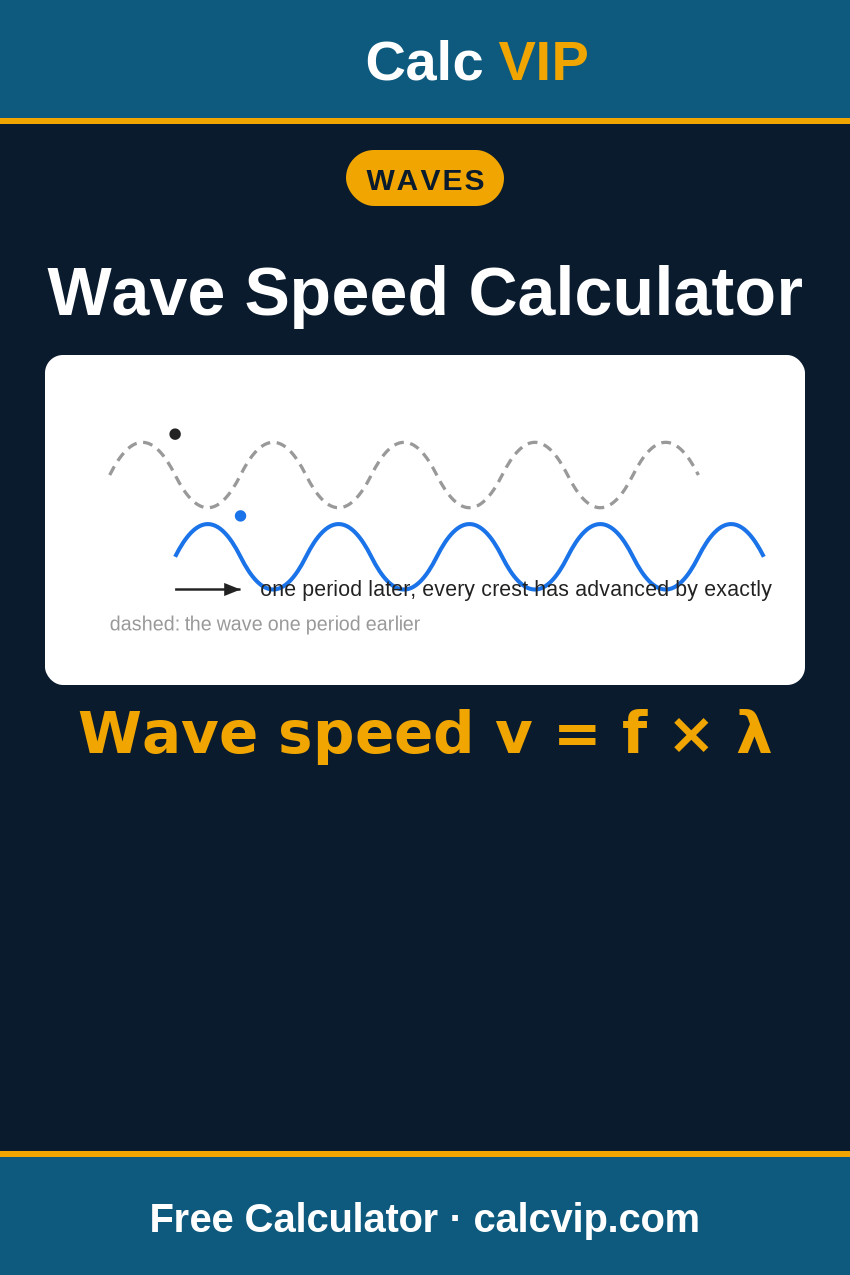
That division of labour explains most wave behaviour you will ever meet. Blow a note on a flute and then play the same note underwater: the frequency, set by your breath and the instrument, is identical, but sound travels over four times faster in water, so the wavelength stretches by the same factor. Change the medium and the speed changes; change the source and the frequency changes; the wavelength quietly absorbs whichever change you made. Keep that picture in mind and the calculator's answers will never surprise you.
Formula
Wave speed v = f × λ • v in metres per second (m/s), f in hertz (Hz), λ in metres (m)
The rearrangements are the other two members of the family: f = v / λ (the Frequency Calculator's wave method) and λ = v / f (the Wavelength Calculator). There is also a period form, v = λ / T, since the wave advances one wavelength in one period — useful when a stopwatch rather than a frequency counter is what you have. Unit discipline is the only real hazard: frequency must be in hertz (so 100 MHz is 100,000,000 Hz), wavelength in metres, and then the speed emerges in m/s, convertible to km/h by multiplying by 3.6 — a conversion this calculator's result line performs for you.
| Symbol | Meaning | Units |
|---|---|---|
| v | wave speed — how fast the pattern travels | m/s |
| f | frequency — complete waves per second | hertz (Hz) |
| λ | wavelength — length of one complete wave | metres (m) |
| T | period — time for one complete wave, T = 1/f | seconds (s) |
What actually sets the speed of a wave
The medium decides the speed, and it decides through a tug-of-war between stiffness and inertia. A stiffer medium snaps back harder when disturbed, passing the disturbance on faster; a denser medium has more mass to shove around, slowing it down. For sound in a gas this becomes v ≈ 331 + 0.6 × T m/s, where T is the temperature in °C — hence 343 m/s at a pleasant 20°C, and hence the squeaky-voice trick with helium, whose light atoms carry sound at about 972 m/s and stretch every wavelength in your throat. For a wave on a stretched string the rule is explicit: v = √(tension ÷ mass per unit length). A guitar string under 100 N of tension with a mass per unit length of 0.01 kg/m carries waves at √(100 ÷ 0.01) = √10,000 = 100 m/s — and tightening the string (more tension) raises the speed, which raises the frequency of the standing waves, which is precisely how the instrument is tuned.
Notice what is absent from both speed laws: the frequency. Within one medium, all frequencies of sound travel together — which is why a distant band still sounds like music rather than a smear of bass arriving before treble. Nature has exceptions, called dispersion, where speed does depend on frequency: deep-water ocean waves travel faster when their wavelength is longer, and glass bends blue light more than red because their speeds in glass differ slightly. But the default — the rule this calculator lives by — is that the medium fixes one speed and every frequency must fit its wavelength to it.
One clarification prevents a deep confusion: the wave speed is the speed of the pattern, not of the material. A water wave crosses a lake while the water itself merely bobs up and down in place — a floating cork traces a small circle and ends where it began. Air molecules in a sound wave oscillate back and forth over micrometres while the sound itself crosses a stadium. Energy and information travel at v; matter mostly stays home. This is why a wave can deliver a message (or an earthquake's punch) across enormous distances without any substance making the journey.
How to use
- Enter the frequency of the wave in hertz (Hz) — the number of complete waves passing a point each second.
- Enter the wavelength in metres — the distance between two neighbouring peaks (marked λ in the diagram).
- Click "Calculate Wave Speed" to see how fast the wave travels, in m/s and km/h.
- Check your answer against the medium: sound in air should come out near 343 m/s and light near 300,000,000 m/s. A result wildly off those landmarks usually means a prefix (kHz, MHz) was not converted.
Worked examples
Example 1 — a water wave. A water wave has a frequency of 50 Hz and a wavelength of 3 m.
v = f × λ = 50 × 3 = 150 m/s
Example 2 — sound in air. A note of frequency 170 Hz has a wavelength of 2 m in air: v = 170 × 2 = 340 m/s — the familiar speed of sound, recovered from a single note's measurements. Any (f, λ) pair for sound in the same air must multiply to this same number; it is a built-in consistency check for lab work.
Example 3 — an FM radio wave. A station at 100 MHz (100,000,000 Hz) broadcasts waves 3 m long: v = 100,000,000 × 3 = 300,000,000 m/s — the speed of light, as it must be, since radio waves are light. The example also shows the equation's range: the same multiplication spans pond ripples and electromagnetic radiation.
Example 4 — an ocean swell. A long Pacific swell has a period of 10 s, so f = 1 ÷ 10 = 0.1 Hz, and a wavelength of 150 m: v = 0.1 × 150 = 15 m/s, which is 15 × 3.6 = 54 km/h — the speed at which storm energy crosses an ocean, and the reason distant storms announce themselves on beaches days ahead of the weather.
Example 5 — a guitar string. The A string of a guitar sounds 110 Hz. The string is 0.65 m long and vibrates in its fundamental mode, so one wavelength spans twice the string: λ = 2 × 0.65 = 1.3 m. The wave speed on the string is v = 110 × 1.3 = 143 m/s — quite different from the 343 m/s of the sound it then launches into the air, and a neat proof that speed belongs to the medium, not to the note.
Wave speed in real life
Counting the thunder. Lightning's flash arrives essentially instantly (light), its thunder at 343 m/s. Count the seconds between them and divide by three: that is the storm's distance in kilometres — pure wave-speed arithmetic, v = distance ÷ time run backwards.
Sonar and echolocation. Ships time sound pulses to the seabed and back at 1,480 m/s (water) to chart depth; bats and dolphins do the same with clicks. Every echo measurement is the wave equation wearing a stopwatch.
Medical ultrasound. Scanners assume sound travels through soft tissue at 1,540 m/s and convert echo times into depths using that speed. If tissue differed much from the assumed value, the image would stretch or squash — the speed is literally the ruler of the picture.
Earthquakes. Seismic waves cross the crust at several kilometres per second — P-waves around 6 km/s. The gap between fast P-waves and slower S-waves at a seismometer tells geologists how far away the quake struck, and three stations triangulate it.
GPS and timing. Your phone locates itself by timing radio signals from satellites at light speed: a timing error of one microsecond is a position error of 300 m, which is why the satellites carry atomic clocks. The wave equation, at 3 × 10⁸ m/s, is the foundation of the whole system.
Musical instruments. Every wind instrument is a device for choosing which wavelength fits inside a tube; every string instrument tunes wave speed via tension. Instrument design is applied v = fλ from end to end.
Testing materials without breaking them. Engineers send ultrasonic pulses through rails, pipelines and aircraft parts and time the echoes: at steel's 5,960 m/s, an echo returning after 34 microseconds has found a reflecting flaw 0.1 m deep (the pulse travelled 0.2 m — down and back). Cracks announce themselves as echoes from places that should be solid, long before they can be seen.
Measuring wave speed yourself
The classic school measurement uses an echo. Stand a known distance from a large flat wall — 85 m, say — and clap sharply; the echo returns after the sound has travelled to the wall and back, 170 m in all. If the round trip takes 0.50 s, then v = 170 ÷ 0.50 = 340 m/s. Timing ten clap-echo cycles and dividing sharpens the result, because human reaction time, the dominant error, is shared across all ten. In the laboratory, the equivalent method for waves on a string or in a tube is to measure f with a signal generator and λ with a ruler on the standing-wave pattern, then multiply — the calculator's own method. The two approaches bookend the subject: v = distance ÷ time when you can follow a pulse, v = f × λ when you can inspect a steady wave.
Tsunamis: a wave whose speed the ocean floor controls
One wave refuses to keep a constant speed, and it matters enormously. A tsunami in the open ocean is a shallow-water wave — its wavelength (hundreds of kilometres) vastly exceeds the ocean's depth — and such waves travel at v = √(g × depth), set by gravity and the water's depth alone. Over a 4,000 m deep ocean that is √(9.81 × 4,000) = √39,240 ≈ 198 m/s, about 713 km/h: jet airliner speed, which is how a tsunami crosses an ocean basin in hours. As the wave reaches shallow coastal water it slows dramatically — at 10 m depth, to √(9.81 × 10) ≈ 10 m/s — and the faster water behind piles into it, compressing the wavelength and forcing the height up from an unremarkable metre at sea to the devastating wall that arrives at the shore. Warning centres race this arithmetic against the wave itself: from the earthquake's location and the ocean-depth map, the arrival time at each coastline is a wave-speed calculation, run for lives.
Quick reference: wave speeds worth knowing
| Wave and medium | Speed |
|---|---|
| sound in air at 20°C | 343 m/s |
| sound in helium at 20°C | 972 m/s |
| sound in fresh water | 1,480 m/s |
| sound in soft body tissue | 1,540 m/s |
| sound in steel | 5,960 m/s |
| seismic P-waves in crust | ≈ 6,000 m/s |
| light in glass (n = 1.50) | 200,000,000 m/s |
| light and radio in vacuum | 300,000,000 m/s |
The spread of the table — five orders of magnitude among the sound speeds alone — is the medium's signature: steel's stiffness wins over its density, helium's lightness wins over everything, and light in vacuum answers to no medium at all, which is why its speed is the universal constant c.
Common mistakes
- Leaving frequency in kHz or MHz. The formula wants hertz. 100 MHz × 3 m gives the speed of light only after the MHz becomes 100,000,000 Hz.
- Expecting a higher pitch to travel faster. In the same medium it does not: raise the frequency and the wavelength shrinks to compensate, keeping v fixed. A chord's notes arrive together.
- Using the period where frequency belongs. v = fλ, or equivalently v = λ/T. Substituting T for f inverts the answer — a 0.1 Hz swell treated as "10" gives a speed a hundred times too big.
- Mixing km/h and m/s. The calculator reports both; by hand, remember m/s × 3.6 = km/h and km/h ÷ 3.6 = m/s, and never multiply f × λ with one unit system while expecting the other.
- Assuming light always travels at c. In glass it manages 2 × 10⁸ m/s, in water 2.25 × 10⁸ m/s. The vacuum value is a ceiling, not a habit — and the slowdown is precisely what refractive index measures.
FAQ
What is the wave equation?
The wave equation v = f × λ links a wave's speed, frequency and wavelength. It applies to every type of wave — sound, light, water waves and waves on a string.
What units should I use?
Use hertz (Hz) for frequency and metres (m) for wavelength, and the speed comes out in metres per second (m/s). For sound in air the answer should be close to 340 m/s.
If the frequency doubles, what happens to the speed?
In the same medium the speed stays the same — instead the wavelength halves, because v = f × λ must stay constant.
What is the speed of sound in water?
About 1,480 m/s in fresh water — roughly 4.3 times faster than in air — because water's stiffness far outweighs its greater density. In seawater it is slightly higher again, around 1,520 m/s, varying with temperature and depth.
Does a louder wave travel faster?
Essentially no. For ordinary sound levels the speed is independent of amplitude; only at extreme intensities (shock waves) does the wave begin to modify its own medium and outrun the normal speed. Loudness rides on the wave; it does not steer it.
Why does sound travel faster on a warm day?
Warmer air molecules move faster and pass the disturbance along more quickly: the speed rises by about 0.6 m/s for every °C. Between a frosty 0°C morning (331 m/s) and a hot 35°C afternoon (352 m/s), the change is over 6% — enough to matter to organ builders, whose pipes drift sharp as the church warms.
Can a wave travel through a vacuum?
Electromagnetic waves — light, radio, X-rays — can and do; they need no medium. Sound and other mechanical waves cannot: with nothing to compress, there is no wave, which is why explosions in space films should be silent.
What is Mach 1 in terms of wave speed?
Mach 1 is the speed of sound in the surrounding air — about 343 m/s at sea level on a mild day, less in the cold air at altitude. An aircraft's Mach number is its speed divided by the local wave speed of sound, so the same true speed is a different Mach number in different weather.
Why do I see lightning before I hear thunder?
Both are waves obeying this page's equation, but at vastly different speeds: light covers the distance at 3 × 10⁸ m/s (effectively instantly), sound at 343 m/s (about 3 seconds per kilometre). The gap between them is a free rangefinder, free to anyone who can count.
Does wave speed ever depend on wavelength?
Yes, in dispersive media: deep-water waves travel faster at longer wavelengths (which is why ocean swells sort themselves by wavelength on long journeys), and light's speed in glass varies slightly with colour, giving prisms their spectra. In air, for sound, dispersion is negligible and this calculator's single speed is the whole story.