 Calc
Thermal Conductivity Solver – Find k from Heat Flow Rate, Area, ΔT & Thickness
 Created by Anna Kowalski · Physics Editor · Heat & Atoms · Last updated: November 2026
Use this free Thermal Conductivity Solver to find a material's k value from a conduction experiment — measure the heat flow rate through a slab of known area, thickness and temperature difference, and rearrange Q/t = kAΔT/d to get k = (Q/t × d)/(A × ΔT).
Every other calculator in the conduction family assumes you already know k. This one exists for the moment you do not — when the material is a mystery board from a supplier, a sample of wall insulation, an unmarked metal bar, a new composite — and its thermal conductivity must be measured rather than looked up. The method is beautifully direct: clamp the sample between a hot face and a cold face, push a measured stream of heat through it, wait for the flow to settle, and read off the four numbers the conduction law needs. The law then runs backwards, and k — the material's thermal fingerprint, the number that decides whether it belongs in a heat sink or a house wall — falls out of the arithmetic.
The fingerprint metaphor is exact. Thermal conductivity is as characteristic of a material as its density or melting point: copper signs its work at about 400 W/m·K, brick at 0.8, wood at 0.15, still air at 0.026, and alloys, foams and composites each land at their own telling values in between. A measured k that refuses to match the label is how mislabelled insulation, adulterated metals and counterfeit building products are caught. Laboratories from school benches to national standards institutes run this same experiment — Searle's bar for metals, Lee's disc for insulators, the guarded hot plate for building materials — differing only in the care taken to make the heat flow honest.
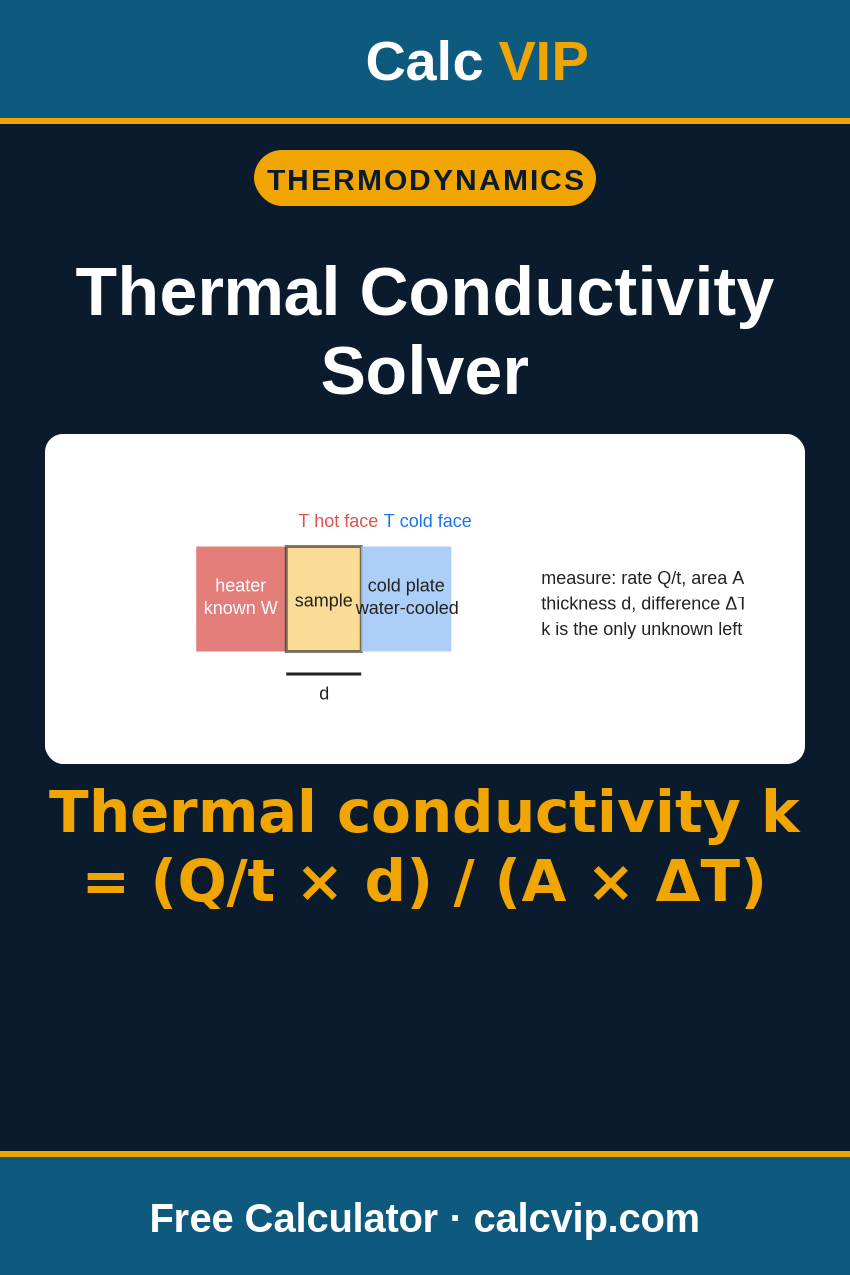
That care is the whole experiment, and it is worth understanding before trusting a result. The formula counts only the heat that crosses the sample's faces, so the apparatus must stop heat leaking out of the edges, slipping past the sides, or hiding in the thermometer pockets. Above all it must wait: until steady state arrives — the same watts entering one face as leave the other, temperatures steady — early readings describe the sample warming up, not conducting. Give the solver a genuinely steady rate, an honest area and thickness, and face temperatures measured at the faces, and it returns the k that the conduction calculator on this site will happily spend on predictions.
Formula
Thermal conductivity k = (Q/t × d) / (A × ΔT) — the conduction law Q/t = kAΔT/d rearranged. Here Q/t is the measured heat flow rate (W), d is the slab thickness (m), A is the area (m²) and ΔT is the temperature difference across the slab (K). The unit of k is W/m·K.
Read the rearrangement as a recipe for a fair test. The measured rate Q/t is what the sample let through; multiplying by d asks what it would pass if it were a metre thick, and dividing by A × ΔT normalises away the size of the sample and the size of the push — leaving a number that belongs to the material alone, reproducible by any laboratory with any sample shape. That normalisation is why k can be tabulated at all. It is also why the formula punishes sloppy inputs asymmetrically: thickness enters once, but an air gap at a face falsifies ΔT itself, and a rate measured before steady state is not the sample's rate at all. The solver is exact; the experiment must deserve it.
| Symbol | Meaning | Units |
|---|---|---|
| k | thermal conductivity of the sample (the unknown) | W/m·K |
| Q/t | measured steady heat flow rate through the sample | W |
| d | sample thickness (direction of flow) | m |
| A | cross-sectional area of the sample | m² |
| ΔT | temperature difference between the two faces | K (same size in °C) |
Two classic benches: Searle's bar and Lee's disc
For good conductors the school and university standard is Searle's bar: a long metal rod, lagged along its length, heated at one end by steam and cooled at the other by a steady stream of water. Four thermometers sit in pockets along the bar, and in steady state their readings fall on a straight line — the temperature gradient made visible. The heat current is measured not electrically but by the cooling water itself: its flow rate and temperature rise give Q/t by Q = mcΔT, the specific heat equation moonlighting as a wattmeter. The bar's k then comes from the same rearrangement as this page, with the gradient ΔT/d read off the thermometer spacing. Example 2 below is a Searle measurement, and its answer — 400, copper — is the classic result generations of students have landed on.
Bad conductors defeat the bar: too little heat flows to measure against the leaks. For them the classic is Lee's disc — a thin disc of the sample sandwiched between a steam chest and a brass disc, allowed to reach steady state, after which the brass disc is removed and its cooling curve near the steady temperature is timed. The cooling rate of a known mass of brass (mc again, times its rate of temperature fall) reveals the trickle of heat that was crossing the sample. Modern building-materials laboratories use the guarded hot plate: a central heater whose every watt is forced through the sample by guard heaters that cancel edge leaks sideways — the same idea as Lee's and Searle's, armoured in feedback electronics, and accurate enough to certify the insulation boards that go into walls.
Both classics teach the same lesson about what can go wrong. Every design is a siege against stray heat: lagging, guards, and patience. And both measure ΔT at the sample's faces or as near as drilling allows, because a degree dropped in a bad contact — an air film, a loose thermometer — is a degree the formula will blame on the sample, and k will come out low. When a measured k disappoints, the sample is usually innocent and the interfaces are guilty.
How to use
- Enter the heat flow rate measured through the slab, in watts.
- Enter the thickness in metres, the area in square metres, and the temperature difference between the faces.
- Click "Solve for k" to get the thermal conductivity in W/m·K.
- Compare with known materials: copper ≈ 400, glass ≈ 1.0, brick ≈ 0.8, wood ≈ 0.15, still air ≈ 0.026.
- If the answer lands between two known materials, suspect the experiment before the sample — check steady state, face contact and edge leaks, then measure again.
Worked examples
Example 1 — the reference wall. A wall section passes 600 W of heat. The slab is 0.2 m thick, has area 10 m², and the faces differ by 15 K.
k = (600 × 0.2) / (10 × 15) = 120 / 150 = 0.8 W/m·K — the value for brick.
Example 2 — Searle's bar finds copper. A metal bar conducts 40 W; the thermometers span 0.5 m of its length, its cross-section is 0.001 m², and the temperature falls 50 K along the measured stretch.
k = (40 × 0.5) / (0.001 × 50) = 20 / 0.05 = 400 W/m·K — copper, identified by heat alone. (Check forwards: 400 × 0.001 × 50 / 0.5 = 40 W, the measured rate.)
Example 3 — certifying a foam board. A test rig pushes 12 W through a foam sample 0.05 m thick and 1 m² in area, holding 20 K across it.
k = (12 × 0.05) / (1 × 20) = 0.6 / 20 = 0.03 W/m·K — genuine insulation-grade foam, matching its label. This is precisely the guarded-hot-plate test, at classroom scale.
Example 4 — a wooden board. A board passes 750 W in a large test wall: thickness 0.02 m, area 4 m², ΔT = 25 K.
k = (750 × 0.02) / (4 × 25) = 15 / 100 = 0.15 W/m·K — wood, as expected; the test confirms the timber is what the invoice claims and not a denser, more conductive substitute.
Example 5 — identifying a glass. A pane sample passes 4,000 W: thickness 0.004 m (4 mm), area 2 m², ΔT = 8 K.
k = (4,000 × 0.004) / (2 × 8) = 16 / 16 = 1.0 W/m·K — ordinary soda glass. Note how a modest ΔT across a thin, wide sample still moves kilowatts; thinness is a conductor's accomplice whatever the material.
Example 6 — the still-air benchmark. A carefully guarded air gap passes just 1.3 W: thickness 0.1 m, area 0.5 m², ΔT = 10 K.
k = (1.3 × 0.1) / (0.5 × 10) = 0.13 / 5 = 0.026 W/m·K — still air itself, the benchmark every insulator tries to bottle. Copper conducts some 15,000 times faster; the entire insulation industry lives in the gap between those two numbers.
Measured k in real life
Certifying insulation products. Building regulations assume the k printed on the datasheet. Manufacturers prove it — and regulators spot-check it — with guarded-hot-plate measurements exactly like Example 3's. A batch of boards measuring 0.045 against a declared 0.032 does not merely fail a test; it fails every wall built with it, on paper and in January.
Sorting scrap and catching counterfeits. A handheld conduction probe is a quick lie detector for metals: copper at 400, aluminium at 237, and their cheap imitations land far away. Recyclers grade scrap this way, and more than one "copper" cable shipment has been unmasked by its k long before any chemical assay.
Geothermal and ground engineering. How fast a borehole can exchange heat with the ground depends on the rock's k, which varies several-fold between clay, sandstone and granite. Designers measure core samples with this formula before sizing a ground-source heat pump's loop field; guess wrong and the system is starved or the drilling bill doubles.
Electronics potting and interfaces. The compounds that pot power electronics are sold on their k — modest numbers, 1–3 W/m·K, but ten times better than the air they displace. Buyers verify with slab tests like this page's, because a potting compound at half its promised k is a warranty claim with a fuse lit.
Building forensics. When a renovated wall grows mould, the investigator's question is thermal: where is the cold stripe? Measuring the actual k of the as-built layers — often different from the drawings, thanks to substitutions and damp — locates the layer that is not performing. The formula is the detective; the wall confesses through its temperatures.
Food and freeze engineering. Freezing times for everything from peas to beef sides are computed from the food's k, which changes as it freezes (ice conducts better than water). Producers measure k for each product state rather than trusting tables — a blast freezer's schedule is this solver's output, industrialised.
Guarding the measurement: where errors creep in
Three thieves steal from every conduction measurement, and good apparatus is designed around all three. The first is time: before steady state, part of the heater's output is busy warming the sample itself, so the rate leaving the cold face is less than the rate entering — measure too early and k comes out low and drifting. The professional habit is to log temperatures until they stop moving, then wait half as long again. The second thief is contact: a hair of air trapped between heater, sample and cold plate is a layer of k = 0.026 in series with your sample, dropping temperature that the formula will blame on the sample. Thermal paste, flat faces and firm clamping are the countermeasures, and in careful work the thermometers are embedded in the sample itself, not the plates. The third is leakage: heat that escapes sideways never crosses the far face at all. Lagging helps; guard heaters — auxiliary heaters held at the sample's edge temperature so no sideways gradient exists — abolish it. When a student measurement and a datasheet disagree, the order of suspicion is fixed: timing, contacts, leaks, and only then the material.
Quick reference: identification table
| Measured k (W/m·K) | Likely material | Verdict |
|---|---|---|
| ≈ 0.026 | still air | the floor of the scale — nothing common beats it |
| 0.03–0.04 | foam, fibreglass | insulation grade — fit for walls and lofts |
| ≈ 0.15 | wood | a middling natural insulator |
| ≈ 0.8 | brick | structural, not thermal, performance |
| ≈ 1.0 | glass, concrete | the boundary of "conducts noticeably" |
| ≈ 16 | stainless steel | alloying has taxed iron's conductivity heavily |
| ≈ 50 | carbon steel | structure that also spreads heat |
| ≈ 237 | aluminium | heat-sink territory |
| ≈ 400 | copper | the practical champion conductor |
Use the table as a first interview, not a verdict: k values overlap between families (a damp brick and a dry concrete can trade places), and moisture is the great confounder — water filling a porous insulator's air pockets can double or treble its measured k, which is why standards specify the sample's conditioning as carefully as the apparatus.
Common mistakes
- Measuring before steady state. The rate on the cold side lags the heater while the sample warms. A k computed from a still-climbing temperature set is a k of the warm-up, not the material — and it always reads low. Wait for flat lines, then wait longer.
- Blaming the sample for its contacts. An air film at either face drops temperature outside the sample but inside your ΔT, and the formula charges it to the material. If a known material measures low, clean, flatten, paste and re-clamp before doubting the tables.
- Confusing face area with edge area. A is the cross-section the heat flows through — the big flat face of a slab, the circular cross-section of a bar. Using the bar's surface area or the slab's edge area scrambles the result by orders of magnitude.
- Taking ΔT from the room and the heater dial. ΔT belongs to the sample's two faces. The heater may be at 100 °C and the room at 20 °C while the faces themselves sit at 92 °C and 24 °C; the 80 K difference gives a very different k from the true 68 K. Measure at the faces, or embed the sensors.
- Thickness in centimetres. As everywhere in conduction, d is in metres. A 5 cm foam board entered as 5 instead of 0.05 inflates k a hundredfold — turning insulation into an apparent conductor and sending the experimenter hunting for a fault that lives only in the units.
FAQ
What does a high or low k mean?
A high k means the material conducts heat quickly (metals, hundreds of W/m·K) and makes a poor insulator. A low k means slow conduction — good insulating materials such as foam and fibreglass are below 0.05 W/m·K.
How is k measured in a real lab?
One face of a sample is kept hot and the other cold, the steady heat flow is measured with a heater of known power, and this formula is applied — the same arrangement as the classic Searle's bar experiment for metals.
Does k depend on temperature?
Slightly, for most materials, but in school and engineering calculations it is treated as a constant for each material over a moderate temperature range.
How does this solver differ from the conduction calculator?
They are the same law read in opposite directions. The conduction calculator spends a known k to predict a heat flow; this solver measures a heat flow to discover an unknown k. Laboratories use the second to earn the numbers that everyone else looks up for the first.
Can I measure the k of a liquid or gas this way?
Not honestly with a simple slab: fluids convect, and the moving fluid carries heat far faster than conduction alone, so the "k" you compute is an inflated mixture of both. Fluid conductivities are measured with transient hot-wire instruments that read the temperature before convection can organise itself — a reminder that every method has a regime where its assumptions hold.
Why do alloys conduct so much worse than pure metals?
The electrons that carry heat in metals are scattered by disorder, and alloying is organised disorder: foreign atoms strewn through the lattice deflect the electron traffic constantly. Pure iron manages about 80 W/m·K; add carbon and it falls to about 50; add chromium and nickel for stainless steel and it collapses to about 16 — the price of corrosion resistance, paid in conductivity.
How accurate is a school measurement of k?
Within 10–20% on a good day for Searle's bar, worse for improvised insulator rigs — the thieves named in the guarding section see to that. Professional guarded-hot-plate work reaches 1–2%. The gap between those figures is not the formula, which is exact, but the experimental hygiene around it.
My measured k for brick came out at 0.4, half the table value. What is wrong?
Work the usual suspects in order: the run was stopped before steady state; a face contact was poor (an air film steals ΔT); the sample was thicker than recorded, or the area smaller; or the brick was genuinely a lighter, more porous specimen than the table's — brick is a family, not a substance, and its k honestly ranges from about 0.5 to 1.3 with density and moisture.
Does moisture really change k that much?
Yes — water (k ≈ 0.6) conducts about twenty-three times better than the air (0.026) it displaces in a porous material's pores. A rain-soaked insulation board or a damp brick wall is, thermally, a different and worse product than the dry one that was certified. It is why insulation is kept dry by design and why k is always quoted for a stated moisture content.
Who were Searle and Lee?
George Searle, a Cambridge physicist, whose bar method became the standard undergraduate measurement for metals; and R. W. Lee, whose disc method (1904-era textbooks attach his name to it) did the same service for poor conductors, which the bar cannot handle. Between them they equipped a century of laboratories to run this page's rearrangement with brass, steam and patience.