Calc
Thermal Resistance Calculator – R = d/kA for Layers in Series
 Created by Anna Kowalski · Physics Editor · Heat & Atoms · Last updated: November 2026
Use this free Thermal Resistance Calculator to find the thermal resistance R = d/(kA) of a single layer, or of up to 3 layers in series. Enter the area and each layer's thickness and conductivity — the tool shows every layer's R and the combined total.
Heat flowing through a wall behaves so much like current flowing through a circuit that engineers long ago gave the wall a resistance. Thermal resistance R measures how hard a layer fights the flow of heat: it grows with thickness, shrinks with area, and is set by the material's thermal conductivity k — the one property that separates brick from insulation board by a factor of twenty. Stack layers and their resistances simply add, exactly like electrical resistors in series, because the same heat current must fight its way through each layer in turn. Once you hold R, the heat flow for any temperature difference is a single division away: Q = ΔT/R, Ohm's law wearing a winter coat.
Two versions of the quantity circulate, and confusing them is the field's favourite error. The absolute resistance R = d/(kA), in K/W, describes one actual piece of material of one actual size — this wall panel, this window. The area-free version r = d/k, in m²·K/W — often itself called the R-value — describes the layer as a material specification, independent of how much of it you have. This calculator reports both, because you need r to compare materials and products, and R to compute the heat your actual building loses.
The inputs are deliberately few: a thickness, a conductivity, an area. Everything else — which layer dominates a wall's behaviour, whether doubling insulation is worth it, why a steel beam bridging a wall leaks heat — falls out of how d, k and A combine. The sections below work through that arithmetic, including the uncomfortable truth the worked example exposes: in most real walls, one layer does nearly all the insulating and the rest are structural passengers.
Formula
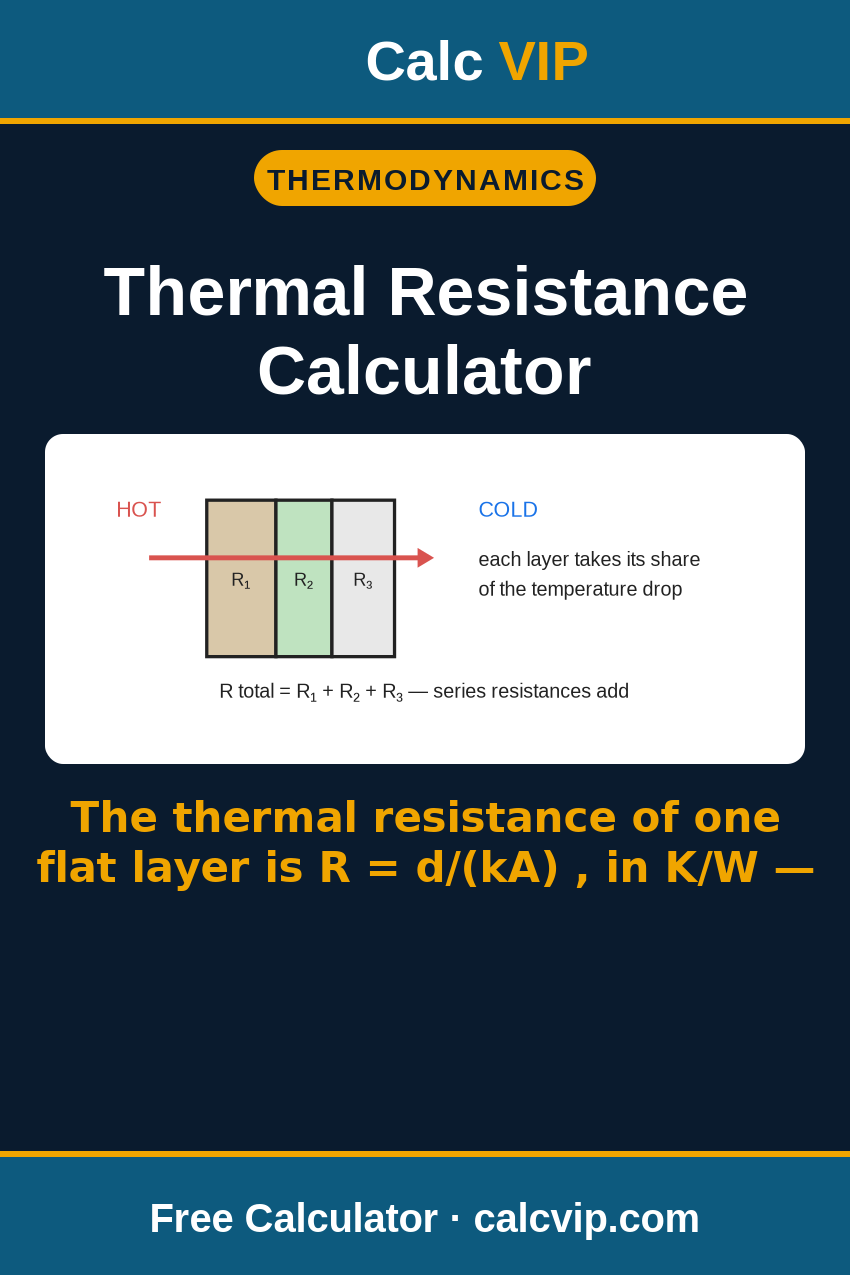
The thermal resistance of one flat layer is R = d/(kA), in K/W — where d is the thickness (m), k is the thermal conductivity (W/m·K) and A is the area (m²). The resistance per unit area (often called the layer's R-value) is r = d/k in m²·K/W. Layers stacked in series add: Rtotal = R₁ + R₂ + R₃. A bigger R means a better insulator: the heat flow through the stack is Q = ΔT/Rtotal.
The formula is Fourier's law of conduction rearranged: the heat flow through a slab is Q = kAΔT/d, and grouping everything except ΔT into one resistance gives Q = ΔT/R with R = d/(kA). The electrical analogy then runs the whole toolbox — series layers add their R; parallel paths (a wall and its window) add their conductances; and the temperature drop across any one layer is its share of the total R times the total ΔT, exactly a voltage divider. The U-value that building regulations quote is the per-area conductance: U = 1/rtotal in W/m²·K.
| Symbol | Meaning | Units |
|---|---|---|
| R | thermal resistance of a specific piece/layer | K/W |
| r | resistance per unit area (the layer's R-value) | m²·K/W |
| d | layer thickness | m |
| k | thermal conductivity of the material | W/m·K |
| A | area the heat flows through | m² |
| U | overall conductance per area, U = 1/r total | W/m²·K |
Conductivity: the one number that decides everything
All the drama in thermal resistance lives in k. Materials span an astonishing range: still air manages 0.026 W/m·K, good insulation foams and fibres cluster around 0.035–0.045, timber is near 0.15, brick 0.8, glass 1.0, concrete around 1.4 — and then the metals leave the chart entirely, with steel near 50, aluminium 237 and copper 401. Four orders of magnitude separate the best common insulator from the best conductor, which is why a centimetre of foam out-insulates a metre of brick, and why a metal spoon in soup becomes untouchable while a wooden one stays kind.
The microscopic story is about carriers. In metals, free electrons ferry energy swiftly — the same electrons that carry current, which is why good electrical conductors are good thermal conductors without exception. In non-metals, heat travels as lattice vibrations (phonons) handed neighbour to neighbour, a slower bucket-brigade; in gases and foams it is slower still, because the carriers are sparse molecules — which is precisely why insulation is mostly trapped air wearing a fibrous or foamy skeleton. Every insulation product is a scheme for holding air still: still air insulates; moving air (convection) betrays the scheme.
How to use
- Enter the area the heat flows through.
- Fill in layer 1 (always needed). Add layers 2 and 3 only if present — leave both boxes of an unused layer blank.
- Typical k values: insulation ≈ 0.04, wood ≈ 0.15, plaster ≈ 0.5, brick ≈ 0.8, glass ≈ 1.0 W/m·K.
- Click "Calculate Resistance" to see each layer's R (and its per-area r-value) plus the series total.
- To turn the total into a heat loss, divide your temperature difference by R total: Q = ΔT/R. To get the U-value, take U = 1/r total.
Worked examples
Example 1 — insulation versus brick. A panel of area 5 m² has two layers: insulation (d = 0.1 m, k = 0.04) and brick (d = 0.2 m, k = 0.8).
R₁ = 0.1/(0.04 × 5) = 0.5 K/W (r₁ = 0.1/0.04 = 2.5 m²·K/W)
R₂ = 0.2/(0.8 × 5) = 0.05 K/W (r₂ = 0.2/0.8 = 0.25 m²·K/W)
Rtotal = 0.5 + 0.05 = 0.55 K/W, with total r = 2.75 m²·K/W.
The 10 cm of insulation resists heat flow 10× more strongly than the 20 cm of brick.
Example 2 — the single glass pane. A window of 2 m², glass 4 mm thick (d = 0.004 m, k = 1.0):
R = 0.004/(1.0 × 2) = 0.002 K/W, r = 0.004 m²·K/W. The glass itself is a negligible resistance — a real window's U ≈ 5.8 W/m²·K comes almost entirely from the thin air films clinging to its surfaces, not from the glass at all (see the surface-resistance section).
Example 3 — doubling the insulation. Double Example 1's insulation to 0.2 m:
R₁ = 0.2/(0.04 × 5) = 1.0 K/W. Resistance is proportional to thickness, so the panel's insulation layer doubles its contribution — the simplest upgrade in building physics, with linearly diminishing company from the unchanged brick.
Example 4 — a wooden door. A door of 2 m², 40 mm of timber (k = 0.15):
R = 0.04/(0.15 × 2) = 0.13 K/W, r = 0.04/0.15 = 0.27 m²·K/W — better than the brick of Example 1 per layer, worse than any real insulation: wood is a mediocre insulator that happens to be structural.
Example 5 — from resistance to heat loss. Put Example 1's panel (R total = 0.55 K/W) between a room and a winter night with ΔT = 25 K:
Q = ΔT/R = 25 / 0.55 = 45.45 W — a small heater's worth escaping through 5 m². Remove the insulation (R = 0.05) and the same panel would leak 500 W: the insulation layer alone is doing 90% of the work.
Example 6 — the steel plate that isn't there. A steel sheet 10 mm thick, area 1 m², k = 50:
R = 0.01/(50 × 1) = 0.0002 K/W — for thermal purposes, a hole in the wall. This is why steel beams and fixings that bridge an insulated wall ("thermal bridges") matter out of all proportion to their size.
Thermal resistance in real life
Building insulation and energy ratings. Wall, roof and floor specifications are written in r-values and U-values derived from exactly this sum. The insulation layer dominates the total, which is why retrofit money goes to thickness of foam and fibre, not to exotic bricks.
Electronics cooling. A chip's heat sink is specified in K/W — the same R. A processor dissipating 50 W through a 0.5 K/W sink rises 25 K above the air; thermal paste exists to erase the extra resistance of imperfect contact between the surfaces.
Clothing and sleeping bags. The clo and tog units are thermal resistances in disguise (1 tog = 0.1 m²·K/W). Down and fleece insulate by trapping still air — the body's insulation layer is the trapped-air layer, exactly as in a wall.
Double glazing. Two panes with a 16 mm air (or argon) gap: the gap's still gas supplies most of the resistance, the glass nearly none — which is why widening the gap helps up to the point where convection starts inside it, and no further.
Cold-chain packaging. Vaccine and food shippers are sized by R: the box's resistance and the ice's latent heat together set how many hours the contents stay in range. The calculation is this page's, with a phase-change battery attached.
Industrial lagging. Steam pipes are wrapped so their surface stays touchable and their heat stays in the process; the lagging thickness is chosen from R = d/(kA) applied to a cylinder — the flat-layer formula's close cousin.
The resistances you cannot see: surface films
The layers in this calculator are solids, but heat must also cross the thin films of nearly-still air clinging to each face of a wall — and those films resist. Building physics adds them as surface resistances: typically r ≈ 0.13 m²·K/W for an inside surface and 0.04 for an outside one exposed to wind. For a well-insulated wall (r total of 3+) they are a rounding error; for a single sheet of glass (r = 0.004) they are essentially the whole story — add both films and the pane's effective r becomes ≈ 0.174, giving U ≈ 5.7 W/m²·K, the textbook figure for single glazing. Honest wall calculations include the films; this calculator gives you the solid layers' sum to which they are added.
A third invisible resistance hides between the layers themselves. Two solids pressed together touch only at microscopic high spots; the rest of the interface is tiny air gaps, and air — for all its virtues as bulk insulation — is a poor bridge across a joint that is supposed to conduct. This contact resistance is why electronics uses thermal paste, why steam flanges are torqued to specification, and why a wall's real performance can fall short of its layer sum when boards are badly fitted: a 1 mm air gap left by poor workmanship adds r = 0.001/0.026 ≈ 0.038 m²·K/W where none was designed, and a gap wide enough to convect behaves worse and unpredictably. The series sum assumes the layers are in perfect thermal communion; workmanship decides how true that is.
The electronics industry quantifies the joint with interface materials — pastes, pads and phase-change foils — precisely because a dry joint can add as much resistance as the heat sink it feeds. A processor rated at 0.5 K/W from case to air may secretly spend half of that budget crossing two imperfect interfaces, which is why mounting pressure, surface flatness and a pea-sized dot of paste feature in serious thermal design reviews. Resistance, like friction, lives at the surfaces as much as in the bulk.
Imperial R-values: the other dialect
North American building practice quotes R-values in imperial units — h·ft²·°F/BTU — which are not this page's r, though they measure the same thing. The conversion is 1 m²·K/W = 5.678 h·ft²·°F/BTU. Example 1's panel, r total 2.75 m²·K/W, is therefore an "R-15.6" wall in American lumber-yard language — respectable, short of the R-20+ that cold-climate codes ask of new walls. When a product sheet quotes R without units, check the dialect before comparing: the same insulation batt is R-3.9 per inch in imperial and r ≈ 0.68 m²·K/W per 25 mm in metric, and mixing the two has embarrassed more than one specification.
Quick reference: conductivity k of common materials
| Material | k (W/m·K) | r of a 10 cm layer (m²·K/W) |
|---|---|---|
| Still air | 0.026 | 3.85 |
| Insulation foam/fibre | 0.04 | 2.50 |
| Wood (softwood) | 0.15 | 0.67 |
| Plaster | 0.5 | 0.20 |
| Brick | 0.8 | 0.125 |
| Glass | 1.0 | 0.10 |
| Concrete | 1.4 | 0.07 |
| Steel | 50 | 0.002 |
| Copper | 401 | 0.00025 |
Read the right-hand column as a shopping list in reverse: the materials that build structures cluster at the bottom, and the materials that insulate are barely materials at all — mostly organised air.
Common mistakes
- Confusing R (K/W) with r (m²·K/W). They differ by the area, and quoting one as the other corrupts everything downstream. R belongs to a specific piece; r belongs to a layer specification. This calculator labels both — honour the labels.
- Entering thickness in centimetres. The formula wants metres. A 10 cm insulation layer entered as "10" returns a resistance a hundred times too large and a wall that appears to defy physics.
- Adding U-values instead of resistances. Layers in series add their R (or r); U is the reciprocal of the total. Averaging or adding the layers' individual U-values is the most common spreadsheet error in the field.
- Forgetting the surface films on thin assemblies. For glass, metal sheet and other low-r layers, the inside and outside air films (≈ 0.13 + 0.04 m²·K/W) exceed the material's own resistance. Omitting them overstates the heat loss of a window several-fold.
- Ignoring thermal bridges. The series sum assumes one uniform stack. A steel stud or beam crossing the insulation is a parallel path with near-zero resistance; the wall's true performance is the area-weighted combination, and the bridge can halve it.
FAQ
What is the difference between R and the r-value (d/k)?
R = d/(kA) describes one actual piece of material of a given size, in K/W. The r-value r = d/k leaves the area out (m²·K/W), so it rates the layer itself and lets you compare materials directly — double the thickness, double the r-value.
Why do series resistances add?
The same heat current must pass through every layer in turn, and each layer "uses up" part of the temperature difference. Like electrical resistors in series, the total opposition is the sum of the parts.
How is this related to the U-value?
The U-value is the per-area version turned upside down: U = 1/rtotal. For the worked example, U = 1/2.75 ≈ 0.36 W/m²·K — a respectably insulated panel.
Does a bigger wall area change the insulation quality?
It changes R (double the area, half the K/W, double the total heat flow) but not r or U, which are area-free. A bigger wall loses more heat in total while being, square metre for square metre, exactly as good.
Which layer should I upgrade first?
The finished wall's weakest link is rarely the problem — the total is dominated by its largest term, so upgrades pay best where they raise the total most cheaply: usually adding insulation thickness, since the structural layers contribute almost nothing to resist.
Why is trapped air such a good insulator?
Air's k is very low (0.026), but a thick open layer of air convects and betrays itself. Fibres and foams divide air into pockets too small to circulate, keeping the low k while killing the convection — the skeleton contributes almost nothing but stillness.
What R do building codes require?
It varies by climate and element, but modern codes commonly demand wall U-values of 0.3 W/m²·K or lower — r total of 3.3+ — with roofs stricter still. Example 1's panel (U = 0.36) sits close to typical minimums.
Can thermal resistance be negative or zero?
No. Every real layer has d > 0 and finite k, so R > 0 always. Vacuum panels approach the practical ceiling by removing the gas conduction path almost entirely, reaching r-values several times those of foam at the same thickness.
How does this apply to a pipe or a sphere?
The geometry changes the formula — for a cylindrical shell, R involves the logarithm of the radius ratio — but the ideas (series addition, Q = ΔT/R) survive intact. Flat-layer R is the slab case of a general framework.
Is a higher k ever desirable?
Constantly — wherever heat must move rather than stay: heat sinks, cookware bases, engine blocks and heat-exchanger fins are all chosen for high k. Resistance is a tool, not a virtue; the engineering is in placing it where you want it.