 Calc
Water Heating Time Calculator – Kettle Time, Energy & Cost
 Created by Anna Kowalski · Physics Editor · Heat & Atoms · Last updated: November 2026
Use this free Water Heating Time Calculator to find how long a heater or kettle takes to heat water: time = mcΔT / P. Enter the amount of water, the start and target temperatures and the heater power — and optionally your electricity rate to see the running cost.
Every kettle is a race between two numbers: the energy the water demands, and the rate at which the element can supply it. The demand is set by Q = mcΔT — mass times water's stubbornly large specific heat times the temperature climb. The supply rate is the heater's power, its watts, which are simply joules per second. Divide demand by rate and you get the only answer anyone actually waits for: the time. This calculator does that division, then goes one step further and prices the wait in kilowatt-hours and money.
Water makes the race slow. Its specific heat — 4,186 joules to warm a single kilogram by one degree — is among the highest of any everyday substance, a tax levied by its hydrogen bonds. A litre heated through 75 degrees, tap-cold to boiling, needs 313,950 joules — and for the 1.5-litre kettle of the worked example the demand is 470,925 J, nearly half a megajoule, for a pot of tea. This is why kettles are among the most powerful appliances in the home — 2,000 to 3,000 W, rivalling an oven — and why they still take minutes.
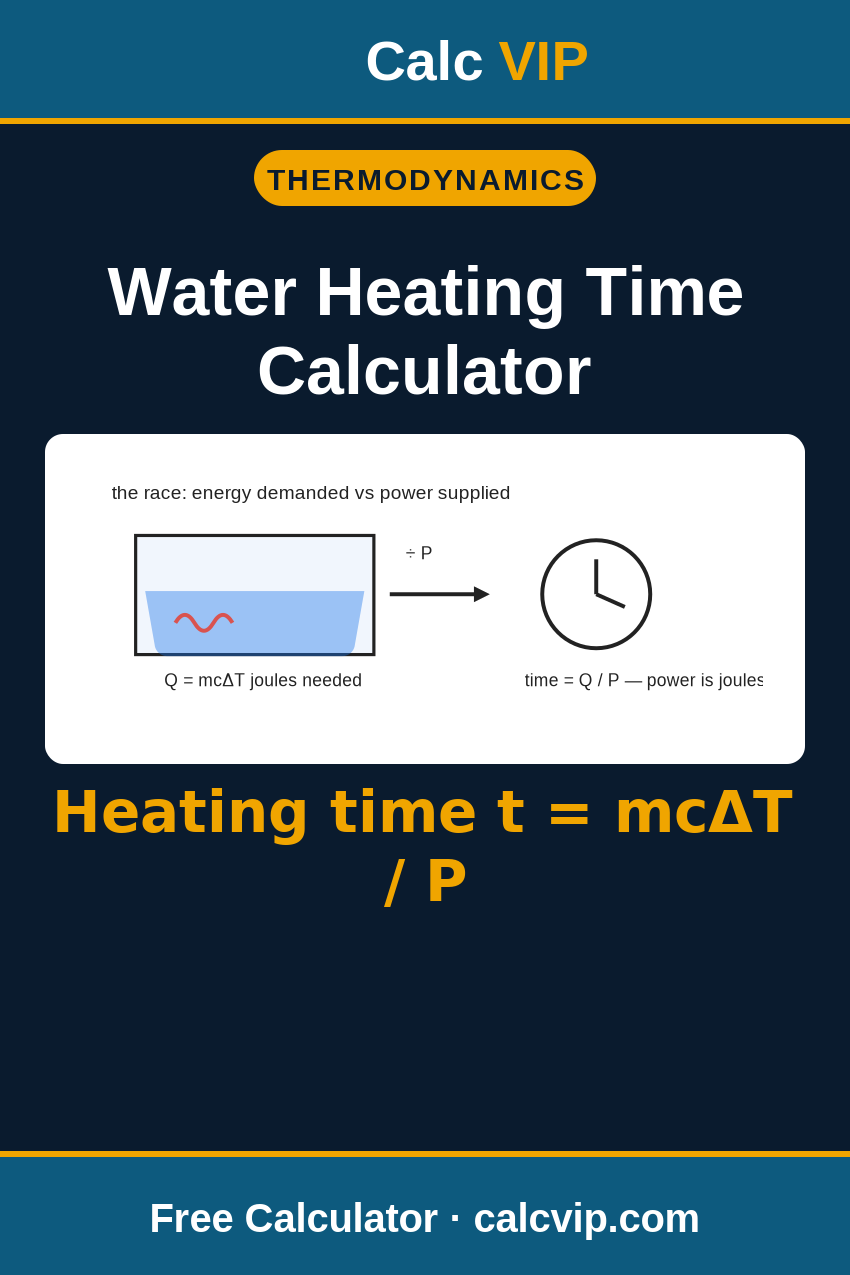
The formula assumes perfection: every joule from the element lands in the water, none warms the jug, the air or the kitchen. Real kettles run at 80–90% efficiency, so treat the computed time as the floor — the fastest the laws of physics permit — and expect the real appliance to take a tenth or so longer. The cost figure needs no such apology: the meter charges for energy drawn, and the energy the water receives is the honest lower bound of the bill.
Formula
Heating time t = mcΔT / P • with Q = mcΔT, c = 4,186 J/(kg·°C) for water, P in watts (J/s), t in seconds
Each piece rearranges usefully. Want the power needed for a deadline? P = mcΔT / t. Want the temperature rise a given heater delivers in a given time? ΔT = Pt / (mc). The electrical energy consumed is the heat itself converted: kWh = Q / 3,600,000, because one kilowatt-hour is a thousand joules per second sustained for 3,600 seconds. Notice the three levers on time and their different characters: mass and ΔT scale it proportionally (double either, double the wait), while power scales it inversely (double the watts, halve the wait). Nothing else enters — not the shape of the vessel, not the starting temperature except through ΔT. This calculator reports the time in seconds and minutes, the energy in joules and kWh, and the cost at your electricity rate if you supply one.
| Symbol | Meaning | Units |
|---|---|---|
| t | heating time | seconds (s) |
| m | mass of water (1 L = 1 kg) | kg |
| c | specific heat of water, 4,186 | J/(kg·°C) |
| ΔT | target temperature − start temperature | °C (same as K for differences) |
| P | heater power — energy per second | watts (W) |
| Q | heat energy the water must absorb | joules (J) |
Power is a rate, energy is the bill
The most persistent confusion in home energy is between the watt and the kilowatt-hour, and this calculator lives exactly on their border. Power (watts) is how fast energy flows — the width of the pipe. Energy (joules, or kilowatt-hours on a bill) is how much has flowed — the volume in the tank. A 2,000 W kettle and a 200 W immersion heater can deliver the same energy and the same final temperature; the kettle simply does it ten times sooner. Your meter, indifferent to speed, counts only the volume: 0.13 kWh for the kettle-full of Example 1, whoever's element delivered it.
This is also why "a more powerful kettle costs more to run" is false. Doubling the power halves the time, and energy = power × time comes out unchanged (slightly better, in practice, because a shorter boil loses less heat to the kitchen). The honest levers on cost are the three inside Q: less water, a lower target temperature, or fewer degrees of climb. Boiling only what you need is not a folk tip — it is the m in mcΔT, and it is the single largest saving available in the whole formula.
How to use
- Enter the amount of water and choose litres or kilograms — for water the numbers are identical.
- Enter the start temperature and the target temperature in °C.
- Enter the heater's rated power in watts (printed on the kettle, heater or its label).
- Optionally enter your electricity price per kWh, then click "Calculate Heating Time" for the time in seconds and minutes, the energy in kWh, and the cost.
Worked examples
Example 1 — the standard kettle. Heat 1.5 L of water from 25 °C to 100 °C with a 2,000 W kettle:
Q = 1.5 × 4,186 × 75 = 470,925 J • time = 470,925 / 2,000 = 235.46 s ≈ 3.92 minutes
Energy used = 0.13 kWh, which at 0.15 per kWh costs about 0.02 — boiling a kettle is cheap!
Example 2 — the fast kettle. One litre from 20 °C to boiling on a 3,000 W element: Q = 1 × 4,186 × 80 = 334,880 J, so t = 334,880 / 3,000 = 111.63 s ≈ 1.86 minutes, using 0.093 kWh. Fifty percent more power than Example 1's rate bought a boil in under two minutes.
Example 3 — one mug of tea. Heat 0.3 L from 25 °C to 95 °C (hot enough for tea, short of a rolling boil) at 2,000 W: Q = 0.3 × 4,186 × 70 = 87,906 J, t = 43.95 s. Filling the kettle "just in case" for this mug would have cost five times the energy and time — the m lever in action.
Example 4 — filling a bath. Warm 100 L from 15 °C to 40 °C with a 3 kW immersion heater: Q = 100 × 4,186 × 25 = 10,465,000 J, so t = 10,465,000 / 3,000 = 3,488.33 s ≈ 58.14 minutes, using 2.91 kWh. A bath is a hundred kettles' worth of demand — the formula scales without blinking.
Example 5 — the storage water heater. A 200 L tank heated from 20 °C to 60 °C at 3,000 W: Q = 200 × 4,186 × 40 = 33,488,000 J, t = 11,162.67 s ≈ 3.10 hours, energy 9.30 kWh. This is why storage heaters charge overnight on cheap tariffs: the demand is fixed by physics, so the only freedom is when to draw the power.
Example 6 — honesty about efficiency. Example 1 assumed every joule reaches the water. At a realistic 85% efficiency the element must supply 470,925 / 0.85 of the energy, and the time stretches to 235.46 / 0.85 = 277.01 s ≈ 4.62 minutes. If your kettle consistently beats the calculator by about that margin, nothing is wrong — the missing 15% warmed the jug and the kitchen instead.
Heating time in real life
Choosing a kettle. Wattage is the only spec that sets boiling speed, and the comparison is pure division: a 3,000 W kettle boils a litre about 105 seconds faster than a 1,000 W travel kettle. Everything else on the box is design.
Instant hot-water taps and showers. An electric shower must heat a continuous flow: at 0.1 L/s warmed through 35 °C, the demand is 0.1 × 4,186 × 35 ≈ 14.7 kW — beyond most home supplies, which is why electric showers top out near 10.5 kW and run cooler or slower. The formula is the product category's founding constraint.
Solar water heating. A rooftop collector delivering an average 500 W to a 150 L tank through a 40 °C rise needs 150 × 4,186 × 40 / 500 = 50,232 s — about 14 hours of rated sunshine. Solar thermal works because the tank stores days, not minutes.
Industrial process water. Breweries, laundries and food plants budget heating with this exact formula at tonne scale; a 10,000 L wash tank through 50 °C is 2.09 GJ of demand however it is met, and the choice of boiler size is just the choice of t.
Aquariums and hydroponics. A 200 W heater in a 100 L tank raises the water by ΔT = Pt/(mc): one hour buys 200 × 3,600 / (100 × 4,186) ≈ 1.72 °C. Small heaters are slow by arithmetic, not by defect — which is why tank heaters are sized in watts per litre.
The cold-tap head start. Filling a kettle from the hot tap at 40 °C instead of the cold at 15 °C cuts ΔT for boiling from 85 to 60 degrees — a 29% saving on time and energy. (Whether it is wise depends on your plumbing, but the arithmetic is unambiguous.)
Why the last degrees are the slowest in practice
The ideal formula heats at a constant rate — the temperature-time graph is a straight line. Real kettles bend the line. Heat loss to the room grows with the temperature gap between water and kitchen, so as the water climbs, a growing share of the element's power leaks away instead of accumulating; near boiling, evaporation joins in, carrying off 2,257 joules for every gram that escapes as steam — the latent heat, over five hundred times the cost of warming that gram by one degree. The result is the familiar experience: the kettle roars quickly to 80 °C, then seems to labour over the final stretch. The calculator's straight-line answer is the right planning number (real kettles land within 10–20%), but the physics of the bend is a useful reminder that Q = mcΔT describes the water's demand, not the appliance's losses.
One more practical drag deserves a name: limescale. In hard-water regions a crust of calcium carbonate grows on the element, insulating it from the water it is meant to heat. The element then runs hotter for the same delivered power, efficiency slides, and the boil drifts further beyond the calculator's floor as the crust thickens — descaling is, thermodynamically, the removal of an unwanted series resistor from the heat path. The formula cannot see the crust; the widening gap between its answer and your kettle's behaviour is how you detect it.
Working backwards: sizing the heater from the deadline
The formula's rearrangements earn their keep when the question is reversed — not "how long will it take?" but "how much power do I need?" A café that must bring 20 L from 15 °C to 100 °C in 10 minutes needs P = mcΔT/t = 20 × 4,186 × 85 / 600 = 11,860 W — nearly 12 kW, which is why commercial boilers are three-phase appliances and why the café's urn is smaller than its ambition. A camper wanting a litre boiled in 5 minutes needs 334,880 / 300 = 1,116 W, beyond a small 12 V socket's honest reach (a car outlet supplies roughly 120–180 W, buying at best a 31-minute boil — which is why 12 V kettles have their reputation). Run the same arithmetic on a heat-pump water heater and the effective power multiplies by its COP: 3 kW of electricity at COP 3 delivers 9 kW of heating, cutting Example 5's 3.10 hours to just over one. Every sizing decision in hot water — element ratings, tank recovery times, tariff windows — is this one division, performed with the deadline on the other side.
Quick reference: boiling one litre from 20 °C
| Heater power | Time for 1 L (ΔT = 80) | Energy |
|---|---|---|
| 500 W (travel kettle) | 669.76 s ≈ 11.16 min | 0.093 kWh |
| 1,000 W | 334.88 s ≈ 5.58 min | 0.093 kWh |
| 1,500 W | 223.25 s ≈ 3.72 min | 0.093 kWh |
| 2,000 W | 167.44 s ≈ 2.79 min | 0.093 kWh |
| 2,500 W | 133.95 s ≈ 2.23 min | 0.093 kWh |
| 3,000 W | 111.63 s ≈ 1.86 min | 0.093 kWh |
The energy column never moves: 334,880 J is what the water demands, and every heater pays it in full. Power only decides how long you stand there.
Common mistakes
- Expecting a powerful kettle to cost more. Energy, not power, is billed. A 3,000 W kettle boiling the same water uses the same 0.093 kWh as a 1,000 W one — it just finishes sooner.
- Entering the target temperature as ΔT. The formula wants the rise: 25 → 100 °C is ΔT = 75, not 100. Using 100 overstates the time by a third.
- Confusing kW with kWh. The element's rating is kW (a rate); the bill counts kWh (an amount). Multiplying power by hours is the only bridge between them.
- Assuming 100% efficiency. The computed time is the physical floor. Real appliances take roughly 10–20% longer; if yours matches the calculator exactly, check the power rating you entered.
- Using the formula for boiling away or freezing. Q = mcΔT covers temperature change only. Turning water to steam costs an extra 2,257 kJ per kilogram at constant temperature — a different and much larger bill.
FAQ
Why does my real kettle take a bit longer?
This calculation assumes every joule from the element goes into the water (100% efficiency). Real kettles lose some heat to the jug and the air, so allow roughly 10–20% extra time.
Does the starting temperature matter much?
Yes — the time is proportional to ΔT. Heating from 25 °C to 100 °C (ΔT = 75) takes three times as long as heating the same water from 25 °C to 50 °C (ΔT = 25).
Can I use this for liquids other than water?
The formula works for any liquid, but this calculator uses water's specific heat (4186 J/(kg·°C)). Oils and milk have lower specific heats and would heat somewhat faster for the same power.
How long does it take to boil exactly one cup?
A 250 mL cup from 20 °C to 100 °C needs Q = 0.25 × 4,186 × 80 = 83,720 J; at 2,000 W that is about 41.86 s of pure heating. If your kettle has a minimum fill above one cup, the extra water is the difference.
Why are kettles so much more powerful than other appliances?
Because water's heat capacity makes heating slow, and nobody tolerates a ten-minute kettle. 2,000–3,000 W is what it takes to make the wait acceptable — the power is a concession to human patience, not to physics.
Does altitude change the time?
Yes, through the target: at 2,000 m water boils near 93 °C, so ΔT shrinks and the boil arrives sooner — though cooks then wait longer at the lower temperature for food to cook through. The formula prices the boil, not the cooking.
What does it cost to run a hot-water tank for a day?
Multiply the energy per heat-up (Example 5: 9.30 kWh) by your rate, then add standing losses — typically 1–3 kWh per day for a tank reheating against its own cooling. The calculator prices each heat-up; your insulation decides how many heat-ups the day demands.
Can I heat with the lid off?
You can, but evaporation taxes you: every gram that escapes as steam carries 2,257 J with it, and an open surface near boiling evaporates steadily. A lid is worth several percent of the bill — small per boil, real per year.
Why does the formula use °C when other formulas demand kelvin?
Because only a difference appears. A rise of 75 °C is a rise of 75 K — the offset cancels, so either scale gives the same ΔT. Absolute-temperature formulas (gas laws, radiation) are the ones that insist on kelvin.
How much energy is in a hot bath, in food terms?
Example 4's bath absorbed 10,465,000 J ≈ 10.47 MJ ≈ 2,500 food Calories (at 4,186 J per Calorie) — roughly a full day's eating, spent warming one tub. Hot water is stored energy on a genuinely large scale.