 Calc
Adiabatic Process Calculator – P₁V₁^γ = P₂V₂^γ Solver
 Created by Anna Kowalski · Physics Editor · Heat & Atoms · Last updated: November 2026
Use this free Adiabatic Process Calculator to solve P₁V₁γ = P₂V₂γ for an ideal gas compressed or expanded with no heat exchange (Q = 0). Find the final pressure from the final volume, or the final volume from the final pressure.
An adiabatic change is a change in thermal isolation. Squeeze a gas so fast that heat has no time to escape — or wrap it so well that none can — and the work you do on it has only one place to go: into the gas's internal energy. The gas heats up. Let it expand against a piston under the same isolation and it pays for the work out of its own internal energy, cooling as it goes. No burner, no ice bath; the temperature change is manufactured entirely by the work. This is why a bicycle pump warms in your hands and why a spray can chills as it empties, and it is the operating secret of the diesel engine.
The mathematics of isolation is the relation P₁V₁γ = P₂V₂γ. Compared with the isothermal law PV = constant, the pressure now responds more than proportionally to a volume change, because the temperature is moving too and helping (in compression) or hindering (in expansion). Halve the volume of air isothermally and the pressure doubles; halve it adiabatically and it climbs by a factor of 21.4 ≈ 2.64. On a P–V diagram the adiabat is visibly steeper than the isotherm through the same point — a picture worth memorising, because it tells you at a glance which process does more work.
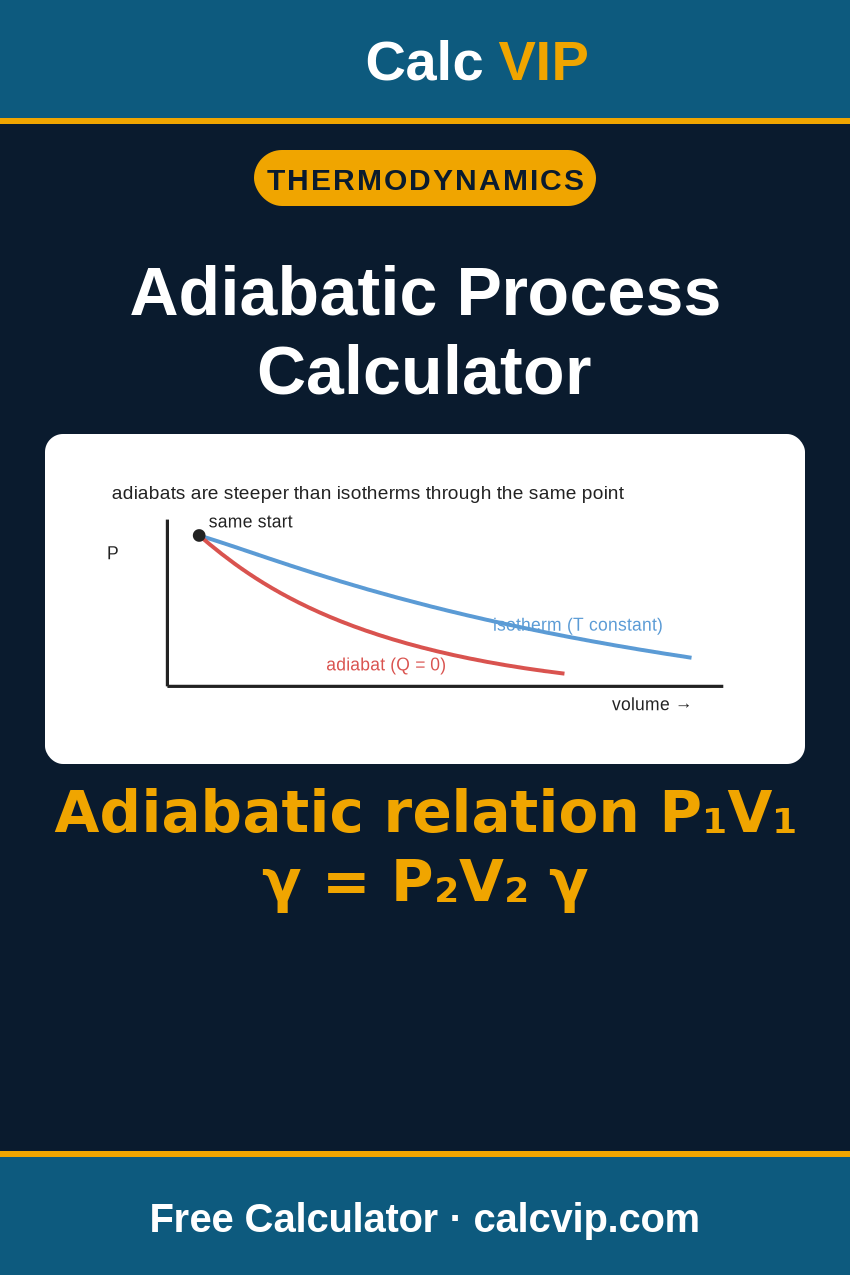
The exponent γ (gamma) is the gas's fingerprint: the ratio of its heat capacities, Cp/Cv, which counts its degrees of freedom. Monatomic gases — helium, argon — have γ = 5/3 ≈ 1.67; diatomic gases — nitrogen, oxygen, air — have γ = 7/5 = 1.40. A bigger γ means a stiffer response: for the same squeeze, a monatomic gas heats and pressurises more. Choose the right γ and the formula will hand you final pressures, final volumes, and — through the companion relation TVγ−1 = constant — final temperatures as well.
Formula
Adiabatic relation P₁V₁γ = P₂V₂γ • rearranged: P₂ = P₁(V₁/V₂)γ and V₂ = V₁(P₁/P₂)1/γ
Two companion forms complete the set. Temperatures obey T₁V₁γ−1 = T₂V₂γ−1, so T₂ = T₁(V₁/V₂)γ−1; and eliminating volume entirely gives T₂/T₁ = (P₂/P₁)(γ−1)/γ. Because only ratios appear in the pressure–volume form, any consistent units work there — kPa with litres, pascals with cubic metres — but temperatures must be in kelvin wherever they stand alone. The exponent γ = Cp/Cv is 1.40 for air and diatomic gases, 1.67 for monatomic gases, and around 1.33 for steam and many polyatomic gases. This calculator solves for P₂ or V₂ with a preset or custom γ.
| Symbol | Meaning | Units |
|---|---|---|
| P₁, P₂ | pressure before and after the change | any consistent unit (kPa here) |
| V₁, V₂ | volume before and after | any consistent unit (L here) |
| γ | heat capacity ratio Cp/Cv | — (always > 1) |
| T₁, T₂ | absolute temperature before and after | kelvin (K) |
Why the temperature must change: the first law with Q = 0
The adiabatic relation is the first law wearing a disguise. With Q = 0, the first law reads ΔU = −W: every joule of work done on the gas becomes internal energy, and every joule the gas spends doing work is deducted from the same account. Internal energy for an ideal gas means temperature — ΔU = (f/2)nRΔT — so work and temperature are locked together. Compress and the gas must warm; expand and it must cool. There is no way to do work on an insulated gas and leave its temperature alone, any more than you can deposit money and leave the balance unchanged.
From that lock-step the whole formula follows. As the volume shrinks, two effects multiply: the same molecules in less space (the Boyle effect, pressure ∝ 1/V) and faster molecules from the rising temperature (pressure ∝ T). The adiabatic exponent γ is precisely the bookkeeping that combines them, and it exceeds 1 because both effects push the same way. It also explains the two ways a real process can be adiabatic: genuine insulation, or sheer speed. A diesel compression stroke takes milliseconds — far too fast for meaningful heat flow through the cylinder walls — so the air behaves as if perfectly insulated even though the engine block is bare metal.
How to use
- Choose what to solve for: final pressure P₂ (you will enter V₂) or final volume V₂ (you will enter P₂). The last input box relabels itself.
- Pick γ for your gas — 1.40 for air/diatomic, 1.67 for monatomic — or choose Custom and type another value.
- Enter the initial pressure P₁ and initial volume V₁.
- Enter the final value you know and click "Calculate". Units cancel in the ratios, so kPa and litres (as labelled) are safe; use the temperature relations from the Formula section, in kelvin, if you also need T₂.
Worked examples
Example 1 — halving the volume of air. Air (γ = 1.40) at P₁ = 100 kPa is compressed adiabatically from V₁ = 2 L to V₂ = 1 L:
P₂ = 100 × (2/1)1.4 = 100 × 2.639 = 263.90 kPa. The pressure more than doubles — an isothermal squeeze would give exactly 200 kPa, and the extra 63.90 kPa is the fingerprint of the temperature rise.
Example 2 — the temperature in Example 1. If the air started at 300 K, the temperature relation gives T₂ = 300 × (2/1)0.4 = 300 × 1.3195 = 395.85 K — a rise of nearly 96 K from a single halving of volume, with no heat added at all.
Example 3 — adiabatic expansion. Air at 500 kPa expands from 1 L to 4 L: P₂ = 500 × (1/4)1.4 = 500 ÷ 6.964 = 71.79 kPa. Isothermally it would have kept 125 kPa; expanding adiabatically it cools, and the pressure falls further — the gas pays for its work in temperature.
Example 4 — a monatomic gas responds harder. Argon (γ = 1.67) at 200 kPa compressed from 3 L to 1 L: P₂ = 200 × 31.67 = 200 × 6.263 = 1,252.63 kPa. The same 3:1 squeeze on air would give only 200 × 31.4 ≈ 931 kPa — the bigger γ is a stiffer spring.
Example 5 — solving for the volume. Air starts at P₁ = 100 kPa, V₁ = 8 L, and is compressed until P₂ = 800 kPa. What is V₂? V₂ = 8 × (100/800)1/1.4 = 8 × 0.2264 = 1.81 L. An eightfold pressure rise needs only a 4.4-fold volume reduction, because the heating helps the pressure along.
Example 6 — the diesel squeeze. A diesel engine compresses air about 18:1. Starting at 320 K, T₂ = 320 × 180.4 = 320 × 3.178 = 1,016.85 K — far above diesel fuel's ignition point, which is why the injected fuel bursts into flame with no spark. Petrol engines, limited by premature ignition, stay near 10:1 and accept the lower efficiency.
Adiabatic changes in real life
Diesel ignition. Example 6 is the whole invention: compress air adiabatically until it is hot enough to ignite fuel on contact. No spark plugs, and the high compression ratio is exactly why diesels are efficient.
The cold spray can. Gas escaping a pressurised can expands rapidly and nearly adiabatically; its temperature plummets, chilling the can and sometimes frosting the nozzle. The same effect cools the air rushing out of a tyre valve.
Mountain weather. Air forced up a mountainside expands into lower pressure and cools adiabatically — about 9.8 K per kilometre when dry. Descending air warms the same way, which is why the foehn and chinook winds arrive hot and dry.
Clouds in a bottle. The classroom demo — pump air into a bottle, release it suddenly — fogs instantly: the rapid adiabatic expansion cools the air below its dew point and water condenses. Real clouds form by the same expansion, at altitude.
Sound itself. Compressions in a sound wave are too fast for heat exchange, so they are adiabatic, not isothermal. Newton assumed isothermal and got the sound speed wrong; Laplace's correction with γ = 1.40 fixed it — γ measured by listening.
Refrigeration and gas liquefaction. Let a compressed gas expand adiabatically through a turbine and it emerges cold enough, after a few stages, to liquefy air. The cooling that throttling only hints at, adiabatic expansion delivers in bulk.
Adiabatic work: the area the steep curve encloses
The work in an adiabatic change has a closed form worth knowing: W = (P₁V₁ − P₂V₂) / (γ − 1), positive when the gas expands. It is just ΔU in disguise — since Q = 0, the work must equal the internal energy given up, (f/2)(P₁V₁ − P₂V₂) with f/2 = 1/(γ−1). Check it against Example 1 in reverse: let the gas at 263.90 kPa and 1 L expand back to 2 L at 100 kPa. Then W = (263.90 × 1 − 100 × 2) / 0.4 kPa·L = 63.90 / 0.4 = 159.75 J (using 1 kPa·L = 1 J). Compressing took the same 159.75 J of work input — and ΔU = (5/2)nRΔT bookkeeping for the diatomic gas agrees, since the temperature swing was 95.85 K. If a problem gives you pressures and volumes at both ends, this formula is faster than any integration.
γ itself can be measured with little more than a jar and a pressure gauge, in the classic Clément–Désormes experiment: pressurise a large bottle slightly, let a puff of gas escape adiabatically (the remaining gas expands and cools), then let it warm back at constant volume and read the recovered pressure. Two pressure readings and the relation between them yield γ directly — historically one of the cleanest routes to the value 1.40 for air, and a satisfying proof that the exponent in this page's formula is a measurable property of the gas, not a theorist's decoration.
Two ways to cool a gas: expansion work vs the throttle
There are two industrial ways to make a gas cold by letting it expand, and contrasting them sharpens what "adiabatic" buys you. In expansion against a piston or turbine — the reversible adiabatic route of this page — the gas pays for its cooling with work, and the temperature drop is large and predictable: T₂ = T₁(V₁/V₂)γ−1. In throttling — forcing the gas through a valve or porous plug, the Joule–Thomson process — no work is extracted, no heat flows, and enthalpy (not internal energy) is the conserved quantity; an ideal gas would not cool at all, and real gases cool only by their slight non-ideality, and only below their inversion temperature. That is why serious liquefiers use expansion turbines for the heavy lifting and throttling valves only for the final step, and why a domestic refrigerator's expansion valve works at all: its refrigerant is chosen to be gloriously non-ideal exactly where it matters. The bicycle pump and the spray can live at the piston end of this contrast; the fridge lives at the throttle end; the formula on this page prices the piston end.
A second contrast is with the free expansion. Let gas burst into a vacuum and the process is adiabatic (Q = 0) yet the temperature of an ideal gas does not change — because W = 0 as well, leaving ΔU = 0. The PVγ law silently assumes the expansion pushes against something, slowly enough for pressure to be defined throughout. Whenever a problem says "expands adiabatically", check whether a piston is present in the story; the exponent only applies when there is.
Quick reference: γ for common gases
| Gas | Type | γ | P₂/P₁ for a 2:1 squeeze |
|---|---|---|---|
| Helium, argon | monatomic | 1.67 | 3.18 |
| Air, N₂, O₂, H₂ | diatomic | 1.40 | 2.64 |
| Steam, CO₂ | polyatomic | ≈ 1.33 / 1.30 | 2.51 / 2.46 |
| (isothermal, any gas) | — | 1 (the γ → 1 limit) | 2.00 |
The last row is a useful way to remember the whole family: an isothermal change is the γ = 1 limiting case, and every real adiabatic exponent sits above it, stiffening the response.
Common mistakes
- Using PV = constant for a fast change. If the process is quick or insulated, PV = constant (isothermal) is the wrong law — it underestimates compression pressures by 30% or more.
- The wrong γ. Air is 1.40, helium 1.67. Using air's γ for a monatomic gas turns Example 4's 1,252.63 kPa into a wrong ~931 kPa.
- Celsius in the temperature relation. T₂ = T₁(V₁/V₂)γ−1 needs kelvin. Feeding it 27 "degrees" instead of 300 K shrinks every temperature rise by a factor of eleven.
- Thinking adiabatic means constant temperature. It means no heat flow. Temperature constancy is the isothermal condition — the two are opposites in every way that matters here.
- Forgetting the process must be reversible for the clean formula. PVγ = constant describes a smooth, quasi-static adiabatic change. A free expansion into a vacuum is adiabatic too (Q = 0, W = 0) but follows no such curve — ΔU = 0 and T simply stays put.
FAQ
What makes a process "adiabatic"?
No heat flows in or out (Q = 0) — either because the container is insulated or because the change happens so fast that heat has no time to escape, like the compression stroke of a diesel engine.
Why does the temperature change?
With Q = 0, the work done on the gas during compression has nowhere to go except into internal energy, so the gas gets hotter. In an adiabatic expansion the gas cools — this is why a spray can feels cold.
What is γ and why is it bigger than 1?
γ = Cp/Cv. Heating a gas at constant pressure takes extra energy because the gas also expands and does work, so Cp > Cv. Monatomic gases have γ = 5/3 ≈ 1.67; diatomic gases γ = 7/5 = 1.40.
How much work does an adiabatic change take?
W = (P₁V₁ − P₂V₂)/(γ − 1) for the work done by the gas. Because Q = 0 it equals −ΔU exactly: the gas's internal energy is the only bank account being settled.
Can an adiabatic process ever keep a constant temperature?
Only in the trivial case where no work is done either — a free expansion into a vacuum, where Q = 0 and W = 0 force ΔU = 0. Any adiabatic change involving boundary work changes the temperature.
Why do diesels not need spark plugs?
Their compression ratio (around 18:1) heats air adiabatically to roughly 1,000 K, well above the fuel's auto-ignition temperature. Inject the fuel and it ignites on contact — compression is the spark.
Is a thermos flask process adiabatic?
Approximately, over short times. A good flask slows heat flow so much that a quick shake or pour changes the contents almost adiabatically — but leave it overnight and the slow leak wins. Adiabatic is always an approximation with a time limit.
What is the adiabatic lapse rate?
The rate at which rising air cools by expansion: about 9.8 K per kilometre for dry air. It sets the temperature profile of the lower atmosphere and decides whether rising air parcels keep rising (unstable) or sink back (stable).
How does γ show up in the speed of sound?
Sound speed is √(γP/ρ) = √(γRT/M). Newton's isothermal version (γ = 1) predicted roughly 300 m/s for air; Laplace's adiabatic correction with γ = 1.40 gives the observed ~343 m/s at room temperature.
Does PV^γ = constant hold for huge compressions?
Only while the gas stays ideal and γ stays constant. At high temperatures vibrational modes wake up and γ drifts down toward 1.3 or lower; at high densities the ideal-gas law itself bends. Textbook problems stay in the safe range — real engine designers use tables.