 Calc
Toroid Magnetic Field Calculator – B = μ₀NI/(2πr) Inside a Ring Coil
 Created by Thomas Becker · Physics Writer · Electricity & Magnetism · Last updated: November 2026
Use this free Toroid Magnetic Field Calculator to find the field inside a doughnut-shaped coil (toroid), using B = μ₀NI ÷ (2πr), at the mean radius of the ring.
Bend a solenoid into a circle and join its ends, and you get the toroid: a coil whose magnetic field lives entirely inside its own ring. Where a straight solenoid sprays field from its open ends, the toroid is self-contained — strong circular field within the doughnut, essentially nothing outside it. That tidiness is why toroidal cores dominate wherever stray fields are unwelcome: hi-fi power supplies that must not hum into audio circuits, medical isolation transformers, precision current sensors, and the great ring-shaped magnets of fusion experiments. The field inside obeys a formula as neat as the geometry: B = μ₀NI/(2πr), the solenoid's μ₀nI with the turn density n written as N turns spread around a circumference 2πr.
Three features of the formula deserve attention before any numbers. First, the field depends on the total ampere-turns NI and on nothing else about the winding — 500 turns at 2 A and 1000 turns at 1 A are the same magnet. Second, it falls as 1/r across the ring's thickness: the field is not uniform inside a toroid, being stronger at the inner edge where the circular path is shorter and the turns crowd closer, weaker at the outer edge. The formula's r is therefore the mean radius, the standard representative value, and Example 3 prices the variation across a real ring. Third, this calculator uses μ₀ — the permeability of free space — so it describes an air- or plastic-cored toroid exactly, and a ferrite- or iron-cored one only after multiplying by the core's relative permeability, a factor that can reach thousands and which the depth section below discusses honestly.
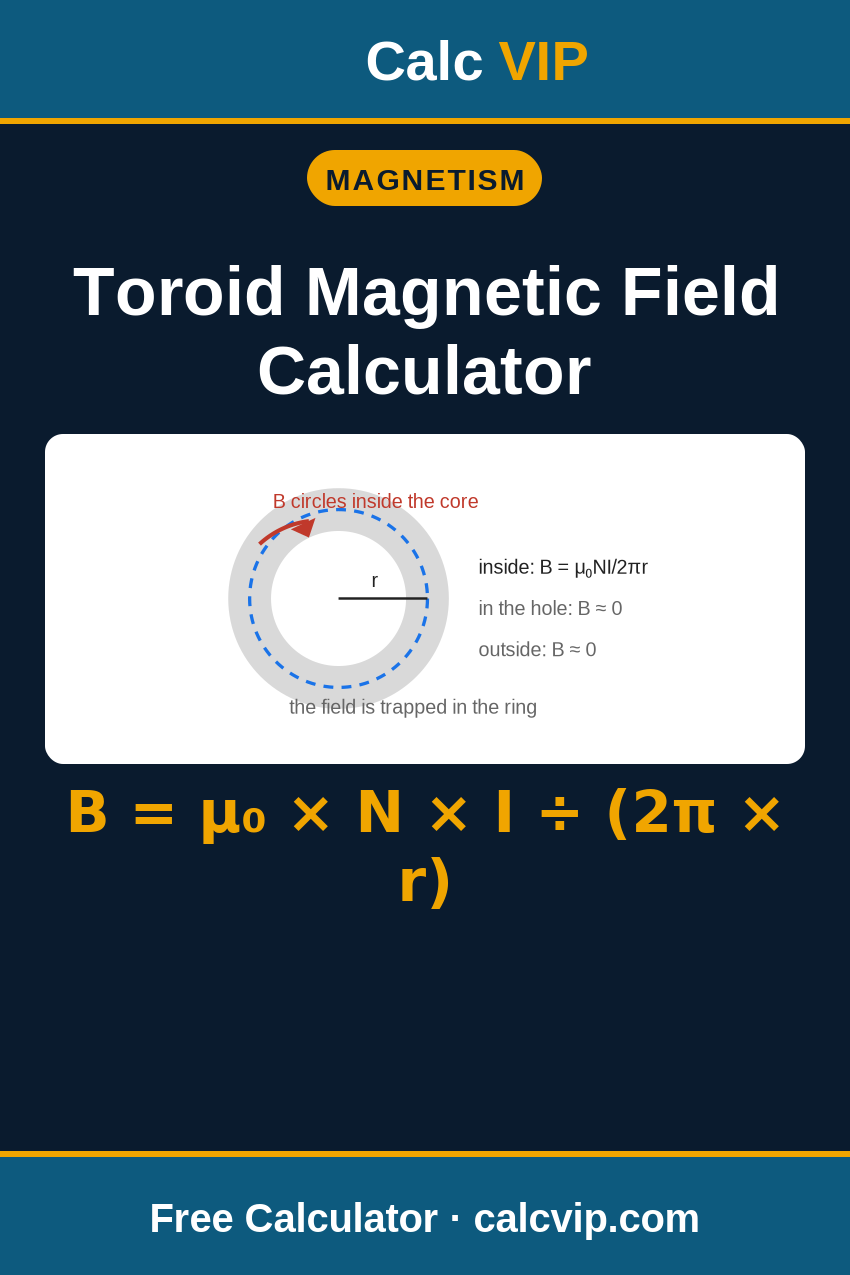
The toroid is also the cleanest place in physics to meet Ampère's law doing real work. Draw a circular path of radius r inside the ring: it encloses every turn's current once, NI in total, and symmetry insists the field is the same all along the path. Ampère's law, B × (path length) = μ₀ × (enclosed current), then reads B × 2πr = μ₀NI — the calculator's formula in one line. Draw the path outside the ring or through its hole and it encloses no net current at all (the windings pass through any such loop equally in both directions), and the same law returns B ≈ 0. Few formulas in electromagnetism can be derived so completely in so few steps, or verified so directly by the geometry.
Formula
B = μ₀ × N × I ÷ (2π × r) • B = magnetic field strength inside the toroid at radius r (T), μ₀ = 4π × 10⁻⁷ H/m, N = total turns wound on the ring, I = current (A), r = radius from the ring's centre (m) — conventionally the mean radius, the average of the inner and outer radii. Since μ₀ ÷ (2π) = 2 × 10⁻⁷, the working form is B = 2 × 10⁻⁷ × N × I ÷ r. Rearrangements: N = B × 2πr ÷ (μ₀I) (turns a target field needs), I = B × 2πr ÷ (μ₀N), and r = μ₀NI ÷ (2πB) (where a given field value occurs). For a core of relative permeability μr, multiply the result by μr — with the saturation caution given below.
| Symbol | Meaning | Units |
|---|---|---|
| B | field strength inside the ring at radius r | teslas (T); mT in practice |
| μ₀ | permeability of free space = 4π × 10⁻⁷ | henries per metre (H/m) |
| N | total turns on the ring | — (a count) |
| I | current in the winding | amps (A) |
| r | radius to the point of interest; mean radius by convention | metres (m) |
| NI | ampere-turns — the magnetomotive force driving the ring | amp-turns (At) |
A bent solenoid — and where the bending shows
The toroid formula is the solenoid formula in disguise. A long solenoid's field is B = μ₀nI with n the turns per metre; wrap the solenoid into a ring of mean radius r and its length becomes the circumference 2πr, so n = N/(2πr) and B = μ₀NI/(2πr) follows at once. But the disguise slips at the edges: in a straight solenoid every turn is spaced like its neighbours, while around the toroid the same turns are packed tighter on the inside of the bend and looser on the outside. That is the geometric origin of the 1/r variation — turn density genuinely changes across the core. For a slim ring (tube diameter small against r) the variation is a few percent and the mean-radius value serves; for a fat ring it can exceed a factor of two from inner to outer wall, and honest design integrates rather than averages.
The confinement, too, deserves a precise statement. The field outside an ideal toroid — infinitely many, perfectly evenly spaced turns — is exactly zero. Real windings are helical: the wire advances slightly with each turn, so the winding as a whole amounts to the ring of turns plus one extra loop of wire running around the ring's centre line. That single phantom loop produces a small external field, exactly as one turn of a circular coil would. It is tiny beside the internal field, and winding the return lead back along the coil cancels most of it — but it is why sensitive measurements near real toroidal transformers find a faint field rather than none, and why the FAQ below says "(almost)".
How to use
- Enter the total number of turns N wound around the ring — count both layers if the winding doubles back.
- Enter the current I in amps.
- Enter the mean radius r in metres: measure to the middle of the ring's tube (average of the inner and outer radii). A ring spanning 8 cm to 12 cm from the centre has r = 0.1 m.
- Click "Calculate" for B in teslas and milliteslas at that radius.
- To feel the field's variation, repeat with the inner and outer radii — Example 3 shows the spread for a typical ring. And remember the result is the air-core value: a ferrite core multiplies it (see the depth section).
Worked examples
Example 1 — the reference toroid. A toroid has N = 500 turns, carries I = 2 A, and has a mean radius r = 0.1 m.
B = μ₀NI ÷ (2πr) = (4π × 10⁻⁷ × 500 × 2) ÷ (2π × 0.1) = 2 × 10⁻³ T = 2.00 mT.
That is about 40 times the Earth's magnetic field, yet it stays almost entirely trapped inside the ring — which is why toroidal cores are used where stray fields would disturb nearby circuits.
Example 2 — same field, different recipe. A smaller ring of r = 0.05 m is wound with N = 1000 turns and run at only I = 0.5 A.
B = 2 × 10⁻⁷ × 1000 × 0.5 ÷ 0.05 = 2 × 10⁻³ T = 2.00 mT — identical.
The two halvings cancel: this ring has half the ampere-turns (NI = 500 against Example 1's 1000) but also half the radius, and B depends on NI ÷ r. Ampere-turns and radius are the only levers; how you split NI between turns and current is then a matter of wire cost, resistance and heating.
Example 3 — the field is not uniform. Example 1's ring has inner radius 0.08 m and outer radius 0.12 m. Evaluate at both walls:
Inner: B = 2 × 10⁻⁷ × 500 × 2 ÷ 0.08 = 2.50 mT. Outer: B = 2 × 10⁻⁷ × 1000 ÷ 0.12 = 1.67 mT.
A 50% spread across one ring — the mean-radius answer of 2.00 mT is a representative, not a uniform, value. Slim rings vary less; fat rings more; the 1/r law prices both.
Example 4 — a compact, strong ring. A small toroid of mean radius r = 0.02 m carries N = 2000 turns at I = 1 A.
B = 2 × 10⁻⁷ × 2000 × 1 ÷ 0.02 = 0.02 T = 20 mT.
Ten times Example 1's field from a ring a fifth the radius: small toroids concentrate field efficiently, which is why toroidal inductors in compact power supplies reach useful inductances in a thimble of ferrite (where the core then multiplies the field further still).
Example 5 — matching the Earth's field. A demonstration toroid has N = 250 turns at mean radius r = 0.1 m. What current reproduces the Earth's field, about 50 µT, inside the ring?
I = B × 2πr ÷ (μ₀N) — or simply try I = 0.1 A in the calculator: B = 2 × 10⁻⁷ × 250 × 0.1 ÷ 0.1 = 5 × 10⁻⁵ T = 50 µT.
A tenth of an amp in a modest ring matches the planet — a vivid calibration of how weak the Earth's field is, and of how easily laboratory fields exceed it (inside a closed ring, at least).
Example 6 — fusion-scale ampere-turns. A tokamak's toroidal field coils must produce B = 1 T at a major radius r = 1 m (a small research machine; the largest aim for about 5 T).
NI = B × 2πr ÷ μ₀ = 1 × 2π × 1 ÷ (4π × 10⁻⁷) = 5 × 10⁶ ampere-turns.
Enter N = 5000 turns at I = 1000 A in the calculator and it returns exactly 1 T. Real machines reach such NI products with superconducting cable — the only way to carry kilo-amps continuously without melting the winding's resistance budget.
Toroids in real life
Toroidal transformers. The doughnut transformers in quality audio amplifiers, medical equipment and bench supplies confine their flux, radiate almost no hum field, and run more efficiently than laminated E-core designs — the direct application of this page's confinement, with a second winding sharing the ring.
Toroidal inductors and chokes. Switch-mode power supplies wind their filter inductors on ferrite toroids: high inductance in a small volume, with a field that stays home instead of coupling into neighbouring circuitry. The air-core formula here, times the ferrite's μr, is the design start.
Residual-current devices (RCD/GFCI). The safety switch in your fuse box threads the live and neutral conductors through a toroidal sensing core. Balanced currents cancel; an imbalance — current leaking through a person — leaves a net ampere-turn signal the toroid detects, tripping the supply in milliseconds.
Current transformers. A conductor passing once through a toroid's hole is a one-turn primary; the ring's secondary of N turns delivers a safely scaled copy of a large current for metering. The same B = μ₀NI/(2πr) governs the coupling, with NI balance doing the metering.
Tokamaks and stellarators. Fusion machines are toroids at civil-engineering scale: the toroidal field (Example 6) confines the plasma ring, and its 1/r variation across the plasma — stronger at the inner wall — is a central fact of fusion plasma physics, not a footnote.
Earth-field and compass testing. A calibrated toroid or its Helmholtz-coil cousins generate known, uniform-ish fields for testing magnetometers and compasses — Example 5's parlour trick, professionalised: produce a field rivalling the Earth's, on demand, pointing any way you like.
Cores, permeability and saturation: the honest multiplier
This calculator's μ₀ describes a toroid wound on air, plastic or ceramic. Slip a ferrite or iron ring inside the winding and the field multiplies by the core's relative permeability μr — hundreds for power ferrites, thousands for silicon iron — because the core's own magnetisation adds its field to the winding's. That multiplication is why real toroidal inductors are small. Two cautions keep it honest. First, μr is not a constant: it varies with field strength, frequency and temperature, so core calculations use the manufacturer's curves, not a single number. Second, every core saturates: beyond a material's saturation flux density (about 0.3–0.5 T for ferrites, 1.5–2 T for silicon iron) the core can add no more, μr collapses toward 1, and the toroid reverts to this page's air-core behaviour — usually mid-cycle, with distortion and heating as the symptoms. Design with the calculator for the winding's contribution, apply μr humbly, and check the total against saturation.
From field to inductance
A toroid's inductance follows from the same geometry: L = μ₀N²A ÷ (2πr), with A the core's cross-sectional area. For Example 1's ring (N = 500, r = 0.1 m) wound on a core of cross-section A = 2 × 10⁻⁴ m², L = (4π × 10⁻⁷ × 500² × 2 × 10⁻⁴) ÷ (2π × 0.1) = 1 × 10⁻⁴ H = 100 µH — before any ferrite multiplier. Note the N²: inductance grows with the square of the turns because each added turn both links more flux and contributes to making it, while the field on this page grows only with N. The two formulas are siblings — B prices the field a current makes; L prices the flux linkage that same field produces — and between them the toroid is fully described.
Quick reference: field across Example 1's ring
| Radius r | B (N = 500, I = 2 A) | Location |
|---|---|---|
| 0.05 m | 4.00 mT | (inside the hole region of a slimmer ring) |
| 0.08 m | 2.50 mT | inner wall of Example 3's ring |
| 0.10 m | 2.00 mT | mean radius — the headline value |
| 0.15 m | 1.33 mT | — |
| 0.20 m | 1.00 mT | outer wall of a fatter ring |
The halving pattern — double r, halve B — is the whole table's content, and the fastest check on any toroid calculation: if doubling the radius in your numbers does not halve the field, something other than r changed.
Common mistakes
- Entering the diameter as r. The formula wants the radius to the point of interest. Feeding in the ring's full width (or its diameter) halves or worse the field — measure from the centre of the hole to the middle of the tube.
- Measuring r to the wrong place. Inner radius understates B's representative value; outer radius overstates the radius and understates B. The convention is the mean of the two — state which you used when reporting a field.
- Expecting a uniform field. B ∝ 1/r across the core is real physics, not measurement error. Quoting one number for a fat ring without its radius is meaningless.
- Applying μr blindly. Multiplying by a ferrite's headline permeability without checking saturation or the operating frequency produces fantasy fields. The calculator's air-core answer is the floor of truth; cores add their contribution conditionally.
- Counting a double-layer winding once. N is every turn the current makes around the ring, including a second layer wound back over the first. Undercounting layers undercounts B in direct proportion.
FAQ
Is the field the same everywhere inside the toroid?
Not quite. B falls off as 1/r, so it is stronger near the inner edge of the ring and weaker near the outer edge. The formula gives the value at the mean radius, which is the standard single-number answer; for a slim ring the variation is small.
Why is there (almost) no field outside?
Each turn's field circles inside the ring and the contributions from all turns add up there. Outside, the fields from the near and far sides of the windings cancel. Ampère's law confirms it: a loop outside the toroid encloses no net current, so B ≈ 0.
Toroid or solenoid — which is better?
A toroid confines its field and barely leaks, but it is harder to wind and you cannot insert samples into a uniform region as easily. A solenoid leaks at its ends but gives a handy uniform field in its bore. Inductors and transformers often use toroids; electromagnets and MRI scanners use solenoids.
What are ampere-turns?
The product NI — the total current effectively circulating around the ring's core, counting each pass of the winding. It is the magnetomotive force of the coil, and the toroid's field depends on it alone (with r). 500 turns at 2 A and 50 turns at 20 A are the same 1000 ampere-turns and make the same field; they differ in wire length, resistance and heating.
Does the toroid's field depend on the core's cross-section?
Not in this formula — B at radius r is set by NI and r alone, whether the tube is pencil-thin or massive. Cross-section enters the inductance (L ∝ A) and the total flux (Φ = B × A), and it decides how much wire fits — but the field strength at a radius is the winding's business only.
Why do toroid cores have a gap sometimes?
A small air gap cut into the ring dominates the magnetic circuit's reluctance, stabilising the inductance against the core's variable μr and letting the inductor store more energy before saturation. The field in the gap fringes outward — the one place a toroid deliberately leaks.
How strong can a toroid's field get?
Air-core: limited by heating — the winding's I²R — so sustained fields are usually milliteslas to tens of milliteslas without cooling or superconductors. Iron cores raise the ceiling to their saturation around 1.5–2 T. Example 6's superconducting route is how research machines pass even that.
Is a toroid the same as a solenoid?
A toroid is a solenoid closed into a ring — same winding idea, different geometry and consequences: no ends, no external field, and a 1/r variation the straight solenoid does not have. Their formulas are literally the same equation with the length written as a circumference.
Can I measure the field inside a toroid?
Not with a probe slid into the core material — but a small sensing coil wound on the ring, or threaded through it, reports the flux via Faraday's law, and a Hall element in a thin gap cut for the purpose reads B directly. In practice the field is usually inferred from NI and r — this calculator — because the confinement that makes toroids useful also hides their field from casual measurement.
Why is there no field in the central hole?
Apply Ampère's law to a circular path in the hole: the net current passing through any surface bounded by that path is zero — the winding threads around the ring, never through the hole's disc — so B × 2πr = 0 and B = 0. The hole of an ideal toroid is one of the quietest magnetic places in the laboratory — which is why sensitive components are sometimes parked there.