 Calc
Velocity Selector Calculator – v = E/B for Crossed Fields (or B Needed for a Chosen Speed)
 Created by Thomas Becker · Physics Writer · Electricity & Magnetism · Last updated: November 2026
Use this free Velocity Selector Calculator to find the one speed that passes undeflected through crossed electric and magnetic fields, using v = E ÷ B — or the field B needed to select a chosen speed.
Pour a beam of charged particles between two charged plates inside a magnet, and something remarkable happens: whatever their charge, whatever their mass, all particles moving at one particular speed fly perfectly straight, while every other speed is bent aside. The device is a velocity selector — also called a Wien filter — and the speed it selects is fixed by the two fields alone: v = E/B. It is among the most democratic devices in physics. An electron and a uranium ion, differing in mass by five orders of magnitude, pass together if they share a speed; the selector reads velocity and velocity only, blind to everything else a particle is.
The blindness is algebraic before it is physical. The electric force on a particle is qE; the magnetic force is qvB. Set them against each other and q — the particle's entire electrical identity — divides out of the balance condition, leaving v = E/B. Mass never even enters the equation: it would matter for how sharply an unbalanced particle curves, but the balance point itself is mass-free. That is why the selector's great partnership is with the mass spectrometer, whose whole problem is the opposite one: a spectrometer fed a beam of mixed speeds cannot read masses cleanly, so the selector stands upstream, discarding every speed but one, and hands over a beam whose only remaining variable is mass.
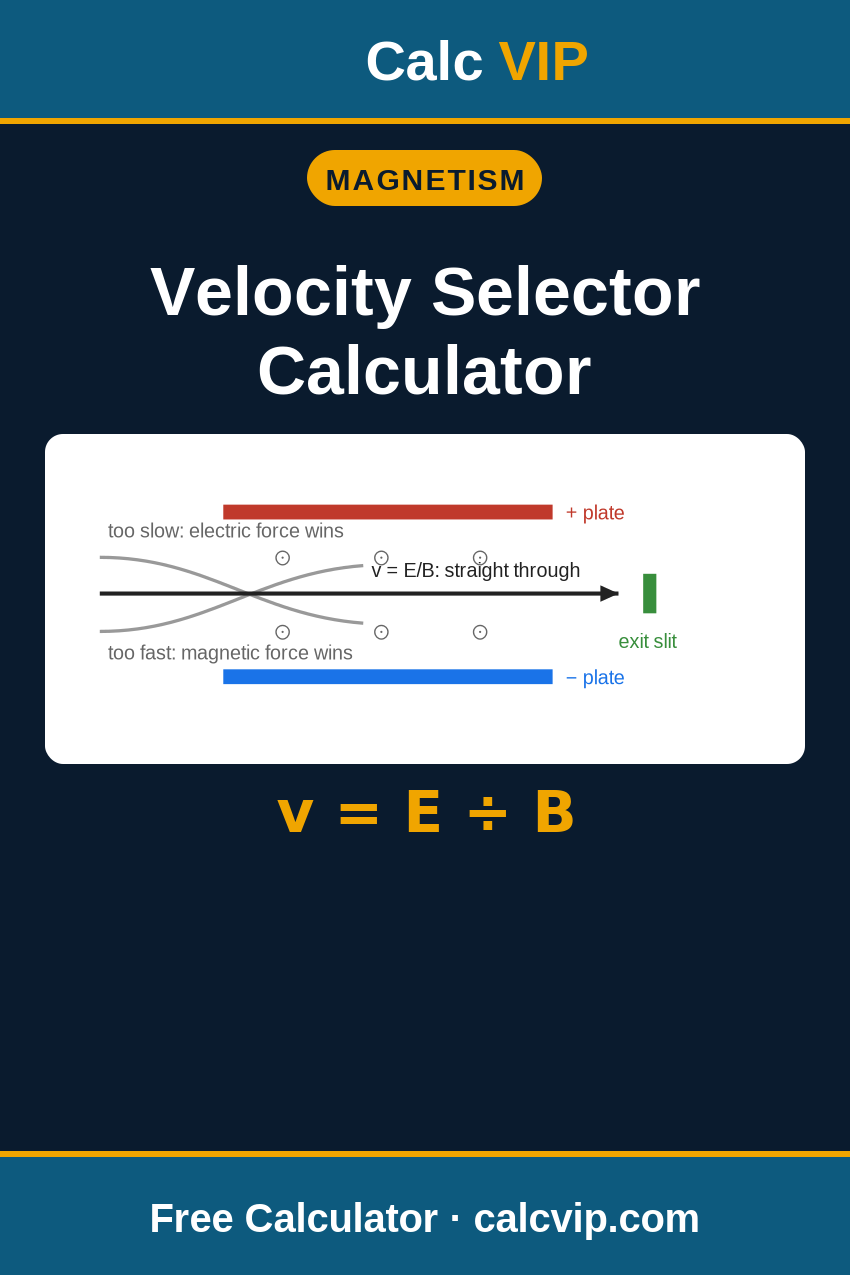
This calculator works the condition in both directions: give it E and B and it returns the selected speed; give it E and a target speed and it returns the magnetic field the selector must provide. The examples span the device's range — from the textbook 3 × 10⁵ m/s of the worked example, through the brisk 1.33 × 10⁷ m/s of electrons from a 500 V accelerator, down to the stately 10⁴ m/s of a heavy-ion beam — and one conceptual leap: the same E/B ratio reappears as the drift speed of whole plasmas, from ionospheric physics to electric spacecraft thrusters, wherever electric and magnetic fields cross.
Formula
v = E ÷ B • v = the undeflected (selected) speed (m/s), E = electric field strength (V/m), B = magnetic field strength (T), with E, B and the beam direction all mutually perpendicular. The balance it encodes is qE = qvB — electric force against magnetic force on a charge q. Rearranged: B = E ÷ v (the field needed to select a chosen speed) and E = v × B (the plate field a given magnet requires). Between parallel plates, the field comes from the plate voltage and gap: E = Vplates ÷ dgap. A useful scale anchor: E/B has units of speed, and 3000 V/m against 0.01 T gives 3 × 10⁵ m/s — 0.1% of the speed of light.
| Symbol | Meaning | Units |
|---|---|---|
| v | selected speed — the only speed passing undeflected | metres per second (m/s) |
| E | electric field strength between the plates | volts per metre (V/m) |
| B | magnetic field strength, perpendicular to E and the beam | teslas (T) |
| q | particle charge — cancels out of the condition | coulombs (C) |
| FE = qE | electric force on the particle | newtons (N) |
| FB = qvB | magnetic force on the particle (at 90° to B) | newtons (N) |
Balance of forces: the whole device in one line
Set the geometry carefully, because the device is the geometry. The beam runs horizontally. The plates are above and below, so E points vertically. The magnet's field points out of the page, perpendicular to both. A positive particle entering the region feels qE toward one plate and qvB toward the other. The magnetic force grows with speed while the electric force does not, so there is exactly one speed at which they are equal — and at that speed the net force is zero at every point of the flight, not just on average: the particle never begins to curve. Slower particles are dragged plateward by the unbeaten electric force; faster ones are swung the opposite way by the triumphant magnetic force; an exit slit on the axis discards both. Reversing every sign for negative particles changes nothing: both forces flip together, and electrons select at the same v = E/B as protons.
Notice what the selector does not do: it exerts no net force on its chosen particles, so it neither accelerates nor decelerates them — it is a filter, not an engine. The energy of the emerging beam is whatever the upstream accelerator gave it. This purity is its laboratory value. Feed a mass spectrometer through a selector set to v, and every ion's kinetic energy per charge is fixed by ½mv² with a known v; the analyser's radius r = mv/(qB) then reads m/q with no speed ambiguity. Historically the same balance, run in a cathode-ray tube, let Thomson and his successors pin down the electron's charge-to-mass ratio: select a speed with crossed fields, then measure the curvature that speed produces in B alone. Two of this site's calculators — this one and the mass spectrometer — are the two halves of that Nobel-grade experiment.
How to use
- Choose the mode: find the selected speed from E and B, or find the field B needed to select a speed you choose.
- Enter the electric field strength E in volts per metre. If you know the plate voltage and gap instead, divide: E = Vplates ÷ dgap (e.g. 300 V across 0.1 m is 3000 V/m).
- Enter B in teslas (speed mode) or the target speed v in m/s (field mode).
- Click "Calculate". Sanity anchor: the answer for 3000 V/m and 0.01 T must be 3 × 10⁵ m/s; if it isn't, a field was probably entered in milliteslas or the plate field was not divided by the gap.
Worked examples
Example 1 — the reference selector. Crossed fields have E = 3000 V/m and B = 0.01 T.
v = E ÷ B = 3000 ÷ 0.01 = 3 × 10⁵ m/s.
Every charged particle moving at exactly 300,000 m/s flies straight through, whether it is an electron or a heavy ion; faster ones are bent by the magnetic force, slower ones by the electric force. This is how a mass spectrometer is fed a beam of one single speed. Run the calculator backwards — E = 3000, v = 3 × 10⁵ — and it returns B = 0.01 T, confirming the pair.
Example 2 — selecting electrons from a 500 V gun. Electrons accelerated through 500 V leave with v = √(2eV ÷ me) = √(2 × 1.602 × 10⁻¹⁹ × 500 ÷ 9.11 × 10⁻³¹) = 1.33 × 10⁷ m/s.
A selector with plates giving E = 10,000 V/m must provide B = E ÷ v = 10,000 ÷ 1.326 × 10⁷ = 7.54 × 10⁻⁴ T (0.754 mT).
A field weaker than a fridge magnet's — electron speeds are so high that only a whisper of B balances a substantial E. This is the regime of Thomson-style e/m apparatus in teaching laboratories.
Example 3 — feeding a mass spectrometer. A selector with E = 5000 V/m and B = 0.02 T passes v = 5000 ÷ 0.02 = 2.5 × 10⁵ m/s.
Downstream, the analyser magnet (B = 0.5 T) curves the Example-1 ion of the mass-spectrometer page (54.27 u) at r = mv ÷ (qB) = 0.281 m.
Two calculators, one beamline: the selector fixes v so the analyser's radius can speak purely of mass. Swap in any other ion mass and only the radius changes — the selected speed does not care.
Example 4 — a slow heavy-ion beam. An ion-source beamline must select heavy ions travelling at just v = 1 × 10⁴ m/s, with plates providing E = 1000 V/m.
B = E ÷ v = 1000 ÷ 10,000 = 0.1 T.
Slow beams need serious magnets: at a hundredth of Example 2's speed, a hundred times the field balances the same plates. This is why low-energy ion facilities are built around substantial electromagnets.
Example 5 — a stronger selector. With E = 2000 V/m and B = 0.004 T:
v = 2000 ÷ 0.004 = 5 × 10⁵ m/s.
Note the pattern across the examples: what matters is never E or B alone but their ratio — 2000/0.004 and 3000/0.006 select identically. Selector design is ratio design; the absolute values are chosen for convenience of plates and magnets.
Example 6 — the same ratio moves plasmas: E×B drift. In a Hall-effect thruster and in the ionosphere, crossed fields of E = 1000 V/m and B = 0.02 T make the plasma itself drift sideways at v = E ÷ B = 5 × 10⁴ m/s.
Electrons and ions drift at the same velocity — charge and mass both absent from the result, exactly as in the selector — so the plasma moves as one fluid without net current from the drift. A laboratory filter for single particles and the motion of whole magnetised plasmas are one piece of physics at two scales.
Velocity selectors in real life
Mass-spectrometer front ends. The flagship use: a selector upstream of the analyser guarantees the single-speed beam the mass formula assumes. High-resolution instruments chain the two so routinely that "selector + sector" reads as one word in the literature.
Measuring e/m and fundamental constants. The crossed-field balance gave the first precise electron charge-to-mass ratios: select v with E/B, then let B alone curve the beam and read the radius. Precision versions of the same idea still anchor teaching laboratories worldwide.
Beam purification in accelerators. Ion sources emit a spread of speeds and charge states. A Wien filter trims the beam to the design speed before injection, protecting downstream optics from particles that would be bent wrongly everywhere they go.
Space plasma instruments. Satellites measuring the solar wind carry electrostatic and crossed-field analysers that select particle speeds channel by channel, building the wind's speed distribution from v = E/B settings — the selector as a scientific instrument in orbit.
Hall thrusters and plasma processing. Example 6's drift is the working principle of the Hall-effect thrusters now standard on satellites: crossed fields trap electrons in an E×B drift while ions are accelerated away. The same drift organises plasma etchers and sputtering sources in chip fabrication.
Isotope and ion-beam laboratories. Where a reaction or implant demands one ion speed — materials doping, ion microscopy, nuclear-physics targets — a Wien filter is the simplest, most robust way to enforce it, with no timing electronics and nothing in the beam but fields.
How sharp is the selection?
An ideal selector passes exactly one speed; a real one passes a narrow band, and the band's width is set by geometry. A particle slightly off-speed feels a small unbalanced force for the whole flight through the fields, so its sideways displacement grows with the square of the field region's length and shrinks with the beam's speed. Longer field regions and a tighter exit slit sharpen the selection — at the cost of discarding more of the beam. In practice a Wien filter resolves speeds to a percent or better, ample for feeding a mass spectrometer whose own resolution then dominates. The design trade is universal in filtering: sharpness is bought with intensity, and this calculator gives the centre of the passband around which that trade is negotiated.
Quick reference: selected speeds at B = 0.01 T
| Electric field E | Selected speed v = E/B | As a fraction of light speed |
|---|---|---|
| 100 V/m | 1 × 10⁴ m/s | 0.0033% |
| 1000 V/m | 1 × 10⁵ m/s | 0.033% |
| 3000 V/m | 3 × 10⁵ m/s | 0.1% |
| 10,000 V/m | 1 × 10⁶ m/s | 0.33% |
| 30,000 V/m | 3 × 10⁶ m/s | 1% |
Even aggressive laboratory fields select thoroughly non-relativistic speeds — a few percent of c at most — which is why the simple Newtonian force balance on this page serves real instruments so well. Relativistic beams need the full machinery of accelerator optics, where the same balance survives with momentum in place of mass × speed.
Common mistakes
- Entering the plate voltage as E. E is a field — volts per metre. 300 V across a 10 cm gap is 3000 V/m, not 300. Skipping the division by the gap understates E, and the selected speed, tenfold in this instance.
- Milliteslas entered as teslas. Bench magnets live in mT: 10 mT is 0.01 T. Entering 10 inflates B a thousandfold and shrinks the selected speed to walking pace.
- Expecting the selector to sort by mass or charge. It cannot — q and m cancel by construction. A selector that appears to separate masses is actually separating speeds; mass sorting needs the curved flight of a spectrometer after the speed is fixed.
- Misaligning the fields. The balance needs E, B and the beam mutually perpendicular. A tilted B adds an unbalanced component along the beam and the "selected" particles drift; the formula assumes the ideal geometry the apparatus must be built to.
- Forgetting neutral particles. Neutrals feel neither force and sail straight at any speed, contaminating the selected beam. Real beamlines add a slight bend or a chopper so the straight-through neutrals miss the target.
FAQ
Why doesn't the particle's charge matter?
Both forces are proportional to q — the electric force is qE and the magnetic force is qvB — so doubling the charge doubles both pushes equally and they still cancel at the same speed. Mass never enters the condition at all.
What happens to particles at other speeds?
A faster particle feels a stronger magnetic force (qvB grows with v) and curves toward the magnetic side; a slower one is pulled toward the electric side. A small exit slit blocks both, so only the selected speed gets through.
Where are velocity selectors used?
In mass spectrometers (to give every ion the same speed before the mass measurement), in particle accelerators and beam lines, and historically in the experiments that first measured the electron's charge-to-mass ratio.
Why is it also called a Wien filter?
After Wilhelm Wien, who developed the crossed-field arrangement in the 1890s for studying canal rays (positive ion beams). "Velocity selector" describes what it does; "Wien filter" credits who built it — the literature uses both, interchangeably.
Does the selector work for negative particles?
Yes, identically. For an electron both forces reverse direction together — the electric force flips because q is negative, and the magnetic force flips for the same reason — so the balance speed is unchanged. One setting serves every sign and species of charge.
What sets the plate field in practice?
E = Vplates ÷ dgap. A modest 300 V across a 0.1 m gap gives Example 1's 3000 V/m; narrower gaps give stronger fields from smaller supplies, at the cost of a thinner beam passage. Guard rings and careful plate edges keep the field uniform where the beam flies.
Can a velocity selector select light-speed particles?
The balance v = E/B formally holds at any speed, but the required ratio grows without limit as v → c, and at relativistic speeds the forces' interplay with the particle's momentum needs the relativistic treatment. Practical Wien filters serve non-relativistic beams, as the quick-reference table shows.
How does the selector affect the beam's energy spread?
It narrows it: since all transmitted particles share one speed, their kinetic energies per unit mass are identical — though different masses at the same speed still carry different energies (½mv²). For a single species, speed selection is energy selection.
Why not just use electric deflection alone to pick a speed?
Electric deflection alone sorts by energy per charge, magnetic deflection alone by momentum per charge — each mixes mass and speed. The crossed-field balance is special precisely because it isolates speed itself, cancelling both q and m, which neither field can do by itself.
Where does the discarded beam go?
Onto the plates, the magnet poles and the exit-slit edges — which is why selectors sit early in a beamline, before expensive downstream components, and why their apertures are built to absorb the rejected current without overheating or scattering debris into the good beam.