 Calc
Train Crossing Calculator – Time to Cross a Pole & a Platform
 Created by Sarah Mitchell · Physics Editor · Motion & Measurement · Last updated: November 2026
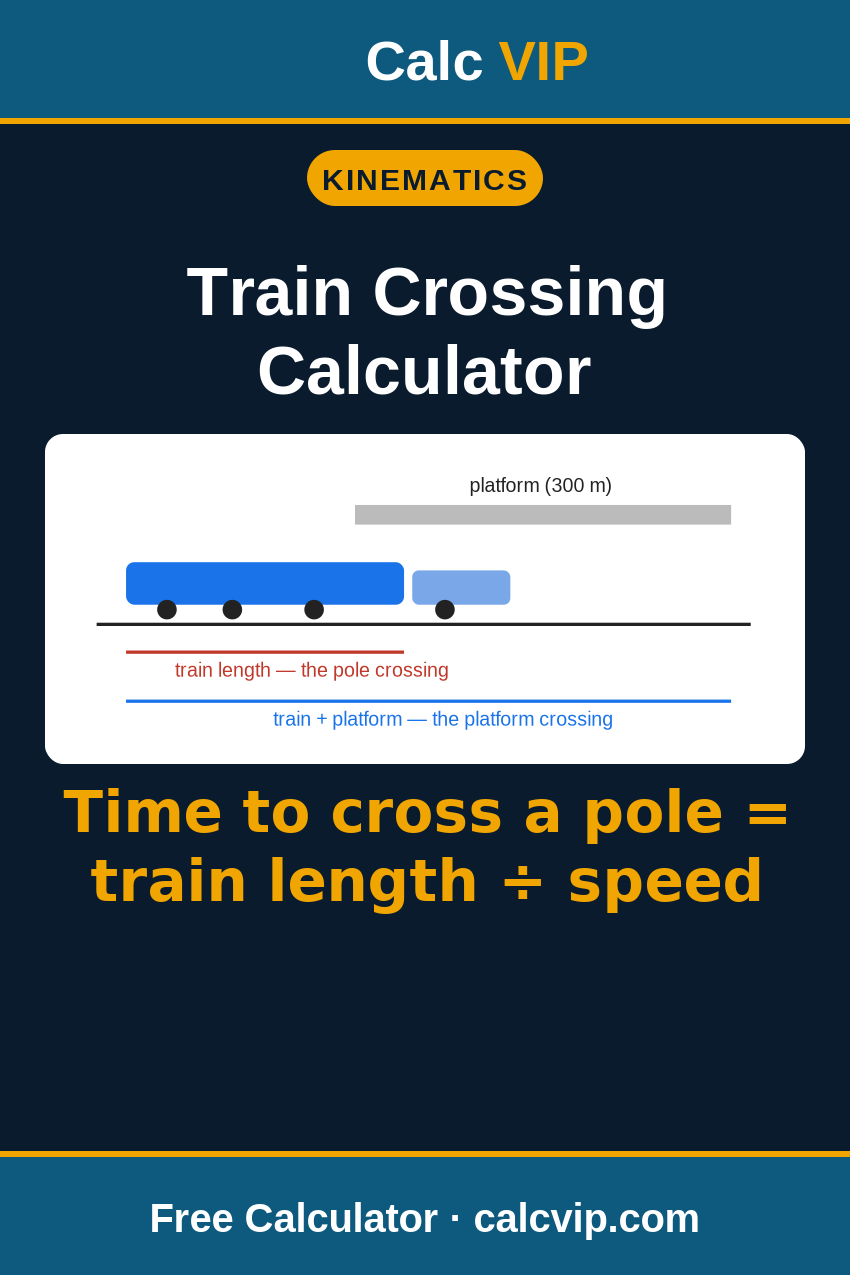
Use this free Train Crossing Calculator to find how long a train takes to cross a pole (a point) and to cross a whole platform or bridge. Crossing a pole only needs the train's own length, but crossing a platform needs the train length plus the platform length — the back of the train must clear the far end.
Train problems are the purest form of the "moving object has length" idea. A car can be treated as a point; a train cannot. When a 200 m train passes a pole, the event is not over when the locomotive arrives — it lasts from the moment the front reaches the pole until the moment the rear leaves it, and in between, the pole has effectively travelled the train's whole length. Crossing a platform stretches the event further: the front must cross the platform and the train's own length before the rear clears the far end. This calculator handles both events, and the only real skill involved is knowing which distance belongs to which question.
These problems are a staple of school physics and aptitude tests for a reason beyond nostalgia. They train the habit of defining an event precisely — when does "crossing" start, and when is it complete? — which is the same habit that decides real questions about signals, level crossings and station dwell times. The numbers are friendly, the picture is drawable, and the one classic error (forgetting the train's own length) is instantly visible when you draw it.
The calculator takes the speed in km/h, as railway speeds are usually quoted, and converts it to m/s internally by multiplying by 5/18. That conversion — divide by 3.6 — is the second skill these problems quietly teach, because every length in the problem is in metres and every time comes out in seconds.
Formula
Time to cross a pole = train length ÷ speed • Time to cross a platform = (train length + platform length) ÷ speed • Speed in m/s = km/h × 5/18
Both formulas are distance ÷ speed; all the physics is in choosing the distance. A pole, a standing person, a signal post — anything effectively a point — demands only the train's length, because the crossing is complete when the rear passes the point. A platform, bridge or tunnel has length of its own, and the front of the train must traverse all of it before the rear even enters the far end's account: the total is the sum of the two lengths. The 5/18 factor is exact, not an approximation: a kilometre is 1,000 metres and an hour is 3,600 seconds, and 1000/3600 reduces to 5/18. Its mirror, ×18/5 = ×3.6, converts m/s back to km/h.
| Symbol | Meaning | Units |
|---|---|---|
| Lt | train length — locomotive plus all carriages | m |
| Lp | platform, bridge or tunnel length (0 for a pole) | m |
| v | train speed | km/h (converted to m/s) |
| t | crossing time, front-arrival to rear-clearance | s |
Start and finish: what "crossing" really means
Every crossing problem is won or lost at the definitions. The crossing of a point begins when the front of the train reaches it and ends when the rear leaves it — the train's length is the distance, full stop. The crossing of a platform begins when the front reaches the near end and ends when the rear leaves the far end; the front has then travelled platform + train, and so has every other point of the train. A useful picture: freeze the train and let the world slide past it instead. The pole must travel the train's whole length; the platform must travel its own length plus the train's. Relative motion turns a confusing chase of ends into one clean sliding distance, and it is the same trick that powers the overtaking and boat-and-stream problems elsewhere in this collection.
The definitions matter beyond examinations. A level-crossing barrier must stay down from front-arrival to rear-clearance at the slowest permitted speed — a time computed exactly as on this page. A train "occupies" a tunnel for the tunnel-plus-train time, which is why long freight trains in long tunnels are a ventilation and scheduling problem, not just a length of track.
How to use
- Enter the train length in metres — locomotive plus every carriage or wagon.
- Enter the platform, bridge or tunnel length in metres. For a pole, signal or standing person, enter 0 (or just read the pole answer).
- Enter the train's speed in km/h; the calculator converts it to m/s for you.
- Click "Calculate Crossing Times" to see the speed in m/s, the pole-crossing time and the platform-crossing time.
- For two trains, adapt the idea: add both lengths, and use the sum of the speeds if they approach each other, or the difference if one overtakes the other.
Worked examples
Example 1 — the textbook train. A train 200 m long passes a 300 m platform at 72 km/h. Convert the speed: 72 × 5/18 = 20 m/s. Time to cross a pole = 200 ÷ 20 = 10 s. Time to cross the platform = (200 + 300) ÷ 20 = 500 ÷ 20 = 25 s.
Example 2 — an express and a tunnel. A 150 m express at 108 km/h (30 m/s) flashes past a pole in 150 ÷ 30 = 5 s. Through a 1,050 m tunnel it is "inside" for (150 + 1,050) ÷ 30 = 40 s — the tunnel length dominates, and the train's own length is a small correction.
Example 3 — a long freight. A 600 m freight train ambles at 36 km/h (10 m/s): a pole takes 600 ÷ 10 = 60 s — a full minute of wagons — and a 400 m bridge takes (600 + 400) ÷ 10 = 100 s. Length, not speed, is the freight railway's ruling quantity.
Example 4 — two trains approaching. A 200 m train at 72 km/h meets a 250 m train at 54 km/h on parallel tracks. Lengths add: 450 m. Speeds add: 126 km/h = 35 m/s. They pass each other — front to front, to rear to rear — in 450 ÷ 35 = 12.86 s. Passengers glimpse the whole opposing train in under thirteen seconds.
Example 5 — an overtake on rails. A 180 m express at 90 km/h catches a 220 m freight at 54 km/h. Lengths add: 400 m. Speeds subtract: 36 km/h = 10 m/s of closure. The overtake lasts 400 ÷ 10 = 40 s — the same relative-speed machinery as a road overtake, stretched by railway lengths.
Example 6 — the passenger's view. Sit in the train and you are a point: crossing a 300 m platform at 20 m/s, the platform slides past your window in 300 ÷ 20 = 15 s, and the train's length never enters it. Whether the length matters depends on whether the observer is extended — a lovely illustration that "the distance" belongs to the event, not to the objects.
Train crossings in real life
Level-crossing timing. Barriers and warning lights are timed from the worst case this calculator can produce: the longest train at its slowest approach speed. The road must be cleared for the full front-to-rear occupancy, plus margins — a pole-crossing calculation with lives staked on it.
Platform and station design. A platform must be at least as long as the trains that stop there, and the signalling must know when a train has fully cleared a junction — rear included. The platform-crossing formula, run in reverse, sets those lengths.
Estimating speed from a video. Count the seconds a train takes to pass a lineside pole of known spacing, measure or look up its length, and speed = length ÷ time falls out. Enthusiasts and accident investigators alike use the pole time as a speedometer.
Tunnel ventilation and safety. A train piston-pushes air through a tunnel for the whole tunnel-plus-train occupancy time. Ventilation, pressure comfort and evacuation planning all start from that duration.
Freight logistics. Passing loops and sidings must be longer than the trains they hold, with the crossing arithmetic deciding how long a single-track line is blocked by each movement — capacity on a rural railway is this formula, scheduled.
Aptitude tests and interviews. The train-and-pole family endures in exams because it tests translation, not memorisation: a paragraph of English must become one correct distance. The diagram-first habit this page teaches is the whole solution method.
The 5/18 conversion, once and for all
More train problems die of unit wounds than of any other cause, so the conversion deserves its own paragraph. One kilometre per hour means 1,000 metres per 3,600 seconds, and 1000/3600 simplifies — divide top and bottom by 200 — to exactly 5/18. So m/s = km/h × 5/18, and the familiar landmarks fall out: 36 km/h = 10 m/s, 72 = 20, 108 = 30, 144 = 40. Dividing by 3.6 is the same operation in decimal dress. Going the other way, multiply m/s by 18/5 = 3.6. Memorise the four landmarks and most exam speeds convert themselves; use the exact factor for everything else, and never let a km/h anywhere near a metre without it.
A companion habit saves equal numbers of marks: estimate before you calculate. A passenger train is a few hundred metres long and travels at a few tens of metres per second, so crossing times should land in the 5–30 s band. An answer of 0.25 s means a conversion was skipped; an answer of 900 s means one was applied twice, or a length crept in in kilometres. The estimate costs five seconds and catches the two commonest errors on this whole page — which is why professional engineers, who have calculators far better than this one, still do it first.
Off the rails: the crossing idea everywhere
Strip away the railway vocabulary and the train problem is a template: an extended object passes a point or a stretch, and the time is (its length plus the stretch) divided by its speed. A ship entering a lock occupies it for (ship + lock chamber) ÷ approach speed, which is why lock-keepers schedule like signalmen. An aircraft on its take-off roll "crosses" the runway threshold markings in its own length divided by its speed — a number flight recorders check. A lorry passing a speed camera's road markings, a conveyor belt carrying a long casting past a sensor, a glacier's terminus retreating past a survey marker: each is the train problem with the nouns changed. Even the humble act of a long vehicle clearing a junction — the driver must wait until the rear is through, not the front — is the pole-crossing definition doing silent work in the highway code. Recognising the template is worth more than memorising the formula, because the formula can always be re-derived from the picture, while the picture — front starts, rear finishes — is the thing examinations and real railways actually test.
Long trains, long waits: capacity is crossing time
On a single-track railway, the line's capacity is rationed by crossing times. A train occupying a single-line section blocks it for the section-plus-train time; a following train cannot enter until the rear clears, exactly as a platform crossing ends only at rear clearance. Doubling a freight train's length therefore does not merely double its pole time — it lengthens every block occupancy, stretches every meet at every loop, and can quietly halve the number of trains a rural line can run in a day. This is why railway planners speak of "headway" the way drivers speak of following distance, and why the humble division on this page sits underneath national timetable models. The same arithmetic, run at road scale, explains the rolling roadblock of an abnormal load: a 60 m transporter at 5 m/s holds a junction for (60 + junction width) ÷ 5 — around twenty seconds of total occupation for a typical wide junction, multiplied by every junction on its route.
Quick reference: pole-crossing times at 20 m/s (72 km/h)
| Train length | Time to cross a pole | Typical train |
|---|---|---|
| 100 m | 5 s | short local train |
| 200 m | 10 s | intercity set |
| 300 m | 15 s | long-distance or double set |
| 400 m | 20 s | heavy freight |
| 500 m | 25 s | long freight |
| 600 m | 30 s | bulk freight, ore or coal |
The proportionality is the point: at fixed speed, crossing time is simply proportional to length. Halve the speed and every entry doubles; the table is one line of a family, all generated by a single division — length by speed, nothing more.
Common mistakes
- Forgetting the train's own length for a platform. Using the platform length alone answers a different question — how long the front spends over the platform — and understates the full crossing every time.
- Adding the length for a pole. The mirror error: a pole is a point, so the distance is the train length alone. Adding a phantom platform length inflates the answer.
- Skipping the 5/18 conversion. Dividing metres by km/h gives a number with no meaning. Convert the speed to m/s first, always.
- Subtracting speeds for approaching trains. Trains moving towards each other close at the sum of their speeds; subtraction is only for same-direction overtakes. Getting this backwards turns 12.86 s into nonsense.
- Counting carriages instead of metres. "Twelve coaches" is not a length until you multiply by the coach length (about 20–26 m each, plus the locomotive). Convert the consist into metres before touching the formula.
FAQ
Why do we add the platform length?
Crossing is complete only when the rear of the train passes the far end of the platform, so the front of the train must travel the platform length plus one full train length.
How do I convert km/h to m/s?
Multiply by 5/18 (or divide by 3.6). For example, 72 km/h = 20 m/s and 90 km/h = 25 m/s.
What about two trains passing each other?
Then use the sum of both lengths and the sum of both speeds (relative speed) if they move in opposite directions, or the difference of the speeds if they move the same way.
What counts as the train's length?
The full consist: locomotive plus every carriage or wagon, coupler to coupler. A ten-coach train of 25 m coaches behind a 20 m locomotive is about 270 m long, and it is that figure — not the number of vehicles — that the formula wants.
How long does a train take to cross a man standing on the platform?
The man is a point, like the pole: time = train length ÷ speed. For a 200 m train at 20 m/s, 10 s — the same as Example 1's pole, because the physics cannot tell a man from a post.
What if the train is accelerating away from the station?
Then no single speed exists and this calculator's constant-speed answer is only an estimate using the average speed over the crossing. Exam problems keep the speed constant for a reason; real signalling systems measure the actual speed profile.
Why do the two passing trains use the sum of lengths?
The event ends when the two rears separate. In the frame of one train, the other approaches at the summed speed and must slide past by its own length plus the first train's length — both lengths, whole, exactly as in Example 4.
Can I time a train with a stopwatch to find its speed?
Yes — that is the forensic trick in reverse: time the pole crossing, divide a known train length by it. A 200 m train taking 8 s past a post is doing 25 m/s = 90 km/h.
Do bridges and tunnels really behave identically?
For timing, yes: both are fixed lengths the train must fully traverse, so (train + structure) ÷ speed. The engineering around them differs — tunnels add air-pressure and ventilation questions — but the crossing clock is the same.
What is the longest a crossing can take?
Bulk freight trains can exceed 2 km in some countries; at a modest 10 m/s such a train occupies a level crossing for over 200 s — more than three minutes — which is why those railways grade-separate their busiest road crossings.