 Calc
Velocity Calculator – Calculate Velocity, Distance & Time
 Created by Sarah Mitchell · Physics Editor · Motion & Measurement · Last updated: November 2026
Use this free Velocity Calculator to find how fast an object is moving. Enter the distance it travelled and the time it took, and the calculator gives you the velocity in metres per second (m/s) and kilometres per hour (km/h).
Velocity is one of the most basic ideas in physics, and you use it every day without thinking. When a sat-nav tells you that you will arrive in 40 minutes, it is doing a velocity calculation: it takes the distance to your destination and divides it by the speed you are likely to travel. When a speedometer shows 50 km/h, it is reporting a velocity — how much distance the car covers in each hour of travel.
Strictly speaking, velocity is speed with a direction. A car doing 50 km/h northwards and a car doing 50 km/h southwards have the same speed but opposite velocities, because their directions differ. In most everyday problems — and in this calculator — we work with the size of the velocity, which is the same number as the speed. Direction only starts to matter when objects can move in different directions, for example two cars approaching each other on the same road.
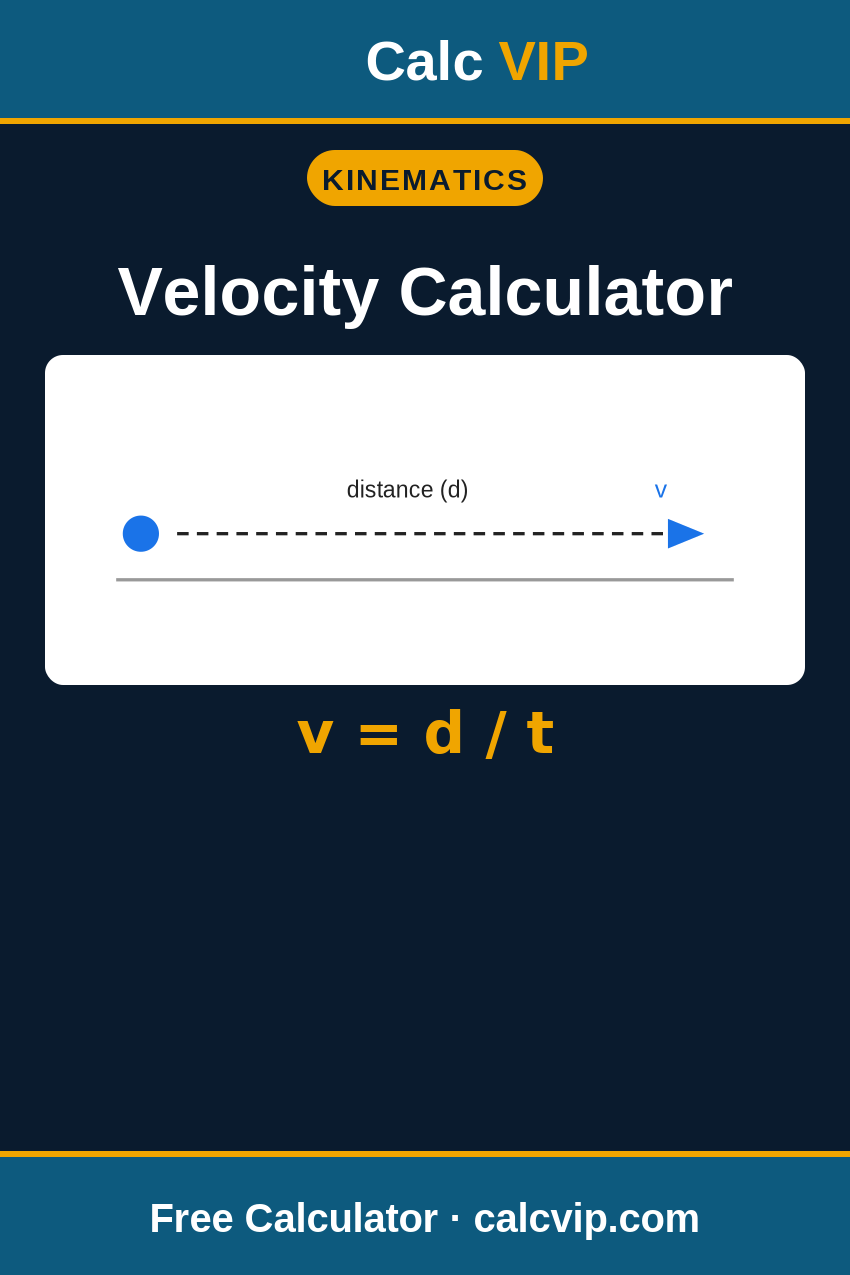
The velocity this calculator finds is an average velocity: the total distance divided by the total time. A car that covers 1000 metres in 50 seconds has an average velocity of 20 m/s, even if it started slowly, sped up and slowed down again along the way. The average smooths out all those changes and answers the simplest useful question: overall, how fast did it go?
Formula
Velocity = Distance ÷ Time → v = d / t
The same relationship can be rearranged to find either of the other two quantities. To find the distance travelled at a steady velocity, use d = v × t: a car at 20 m/s for 50 seconds covers 20 × 50 = 1000 m. To find how long a journey takes, use t = d ÷ v: 1000 metres at 20 m/s takes 1000 ÷ 20 = 50 seconds. Knowing any two of the three values always gives you the third.
Read the unit m/s literally: metres per second — the number of metres covered in every one second. A velocity of 20 m/s means the object moves 20 metres further away every second: 20 m after one second, 40 m after two, and so on for as long as the velocity stays the same.
| Symbol | Meaning | Units |
|---|---|---|
| v | velocity (average, over the journey) | m/s or km/h |
| d | distance travelled | metres (m) or kilometres (km) |
| t | time taken | seconds (s) or hours (h) |
Velocity on a distance–time graph
Plot distance against time and the velocity is the slope of the line. A steep line means a high velocity; a flat line means the object is stationary, however much time passes. In the graph below, the object covers 1000 m in 50 s, so the slope is 1000 ÷ 50 = 20 m/s — exactly the answer the calculator gives for the same journey.
How to use
- Enter the distance and choose its unit (metres or kilometres).
- Enter the time and choose its unit (seconds, minutes or hours).
- Click "Calculate Velocity" to see the result in m/s and km/h.
- To convert by hand: multiply m/s by 3.6 to get km/h, and divide km/h by 3.6 to get m/s.
Worked examples
Example 1 — a car on a measured stretch. A car travels 1000 metres in 50 seconds. Velocity = 1000 ÷ 50 = 20 m/s, which is 20 × 3.6 = 72 km/h.
Example 2 — a train journey. A train covers 180 km in 1.5 hours. Velocity = 180 ÷ 1.5 = 120 km/h. In SI units that is 120 ÷ 3.6 = 33.33 m/s. Notice the calculator handles this automatically because you can pick kilometres and hours as the input units.
Example 3 — a sprinter. A sprinter runs 100 metres in 9.58 seconds (the world-record pace). Average velocity = 100 ÷ 9.58 = 10.44 m/s, or 10.44 × 3.6 = 37.58 km/h. The top speed reached mid-race is higher — around 12 m/s — because the average includes the slow start from the blocks.
Example 5 — timing thunder. Lightning flashes, and the thunder arrives 3 seconds later. Entering the sound's journey the other way round — distance 1029 m in 3 s — gives v = 1029 ÷ 3 = 343 m/s, the speed of sound. Run forwards, the same numbers are the camper's rule: count the seconds, multiply by 343, and you know how far away the storm is — about a kilometre for every three seconds.
Example 6 — the Earth itself. The Earth travels about 9.4 × 10⁸ km around its orbit in one year (8760 hours). v = 9.4 × 10⁸ ÷ 8760 ≈ 107,306 km/h, about 29.8 km/s. You are, at this moment, moving faster than any spacecraft humanity built until the solar probes — and because the velocity is steady and the direction changes only gently, you feel none of it.
Velocity in real life
Everyday speeds. A person walking briskly moves at about 1.4 m/s (5 km/h). A cyclist typically rides at 5–7 m/s. A car on a motorway travels at about 30 m/s (108 km/h), and a passenger jet cruises near 250 m/s. Comparing numbers in the same unit makes these differences easy to feel: the jet covers in one second what the walker covers in about three minutes.
Sound and thunder. Sound travels through air at about 343 m/s. That is why you see lightning before you hear thunder: the light arrives almost instantly, while the sound takes roughly 3 seconds to travel each kilometre. Count the seconds between the flash and the rumble and divide by 3, and you have the storm's distance in kilometres — a velocity calculation done in your head.
Light. Light itself has a velocity: 299,792,458 m/s in a vacuum, usually rounded to 3 × 10⁸ m/s. Even at that enormous speed, light from the Moon takes about 1.28 seconds to reach Earth, and sunlight takes about 8 minutes 20 seconds. Nothing is known to travel faster, which is why this value, called c, appears all over modern physics.
Signals in fibre. Light in a glass fibre travels at about 2 × 10⁸ m/s — two-thirds of its vacuum speed. A message crossing a 5000 km undersea cable therefore needs 5 × 10⁶ ÷ 2 × 10⁸ = 0.025 s one way. The delay you notice on intercontinental calls is this calculation, plus the satellites' longer detour when the call goes by space instead.
Hiking pace and the map. Walkers plan with Naismith's rule — about 5 km/h on the flat, plus time for climbing — which is an average-velocity budget exactly like this calculator's: total distance over total time, stops and scrambles included. A route that "should" take four hours by the moving speed takes five by the average, and the mountain does not accept the moving speed as an excuse.
Units of velocity around the world
The SI unit, m/s, is what physics uses, but you will meet others. Road speeds in most countries are in km/h; in the United States and United Kingdom, miles per hour (mph) is used — 1 mph = 0.447 m/s, so 60 mph ≈ 26.8 m/s (about 96.6 km/h). At sea and in the air, speed is measured in knots: one knot is one nautical mile per hour, equal to 1.852 km/h or 0.514 m/s. A ferry cruising at 20 knots is travelling at about 10.3 m/s. Older engineering texts use feet per second (ft/s); 1 m/s ≈ 3.28 ft/s. Whatever the unit, the definition underneath never changes — distance divided by time — and the calculator's unit menus spare you the conversions entirely.
How velocity is measured
A car's speedometer traditionally counts how fast the wheels or gearbox shaft turn and converts that rotation into a road speed — which is why fitting different-sized tyres can make it read slightly wrong. Radar and laser speed guns work completely differently, bouncing a signal off the vehicle and measuring the shift in its frequency (the Doppler effect) to get the velocity directly. GPS devices take the other approach used by this calculator: they record positions at known times and divide the distance moved by the time elapsed, which is why a sat-nav's speed reading is an average over the last second or so. Aircraft measure airspeed with a pitot tube sensing the pressure of the oncoming air, then correct it to find their velocity through the air mass. Four technologies, one definition.
Example 4 — a delivery drone. A drone covers 2.4 km in 4 minutes. Converting first: 2.4 km = 2400 m and 4 minutes = 240 s. Velocity = 2400 ÷ 240 = 10 m/s, which is 10 × 3.6 = 36 km/h. The unit menus in the calculator exist precisely for mixed-unit problems like this one.
A sense of scale: the slowest and fastest things
Velocities in nature span an almost absurd range. Your fingernails grow at roughly a billionth of a metre per second (about 3.5 mm a month), and the tectonic plates drift at a similar pace — continents move about as fast as nails grow. A garden snail at full stretch manages around 0.01 m/s. At the other end of the scale, the Earth orbits the Sun at about 29.8 km/s, sweeping through its own diameter every seven minutes, and the whole Solar System circles the centre of the Milky Way at roughly 230 km/s. Yet even that is less than a thousandth of the speed of light. Having one consistent unit — the humble m/s — lets all of these sit on the same number line, which is precisely why scientists insist on it.
Velocity is a vector: the direction half of the story
This calculator returns a size, but velocity's full identity includes direction — and the direction half produces physics the size alone cannot. Drive around a roundabout at a perfectly constant 10 m/s and your speed never changes, yet your velocity changes continuously, because its direction rotates. That change is an acceleration (the centripetal acceleration, v²/r), supplied by the tyres' friction. Speedometers, which read only size, insist nothing is happening; passengers, who feel the acceleration, know better.
Direction also decides addition. Two velocities in the same line add or subtract plainly — a boat at 5 m/s in a 2 m/s current makes 7 m/s downstream and 3 m/s up. At right angles they combine by Pythagoras: a plane flying north at 100 m/s in a 30 m/s west wind has a ground velocity of √(100² + 30²) ≈ 104.4 m/s, aimed slightly off north — which is why pilots point the nose into the wind and let the vector sum do the steering.
Quick reference: velocities across the scales
From a snail to light itself, velocity spans twelve orders of magnitude, and the m/s column is the honest common currency: convert everything into it and comparisons that km/h hides become obvious — an airliner, for instance, cruises at 250 m/s, about three-quarters of the speed of sound.
| Mover | Velocity |
|---|---|
| garden snail | ≈ 0.05 m/s |
| walking | ≈ 1.4 m/s (5 km/h) |
| cycling | ≈ 5 m/s (18 km/h) |
| car in town | ≈ 13.9 m/s (50 km/h) |
| car on a motorway | ≈ 33.3 m/s (120 km/h) |
| airliner cruising | ≈ 250 m/s (900 km/h) |
| sound in air | 343 m/s |
| light in a vacuum | 300,000,000 m/s |
Relative velocity: rain on a moving train
Velocity is always measured against something, and changing the observer changes the number — the seed of relativity, visible from a train window. Rain falls vertically at 10 m/s past a train doing 30 m/s. To a passenger, the rain arrives with both motions combined: an apparent speed of √(10² + 30²) ≈ 31.62 m/s, slanting at arctan(30 ÷ 10) ≈ 71.6° from the vertical — which is why rain streaks train windows diagonally and why the slant steepens with the train's speed.
The same vector addition steers boats across rivers and aircraft through crosswinds, and it is already hiding inside everyday language: a headwind "slows the plane" because the ground velocity is the air velocity minus the wind's. This calculator returns the size of a single velocity; relative velocity is what happens when two of them meet — added as arrows, never as bare numbers.
The same arithmetic governs the smallest daily journey: a pedestrian at 1.4 m/s needs 20 ÷ 1.4 ≈ 14.3 s to cross a 20 m road. Traffic engineers budget crossing times from exactly this division — distance over velocity — which is why signal phases lengthen on wide roads and why the green man seems to hurry you: he is a velocity calculation with a deadline.
Common mistakes
- Mixing units. Dividing kilometres by seconds gives a meaningless number. Convert first, or use the unit menus in the calculator so it converts for you.
- Confusing average with top speed. The average velocity over a journey is almost always lower than the fastest speed reached during it, because it includes slow parts and stops.
- Forgetting that stopped time counts. If a journey includes a 10-minute rest, those minutes are part of the total time and pull the average down.
- Using zero time. Nothing can travel a distance in no time at all, so a time of zero can never give a velocity — division by zero is undefined.
- Dividing time by distance and calling it velocity. Time ÷ distance is pace — minutes per kilometre, a perfectly good runner's number, but the reciprocal of velocity. If your "velocity" for a car comes out as 0.05, you have computed its pace in hours per kilometre and labelled it backwards.
FAQ
What is the difference between speed and velocity?
Speed only tells how fast something moves. Velocity also includes the direction of movement. This calculator gives the magnitude, which is the same number for both.
How do I convert m/s to km/h?
Multiply the value in m/s by 3.6. To go the other way, divide km/h by 3.6. The 3.6 comes from 1000 metres in a kilometre and 3600 seconds in an hour: 3600 ÷ 1000 = 3.6.
What if the time is zero?
Velocity cannot be calculated with zero time, because nothing can travel a distance in no time. The calculator will ask you to enter a time greater than zero.
Can velocity be negative?
Yes, once a direction is chosen as positive. An object moving the opposite way has a negative velocity — for example, a ball thrown up at +8 m/s comes back down at −8 m/s as it passes the same point. Speed, by contrast, is never negative.
What is the difference between average and instantaneous velocity?
Average velocity is the total distance divided by the total time for a whole journey. Instantaneous velocity is the value at one moment — the number on a speedometer. This calculator gives the average.
Can the average velocity of a round trip be zero?
If velocity is worked out from displacement (the straight-line change of position), yes: go somewhere and come back, and your overall displacement is zero, so the displacement-based average velocity is zero too. Your average speed is not zero, because you really did cover the distance. This calculator uses distance, so it gives the speed-like value.
Which unit do scientists use for velocity?
The SI unit is metres per second (m/s). Kilometres per hour (km/h) is common in everyday life and on road signs, which is why the calculator shows both.
How fast is the International Space Station?
About 7.66 km/s — 7660 m/s, or roughly 27,600 km/h. At that velocity it crosses a football pitch in about a hundredth of a second and circles the whole Earth in about 92 minutes, which is why its crew sees sixteen sunrises a day.
How do average-speed cameras work?
Exactly like this calculator, with number-plate recognition: the system times a car between two cameras a known distance apart and divides distance by time. There is no radar gun to beat — the average over the whole stretch is the measurement, which is why slowing only at the cameras achieves nothing.
Why does my treadmill show km/h but races quote pace?
Both describe the same motion from opposite sides. Velocity (km/h) answers "how far in an hour?"; pace (minutes per kilometre) answers "how long for each kilometre?" Runners think in pace because races are measured in kilometres; convert by dividing 60 by the speed — 12 km/h is 5 minutes per kilometre.