 Calc
Acceleration From Distance Calculator – v² = u² + 2as Solver
 Created by Sarah Mitchell · Physics Editor · Motion & Measurement · Last updated: November 2026
Use this free Acceleration From Distance Calculator to find acceleration from a change in velocity over a known distance, using v² = u² + 2as — the equation of motion that does not need time. You can also switch the mode to solve for the distance instead.
Every other equation of motion asks for the time. This one refuses to: v² = u² + 2as links the start velocity, the end velocity, the acceleration and the distance, and time appears nowhere in it. That absence is its superpower. Plenty of real situations hand you exactly these four quantities and withhold the clock — a braking car whose skid marks can be measured but whose braking time cannot, an aircraft whose takeoff speed and runway length are known to the metre, a particle in an accelerator whose energy gain over a known stage length is the whole design question. Where the other equations stall for want of a stopwatch, this one answers immediately, in both directions: this calculator finds a from u, v and s, or flips to find s from u, v and a.
The squared velocities are the formula's signature, and they carry a warning and a promise. The warning: velocity changes do not translate linearly into distance. Double the speed and the distance needed to reach it — or to stop from it — quadruples, because v² has quadrupled. The promise: the equation is secretly an energy statement. Multiply through by ½m and v² = u² + 2as becomes ½mv² = ½mu² + mas — final kinetic energy equals initial kinetic energy plus force × distance, the work–energy theorem wearing kinematics clothing. The calculator on this page is therefore doing quiet double duty: every acceleration it finds is also a statement about energy gained per metre travelled.
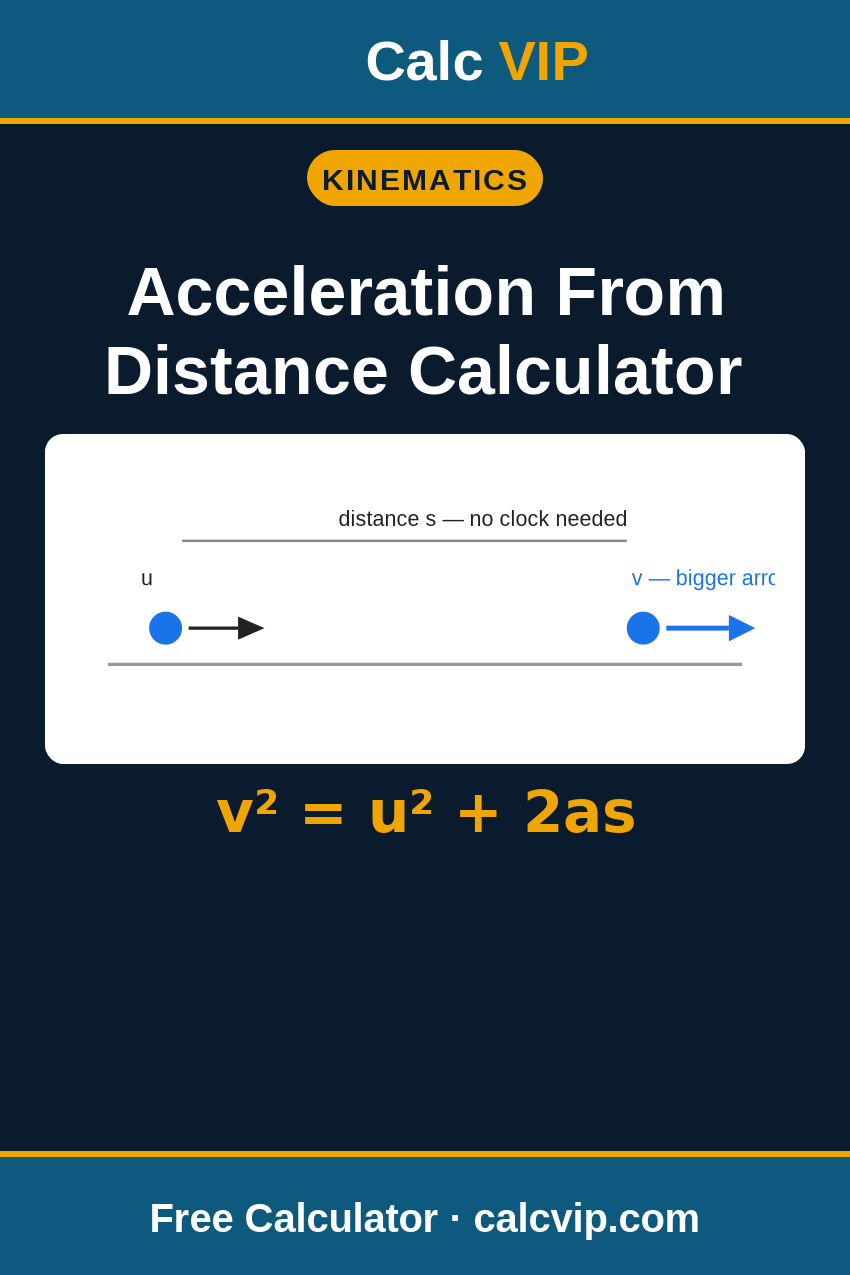
Signs behave exactly as physics demands. If v exceeds u, the acceleration comes out positive; if the object slowed, a comes out negative — deceleration — and in distance mode a negative acceleration paired with a falling velocity returns a positive, sensible stopping distance. The tool refuses only the genuinely impossible: zero or negative distance when solving for a, zero acceleration when solving for s, and combinations whose signs would demand a negative distance.
Formula
v² = u² + 2as • velocities in m/s, a in m/s², s in metres (m)
The equation rearranges for each of its variables: a = (v² − u²) / 2s solves for acceleration, s = (v² − u²) / 2a solves for distance, v = √(u² + 2as) solves for the final velocity, and u = √(v² − 2as) runs it backwards to the start velocity. Two special cases do heavy everyday work: from rest (u = 0) it collapses to v² = 2as, and for a full stop (v = 0) it gives the stopping distance s = u² / 2|a|. The equation is derived by eliminating time between v = u + at and s = ½(u + v)t — which is precisely why time never appears: it was divided out. This calculator's two modes cover the a and s rearrangements; the root forms are one further step of algebra.
| Symbol | Meaning | Units |
|---|---|---|
| u | initial velocity at the start of the measured distance | m/s |
| v | final velocity at the end of the measured distance | m/s |
| a | constant acceleration (negative when slowing) | m/s² |
| s | distance over which the velocity changed | m |
The hidden energy equation
It is worth seeing the disguise come off, because it changes how you think about the answers. Multiply v² = u² + 2as by half the mass: ½mv² − ½mu² = mas = Fs. The left side is the change in kinetic energy; the right side is the work done by the net force. So when this calculator reports that a train needed 4 m/s² to climb from 10 to 30 m/s over 100 m, it is simultaneously reporting that each kilogram of the train gained ½(30² − 10²) = 400 J of kinetic energy across that stretch, delivered at 4 joules per kilogram per metre. Acceleration-from-distance and energy-per-distance are the same number in two dialects — which is why accelerator physicists, who think in energy gained per stage, and vehicle engineers, who think in acceleration over a runway, are unknowingly sharing one equation.
The squared terms also dictate the safety arithmetic of speed. Kinetic energy grows with v², and the distance needed to shed that energy at a fixed braking force grows with it identically. A car at 30 m/s does not need twice the stopping distance of one at 15 m/s — it needs four times, as the quick-reference table below shows with the arithmetic laid bare. Road-safety campaigns about "just 5 km/h faster" are, underneath, campaigns about squares.
Engineers often quote the accelerations this calculator returns in g's — multiples of 9.81 m/s² — because the human body experiences acceleration as apparent weight. The train of Example 1 accelerates at 4 m/s² ≈ 0.41 g: noticeable, unremarkable. Firm braking at −5 m/s² is about 0.51 g; the dry-road friction ceiling of 6.87 m/s² is 0.7 g; a lift's comfortable 1 m/s² is barely 0.1 g, which is why it feels gentle; and the takeoff roll of Example 5, at 2 m/s² ≈ 0.2 g sustained for 40 s, is an exercise in patience rather than force. Converting with a ÷ 9.81 gives every result on this page a bodily meaning — and gives an instant absurdity check, since ordinary vehicles live between about −0.8 g and +0.5 g and answers outside that band deserve a second look at the inputs.
The exceptions prove the scale's usefulness. A launched roller coaster that reaches 100 km/h (27.78 m/s) in 2 s averages 13.89 m/s² ≈ 1.42 g over its launch track — and distance mode prices that launch at s = 27.78² ÷ (2 × 13.89) = 27.78 m of track per the same arithmetic. Riders feel the 1.42 g as a sustained shove; the equation feels it as 27.78 metres of runway. One event, two dialects, again.
How to use
- Choose the mode: "Acceleration a" if you know the distance and want the acceleration, or "Distance s" if you know the acceleration and want the distance.
- Enter the initial velocity u and final velocity v in m/s.
- Enter the distance s in metres (acceleration mode) or the acceleration a in m/s² (distance mode) — the third field's label switches to match.
- Click "Calculate" for the answer.
- For braking problems, expect a negative acceleration; in distance mode, enter that negative value and the calculator returns the positive stopping distance.
Worked examples
Example 1 — the train. A train speeds up from u = 10 m/s to v = 30 m/s over a distance of s = 100 m.
a = (30² − 10²) ÷ (2 × 100) = 800 ÷ 200 = 4 m/s². Check with distance mode: s = (30² − 10²) ÷ (2 × 4) = 100 m. ✔
Example 2 — braking to a stop. A car brakes from 20 m/s to a standstill over 50 m of skid marks. a = (0 − 20²) ÷ (2 × 50) = −400 ÷ 100 = −4 m/s² — firm braking on a decent surface, and exactly the figure a crash investigator extracts from the marks.
Example 3 — the cyclist from rest. A cyclist starts from rest and reaches 15 m/s over 75 m of gentle slope. a = (15² − 0) ÷ (2 × 75) = 225 ÷ 150 = 1.5 m/s².
Example 4 — distance mode: the merge. A car accelerates from 5 m/s to 25 m/s at a steady 2 m/s² joining a motorway. s = (25² − 5²) ÷ (2 × 2) = 600 ÷ 4 = 150 m of slip road needed — a number road designers genuinely use.
Example 5 — the takeoff roll. A light aircraft lifts off at 80 m/s after a 1,600 m ground roll from rest. a = 80² ÷ (2 × 1600) = 6400 ÷ 3200 = 2 m/s² average acceleration — modest, but sustained over a long roll, which is why runways are long.
Example 6 — distance mode: emergency stop from 30 m/s. With firm braking at −6 m/s², s = (0 − 30²) ÷ (2 × −6) = −900 ÷ −12 = 75 m. Compare Example 2's gentler stop and the square law bites: 50% more speed needed 50% more road even with 50% stronger brakes — at the same −4 m/s² it would have needed 112.5 m, 2.25 times the distance.
Acceleration from distance in real life
Skid-mark analysis. The classic forensic measurement: the length of a skid is s, the final velocity is zero (or the impact speed), and a follows from the road's friction. This calculator is the arithmetic heart of that reconstruction.
Runway and slip-road design. Engineers are given speeds and vehicle accelerations; the unknown is always a length — of runway, of merge lane, of escape ramp. Distance mode is the design tool.
Particle accelerators. Each accelerating stage has a fixed length and must deliver a fixed velocity (energy) gain; a = (v² − u²)/2s, translated into field strength, is the per-stage specification.
Sports track events. A javelin or shot athlete accelerates the implement over the fixed length of an arm's sweep or a throwing circle; coaches use the equation to link release speed to the acceleration the athlete must produce in that space.
Roller-coaster launches. Launched coasters specify track length and target speed; the required launch acceleration — and the g-force riders feel — comes straight from a = v²/2s.
Elevator and cable-car spans. Comfort limits cap acceleration, and station spacing fixes distance; the equation checks whether a target cruise speed is even reachable between stops.
Eliminating time: where this equation comes from
The derivation is short and worth owning. From v = u + at, the time is t = (v − u)/a. Substitute that into the average-velocity distance, s = ½(u + v)t, and the a in the denominator meets the (v − u) to make (v² − u²)/2a — rearranged, v² = u² + 2as. Time was not ignored; it was eliminated, which is why the equation stays exactly true for any constant-acceleration motion while saying nothing about duration. The practical moral cuts both ways: if a problem gives you no time and asks for none, reach for this equation first; if it asks how long, this equation alone cannot answer, and you must pair it with one of its time-carrying siblings.
Quick reference: stopping distances at a = −5 m/s² (v = 0)
| Start speed u (m/s) | u in km/h | Stopping distance s (m) | Compared with 10 m/s |
|---|---|---|---|
| 5 | 18 | 2.5 | quarter |
| 10 | 36 | 10 | — |
| 15 | 54 | 22.5 | 2.25× |
| 20 | 72 | 40 | 4× |
| 25 | 90 | 62.5 | 6.25× |
| 30 | 108 | 90 | 9× |
Triple the speed, nine times the stopping distance — and these figures exclude the thinking distance travelled before the brakes bite, which grows only linearly and still adds metres. The square is the whole story of speed and stopping.
When a is not one number: staged acceleration and the equivalent value
Real accelerations fade. An aircraft's engines produce roughly constant thrust, but drag grows with speed, so the net acceleration sags throughout the takeoff roll; a sprinter's acceleration collapses from its first-step peak toward zero at top speed. The equation v² = u² + 2as, applied to such motion over the whole distance, returns the equivalent constant acceleration — the steady value that would produce the same velocity change over the same distance. That number is honest and useful (it sizes runways and compares vehicles), provided it is not mistaken for the acceleration at any particular moment.
Staged calculation shows how the equivalent value is built. Suppose an aircraft accelerates at 3 m/s² from rest to 20 m/s, then at a faded 2 m/s² from 20 to 40 m/s. Stage one: s = (20² − 0)/(2 × 3) = 66.67 m. Stage two: s = (40² − 20²)/(2 × 2) = 300 m. Total roll: 366.67 m — against only 266.67 m had the 3 m/s² held throughout, a 100 m penalty exacted by the fade. The equivalent constant acceleration for the whole roll is (40² − 0)/(2 × 366.67) = 2.18 m/s² — note, closer to the weaker stage than the stronger, because the weaker stage occupied most of the distance. Distance-weighting, not time-weighting, is how this equation averages, and staged problems — gear by gear, stage by stage, slope by slope — are solved by applying the formula piece by piece and adding the distances, exactly as above.
Airlines plan with precisely this equivalent value: a takeoff performance chart is, in essence, a table of the distance a given aircraft at a given weight needs to reach rotation speed on a given runway — v² = u² + 2as with u = 0, the fade folded in, and a safety margin standing guard over the arithmetic.
Common mistakes
- Forgetting to square. Writing a = (v − u)/2s instead of (v² − u²)/2s. The squares are not decoration — they are the difference between this equation and a wrong one. If your answer looks like a time-based result, check the squares.
- Expecting distances to scale with speed. Planning a stop in "about twice the distance" from double the speed underestimates by a factor of two. Distances scale with the square of the velocity change's endpoints.
- Sign chaos in distance mode. Braking means a is negative and v < u, so numerator and denominator are both negative and s comes out positive. Enter a as a positive "deceleration" while v < u and the calculator rightly objects to the impossible negative distance.
- Using it when acceleration varies strongly. The equation assumes constant a over the whole s. For a car whose brakes fade or an aircraft lightening as fuel burns, it returns the equivalent constant value — useful, but an average.
- Asking it for time. v² = u² + 2as contains no t and can yield none. If the question includes "how long", pair it with t = (v − u)/a afterwards — do not expect one equation to do both jobs.
FAQ
When is v² = u² + 2as the best equation to use?
Use it when time is not given and not asked for — it links velocity, acceleration and distance directly.
Does it work for braking?
Yes. If the final velocity is smaller, the acceleration comes out negative, which means deceleration.
What if the object starts from rest?
Then u = 0 and the formula becomes v² = 2as, so a = v²/2s.
Why are the velocities squared?
Because the equation is the work–energy theorem in disguise: kinetic energy grows with v², and the work done by the force over distance s is what changes it. The squares are energy showing through.
Can I find the final velocity with this equation?
Yes: v = √(u² + 2as). Enter the acceleration-mode numbers in reverse to check — or use the Final Velocity calculator on this site, which builds on the time-based form.
What does a negative distance result mean?
That the signs are inconsistent: typically a positive acceleration entered alongside a velocity decrease, or vice versa. The calculator refuses such combinations in distance mode because no real motion matches them.
Does it work going uphill or in free fall?
Yes, with a set to the component of acceleration along the motion: for vertical falls, a = 9.81 m/s² downward and s is the height — the same algebra that powers the Free Fall Height calculator.
How accurate is the skid-mark method built on this?
Good to perhaps 10–20% in practice: the equation is exact, but the braking acceleration depends on the surface, tyres and whether all wheels locked — investigators measure a for the actual road rather than assuming it.
What if acceleration is zero?
Then v must equal u and no distance is defined by the equation — any distance is covered at constant speed, which is the Speed Distance Time calculator's territory. The tool rejects a = 0 in distance mode for this reason.
Is this the third equation of motion?
Yes — the set is v = u + at, s = ut + ½at², and v² = u² + 2as (with s = ½(u + v)t as the useful fourth). Choosing between them is purely a matter of which variable is missing: here, time.