 Calc
Vertical Motion Calculator – Thrown Up: Max Height & Time to Apex
 Created by Yuki Tanaka · Physics Editor · Modern Physics · Last updated: November 2026
Use this free Vertical Motion Calculator for an object thrown straight up into the air. Enter the upward launch speed and a time, and find the maximum height, the time to reach the top, and the object's velocity at that time (g = 9.81 m/s²).
Throw a ball straight up and you stage the purest drama in mechanics: a journey with a beginning, a climax and a return, governed by a single unchanging adversary. Gravity taxes the upward velocity at 9.81 m/s every second, without pause or negotiation. The ball rises while it still has upward velocity to spend, hesitates for one weightless instant at the top when the account reads exactly zero, and then falls as gravity rebuilds the velocity downwards, arriving back at your hand with precisely the speed it left — every feature of the flight fixed in advance by the one number you chose at the throw, the launch speed u.
Three questions organise everything there is to ask about such a flight, and they are the three this calculator answers. How high does it go — H = u²/2g, the height at which the upward velocity is fully spent. When does it get there — ttop = u/g, the launch speed divided by gravity's tax rate. And what is it doing at any other moment — v = u − gt, positive while rising, zero at the summit, negative on the way down, the sign itself narrating which act of the drama you are watching. The flight is also perfectly symmetric: time up equals time down (to the same level), and the speed at any height is the same rising as falling. Few physical systems offer so much structure from so little input.
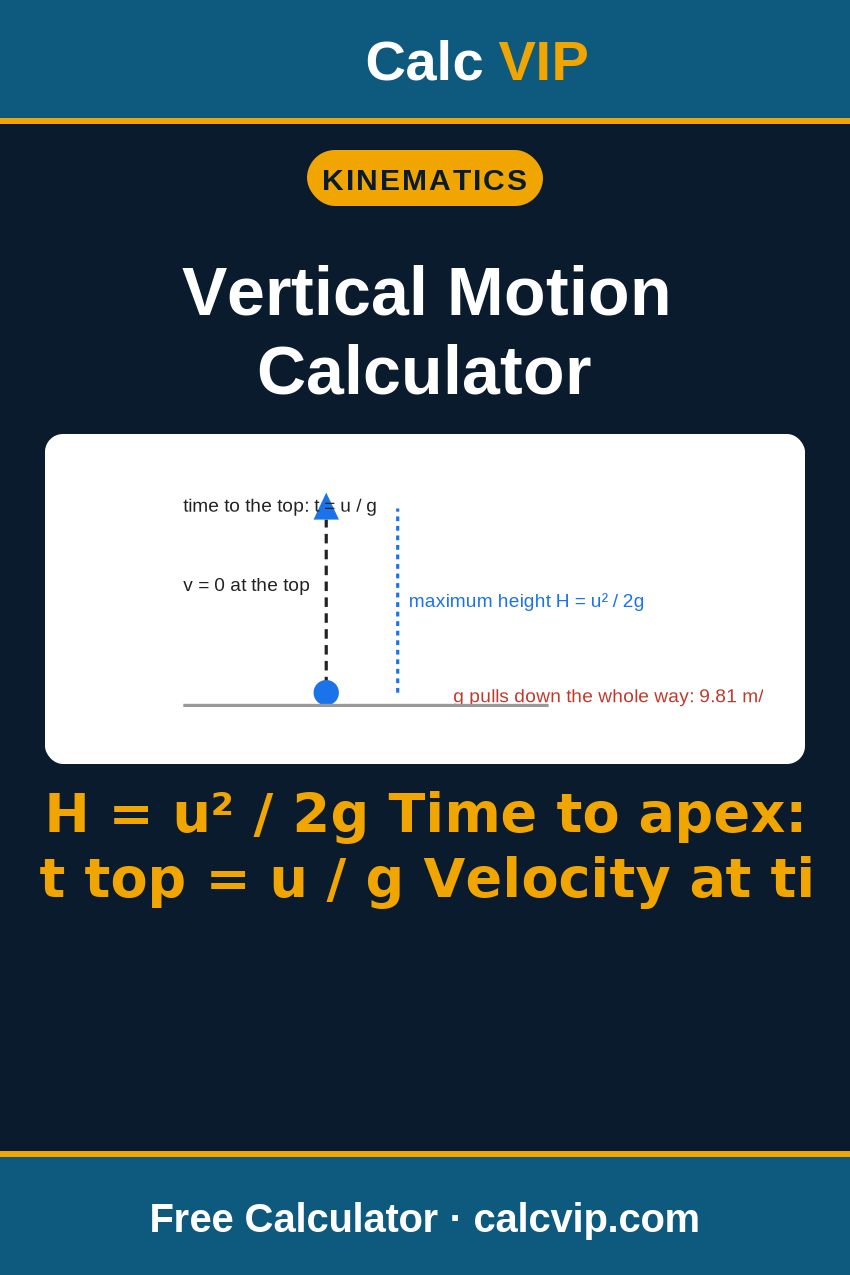
Enter the upward launch speed u in m/s and any time t in seconds after the throw, and the calculator returns the maximum height, the time to the top, and the velocity at your chosen t, labelled rising or falling. It assumes the object lands back at its launch height and ignores air resistance, as standard treatments do — excellent for balls, stones and tools, optimistic for feathers and balloons. The examples below follow throws from a gentle 9.81 m/s (chosen so the numbers turn out beautifully) to a powerful 25 m/s, and the depth sections take the same three formulas to the Moon and into the energy picture.
Formula
Maximum height: H = u² / 2g
Time to apex: ttop = u / g
Velocity at time t: v = u − gt (positive = still rising, negative = falling)
The three lines are the equations of motion specialised to a vertical launch with the acceleration set to −g. The first comes from v² = u² + 2as with v = 0 at the top: 0 = u² − 2gH. The second is v = u + at with the same condition: 0 = u − g·ttop. The third is that same first equation left unspecialised — the running balance of the flight. A fourth relation completes the toolkit even though the calculator does not need it: the height at time t is s = ut − ½gt², the arc's own equation, whose two solutions for any height below H are the rising and falling passes of that level. Note the u² in the height formula — the same square law that governed the projectile's peak: double the throw speed and the height quadruples, while the time to the top merely doubles. Height is bought dearly and time cheaply, a trade every juggler and fountain designer feels in their hands.
| Symbol | Meaning | Units |
|---|---|---|
| u | upward launch speed at release | m/s |
| H | maximum height above the launch point | m |
| ttop | time from launch to the highest point | s |
| v | velocity at time t — positive up, negative down | m/s |
| t | any chosen moment after launch | s |
| g | acceleration due to gravity — the constant tax on upward motion | m/s² (9.81) |
| 2u/g | total flight time back to launch height | s |
The symmetry at the heart of the throw
Vertical motion under gravity is time-symmetric, and the symmetry is worth staring at. Run the film of a throw backwards and physics cannot tell: the falling ball gains speed at exactly the rate the rising ball lost it, passes each height with the same speed in both directions, and takes equal time for each half of the journey. The calculator's outputs encode this quietly — v at time t and v at time (2ttop − t) are negatives of each other, equal in size, opposite in direction. This is why a ball thrown up at 15 m/s returns to the hand at 15 m/s, why the total flight time is exactly 2u/g, and why "how long was it in the air?" and "how fast was it thrown?" are the same question asked in two dialects — circus artists who catch by timing are solving for u with their hands.
The top of the flight deserves its own moment, because it is widely misunderstood. At the apex the velocity is zero — but the acceleration is not. Gravity does not pause at the summit; it is the very thing that brings the velocity through zero and out the other side. The ball at its peak is in the same physical state as a ball dropped from rest at that height: momentarily stationary, fully accelerated. Confusing "zero velocity" with "zero acceleration" is the classic error here, and the formula v = u − gt refutes it by construction — the line passes through zero with its slope, −g, utterly unchanged. What is special about the apex is energetic: every joule of the vertical kinetic energy has become potential energy, ½mu² = mgH, the exchange the height formula records.
Air resistance, when it matters, breaks the symmetry in a characteristic direction: it taxes both halves of the flight, so the real ball peaks lower than u²/2g, takes longer to rise than to fall from that lower peak, and lands slower than it left. For a dense ball at schoolyard speeds the effect is a few percent; for a table-tennis ball it is the whole story. The calculator's world — no air — is the clean skeleton; drag is flesh that each real object adds in its own measure.
How to use
- Enter the speed u at which the object is thrown straight up, in m/s.
- Enter any time t in seconds after the throw.
- Click "Calculate Vertical Motion" to see the max height, the time to the top, and the velocity at time t.
- Read the label beside the velocity: "still rising" means t is before the apex, "already falling" means after it; at t = u/g exactly, the object is at the top.
- For the full flight back to your hand, double the time to the top: total time = 2u/g, and the landing speed equals u.
Worked examples
Example 1 — the standard throw. A ball is thrown straight up at u = 15 m/s. Maximum height = 15² ÷ (2 × 9.81) = 11.47 m. Time to the top = 15 ÷ 9.81 = 1.53 s. At t = 1 s its velocity is v = 15 − 9.81 × 1 = 5.19 m/s (still moving up) — two-thirds of the way to the summit in time, though higher than two-thirds in height, because it covered the early metres fastest.
Example 2 — the strong throw, caught late. At u = 20 m/s: H = 400 ÷ 19.62 = 20.39 m, ttop = 2.04 s, total flight 4.08 s. At t = 3 s the ball is on its way down: v = 20 − 29.43 = −9.43 m/s. The negative sign is the calculator narrating the second act — falling at 9.43 m/s, exactly the speed it had at t = 1.08 s on the way up, by symmetry.
Example 3 — the elegant throw. At u = 9.81 m/s — gravity's own number — the time to the top is exactly 1.00 s and the height is 9.81² ÷ 19.62 = 4.91 m (precisely 4.905 m). A throw at g metres per second is the cleanest demonstration in the topic: one second up, one second down, five metres of altitude, all from a single digit of input.
Example 4 — the gentle lob. At u = 12 m/s: H = 144 ÷ 19.62 = 7.34 m, ttop = 1.22 s. At t = 0.5 s, v = 12 − 4.905 = 7.10 m/s — barely slowed, because half a second of gravity's tax is under 5 m/s. Early in the flight the ball keeps most of its speed; the tax compounds quietly and collects at the top.
Example 5 — the powerful launch. At u = 25 m/s: H = 625 ÷ 19.62 = 31.86 m — a ten-storey throw — ttop = 2.55 s, and the whole flight lasts 5.10 s, ending with the ball returning at −25 m/s. Five seconds of airtime from a strong arm: this is the scale of a good juggler's cascade pattern, multiplied by several balls.
Example 6 — where is it at t = 1.2 s? For u = 18 m/s the calculator gives v = 18 − 9.81 × 1.2 = 6.23 m/s (still rising; the top comes at 1.83 s, H = 16.51 m). Its height then, from the companion formula s = ut − ½gt², is 18 × 1.2 − 4.905 × 1.44 = 21.6 − 7.06 = 14.54 m — most of the height gained already, with a third of the climb time still to run: height races ahead of time early in the flight.
Vertical motion in real life
Juggling and circus arts. A juggler's pattern is a budget of flight times: each ball thrown to H = u²/2g stays aloft 2u/g, and that airtime is what the hands spend catching and re-throwing the others. Raising the pattern by a metre costs a precisely computable slice of u — performers do this arithmetic in their wrists.
Fountains. A vertical jet is this page's throw performed by water: nozzle speed u sets the crown height u²/2g, and the shimmering stillness at the top of each jet is the v = 0 instant, repeated continuously. Pump pressure is chosen from H backwards.
Estimating building heights. Drop or throw-and-time is the oldest altimeter: time a stone's fall or a throw's full flight and the height follows — flight time 2 s means u ≈ 9.81 m/s and H ≈ 4.91 m; a 3 s fall means about 44 m. Surveyors' apps still hide this formula inside.
Basketball free throws and high balls. The arc of a free throw peaks where vy = 0; players who "use more arc" are raising uy, buying height and a steeper, more forgiving entry — the trade between H and flight time is this page's second formula, felt as touch.
Volcanology and geysers. Timing the rise of eruption ejecta or a geyser's jet gives its exit speed through u = g·ttop: Old Faithful's water, timed to its peak, leaves the vent at tens of metres per second — measured with a stopwatch and this equation, from a safe boardwalk.
Safety: dropped and thrown tools. A tool knocked from a scaffold is Example 3 read downwards: from 4.91 m it takes exactly 1.00 s to arrive, from 11.47 m about 1.53 s. Exclusion zones and toe-boards exist because those times are shorter than any shout of warning.
Quick reference: throws at a glance
| Launch speed u | Max height H | Time to top | Total flight |
|---|---|---|---|
| 5 m/s | 1.27 m | 0.51 s | 1.02 s |
| 10 m/s | 5.10 m | 1.02 s | 2.04 s |
| 15 m/s | 11.47 m | 1.53 s | 3.06 s |
| 20 m/s | 20.39 m | 2.04 s | 4.08 s |
| 25 m/s | 31.86 m | 2.55 s | 5.10 s |
| 30 m/s | 45.87 m | 3.06 s | 6.12 s |
Read the columns against each other: the time columns grow in simple proportion to u, the height column with its square. A throw twice as fast waits twice as long at the top's approach but stands four times as tall — the reason elite javelin-speed arms produce such disproportionate spectacles from such modest speed gains.
The same throw on the Moon
Replace g with the Moon's 1.62 m/s² and the whole drama slows and stretches. The standard 15 m/s throw peaks at H = 225 ÷ (2 × 1.62) = 225 ÷ 3.24 ≈ 69.44 m — six times higher — takes 9.26 s just to reach the top, and stays aloft for over 18 seconds. Apollo astronauts felt this in every tossed tool and geological hammer: familiar arm speeds produced dreamlike, slow-motion arcs. Mission planners designing lunar hoppers and sample-return launchers use exactly these rescaled formulas — the physics is identical, only the tax rate changed, which is the surest sign that the three lines in the formula box capture something real about the world rather than something local about Earth.
Common mistakes
- Claiming the acceleration is zero at the top. Only the velocity is zero, for one instant. Gravity acts undiminished throughout — if it paused at the apex, the ball would stay there. This is the most-tested misconception in the topic.
- Using the total flight time in v = u − gt for the way up only. The formula is valid for the whole flight, but "time to the top" is u/g, not 2u/g. Halving or doubling at the wrong moment is the commonest arithmetic slip here; label every t before using it.
- Forgetting the square in H = u²/2g. Height scales with the square of the launch speed. Estimating the height of a 20 m/s throw as "double the 10 m/s height" gives 10.19 m instead of the true 20.39 m — a factor-of-two error with real consequences for safety screens and fountain pumps.
- Reading a negative velocity as an error. v = −9.43 m/s is a complete statement: falling at 9.43 m/s. The sign is the direction, and discarding it discards the difference between a ball rising through a window and falling past it.
- Applying the symmetry to a cliff throw. Time up equals time down only when the object lands at its launch height. Thrown from a roof, the fall continues past launch level — use the projectile-range treatment, where the extra height extends the descent and breaks the symmetry.
FAQ
Why is the velocity zero at the top?
Gravity slows the upward motion by 9.81 m/s every second. At the highest point the upward speed has been used up completely — then the object starts falling back down.
Is the time up equal to the time down?
Yes, if it lands at the same height it was thrown from. The whole flight lasts 2u/g, and it lands with the same speed it was thrown (in the opposite direction).
What does a negative velocity at time t mean?
It means the object is already on its way down. For example v = −3 m/s means it is falling at 3 m/s.
What is the acceleration at the highest point?
Still 9.81 m/s² downward. Velocity vanishes at the apex; acceleration does not. The ball is momentarily at rest but fully accelerated — identical, for that instant, to an object just released from rest at that height.
How high would a 30 m/s throw go?
H = 900 ÷ 19.62 = 45.87 m, with 3.06 s to the top and 6.12 s aloft — see the quick-reference table. That is a strong professional throw, and it would clear a 14-storey building.
Does the mass of the object change the height?
No — mass cancels from every formula on this page. In air, a heavier (denser) object flies closer to these predictions because drag disturbs it less, but the ideal height is the same for a marble and a cannonball.
What if I throw the object down instead of up?
Then u is negative in the sign convention (or equivalently, treat it as a fall with a head start): the object never rises, and its speed at time t is u + gt in magnitude. The height and apex questions no longer apply, but the velocity formula still works with the sign flipped.
How long does the object spend near the top?
Longer than intuition suggests: because it slows as it climbs, it spends about 71% of its flight above half its maximum height — the same 1/√2 fraction that appears in projectile motion generally.
Can I find the height at a specific time, not just the maximum?
Yes, with the companion formula s = ut − ½gt². Example 6 works it: at u = 18 m/s and t = 1.2 s, s = 14.54 m. This calculator focuses on the peak and the velocity, but the height-at-time is one substitution away.
Why does the ball return at the same speed it was thrown?
Energy: at the launch height on the way down, all the potential energy gained has been converted back to kinetic, and the horizontal story never existed. Gravity is a conservative tax — everything it collected on the way up is refunded on the way down (air resistance, the non-conservative part, is what breaks the refund in real life).