 Calc
Angular Velocity Calculator – ω = θ/t and ω = 2π/T
 Created by Sarah Mitchell · Physics Editor · Motion & Measurement · Last updated: November 2026
Use this free Angular Velocity Calculator to find how fast an object rotates, in radians per second (rad/s). You can calculate it either from the angle turned and the time taken, or from the time period of one full rotation.
Everything that spins has an angular velocity: the wheels of a bicycle, a ceiling fan, a washing-machine drum, the hands of a clock, the Earth itself turning once a day. Linear velocity asks "how much ground does it cover each second?" Angular velocity asks a different question: "how much angle does it sweep out each second?"
That difference matters. On a spinning wheel, a point on the rim travels much faster than a point near the hub — their linear velocities are completely different. But both points go round together, sweeping the same angle in the same time. They share one angular velocity. That is why ω (the Greek letter omega) is the natural way to describe rotation: one number captures the spin of the whole object, whatever its size.
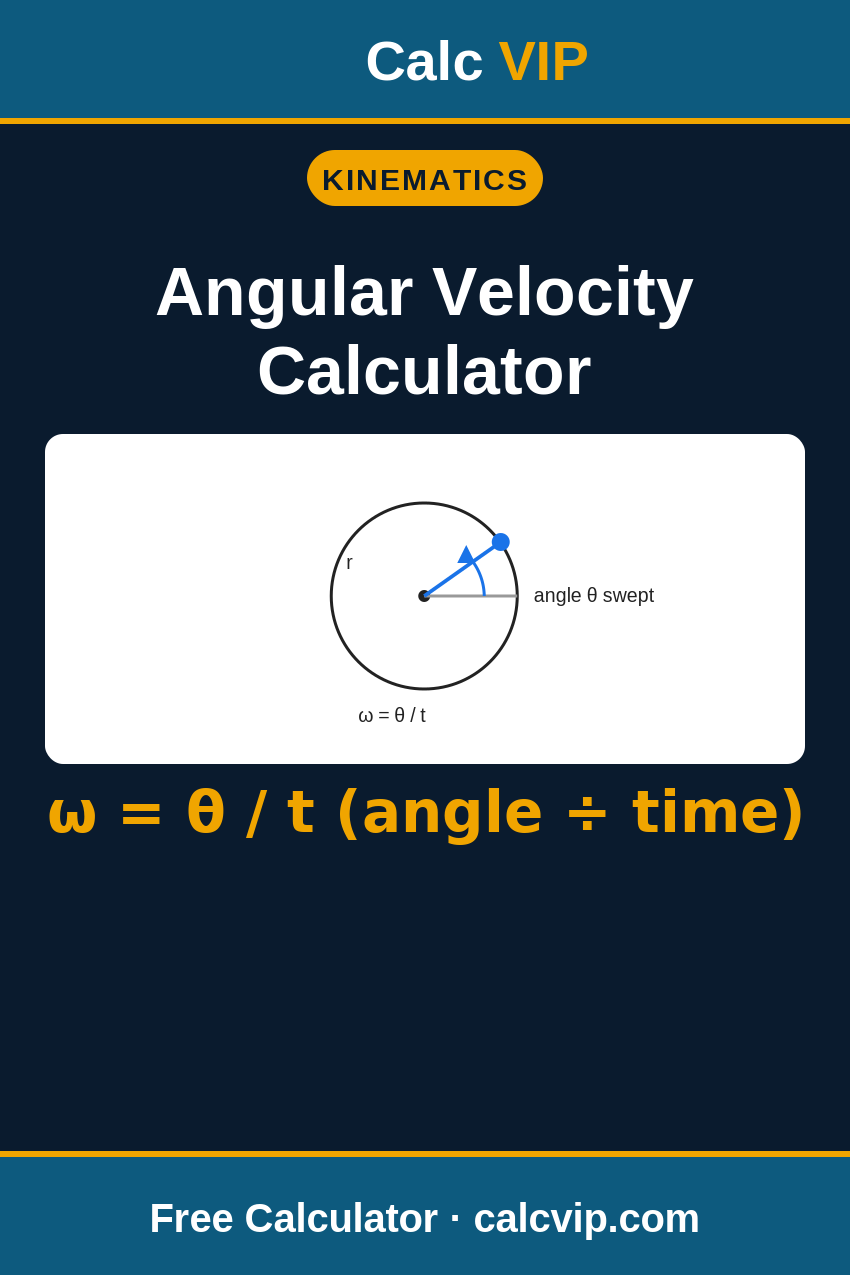
Angles in this calculator are measured in radians, the natural unit for rotation. A radian is defined by the circle itself: it is the angle you get when the arc length equals the radius. One complete turn is 2π radians (about 6.28 rad), because the circumference of a circle is 2π times its radius.
Formulas
ω = θ / t (angle ÷ time) • ω = 2π / T (one full turn of 2π radians in period T)
Two close relatives complete the picture. The frequency f counts complete turns per second, and ω = 2πf — each turn contributes 2π radians. And the linear speed of a point at distance r from the centre is v = ωr: double the distance from the centre and the point moves twice as fast, at exactly the same angular velocity. The calculator shows the frequency alongside ω, so you can see both descriptions of the same spin.
Read the unit literally: rad/s means radians swept per second. An angular velocity of 4 rad/s means the object turns through 4 radians — a little over half a full turn — every second.
| Symbol | Meaning | Units |
|---|---|---|
| ω | angular velocity — angle swept per second | rad/s |
| θ | angle turned | radians (rad) |
| t | time taken | seconds (s) |
| T | period — time for one complete turn | seconds (s) |
| f | frequency — complete turns per second | hertz (Hz) |
| r | distance from the centre of rotation | metres (m) |
| v | linear (tangential) speed of a point, v = ωr | m/s |
Radians, degrees and revolutions
Three angle units appear in rotation problems, and converting between them is simple. One full turn = 360° = 2π radians = 1 revolution. So to turn degrees into radians, multiply by π/180 (or divide by about 57.3); to turn radians into degrees, multiply by 57.3. An angular velocity of 4 rad/s is 4 × 57.3 ≈ 229° per second.
Engineers often quote rotation in revolutions per minute (rpm). To convert rpm to rad/s, multiply by 2π and divide by 60 — a combined factor of about 0.1047. A motor spinning at 3000 rpm therefore has ω = 3000 × 0.1047 ≈ 314 rad/s.
How to use
- Choose the mode: use angle and time if you know how far the object rotated, or use the period if you know how long one full turn takes.
- Angles must be in radians — one full turn is 2π ≈ 6.28 radians.
- If your angle is in degrees, convert first: divide by 57.3 (or multiply by π ÷ 180) to get radians. A quarter turn is 90°, which is π/2 ≈ 1.57 rad.
- Click "Calculate Angular Velocity" to get ω in rad/s, plus the rotation frequency.
Worked examples
Example 1 — a wheel. A wheel turns through 12 radians in 3 seconds. ω = 12 ÷ 3 = 4 rad/s. That is 4 ÷ 2π ≈ 0.64 full turns per second — the frequency the calculator reports alongside.
Example 2 — a washing machine on spin. The drum spins at 1200 rpm, which is 1200 ÷ 60 = 20 full turns per second, so its period is T = 1 ÷ 20 = 0.05 s. Using the period mode: ω = 2π ÷ 0.05 = 125.66 rad/s. (The original worked example's turntable, with T = 0.5 s, gives ω = 2π ÷ 0.5 = 12.57 rad/s.)
Example 3 — the Earth. The Earth turns once in 24 hours, so T = 86,400 s and ω = 2π ÷ 86,400 ≈ 7.27 × 10⁻⁵ rad/s — a tiny angular velocity. But multiply by the Earth's radius (6.37 × 10⁶ m) using v = ωr and a point on the equator is moving at about 463 m/s (roughly 1,670 km/h). Slow spin, enormous radius, high speed.
Example 5 — a ceiling fan. A ceiling fan completes one full turn every 0.25 s. Using the period mode: ω = 2π ÷ T = 2π ÷ 0.25 = 25.13 rad/s — four full turns every second, which is why the blades blur into a disc.
Example 6 — a vinyl record. An LP turns at 33⅓ rpm, so one turn takes T = 60 ÷ 33.33 = 1.8 s, and ω = 2π ÷ 1.8 = 3.49 rad/s. Slow as that sounds, the outer groove, 0.15 m from the centre, is sliding under the needle at v = ωr = 3.49 × 0.15 ≈ 0.52 m/s — the speed the music is physically written at.
Angular velocity in real life
Clocks. A clock's second hand completes one turn in 60 s, so ω = 2π ÷ 60 ≈ 0.105 rad/s. The minute hand is 60 times slower, ω ≈ 0.00175 rad/s, and the hour hand slower still at about 0.000145 rad/s. All three are steady, which is exactly why clockwork was the first precision rotating machinery.
Machines. A computer hard-drive platter spinning at 7200 rpm has ω ≈ 754 rad/s; a car engine idling at 900 rpm turns at about 94 rad/s, and at its red line near 6000 rpm it reaches roughly 628 rad/s. Laboratory centrifuges go far beyond this, which is why they can separate blood samples: the huge ω produces enormous centripetal acceleration at the rim.
Skating spins. A figure skater who pulls her arms in spins noticeably faster. No new push is involved — as the mass moves closer to the axis, the angular velocity rises to keep the total angular momentum the same. It is the same reason a collapsing star spins up into a rapidly rotating neutron star.
Satellites. The International Space Station circles the Earth in about 92 minutes (5520 s), so its angular velocity is ω = 2π ÷ 5520 ≈ 1.14 × 10⁻³ rad/s — slower than a clock's minute hand. Yet because its "radius" is thousands of kilometres, that crawl of an angle carries it along at 7.66 km/s.
Hard drives and motors. A hard-drive platter at 7200 rpm turns 120 times per second, ω = 7200 × 2π ÷ 60 ≈ 753.98 rad/s. Electric motors are routinely rated in thousands of rpm for the same reason: angular velocity is the shop-floor language of spin, and rad/s is its translation into physics.
Which way is positive? The direction of ω
Angular velocity is really a vector, pointing along the axis of rotation. Its direction is given by the right-hand rule: curl the fingers of your right hand in the direction of the spin, and your thumb points along ω. For a wheel rolling towards you, ω points to the left; for the Earth, it points along the axis towards the North Pole — which is why, seen from above the North Pole, the Earth turns anticlockwise. In flat, two-dimensional problems the vector collapses into the sign convention used in the FAQ: anticlockwise positive, clockwise negative. The size of ω — what this calculator gives — is unaffected by these conventions.
Angular velocities you already know
A vinyl LP turns at 33⅓ rpm, which is ω = 33.33 × 0.1047 ≈ 3.49 rad/s. A microwave turntable creeping at about 6 rpm turns at roughly 0.63 rad/s. A ceiling fan on a typical setting, near 200 rpm, reaches about 21 rad/s, and the tip of a 0.7 m blade is then moving at v = ωr ≈ 21 × 0.7 ≈ 14.7 m/s — which is why fan blades are treated with respect despite the fan looking lazy. At the other extreme, the ultracentrifuges used to separate cell components can exceed 100,000 rpm, an angular velocity over 10,000 rad/s.
Example 4 — a bicycle wheel. A cyclist rides at 8 m/s on wheels of radius 0.35 m. The contact point with the road is instantaneously at rest, so the axle's speed gives ω = v ÷ r = 8 ÷ 0.35 ≈ 22.86 rad/s — about 218 rpm. The top of the wheel, meanwhile, is moving at 2v = 16 m/s relative to the ground: twice the bike's speed, a fact that surprises almost everyone the first time they meet it.
One spin, three numbers: T, f and ω
Period, frequency and angular velocity are three descriptions of the same rotation, and fluency means sliding between them without thinking. Take the washing machine of Example 2: its period is T = 0.05 s (each turn takes a twentieth of a second), its frequency is f = 1 ÷ T = 20 turns per second (20 Hz), and its angular velocity is ω = 2πf = 125.66 rad/s. Given any one of the three, the other two follow immediately: T = 1/f, f = ω/2π, ω = 2π/T. Instruments choose whichever suits them — tachometers report rpm (a frequency in disguise), physicists work in ω, and engineers designing for vibration often start from T. This calculator accepts θ with t, or T directly, because those are the two quantities most often measurable with nothing more than a stopwatch and a mark on the rim.
Why radians are the natural unit of spin
Degrees are a human invention — 360 of them because ancient astronomers liked the number. Radians are discovered, not invented: one radian is the angle for which the arc length equals the radius, and only in radians does the beautiful identity s = rθ hold with no fudge factor. That is why v = ωr and a = ω²r work cleanly in rad/s and would each need a conversion constant in degrees per second. A full turn is 2π radians because the circumference is 2π radii — the geometry of the circle is doing the bookkeeping.
Practically, this means every formula on this page assumes radians, and every calculator in this family does too. If a problem hands you degrees, convert first (multiply by π ÷ 180). If it hands you revolutions, remember each one is 2π rad. Most angular-velocity errors in student work are not physics errors at all; they are unit smuggling, and radians are the border control.
Quick reference: angular velocities of familiar spinners
The range of everyday spins is enormous — nine orders of magnitude from a clock's hour hand to a dentist's drill — yet one formula prices them all. Notice how the table pairs each ω with its period: the two are locked together by ω = 2π/T, so whichever a problem gives you, the other is one division away.
| Spinner | Period T | ω |
|---|---|---|
| hour hand of a clock | 43,200 s | ≈ 0.000145 rad/s |
| minute hand of a clock | 3600 s | ≈ 0.00175 rad/s |
| Earth's rotation | 86,400 s | ≈ 7.27 × 10⁻⁵ rad/s |
| second hand of a clock | 60 s | ≈ 0.105 rad/s |
| vinyl LP (33⅓ rpm) | 1.8 s | ≈ 3.49 rad/s |
| car wheel at 30 m/s (r = 0.3 m) | 0.063 s | 100 rad/s |
| washing machine on spin (1200 rpm) | 0.05 s | 125.66 rad/s |
Gears and pulleys: trading angular velocity
Connect two spinning parts and their angular velocities trade against each other in inverse proportion to their sizes. A 20-tooth gear driving a 60-tooth gear slows the spin threefold: an input of 300 rpm (31.42 rad/s) emerges as 100 rpm, ω = 100 × 2π ÷ 60 ≈ 10.47 rad/s, with the torque multiplied by the same factor of three. Bicycle gears, car gearboxes and clock trains are all this single exchange — angular velocity for torque, at a rate set by teeth or diameters — repeated in cascade.
The rim-speed identity v = ωr polices the trade: at the mesh point the two gears' surfaces must move at the same linear speed, or teeth would shear. So the small gear's rim and the large gear's rim agree on v, and their ω values differ by exactly the ratio of their radii. Whenever a machine seems to create speed or force from nothing, look for the mesh point where v is shared and the ω values quietly split the difference.
At the far end of the scale, a dentist's drill spins at up to 300,000 rpm — ω = 300,000 × 2π ÷ 60 ≈ 31,416 rad/s, a quarter of a million times the hour hand's pace, in a tool held between two fingers.
Common mistakes
- Using degrees in ω = θ / t. The formula expects radians. Feeding in 360 for one turn instead of 2π makes the answer about 57 times too big.
- Confusing period and frequency. The period T is seconds per turn; the frequency f is turns per second. They are reciprocals: f = 1/T. Mixing them up inverts the answer.
- Thinking the rim and hub have different ω. Every point of a rigid spinning object shares the same angular velocity. What changes with radius is the linear speed, v = ωr.
- Forgetting the 2π. One turn is not 1 radian — it is 2π radians. ω = 1/T is a frequency, not an angular velocity.
- Leaving the period in minutes. ω = 2π/T needs T in seconds. A turntable with a period of "1.8" is turning once per 1.8 seconds, but an orbit quoted as 92 minutes must become 5520 s before it enters the formula.
FAQ
What is a radian?
A radian is an angle unit based on the radius of a circle. A full turn is 2π radians (about 6.28 rad), which equals 360 degrees.
How is angular velocity different from normal velocity?
Normal (linear) velocity measures distance per second along a path. Angular velocity measures the angle swept per second around a centre. They are linked by v = ωr.
What is the angular velocity of a clock's second hand?
It makes one turn (2π rad) in 60 s, so ω = 2π ÷ 60 ≈ 0.105 rad/s.
How do I convert rpm to rad/s?
Multiply by 2π and divide by 60 — a factor of about 0.1047. For example, 1200 rpm × 0.1047 ≈ 125.66 rad/s, the washing-machine value in Example 2.
Can angular velocity be negative?
Yes. By convention, anticlockwise rotation is usually positive and clockwise negative (viewed from the same side). The sign simply records the direction of the spin.
Is angular velocity the same everywhere on a spinning object?
Yes — that is its great advantage. Every part of a rigid rotating object sweeps the same angle per second, from hub to rim. Linear speed, by contrast, grows with distance from the centre.
What is the Earth's angular velocity?
One turn per day: ω = 2π ÷ 86,400 s ≈ 7.27 × 10⁻⁵ rad/s. Tiny as that sounds, it carries the equator around at about 463 m/s because the radius is so large.
What is the angular velocity of a car engine at 3000 rpm?
ω = 3000 × 2π ÷ 60 = 314.16 rad/s. Engine speeds sound modest in rpm; in rad/s the crankshaft is sweeping five full turns' worth of angle every hundredth of a second.
Does angular velocity depend on the size of the object?
No. A coin and a cathedral turntable rotating once a minute share the same ω. Size enters only when you convert to linear speed with v = ωr: the bigger the radius, the faster its rim travels at the same ω.
Why do figure skaters spin faster when they pull their arms in?
Pulling the arms in does not change ω directly — it reduces the resistance to spinning (the moment of inertia), and conservation of angular momentum then raises ω. The angular velocity this calculator finds from angle and time is the result the skater ends up with.