 Calc
Apparent Depth Calculator – Real Depth vs Apparent Depth in Water
 Created by David Okafor · Physics Writer · Waves & Light · Last updated: November 2026
Use this free Apparent Depth Calculator to find how deep an underwater object looks from above the surface. Refraction makes pools, rivers and fish tanks look shallower than they really are — this tool tells you by how much.
Every swimmer knows the moment: the pool floor looks close enough to touch, yet your reaching hand falls short, and the steps descend further than your eyes reported. The water is not lying exactly — it is refracting. Light from the submerged object bends as it leaves the water, and your visual system, which assumes light travels in straight lines, reconstructs the object where the straightened rays point: higher than it really is. The ratio between the two depths is one of the cleanest results in optics — apparent depth equals real depth divided by the refractive index.
For water (n = 1.33) the discount is a quarter: everything under the surface sits, visually, at three-quarters of its true depth. A 2.00 m pool presents itself as 1.50 m deep; a fish a metre down cruises at an apparent 75 cm. The effect is not a curiosity — it is a safety issue enshrined in pool design rules, a hunting problem solved independently by spearfishers, herons and archerfish, and a measurement technique that turns a microscope into an instrument for finding refractive indices.
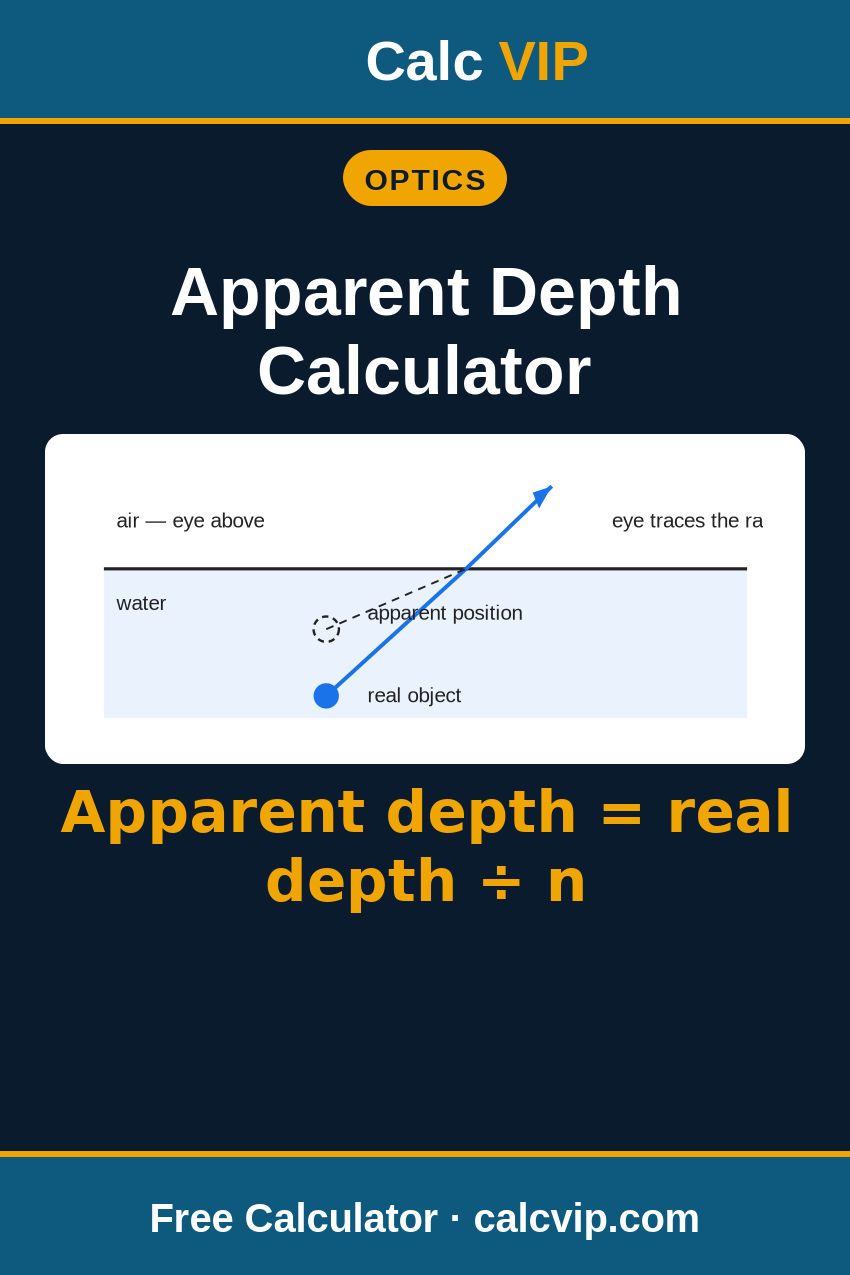
This calculator takes the real depth and the liquid's index and returns the apparent depth and the "raise" — how much higher the object appears. The sections below explain the ray geometry behind the simple division, why the formula is exact only when you look almost straight down, what the world looks like from the fish's side of the surface, and how the same physics bends the straw in your drink.
Formula
Apparent depth = real depth ÷ n • for an observer in air looking roughly straight down into a liquid of refractive index n; the object appears raised by real depth − apparent depth
More generally, apparent depth = real depth × (nobserver ÷ nobject's medium) — what matters is the ratio of indices across the surface. The simple ÷ n form is the near-vertical limit of the exact ray geometry: for a ray leaving at angle θt in the liquid and reaching the eye at θi in air, the apparent depth is real depth × (tanθt ÷ tanθi), which collapses to ÷ n as both angles approach zero (Snell's law makes the sine ratio, hence the tangent ratio, equal to 1/n). Look steeply sideways and the apparent depth shrinks further — the depth section quantifies it.
| Symbol | Meaning | Units |
|---|---|---|
| d | real depth of the object below the surface | m |
| d′ | apparent depth — where the object appears to be | m |
| n | refractive index of the liquid (water 1.33) | no units |
| raise | d − d′ — how much higher the object appears | m |
Why the object rises: straight-line vision in a bent-ray world
Your visual system is a ray-tracer with one rigid rule: light travels straight. It cannot do otherwise — in everyday air the rule is essentially true, and evolution built the assumption in at the hardware level. At a water surface the rule fails. A ray from a submerged coin, heading up and sideways toward your eye, refracts at the surface: entering the faster medium, it bends away from the normal, taking a shallower path through the air. Your eye receives it along that shallower direction and dutifully extends the line straight backward — into the water at the wrong angle, intersecting the coin's vertical line well above the coin itself. The dashed position in the diagram is where the brain files the object.
Two rays make an image, and here is the subtlety: rays leaving the coin at slightly different angles, traced back, do not meet at exactly one point. Near the vertical they nearly do — the apparent position is well defined, and the ÷ n formula is trustworthy. At oblique angles the traced-back rays fan out (an astigmatic smear), the apparent position shifts sideways as well as up, and "the" apparent depth becomes angle-dependent. That is why the pool floor looks dished — deeper straight below you, progressively shallower and more distorted toward the far edge — and why the formula on this page is honestly labelled "looking roughly straight down".
The raise has a memorable size: it is the fraction (n − 1)/n of the real depth. For water that is 0.33/1.33, almost exactly a quarter of the depth, surrendered to refraction. For glass (n = 1.50) it is a third — the reason specimens under a microscope slide sit a third higher than their mechanical depth, a correction built into the design of high-power objectives.
How to use
- Enter the true depth of the object below the surface, in metres — measure or estimate the real depth, not the one your eyes report.
- Enter the refractive index of the liquid: 1.33 for water, about 1.36 for ethanol, 1.47 for glycerine or many oils, 1.31 for ice.
- Click "Calculate Apparent Depth" to see where the object appears to be, and how much it is raised.
- Remember the viewing condition: the result is for looking almost straight down. From a shallow angle the object appears shallower still and shifted sideways (see the depth section).
Worked examples
Example 1 — the coin in the pool. A coin lies at the bottom of a pool 2.00 m deep (water, n = 1.33).
Apparent depth = 2.00 ÷ 1.33 = 1.50 m.
The coin looks raised by 2.00 − 1.50 = 0.50 m — which is why the pool floor is never quite where your feet expect it to be.
Example 2 — the deep end. A pool's deep end is a true 3.00 m.
Apparent depth = 3.00 ÷ 1.33 = 2.26 m, raised by 0.74 m. Nearly three-quarters of a metre of water is hidden by refraction — the margin that makes "no diving" signs and depth markings matters of physics, not caution theatre.
Example 3 — the shallow end. The children's end is 1.20 m deep.
Apparent depth = 1.20 ÷ 1.33 = 0.90 m, raised by 0.30 m. It looks waist-deep-on-a-child shallow — and is a full 30 cm deeper than it looks, which is why toddlers' pools surprise.
Example 4 — an object under oil. A washer lies 0.40 m down in oil of n = 1.47.
Apparent depth = 0.40 ÷ 1.47 = 0.27 m, raised by 0.13 m. Higher index, bigger discount: the oil hides a third of the depth, against water's quarter.
Example 5 — under the ice. A fish hovers 0.50 m beneath lake ice (n = 1.31).
Apparent depth = 0.50 ÷ 1.31 = 0.38 m, raised by 0.12 m. Ice-fishers sighting down the hole see the fish a hand's breadth higher than it swims — the same correction a heron makes instinctively.
Example 6 — the microscope's correction. A mark lies beneath a glass block 10.0 cm thick (n = 1.50).
Apparent depth = 10.0 ÷ 1.50 = 6.7 cm, raised by 3.3 cm. Scaled down a thousandfold, this is exactly the microscopist's situation: the focus travel between the top of a cover glass and the specimen beneath it reads apparent depths, and the real thicknesses are n times larger than the dial suggests.
Apparent depth in real life
Pool safety. The ÷ 1.33 illusion is a documented drowning factor: water that looks knee-deep is thigh-deep, and a diving entry judged on apparent depth can fall 25% short of the clearance the diver believed in. Depth markings state real depth; the calculator shows the depth your eyes will argue for.
Spearfishing and herons. The FAQ below gives the aiming rule; nature got there first. Herons strike below the fish they see, and the archerfish — which spits water jets at insects above the surface — solves the same refraction problem in reverse, from below, correcting for the apparent position of prey in air. Two species, one formula.
Measuring refractive index. Run the formula backwards and it becomes an instrument: n = real depth ÷ apparent depth. Focus a travelling microscope on a mark, then on the mark seen through a liquid layer, then on the liquid's surface; the two focus travels give the depths, and their ratio is n to three figures — a classic school determination.
The bent straw. A straw in a glass of water looks broken at the surface — the submerged part is displaced sideways as well as raised, because at the glass's curved, oblique surface the rays bend in a more complicated pattern. It is apparent depth's unruly cousin, from the same Snell's-law family.
Glass-bottom boats and aquarium panels. Looking down through a boat's window, the reef appears at 75% of its true depth — wrecks and coral heads are a quarter farther away than they seem, a correction every snorkeller learns by reaching. Thick aquarium acrylic (n ≈ 1.49) similarly displaces the fish you photograph.
Riverbeds and fords. A ford that looks ankle-deep over the stones is a quarter deeper in fact; wading staffs and marked poles exist because eyes systematically under-read water depth. Surveyors measuring bed profiles optically apply the same correction in reverse.
The view from below: apparent height and Snell's window
Swap sides and the formula inverts. A fish looking up at an object in air sees it at an apparent height of real height × n: a 1.80 m angler on the bank presents to the fish as standing 1.80 × 1.33 = 2.39 m tall above the surface. And the fish's whole above-water world is compressed into a cone — Snell's window — whose full width is twice water's critical angle, 2 × 48.8° = 97.5°. Inside the cone: sky, banks, anglers, all squeezed and brightened. Outside it: total internal reflection turns the surface into a mirror showing the fish its own riverbed. The apparent-depth ratio runs both ways, and each side misjudges the other's distances by the same factor of n.
Looking at an angle: shallower still
The exact apparent depth for a ray reaching your eye at incidence angle θi (in air) is real depth × tanθt ÷ tanθi, with θt the refracted angle in the liquid. View a 2.00 m pool at θi = 60° from the vertical: Snell's law gives θt = 40.6° in the water, and the ratio tan(40.6°) ÷ tan(60°) = 0.858 ÷ 1.732 = 0.50 — the pool's apparent depth has shrunk from 1.50 m (vertical view) to about 0.99 m, and the image has also slid sideways toward you. The dished, shifting floor that swimmers notice at glancing angles is this formula at work; the calculator's ÷ n is its honest vertical limit.
Two layers: looking through a tank wall
Real viewing often stacks interfaces: a fish behind water, behind glass, behind air. Each interface applies its own ratio, and to first approximation the raises add: the water raises the fish by a quarter of its depth in the tank, and the glass wall (viewed at its own thickness) shifts the image by a third of the wall's thickness, chiefly sideways when the wall is vertical. This is why aquarium fish appear displaced toward the viewer by more than the water alone explains, and why thick shop windows make the goods behind them sit measurably closer than the shelf they rest on.
Quick reference: real vs apparent depth in water (n = 1.33)
| Real depth | Apparent depth | Raised by |
|---|---|---|
| 0.50 m | 0.38 m | 0.12 m |
| 1.00 m | 0.75 m | 0.25 m |
| 1.50 m | 1.13 m | 0.37 m |
| 2.00 m | 1.50 m | 0.50 m |
| 2.50 m | 1.88 m | 0.62 m |
| 3.00 m | 2.26 m | 0.74 m |
| 4.00 m | 3.01 m | 0.99 m |
The raise column is the one to memorise: in water, refraction quietly deletes a quarter of every depth. Any judgement made by eye over water — a jump, a grab, a wading step — should budget for it.
Common mistakes
- Multiplying by n instead of dividing. From the air side, objects in a denser medium appear shallower: divide. (Multiplication is the fish's version — apparent height from below.) A result deeper than the real depth is the signature of the inverted formula.
- Trusting the formula at steep angles. ÷ n is the straight-down limit. At 60° the same pool appears a third shallower again, and its image shifts sideways. Spearfishers and photographers at glancing angles need the tangent form, not the headline rule.
- Using the wrong medium's index. The n belongs to the liquid the object sits in — oil at 1.47 raises objects far more than water at 1.33. And if you view through a second layer (a glass tank wall), each interface takes its own cut.
- Believing the object itself has moved. Nothing physical rises. The image is virtual — formed where traced-back rays meet — and it vanishes the moment you drain the tank or submerge your own head. Confusing image with object leads to spears aimed at ghosts.
- Forgetting the observer's medium. The general formula uses the ratio nobserver/nobject. A diver (in water, wearing a mask with an air layer) looking at a fish in the same water sees essentially true depths — the ratio across the mask's surfaces nearly cancels, which is why masks restore normal vision.
FAQ
Why does the object look raised at all?
Light from the object bends away from the normal as it leaves the water. Your eye assumes light travels in straight lines, so it traces the bent rays backwards to a point that is higher than the real object — the dashed position in the diagram.
Does the effect change when I look at an angle?
Yes. The simple ÷ n formula is for looking almost straight down. At slanting angles the apparent position shifts sideways as well as up, and the image becomes distorted — one reason spearfishing by eye is so tricky.
Why do spearfishers aim below the fish?
The fish appears higher than it really is, so an arrow or spear aimed straight at the seen image passes above the real fish. Aiming a little low compensates for the refraction.
Why does a straw look bent in a glass of water?
The submerged part of the straw is imaged by rays that refract at the water's surface and at the curved glass, so it appears raised and shifted sideways relative to the part in air. The two images no longer line up, and the straw looks broken at the surface — apparent depth plus a sideways displacement.
Is the ÷ n formula exact?
It is exact in the limit of looking straight down (rays near the normal). Real viewing uses a narrow cone of rays around the vertical, for which it is accurate to a fraction of a percent. At wider angles use the tangent form in the depth section — the discrepancy is geometry, not error.
Does the effect work through ice or glass?
Yes — any transparent layer does it, with its own n. Through glass (1.50) the discount is a third; through ice (1.31) it is close to water's. Stacked layers compound: an object under ice on water is raised at the ice surface and again, in effect, by the water beneath.
Why do swimming pools print the depth on the wall?
Because your eyes will misreport it by 25% — the printed number is the real depth, the one that governs diving clearance and a child's footing. The marking is a standing correction to a predictable optical illusion.
Can apparent depth measure an unknown liquid's index?
Yes — it is one of the oldest methods. Measure the real depth of a mark under the liquid and its apparent depth with a travelling microscope focused first on the mark (through the liquid) and then on the surface; n = real ÷ apparent. No angle measurement is needed.
What does a fish see when it looks at me?
You, but taller and compressed into a bright cone 97.5° wide — Snell's window. Your apparent height above the surface is your real height × 1.33, and everything outside the cone is replaced by a mirror image of the underwater world. Anglers staying low and back are exploiting the cone's edge.
Does apparent depth change the object's apparent size?
Slightly. Because the image is raised toward you, it is also a little nearer, and near things look bigger — a submerged coin appears both shallower and marginally larger. Underwater photographers call the pair of effects the "mask magnification": through a diver's mask, objects look about a third closer and larger.