 Calc
Critical Angle Calculator – θc = sin⁻¹(n₂/n₁) & Total Internal Reflection
 Created by David Okafor · Physics Writer · Waves & Light · Last updated: November 2026
Use this free Critical Angle Calculator to find the critical angle at a boundary between two materials — the angle at which total internal reflection begins. This is the physics that keeps light trapped inside optical fibres.
When light travelling inside glass or water reaches the surface, it does not always escape. At shallow angles, most of it breaks out into the air. But as the ray tilts further from the normal — the imaginary line at right angles to the surface — the escaping ray bends further from the normal too, until it is skimming exactly along the boundary. Tilt the ray one degree more and something remarkable happens: no light escapes at all. Every bit of it reflects back inside, as perfectly as if the surface were a mirror. The angle where this switch happens is the critical angle, and the effect is called total internal reflection.
The critical angle depends only on the two materials involved, through their refractive indices. A refractive index measures how much a material slows light down: light travels at full speed in a vacuum, at about three-quarters speed in water (n = 1.33), at two-thirds speed in ordinary glass (n = 1.50), and at less than half speed in diamond (n = 2.42). The bigger the jump in refractive index at the boundary, the smaller the critical angle, and the more easily light gets trapped.
Total internal reflection is one of the most useful effects in all of optics. It carries telephone calls and internet data through glass fibres thinner than a hair, lets doctors see inside the body with endoscopes, and turns simple prisms inside binoculars into perfect reflectors. Unlike an ordinary silvered mirror, which absorbs a few per cent of the light at every bounce, total internal reflection returns 100% of the light — nothing is lost at the boundary. This calculator finds the exact angle where the trapping begins for any pair of materials you enter.
Formula
Critical angle θc = sin−1(n₂ / n₁)
The critical angle only exists when light travels from a denser material (n₁) towards a less dense one (n₂), so n₁ must be bigger than n₂. The formula is really Snell's law in disguise: it is the angle of incidence that makes the refraction angle exactly 90°, so that sinθ₂ = 1 and the general law n₁ sinθ₁ = n₂ sinθ₂ collapses to sinθc = n₂ / n₁. Like any formula, it rearranges. If you know the critical angle and the denser material, the less dense index is n₂ = n₁ × sinθc — for glass with θc = 41.81°, n₂ = 1.50 × 0.6667 = 1.00, which is air, as it should be. Working the other way, n₁ = n₂ / sinθc: if light escapes from an unknown liquid into air (n₂ = 1.00) with a critical angle of 48.75°, then n₁ = 1.00 ÷ 0.7519 = 1.33, and the liquid is water.
Common refractive indices: air 1.00, water 1.33, glass 1.50, diamond 2.42.
| Symbol | Meaning | Units |
|---|---|---|
| θc | critical angle, measured from the normal | degrees (°) |
| n₁ | refractive index of the denser material the light starts in | no units (a ratio) |
| n₂ | refractive index of the less dense material beyond the boundary | no units (a ratio) |
A refractive index has no units because it is a ratio of two speeds: the speed of light in a vacuum divided by its speed in the material. That is also why n can never be less than 1 for ordinary materials — nothing in them makes light go faster than its vacuum speed.
Below, at and above the critical angle
It helps to picture the three things a ray can do at the boundary. Below the critical angle — say a ray in glass meeting air at 30° from the normal — the ray mostly refracts out into the air, bending away from the normal, although a weak reflection also bounces back inside. Exactly at the critical angle (41.81° for glass), the refracted ray runs along the surface itself at 90° from the normal, while the reflected part grows stronger. Above the critical angle, the refracted ray vanishes completely and the reflection takes everything: the boundary behaves as a flawless mirror. The change is sudden, not gradual — one degree below the critical angle some light still escapes, and one degree above it, none does. Engineers rely on this sharp switch when designing fibres and prisms, because a ray safely above the critical angle can bounce thousands of times without leaking.
There is a subtle footnote to the "total" in total internal reflection. Physicists find that a faint, rapidly fading wave — called an evanescent wave — does reach a tiny distance into the second material, dying away within about a wavelength of the surface. Normally it carries no energy away, so the reflection really is total. But bring a second dense material within that hair's breadth and light can leak across the gap, an effect called frustrated total internal reflection. It is not just a curiosity: fingerprint scanners work by pressing skin against a glass plate, so that the ridges of the fingerprint touch the glass and frustrate the reflection exactly where they make contact, painting a map of the print in dark and light patches.
How to use
- Enter the refractive index of the denser material the light starts in (n₁) — for example, glass = 1.50.
- Enter the refractive index of the less dense material on the other side (n₂) — for example, air = 1.00.
- Click "Calculate Critical Angle". At exactly this angle of incidence the refracted ray runs along the boundary at 90°; at any larger angle, total internal reflection occurs and all the light reflects back inside the denser material.
- Remember that all angles here are measured from the normal (the line at 90° to the surface), not from the surface itself.
Worked examples
Example 1 — glass to air. Light inside glass (n₁ = 1.50) reaches a glass–air boundary (n₂ = 1.00).
θc = sin−1(1.00 ÷ 1.50) = sin−1(0.6667) = 41.81°
So any ray hitting the boundary at more than 41.81° from the normal is totally internally reflected.
Example 2 — water to air. For a swimmer looking up, or light trying to leave a pond: θc = sin−1(1.00 ÷ 1.33) = sin−1(0.7519) = 48.75°. A diver looking up therefore sees the whole above-water world squeezed into a bright cone about 97.5° wide (twice 48.75°) overhead, while the surface outside that cone mirrors the underwater scene.
Example 3 — diamond to air. θc = sin−1(1.00 ÷ 2.42) = sin−1(0.4132) = 24.41°. Because this angle is so small, almost every ray inside a cut diamond strikes a back surface above 24.41° and reflects instead of escaping; the cutter shapes the stone so the trapped light is finally steered out through the top — the famous fire and sparkle.
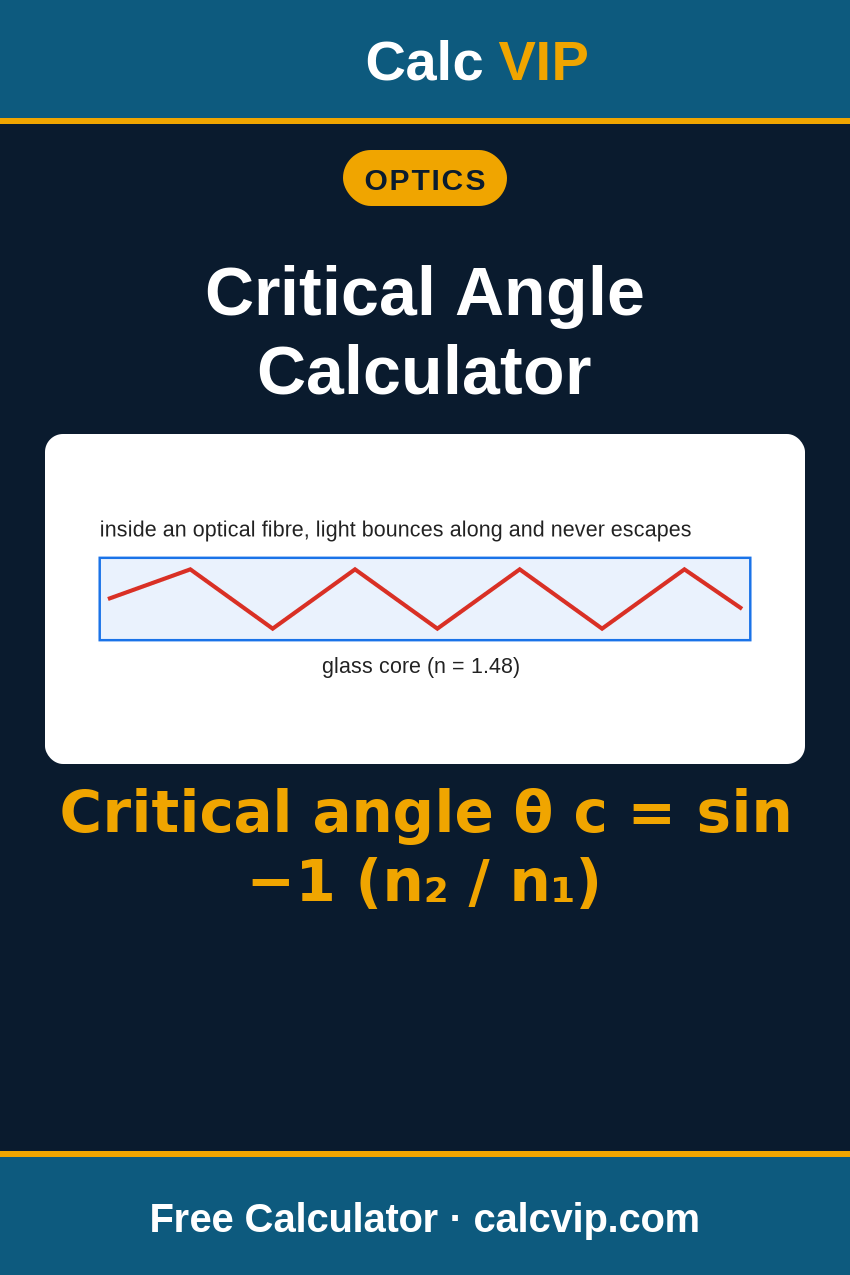
Example 4 — an optical fibre. A fibre core of glass with n₁ = 1.48 is wrapped in cladding glass with n₂ = 1.46. θc = sin−1(1.46 ÷ 1.48) = sin−1(0.9865) = 80.57°. The indices are nearly equal, so the critical angle is huge: only rays travelling almost parallel to the fibre's axis — within about 9° of it — are trapped. In practice light is launched almost straight down the fibre, and gentle bends keep the bounce angles above 80.57° all the way.
Example 5 — working backwards to identify a material. A student measures the critical angle of an unknown clear solid against air and finds θc = 38°. Rearranging the formula, n₁ = n₂ / sinθc = 1.00 ÷ sin38° = 1.00 ÷ 0.6157 = 1.62. Looking the value up, the solid is a dense flint glass (n ≈ 1.62) — the same glass used in fine camera lenses. This backwards use of the critical angle is exactly how refractometers and gem testers identify materials without damaging them.
Total internal reflection in real life
Optical fibres and the internet. Every video call and web page that crosses an ocean travels as pulses of light totally internally reflecting down glass fibres. A single fibre can carry a signal for tens of kilometres before it needs boosting, because the reflection at each bounce loses nothing at all.
Medicine. An endoscope is a bundle of fibres: one carries light in to illuminate the scene, the other carries the image back out, letting doctors inspect a stomach or artery through a tiny opening.
Binoculars and cameras. Porro prisms inside binoculars fold the light path twice using total internal reflection, replacing mirrors that would tarnish and dim the image. The same trick lights the viewfinder of many cameras.
Swimming pools and mirages. Look up from underwater and the surface outside the bright cone mirrors the pool floor — total internal reflection again.
Reflectors and road safety. The red reflector on a bicycle and the "cat's eyes" in the road are moulded arrays of tiny prisms. Light from a car's headlamps enters the front face, totally internally reflects off the prism's back faces, and is sent straight back towards the driver — bright, reliable and needing no battery.
Fingerprint and touch sensors. As the concept section explained, a fingertip pressed on glass frustrates the reflection where its ridges touch. The same physics appears in some optical touchscreens and in fibre-optic sensors that detect pressure, strain and chemicals by watching for light leaking out of a fibre.
Why diamond's small critical angle matters
A gem cutter faces a trade-off that the critical angle controls completely. If a diamond's back facets are angled too shallowly, light arriving from the top strikes them below 24.41°, leaks out of the bottom, and the stone looks dull and glassy — jewellers call this a "window". If the facets are cut so that light strikes them above the critical angle, the light bounces across the stone and returns out of the top face to the viewer's eye. The difference between a lifeless stone and a brilliant one is just a few degrees of facet angle, chosen with the critical angle in mind. Glass imitations, with a critical angle of 41.81°, can never trap light as thoroughly, which is one reason paste jewels sparkle less even when cut to the same shape.
Prisms: total internal reflection doing a mirror's job
A right-angled glass prism is the simplest total internal reflection device. Light entering one short face meets the long sloping face from inside at 45° — comfortably above glass's critical angle of 41.81° — so it reflects perfectly across the prism and leaves through the other short face, its direction turned through 90°. Put two such prisms in a binocular and the light path folds neatly in half, which is why binoculars are shorter than the telescopes they evolved from. A pentaprism in a camera does a similar fold to bring the lens's view up to the photographer's eye. In every case the prism beats a metal mirror on three counts: it reflects 100% of the light, it never tarnishes, and it never needs re-silvering. The one design rule is the critical angle itself — the internal faces must be angled so that light always strikes them above θc, which is why these prisms use precise 45° geometry with glass of n ≈ 1.50 or higher.
Quick reference: critical angles for common boundaries
| Boundary (from → to) | n₁ / n₂ | Critical angle |
|---|---|---|
| water → air | 1.33 / 1.00 | 48.75° |
| acrylic (Perspex) → air | 1.49 / 1.00 | 42.16° |
| glass → air | 1.50 / 1.00 | 41.81° |
| crown glass → air | 1.52 / 1.00 | 41.14° |
| glass → water | 1.50 / 1.33 | 62.46° |
| diamond → air | 2.42 / 1.00 | 24.41° |
The pattern in the table is worth noticing: what matters is the ratio n₂/n₁, not the individual values. Glass against water traps light far less readily than glass against air, because water's index is much closer to glass's — the "step down" at the boundary is smaller, so rays must strike at a steeper angle before they are trapped.
Common mistakes
- Measuring the angle from the surface. All optics angles are measured from the normal. A ray skimming the surface at 10° to the glass is at 80° to the normal — well above most critical angles, not below them.
- Swapping n₁ and n₂. The denser material (bigger index) goes on the bottom of the fraction. If your answer comes out impossible — sin−1 of a number bigger than 1 — the indices are the wrong way round.
- Expecting a critical angle into a denser material. There is none. Light going from air into glass always refracts through; total internal reflection is strictly a dense-to-less-dense effect.
- Assuming the reflection is weak. Below the critical angle the internal reflection is only partial, but above it the reflection is total — 100% — better than any ordinary mirror.
- Using the wrong boundary. The critical angle belongs to a pair of materials, not to one material alone. Glass gives 41.81° against air but 62.46° against water; quoting "the critical angle of glass" without naming the second material is meaningless.
FAQ
What is total internal reflection?
When light in a denser material hits a boundary with a less dense material at an angle greater than the critical angle, none of it escapes — 100% of the light reflects back inside, following the normal law of reflection.
Where is total internal reflection used?
It carries internet and phone signals through optical fibres, makes diamonds sparkle (diamond's high refractive index gives it a very small critical angle of about 24°, trapping light inside), and is used in binoculars, periscopes and endoscopes.
Can total internal reflection happen going from air into glass?
No. It can only happen when light travels from a denser material towards a less dense one. Going from air into glass, the light always refracts through the boundary instead.
Does total internal reflection lose any light?
No — that is its great advantage. A silvered mirror absorbs a few per cent of the light at every reflection, but a totally internally reflecting surface returns all of it, which is why signals survive thousands of bounces inside a long optical fibre.
What is the critical angle for a glass–water boundary?
Glass (1.50) to water (1.33): θc = sin−1(1.33 ÷ 1.50) = sin−1(0.8867) = 62.46°. The indices are closer together than glass and air, so the critical angle is larger and light escapes more easily — a glass rod dipped in water stops behaving like a light pipe.
Why do wet roads and deserts show mirages?
Hot air near the ground has a slightly lower refractive index than the cooler air above it. Sky light bending through these layers is turned back upward — a continuous version of total internal reflection — so you see a shimmering patch that looks like water on the road.
How is the critical angle measured in practice?
With a refractometer: a sample is placed against a glass prism of known index, light is shone through at a range of angles, and the boundary between the bright and dark regions of the view reveals the critical angle. From it, the sample's refractive index follows from n₁ = n₂ / sinθc — a standard purity test for oils, honey and gemstones.
Does the colour of the light matter?
Slightly. Refractive index depends a little on wavelength — blue light is slowed slightly more than red — a fact called dispersion. So blue light has a marginally smaller critical angle than red light in the same material. The difference is tiny (fractions of a degree in glass) but it is why prisms spread white light into a spectrum.
Why do optical fibres have a cladding layer?
The cladding — glass of slightly lower index wrapped around the core — gives the light a clean, protected boundary to reflect from. Without it, the reflecting surface would be the fibre's outer skin, where scratches, dirt and contact with neighbouring fibres would let light leak out. The cladding also stops light crossing between fibres packed side by side in a bundle.
Is there a critical angle in both directions?
No. The critical angle is defined only for light travelling from the denser material towards the less dense one. Travelling the other way, from air into glass for instance, the ray always refracts through the boundary at every angle of incidence — there is no angle at which it is turned back.