 Calc
Brewster Angle Calculator – Polarisation Angle tanθB = n₂/n₁
 Created by David Okafor · Physics Writer · Waves & Light · Last updated: November 2026
Use this free Brewster Angle Calculator to find the special incidence angle at which reflected light is completely polarised — the angle that makes polarising sunglasses so good at killing glare from water, roads and glass.
Most reflected light is a mixture, but at one particular angle of incidence a surface performs a remarkable act of selection: the light it reflects is completely polarised, vibrating in a single plane. That angle — Brewster's angle, after the Scottish physicist David Brewster, who found it experimentally in 1815 — is set entirely by the refractive indices of the two materials meeting at the surface: tanθB = n₂/n₁. For glass it is about 56°, for water about 53°, values this calculator produces for any pair of materials you give it.
The geometry at Brewster's angle has an elegant signature: the reflected and refracted rays leave the surface exactly perpendicular to each other, θB + θt = 90°. That right angle is not decoration — it is the mechanism. The reflected ray is generated by charges oscillating in the surface under the refracted wave's influence, and oscillating charges cannot radiate along their own direction of motion. At the Brewster geometry, one polarisation's would-be reflection direction coincides with its oscillation direction, so that component simply cannot reflect. Only the other polarisation survives.
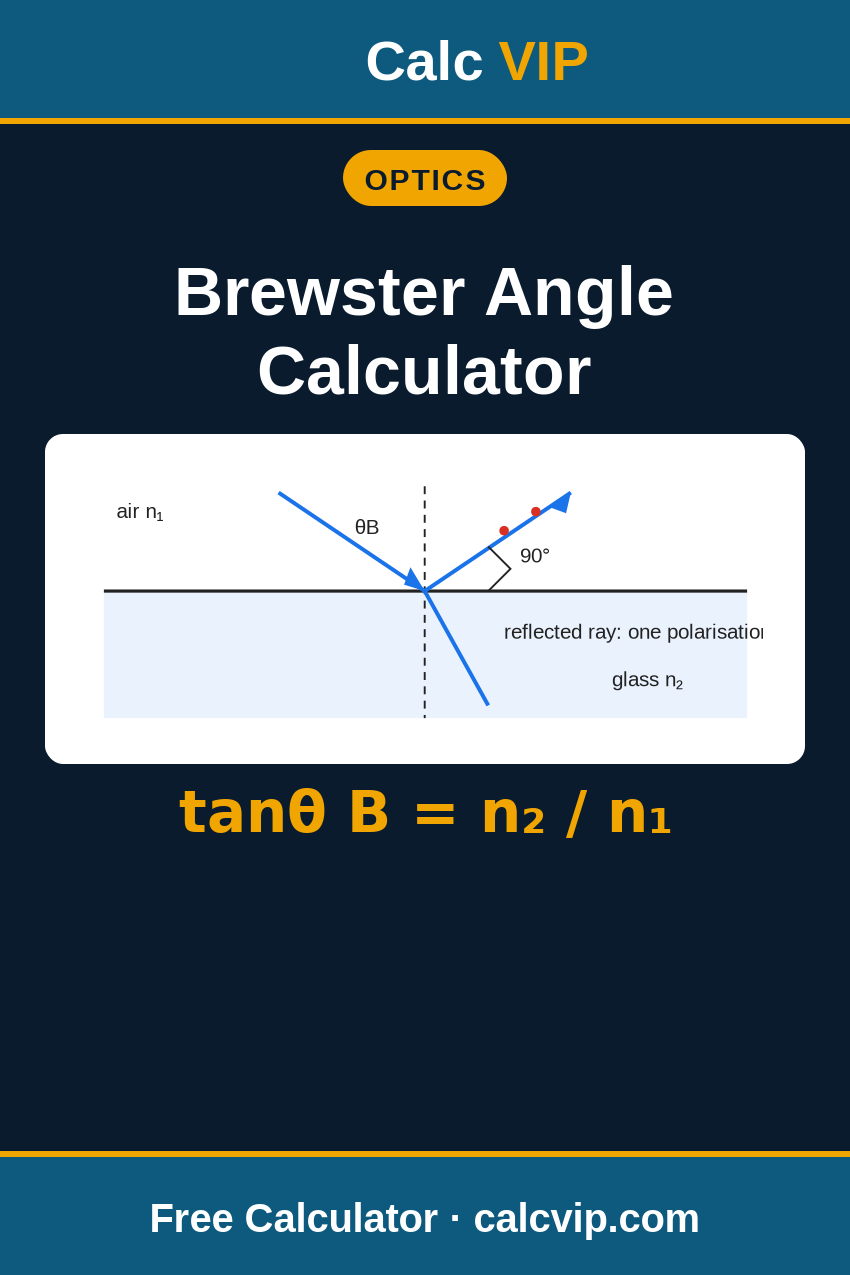
The consequences run from the mundane to the high-tech: the glare that blinds drivers off wet roads is Brewster-polarised, which is why polarising sunglasses are aligned to block it; photographers rotate polarising filters to dial reflections up or down; and gas lasers are built with their windows tilted at exactly this angle so one polarisation passes through with zero reflection loss. The sections below compute the angle for the common material pairs, explain the dipole mechanism, and survey where polarised reflections help and hinder.
Formula
tanθB = n₂ / n₁, so θB = tan−1(n₂ / n₁) • all angles measured from the normal (the perpendicular to the surface)
At exactly this angle, the reflected and refracted rays are perpendicular (θB + θt = 90°), and the reflected light is 100% polarised parallel to the surface. The two facts are the same fact: combine Snell's law, n₁ sinθB = n₂ sinθt, with the perpendicular condition θt = 90° − θB, and sinθt becomes cosθB — the equations collapse to tanθB = n₂/n₁. Brewster's law is Snell's law plus a right angle. The calculator returns both angles, so you can check the 90° sum yourself for any material pair.
| Symbol | Meaning | Units |
|---|---|---|
| θB | Brewster's angle — incidence angle of complete polarisation | degrees, from the normal |
| θt | refraction angle at Brewster incidence (= 90° − θB) | degrees |
| n₁ | refractive index of the material the light starts in | no units |
| n₂ | refractive index of the material it strikes | no units |
The mechanism: charges that cannot radiate along their swing
Reflection is re-radiation. The incoming wave's electric field drives the electrons at the surface into oscillation, and those oscillating charges broadcast the reflected wave. But an oscillating charge has a blind direction: it radiates nothing along its own axis of oscillation, just as a radio dipole broadcasts nothing off its own ends. Now resolve the incoming light into its two polarisations. The component whose electric field lies in the plane of the diagram (p-polarisation) sets the surface charges swinging along a direction in that plane; the component perpendicular to the plane (s-polarisation) swings them across it.
At most incidence angles both components manage to radiate a reflection. But at the Brewster geometry — where the reflected ray would leave at exactly 90° to the refracted ray — the p-component's required reflection direction points precisely along its charges' swing axis, inside the material along the refracted ray's direction. Radiation along the swing is forbidden, so the p-reflection vanishes identically. The s-component, swinging across the plane, radiates freely in all directions including the reflection direction. What remains in the reflected beam is pure s: light polarised parallel to the surface, completely.
Away from θB the p-reflection is merely weak, not zero, so reflected light is partially polarised — most strongly near the Brewster angle, which is why glare off a lake is worst, and sunglasses work best, when the Sun sits at the corresponding height: 90° − 53.06° ≈ 37° above the horizon for water. Complete polarisation is the peak of a broad hill, not a spike, and the calculator's angle marks the summit.
How to use
- Enter the refractive index of the material the light is travelling in (n₁) — usually air, 1.00.
- Enter the refractive index of the surface material (n₂) — water 1.33, ice 1.31, glass about 1.50, diamond 2.42.
- Click "Calculate Brewster Angle" to get θB and the refraction angle θt at that incidence.
- Verify with the signature check: the two angles must sum to exactly 90°. If they do not, an index was mistyped.
- To find the glare geometry for the Sun, convert to elevation: the Sun's height above the horizon for strongest polarised glare is 90° − θB.
Worked examples
Example 1 — air to glass. Light in air (n₁ = 1.00) strikes glass (n₂ = 1.50).
θB = tan−1(1.50 ÷ 1.00) = tan−1(1.50) = 56.31°.
At this angle the refracted ray goes in at θt = 90° − 56.31° = 33.69°, exactly perpendicular to the reflected ray.
Example 2 — air to water. n₁ = 1.00, n₂ = 1.33.
θB = tan−1(1.33) = 53.06°, and θt = 90° − 53.06° = 36.94°.
Equivalently, when the Sun stands 36.94° above the horizon, lake glare is at its most polarised — and polarising sunglasses at their most devastating.
Example 3 — air to diamond. n₂ = 2.42.
θB = tan−1(2.42) = 67.55°, θt = 22.45°. High-index materials push Brewster's angle toward grazing incidence — their polarising geometry happens at a slant, one more optical eccentricity of the hardest gem.
Example 4 — from inside the glass. Light inside glass (n₁ = 1.50) strikes the surface with air beyond (n₂ = 1.00).
θB = tan−1(1.00 ÷ 1.50) = 33.69°, θt = 56.31° — exactly Example 1's angles swapped. Brewster's angle is a property of the boundary, and it reads the same story from either side, with the roles reversed.
Example 5 — air to ice. n₂ = 1.31.
θB = tan−1(1.31) = 52.64°, θt = 37.36°. Skiers' glare off ice and snowfields obeys nearly the water numbers — unsurprising, as ice is water with its molecules locked in place.
Example 6 — air to flint glass. n₂ = 1.62.
θB = tan−1(1.62) = 58.31°, θt = 31.69°. Dense flint, the glass of chandeliers and fine optics, polarises at a noticeably steeper angle than crown glass (56.66° at n = 1.52) — the index writes itself into the angle every time.
Brewster's angle in real life
Polarising sunglasses. Glare from horizontal surfaces near Brewster incidence is polarised horizontally — parallel to the surface. Sunglass lenses are polarised vertically, blocking that component while passing ordinary light. The match between the physics of the reflection and the design of the filter is exact, which is why the glare dies so completely while the scene merely dims.
Photography's polarising filter. A circular polariser on a lens is rotated until it crosses the polarisation of the reflected light, deleting reflections from water, glass and foliage on demand — or, rotated 90°, preserving them. Shooting near 53° to water puts the filter at maximum leverage, a working photographer's use of this calculator.
Brewster windows in gas lasers. A helium–neon laser's tube is sealed with windows tilted at Brewster's angle for the glass. The p-polarised light passes through both surfaces of each window with zero reflection loss, round trip after round trip, while s-polarised light bleeds away — so the laser emerges polarised and the cavity stays efficient. It is the vanishing p-reflection, employed as engineering.
Measuring unknown materials. Shine light at a sample, find the angle where the reflection becomes fully polarised (the reflected intensity of one component dips to zero), and n = n₁ tanθB. The method works on materials you cannot see through — polished semiconductors, ceramics, lacquers — where transmission methods fail.
Road glare and architecture. Wet asphalt at low sun is a Brewster mirror: the reflected light is polarised, intense, and exactly what polarised driving glasses are built for. Architects tilting glass facades, and museums specifying anti-glare glazing angles, are managing the same reflection geometry, whether or not they name it.
Remote sensing of the sea. Polarised reflections from water carry information about surface roughness and oil films, which damp the waves and change the polarisation signature. Satellite and aircraft sensors exploit Brewster geometry to detect slicks and map winds over the ocean surface.
Completely polarised — but how strong?
Complete is not the same as bright. At Brewster's angle the p-reflection is zero, but the surviving s-reflection is modest: for air-to-glass, Fresnel's equations give the s-component's reflectance as about 15% — the reflected beam is pure, but it carries only some 15% of the s-polarised half of the incoming light (against 4% of all the light reflected per surface at normal incidence). This is why Brewster polarisers, though perfect in quality, are dim: a polarising filter absorbs the unwanted component from a strong beam instead, wasting half the light to keep the other half bright. Purity versus efficiency — the same trade the laser window resolves the other way, cherishing the component that passes and letting the reflected purity go.
Brewster meets the critical angle
For light travelling from dense to rare (glass to air), the boundary owns two special angles, and Brewster's always comes first: θB = tan−1(n₂/n₁) = 33.69°, against the critical angle sin−1(n₂/n₁) = 41.81° for the same pair. Between them lies a curious stretch of incidence angles where the reflection is strongly polarised but still partial; beyond the critical angle, total internal reflection returns both polarisations equally and polarisation selection ends. The ordering is guaranteed by geometry — for any ratio below 1, tan−1 of it is smaller than sin−1 of it — so every dense-to-rare boundary presents its Brewster angle before its trap slams shut.
Seeing a single layer of molecules: Brewster-angle microscopy
Set p-polarised light onto clean water at exactly 53.06° and the surface reflects nothing — the Brewster null makes it optically invisible. Spread a film of molecules one layer thick on that water and the film's different index breaks the null: the covered patches reflect, the bare water stays black, and a microscope camera sees the monolayer's domains, islands and collapse in real time, without dyes or probes. Brewster-angle microscopy, built entirely on this calculator's angle for air–water, is a standard tool of surface chemistry — perhaps the purest demonstration that the vanishing p-reflection is not a textbook nicety but a measurable zero.
Quick reference: Brewster angles for common boundaries
| Boundary (n₁ → n₂) | θB |
|---|---|
| air → ice (1.31) | 52.64° |
| air → water (1.33) | 53.06° |
| air → glass (1.50) | 56.31° |
| air → crown glass (1.52) | 56.66° |
| air → flint glass (1.62) | 58.31° |
| air → sapphire (1.77) | 60.53° |
| air → diamond (2.42) | 67.55° |
| glass → air (from inside) | 33.69° |
The table's spread is modest — barely 15° across the whole of everyday optics — because the arctangent compresses ratios: indices must change a lot to move the angle a little. That compression is why "about 55°" serves as a reliable field estimate for almost any glassy or watery surface you will ever meet.
Common mistakes
- Measuring the angle from the surface. Brewster's angle, like all optics angles, is measured from the normal. A student who sets 56° from the glass surface has actually set 34° from the normal — near the internal Brewster angle, a different beast — and finds no complete polarisation.
- Swapping n₁ and n₂. The ratio is destination over source: n₂/n₁. Inverting it for air-to-glass gives tan−1(0.667) = 33.7°, the internal angle, not the 56.3° asked for. The calculator's labels — "light starts here" — exist to prevent exactly this.
- Expecting the refracted beam to be fully polarised too. It is not. The transmitted light loses its s-component's reflected share but keeps both polarisations; it emerges only partially polarised. Complete polarisation is a property of the reflected beam alone (a stack of plates at Brewster incidence — a pile-of-plates polariser — gradually purifies the transmitted beam by skimming).
- Expecting a strong reflection at θB. The reflected beam is completely polarised but weak — about 15% of one component for glass. Hunt for it in a bright room and you may miss it entirely; the effect announces itself through a polarising filter, not through brilliance.
- Applying the law to metals. Absorbing materials like metals have complex refractive indices and no true Brewster angle — their reflection polarisation peaks at a "principal angle" nearby but never reaches completeness. The calculator's law is for transparent dielectrics: glass, water, ice, plastics.
FAQ
Why does the reflected light become polarised at this angle?
The reflected ray is produced by charges jiggling in the surface. At Brewster's angle, the would-be reflection direction for one polarisation lines up exactly with the jiggling direction, and charges cannot radiate along their own motion — so that polarisation is missing from the reflection, leaving only the other one.
How do polarising sunglasses use this?
Glare from a flat surface near Brewster's angle is polarised horizontally. Sunglasses with a vertical polarising filter block that polarisation, cutting the glare while letting ordinary light through.
Does every material pair have a Brewster angle?
Yes — any boundary between two transparent materials with different refractive indices has one. For air-to-water it is about 53°, and for air-to-glass about 56°.
Is the refracted light polarised as well?
Partially. The transmitted beam keeps both polarisations, but its s-component has been skimmed by reflection, so the p-component dominates. Pass the beam through many surfaces at Brewster incidence — a pile of glass plates — and each surface skims more s away, until the transmitted light is nearly as pure as the reflected.
Why do photographers rotate the polarising filter?
The filter passes one polarisation direction and blocks the perpendicular one. Reflections are polarised parallel to the reflecting surface, so rotating the filter either crosses that direction (reflections deleted) or aligns with it (reflections kept). The correct angle changes with every surface you aim at — hence the rotating mount.
At what Sun height is water glare worst?
When the geometry hits Brewster incidence: the Sun's rays must strike the water at 53.06° from the vertical, i.e. the Sun stands 90° − 53.06° ≈ 37° above the horizon. Morning and afternoon glare off lakes is at its most polarised — and most completely removable by polarised glasses — around that height.
Can Brewster's angle be used in reverse, to find n?
Yes — it is a standard refractometry method for opaque or polished solids. Find the incidence angle at which the reflected beam becomes completely polarised (detected as the angle where rotating a polariser extinguishes it fully), then n₂ = n₁ tanθB. Gemmologists and semiconductor labs both use it.
Does Brewster's angle exist for radio waves and microwaves?
Yes — the law is pure electromagnetism, indifferent to wavelength. Microwave reflections off walls and water show the same polarisation null at tan−1(n₂/n₁), and antenna engineers account for it when planning links that bounce signals off surfaces.
What is a Brewster window?
A window mounted at Brewster's angle to a beam, used on gas lasers. The desired polarisation crosses both its faces with no reflection at all, so the window seals the tube without costing light. Any other polarisation is steadily reflected away — the window doubles as the laser's polariser.
Why is the sky itself polarised?
Sunlight scattered by air molecules is polarised most strongly at 90° from the Sun — a cousin of the Brewster mechanism, since scattering is also dipole radiation with a forbidden direction. Bees navigate by the pattern, and photographers darken blue skies with polarisers by exploiting it. Different geometry, same dipole rule.