 Calc
Combined Lenses Calculator – Two Thin Lenses in Contact, Total Power
 Created by David Okafor · Physics Writer · Waves & Light · Last updated: November 2026
Use this free Combined Lenses Calculator to find the effective focal length and total power of two thin lenses placed in contact — the trick opticians use when they stack trial lenses, and the idea behind many camera and telescope lens groups.
Put two lenses together and something convenient happens: their powers simply add. A +5.00 D lens touching a +3.33 D lens behaves, to a very good approximation, as a single +8.33 D lens. Focal lengths enjoy no such courtesy — they combine through the reciprocal rule 1/F = 1/f₁ + 1/f₂, which is why the 20 cm and 30 cm lenses of the worked example merge into a 12 cm lens rather than anything resembling 50 or 25. This calculator performs both versions of the arithmetic and keeps the signs straight.
The additivity of power is not a bookkeeping trick; it is the physics of vergence. Each thin lens adds its own fixed change to the convergence of the light passing through it, and when the lenses touch, the second lens receives exactly the light the first one produced, with no gap in which the beam can evolve. Add a change of +5 D and then a change of +3.33 D and the total change is +8.33 D, whoever performs the addition. It is the same reason opticians can build any prescription from a box of trial lenses.
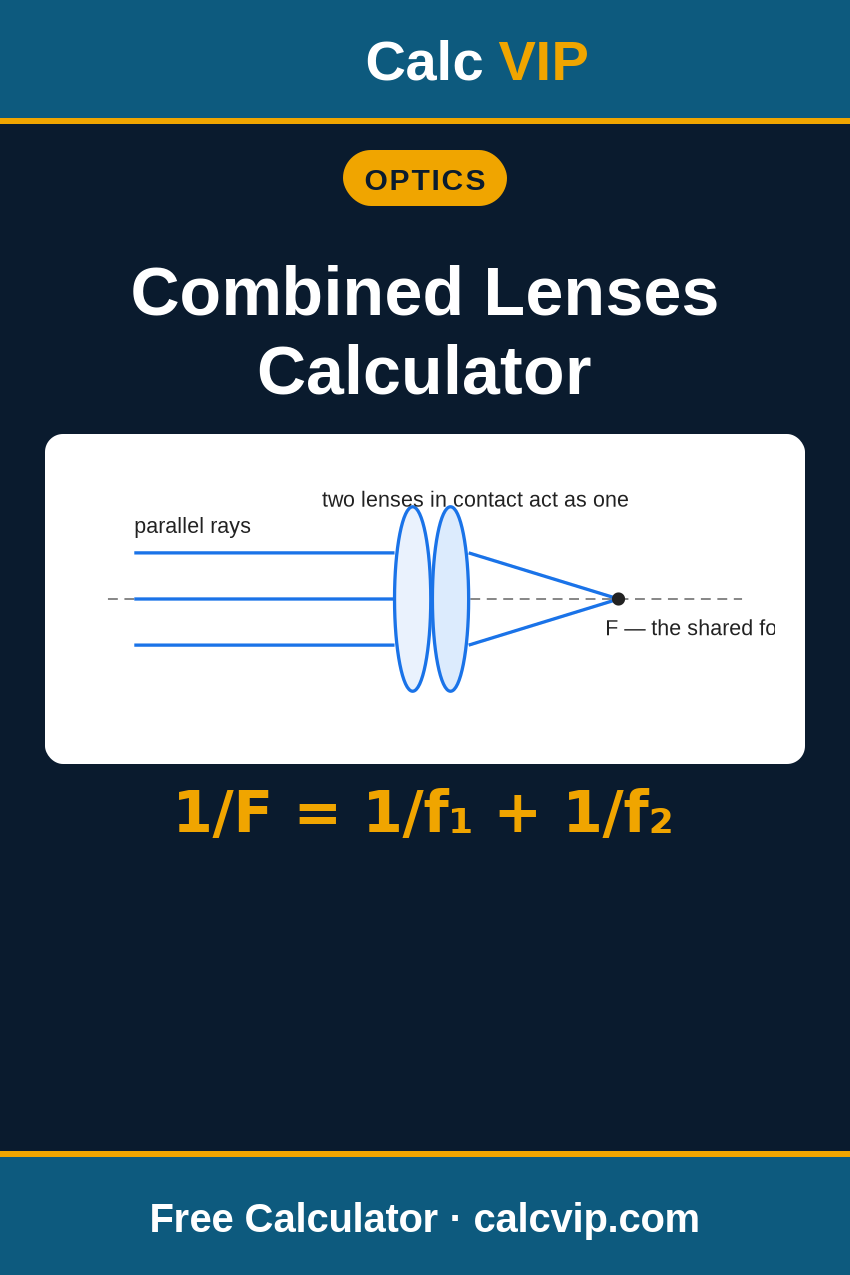
Real optical systems push the idea further — and complicate it. Separate the lenses and a correction term appears; pair glasses of different materials and the combination can cancel colour error while keeping power, the achromatic doublet inside every decent telescope. The sections below work the contact rule thoroughly, then open the gap, then show why the humble act of stacking two lenses is the seed from which all multi-element lens design grows.
Formula
1/F = 1/f₁ + 1/f₂ • equivalently, the powers add: P = P₁ + P₂ (P in diopters, focal lengths in metres for the power form, or work in centimetres throughout for F)
Use the usual sign convention: converging (convex) lenses have positive focal lengths, diverging (concave) lenses negative. A converging and a diverging lens of equal strength cancel out, giving F = ∞ — the pair behaves like a flat sheet of glass. Introduce a gap d (in metres) between the lenses and the rule grows a correction term: P = P₁ + P₂ − d × P₁ × P₂ — contact is simply the d = 0 case, and the depth section below explores what the gap does.
| Symbol | Meaning | Units |
|---|---|---|
| f₁, f₂ | focal lengths of the two lenses | cm in this calculator |
| F | effective focal length of the combination | cm |
| P₁, P₂ | powers of the individual lenses | diopters (D) |
| P | total power of the combination | diopters (D) |
| d | separation between lenses (zero when in contact) | m |
Why powers add: vergence bookkeeping
Follow a beam of parallel light — vergence zero — into the pair. The first lens adds its power: the beam leaves converging at +5.00 D, heading for a focus 20 cm beyond. But it never gets there; the second lens, touching the first, intercepts it immediately and adds its power to the vergence: +5.00 + 3.33 = +8.33 D, a focus 12 cm away. Each lens is a vergence cashier, stamping its own fixed change onto whatever beam arrives. Because the lenses touch, no travel happens between the two transactions, and the stamps simply add. Focal length, being the reciprocal of the running total, inherits all the awkwardness — reciprocals of sums refuse to simplify, which is precisely why professionals refuse to work in focal lengths when combining lenses.
The same bookkeeping handles subtraction. A diverging lens stamps a negative change: +5.00 D followed by −2.00 D nets +3.00 D. Match the magnitudes exactly and the stamps cancel — the pair has no power at all, a "lens" that images like a window pane. Opticians exploit the cancellation deliberately in neutralising an unknown lens: stack trial lenses against it until the combination stops bending light, and the trial stack's total, negated, is the unknown lens's power.
Notice, too, what the rule assumes: thin lenses, sharing an axis, in contact. Thickness moves each lens's effective plane; a gap lets the beam's vergence evolve in transit (the beam from a +5 D lens is more converged 10 cm later than at the lens face, so the second lens has different light to work on). Those refinements are the correction term and the thick-lens theory — the contact rule is the clean limiting case, and for spectacle trial lenses it is accurate to a small fraction of a diopter.
How to use
- Enter the focal length of the first lens in centimetres, with a minus sign if it is a diverging lens.
- Enter the focal length of the second lens the same way.
- Click "Calculate Combined Lens" to get the combined focal length F and the total power P.
- If you know the lenses by power instead, add the powers directly (P = P₁ + P₂) and convert back with F(cm) = 100 ÷ P — the calculator's two outputs let you cross-check.
- Remember the assumption: the lenses must be thin and touching. If your pair is separated by a gap, use the corrected formula in the depth section below.
Worked examples
Example 1 — two converging lenses. A converging lens of f₁ = 20 cm is placed in contact with another of f₂ = 30 cm.
1/F = 1/20 + 1/30 = 0.0500 + 0.0333 = 0.0833
F = 1 ÷ 0.0833 = 12 cm.
In powers: P₁ = +5.00 D and P₂ = +3.33 D, so P = +8.33 D — stronger than either lens alone.
Example 2 — a converging lens tamed by a diverging one. f₁ = 25 cm (+4.00 D) with f₂ = −50 cm (−2.00 D).
1/F = 1/25 − 1/50 = 0.040 − 0.020 = 0.020
F = 50 cm, P = +2.00 D. The diverging lens does not reverse the combination; it merely taxes it by its own power — addition with signs, nothing more.
Example 3 — identical twins. Two lenses of f = 40 cm each (+2.50 D each).
1/F = 1/40 + 1/40 = 0.050
F = 20 cm, P = +5.00 D. Equal lenses in contact halve the focal length — the special case everyone remembers, and a dangerous one to generalise from (see the mistakes).
Example 4 — a strong lens, a weak opponent. f₁ = 15 cm (+6.67 D) with f₂ = −30 cm (−3.33 D).
1/F = 0.0667 − 0.0333 = 0.0333
F = 30 cm, P = +3.33 D. Note the elegant residue: the combination ends up exactly as strong as the weaker lens's magnitude — coincidence of these numbers, but a memorable check on the arithmetic.
Example 5 — perfect cancellation. f₁ = +20 cm with f₂ = −20 cm.
1/F = 0.050 − 0.050 = 0, so F = ∞ and P = 0.00 D. The pair neither converges nor diverges parallel light; it is an expensive window. This is the neutral point opticians hunt for when measuring an unknown lens.
Example 6 — two short, strong lenses. f₁ = f₂ = 10 cm (+10.00 D each).
1/F = 0.100 + 0.100 = 0.200
F = 5 cm, P = +20.00 D — camera-lens territory, built from two magnifiers. Short focal lengths stack into serious power quickly, because their reciprocals are already large.
Combined lenses in real life
The trial lens case. An optician's case holds over a hundred lenses, yet any prescription can be assembled: sphere from one lens, cylinder from another, fine-tuned with ±0.25 D flips. The whole ritual works because contact powers add — the stack on your nose during the test is the prescription being ground later.
Achromatic doublets. Cement a positive crown-glass lens to a weaker negative flint lens and the pair keeps most of its power while cancelling most of its colour fringing — the flint's dispersion per diopter is roughly double the crown's, so unequal powers can have equal-and-opposite colour spread. Every quality telescope objective begins as this combination (details below).
Reading glasses, doubled. Two pairs of +1.50 D readers worn together — the classic lost-glasses emergency — give roughly +3.00 D, with the small gap between the frames stealing a little of the total via the separation term. It works, briefly, at the cost of every aberration both pairs own.
Camera lens groups. A modern prime lens is six to ten elements, several cemented or nearly touching in groups. Designers still budget each group by its summed power first — the contact rule — then spend computer time on the aberrations the simple sum ignores.
The Galilean telescope. A convex objective and a concave eyepiece, separated rather than touching, give an upright image in a short tube — opera glasses still use the arrangement. It is the combined-lens idea with the gap term promoted from correction to design feature.
Close-up filters. Photographers screw +1, +2 or +4 D supplementary lenses onto a camera lens — literally adding power in near-contact. A 50 mm lens (+20 D) wearing a +4 D close-up filter becomes a +24 D system focusing at about 42 cm maximum: macro photography by lens addition.
Opening the gap: separated lenses
Slide the lenses apart and the simple sum overstates the power, because the first lens's beam converges as it crosses the gap and arrives at the second lens already part-way to its focus. The corrected rule, with the gap d in metres, is P = P₁ + P₂ − d·P₁·P₂. Take two +5.00 D lenses: in contact, P = +10.00 D (F = 10 cm). Separate them by 10 cm and P = 5 + 5 − 0.10 × 25 = +7.50 D (F = 13.3 cm). Separate them by 40 cm — the full focal-length sum — and the correction devours everything: the system becomes afocal, a telescope, imaging infinity to infinity. The gap term is also why a telephoto lens (positive front group, negative rear group, widely separated) can be physically shorter than its own focal length.
The achromatic doublet: cancelling colour, keeping power
A single lens focuses blue light closer than red — its power differs by colour, because n does. The doublet's fix exploits a mismatch between two glasses: flint glass disperses light roughly twice as strongly as crown glass, per diopter of power. Cement a +5.00 D crown lens to a −3.00 D flint lens and the pair nets +2.00 D (F = 50 cm) — but the flint's −3.00 D carries as much colour spread as the crown's +5.00 D, in the opposite sense, so the spreads cancel and red and blue share a focus. Power adds arithmetically; dispersion adds with different exchange rates, and the doublet arbitrages the difference. It is the most consequential application of this page's humble addition rule ever devised — every apochromatic telescope and camera lens is its descendant.
Quick reference: common pairs
| Lens pair (f₁, f₂) | Combined F | Total power |
|---|---|---|
| 20 cm and 30 cm | 12 cm | +8.33 D |
| 25 cm and 25 cm | 12.5 cm | +8.00 D |
| 40 cm and 40 cm | 20 cm | +5.00 D |
| 25 cm and −50 cm | 50 cm | +2.00 D |
| 15 cm and −30 cm | 30 cm | +3.33 D |
| 20 cm and −20 cm | ∞ | 0.00 D |
| 10 cm and 10 cm | 5 cm | +20.00 D |
Read the table with the vergence story in mind: the combined focal length is always shorter than the shortest positive contributor — unless a negative lens intervenes, in which case the pair can end up weaker than either lens's magnitude, or cancel entirely. When in doubt, convert everything to diopters first and let the addition do the work.
Common mistakes
- Adding the focal lengths. 20 cm + 30 cm = 50 cm is the answer to a question nobody asked. Focal lengths combine reciprocally (the pair gives 12 cm); only powers add directly. This single slip accounts for most wrong answers in the topic.
- Halving by habit. Example 3's twins halve the focal length, and the pattern is seductive — but it holds only for identical lenses. A 20 cm with a 60 cm gives 1/F = 0.050 + 0.0167, F = 15 cm, not 40 or 30.
- Entering a diverging lens as positive. The minus sign is the lens's identity. A +25/−50 pair is a +2.00 D system; entered as 25/50 it becomes a fictitious +6.00 D system — plausible-looking, and entirely wrong.
- Applying the contact rule across a gap. Two +5 D lenses 10 cm apart deliver +7.50 D, not +10.00 D. The longer the gap and the stronger the lenses, the bigger the theft by the −d·P₁·P₂ term.
- Mixing centimetres into the power formula. P = 100 ÷ f(cm) per lens, or convert to metres and use P = 1 ÷ f(m). Adding a power computed in "per centimetre" to one in diopters corrupts the sum by a factor of 100.
FAQ
Why do the powers add but the focal lengths don't?
Each lens bends the light by its own amount, and the bends stack up. Power measures bending directly, so powers add. Focal length is the reciprocal of power, so it combines "upside down" through the 1/F rule instead.
Can a convex and a concave lens be combined?
Yes — just enter the concave lens with a negative focal length. If the convex lens is stronger, the pair is still converging overall; if they are equal and opposite, the pair has no power at all.
Does the order of the two lenses matter?
For thin lenses in contact, no — addition works the same either way round. Once a gap is introduced between the lenses, the separation starts to matter and a more complete formula is needed.
Can I combine three or more lenses?
Yes — the rule extends by simple continuation: P = P₁ + P₂ + P₃ + …, or 1/F = Σ 1/fᵢ. Opticians stack three trial lenses routinely, and camera groups may have five elements in near-contact. Add them in any order; addition does not care.
Why do camera lenses need so many elements if powers just add?
Because the summed power is only the first line of the specification. Each element also introduces aberrations — colour fringing, spherical blur, distortion — and extra elements exist largely to cancel each other's faults while preserving the total power. A single +20 D lens focuses; ten elements focus well.
Does the combination ever come out weaker than both lenses?
With opposite signs, yes: +6.67 D combined with −3.33 D nets +3.33 D — weaker than the stronger lens alone. Two positive lenses, by contrast, always combine to something stronger than either, and two negative lenses to something more negative than either.
What is the difference between effective and back focal length?
The effective focal length F is measured from the combination's principal plane, an imaginary reference inside the system. The back focal length — from the rear lens surface to the focus — is what a camera body actually feels, and for separated or asymmetric systems the two differ. In contact, thin lenses share one plane and the distinction vanishes.
How accurate is the contact rule for real spectacle lenses?
Very. Trial lenses are thin and their rims hold them within a millimetre or so of contact; the residual gap term for typical powers is a few hundredths of a diopter — far below the 0.25 D step of a prescription. The rule fails noticeably only for strong lenses held well apart.
Can two lenses make a microscope?
Not in contact — a microscope needs its objective and eyepiece separated by a tube, each magnifying in turn, with total magnification the product of the two. The contact rule of this page governs stacked filters and trial lenses; separated systems like microscopes and telescopes use the gap-corrected power and multiply magnifications instead.
Why does the calculator ask for focal lengths, not powers?
Because lenses are so often labelled and measured by focal length — magnifiers, camera lenses, telescope objectives. If your lenses are specified in diopters (trial lenses, close-up filters), skip the conversion entirely: just add the powers, then turn the total back into a focal length with F(cm) = 100 ÷ P if you need one.