 Calc
Critical Angle Solver – θc from Material, or Refractive Index from θc
 Created by David Okafor · Physics Writer · Waves & Light · Last updated: November 2026
Use this free Critical Angle Solver in both directions. Pick a material to get its critical angle for light escaping into air, or run it in reverse — enter a measured critical angle and find the refractive index of the unknown material, the trick gemmologists use to identify stones.
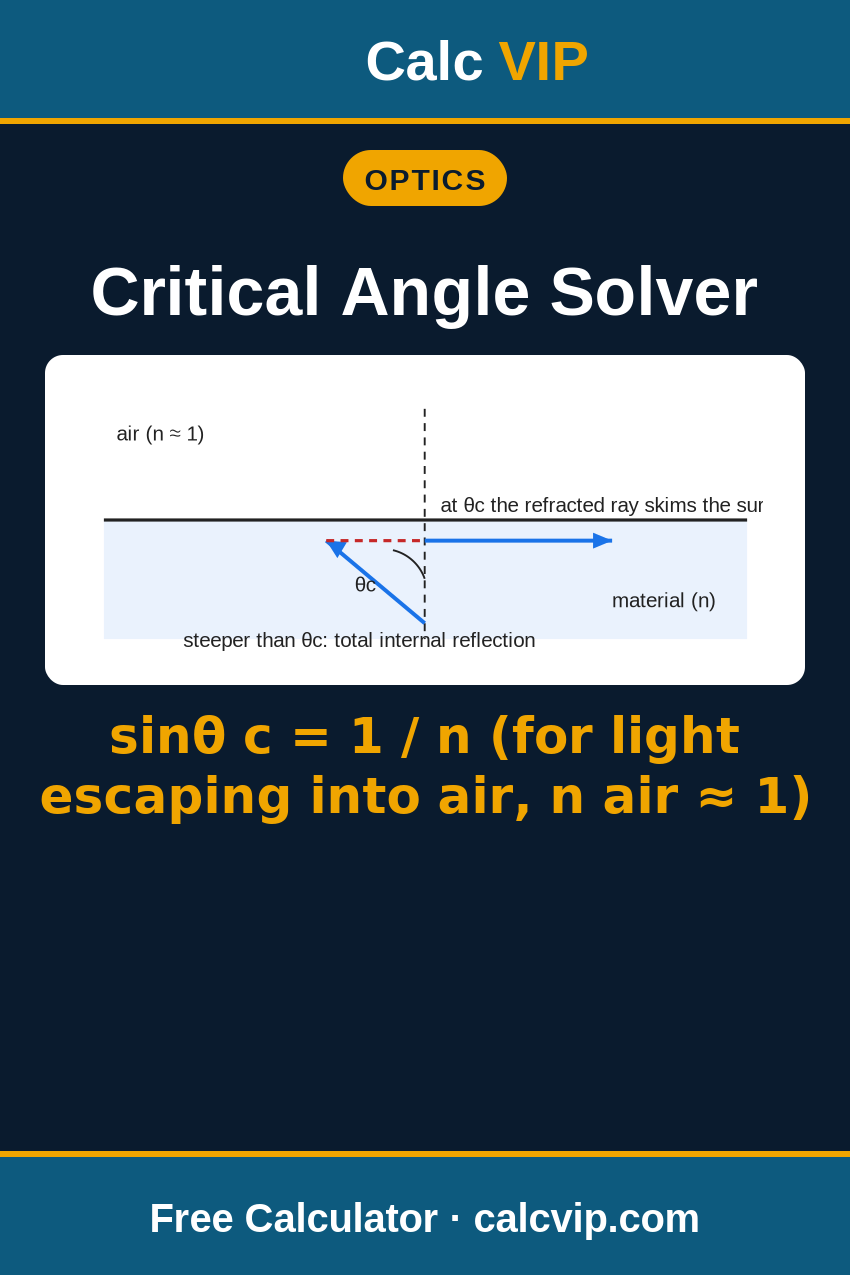
Every transparent material keeps a secret angle. Shine light from inside water, glass or diamond towards the surface, steeply enough, and at one precise inclination escape becomes impossible: the refracted ray that should leave instead skims along the surface at 90°, and beyond that angle the surface turns into a perfect mirror, reflecting everything back inside. That threshold is the critical angle θc, and it is fixed by a single property of the material — its refractive index — through sinθc = 1/n. Measure the angle and you have measured the material; know the material and you can predict the angle. This solver runs the identity in both directions.
The phenomenon, total internal reflection, is one of physics' most useful accidents. It is the reason optical fibres can pipe light around corners and across oceans without a single mirror coating; the reason a diver looking up sees the world compressed into a bright cone overhead with a mirror sea beyond it; and the reason a diamond, whose critical angle is a mere 24.41°, traps light through multiple internal bounces and returns it to your eye as fire. None of these technologies was designed around a formula for its own sake — each is the critical angle, exploited.
The reverse mode deserves emphasis because it is a genuine instrument, not a classroom exercise. A gemmologist's refractometer is, at heart, a device for finding the critical angle at a stone's contact with a known glass hemisphere; from that angle, n = 1/sinθc identifies the species — diamond from moissanite from glass — without scratching the stone. Whenever an unknown transparent material must be named non-destructively, this little inversion is one of the first tools reached for, and it is why the calculator treats the reverse direction as a first-class citizen.
Formula
sinθc = 1 / n (for light escaping into air, nair ≈ 1) • so θc = sin−1(1/n) and in reverse n = 1 / sinθc • general boundary: sinθc = n₂ / n₁
The critical angle is the incidence angle (measured from the normal, inside the denser material) at which the refracted ray would travel along the surface at 90°. Any steeper than this and no light escapes at all — it is totally internally reflected. For a boundary with a second material of index n₂ instead of air, the general form is sinθc = n₂/n₁. The formula is Snell's law evaluated at θ₂ = 90° — nothing more, and nothing less: set the escaping ray grazing, and the incidence angle that produces it is the largest angle at which escape is possible at all.
| Symbol | Meaning | Units |
|---|---|---|
| θc | critical angle, from the normal, inside the denser material | degrees (0–90) |
| n₁ | refractive index of the material the light starts in | no units; must exceed n₂ |
| n₂ | refractive index of the material beyond the surface | no units; ≈ 1 for air |
| n | the single-material shorthand when n₂ = 1 (air) | no units |
Total internal reflection: the perfect mirror with no silver
An ordinary mirror reflects perhaps 95% of the light striking it; the rest is absorbed by the metal coating, pass after pass, loss after loss. A totally internally reflecting surface reflects all of it — 100%, by the laws of refraction themselves, with no coating to tarnish and no metal to absorb. That is why quality binoculars and periscopes route light through glass prisms rather than mirrors: two or three total internal reflections fold the path with zero loss, where silvered mirrors would dim the image at every bounce. The condition is merely geometric — incidence beyond θc — and the reward is the only perfect reflector in everyday optics.
There is a subtlety the ray picture hides, worth one paragraph. Even under total internal reflection, an evanescent wave reaches a fraction of a wavelength beyond the surface — the field does not stop dead at the boundary. Bring another dense material within that hair's breadth and light can tunnel across: frustrated total internal reflection, the working principle of some beam splitters, fingerprint readers and touch sensors. The critical angle tells you where the simple story starts; the evanescent tail is where modern photonics begins.
How to use
- To get a critical angle, pick the material from the list (or choose "Custom" and type its refractive index).
- To identify an unknown material, switch the mode and enter the critical angle you measured.
- Click "Solve" for the answer, with common materials listed for comparison.
- Remember the angle lives inside the denser material and is measured from the normal — a surface-grazing ray inside water at 80° from the normal is far beyond θc, not below it.
Worked examples
Example 1 — water. For water, n = 1.33:
θc = sin−1(1 ÷ 1.33) = sin−1(0.7519) = 48.75°. Light inside water hitting the surface steeper than 48.75° from the normal cannot escape — which is why a diver looking up sees a bright mirror-like cone of that half-angle.
In reverse, a measured critical angle of 48.75° gives n = 1 ÷ sin48.75° = 1.33 — the sample is water.
Example 2 — crown glass. n = 1.52.
θc = sin−1(1 ÷ 1.52) = sin−1(0.6579) = 41.14°. This is the number that makes 45° prisms work: a ray crossing a right-angle prism strikes the hypotenuse face at 45°, comfortably beyond 41.14°, and reflects totally — the binocular fold of the concept section, guaranteed by six degrees of margin.
Example 3 — flint glass. n = 1.62.
θc = sin−1(1 ÷ 1.62) = 38.12°. Flint's denser glass traps light more easily than crown — one reason flint elements are chosen where internal reflections must be managed carefully in both directions.
Example 4 — ice. n = 1.31.
θc = sin−1(1 ÷ 1.31) = 49.76° — slightly wider than water's, as its slightly smaller index requires. Light pipes through ice cores and frozen surfaces obey this threshold, a detail in the optics of polar mirages.
Example 5 — quartz, and the gemmologist's bench. Fused quartz has n = 1.46.
θc = sin−1(1 ÷ 1.46) = 43.23°. Quartz is the fibre-optic material (silica), and 43.23° against air is the loosest confinement a silica surface can offer — real fibres tighten it with a cladding of slightly lower index, using the general form of the formula.
Example 6 — reverse identification. A refractometer reports a critical angle of 42° for an unknown gem.
n = 1 ÷ sin42° = 1 ÷ 0.6691 = 1.49. Higher than quartz's 1.46 and lower than crown glass's 1.52 — the stone is likely a glass imitation of a specific common type, or a less common mineral; the single number has narrowed the field enormously. And diamond itself, from the introduction: θc = sin−1(1 ÷ 2.42) = 24.41°, the smallest critical angle of any common gem.
Critical angles in real life
Optical fibres. A core of n = 1.46 with cladding at 1.44 has, by the general formula, sinθc = 1.44/1.46 — a critical angle of about 80.5° from the normal, meaning rays travelling within about 9.5° of the axis are trapped. The numerical aperture that follows, NA = √(1.46² − 1.44²) = 0.24, sets the fibre's acceptance cone at about 13.9° half-angle: light entering within that cone never leaves the core.
Snell's window. A diver sees the above-water world squeezed into a cone of half-angle 48.75° — a full 97.5° window — because rays from outside arrive at every angle up to grazing and refract in. Outside that cone the surface is a perfect mirror showing the underwater world reflected. One critical angle draws the entire picture.
Diamond cutting. The brilliant cut's facet angles are chosen against 24.41°: light entering the crown strikes the pavilion facets well beyond θc, bounces twice, and exits through the top. A stone cut too shallow or too deep lets light fall below the threshold at some facet and leak out of the bottom — visibly dead. The cut is applied critical-angle engineering, three centuries old.
Prism binoculars and periscopes. Porro prisms fold the light path with two total internal reflections at 45° incidence against glass's 41.14° threshold (Example 2) — lossless, tarnish-proof mirrors made of nothing but geometry.
Reflective road signs and bicycle reflectors. Arrays of tiny glass beads and corner-cube prisms trap incoming headlight beams through refractions and total internal reflections and return them towards the driver — retroreflection built from this page's physics at millimetre scale.
Edge-lit signs and light guides. A sheet of clear acrylic lit from its edge traps the light by total internal reflection — until it meets an etched letter or logo, where the disturbed surface lets it escape towards the viewer. The glowing signage in shops and aircraft cabins is this page's threshold, switched on and off by surface texture.
Fingerprint readers and rain sensors. A frustrated-TIR fingerprint reader images the ridges that touch its glass (frustrating the reflection) against the valleys that do not; a car's rain sensor watches total internal reflection inside the windscreen fail exactly where raindrops sit. Both are critical-angle instruments in mass production.
Quick reference: critical angles of common materials (into air)
| Material | n | θc |
|---|---|---|
| ice | 1.31 | 49.76° |
| water | 1.33 | 48.75° |
| ethanol | 1.36 | 47.33° |
| quartz (fused silica) | 1.46 | 43.23° |
| glycerine | 1.47 | 42.86° |
| crown glass | 1.52 | 41.14° |
| flint glass | 1.62 | 38.12° |
| diamond | 2.42 | 24.41° |
The table reads as a trap-tightness league: every step up in index closes the escape hatch further, until diamond — where light arriving within 24.41° of the normal is the only light that can leave at all.
When the second material is not air
The general form sinθc = n₂/n₁ governs every dense-to-less-dense boundary, and it produces results the air-only rule cannot: glass (1.52) against water (1.33) has θc = sin−1(1.33/1.52) ≈ 61° — a much wider escape cone than glass against air, because the index step is smaller. Push n₂ towards n₁ and θc climbs towards 90°, the reflection weakening to nothing at index match — which is why a glass rod disappears in glycerine of the same index, and why fibre designers choose core and cladding indices a hair apart to control how tightly the fibre guides. There is no critical angle at all when n₂ ≥ n₁: light entering a denser material can always refract, however steep the approach.
Between the two regimes sits a useful borderline trick: at incidence just below θc the escaping ray grazes the surface, enormously sensitive to the index — which is why critical-angle refractometers (see the instrument section below) read n so precisely from so crude an observation as the position of a shadow's edge.
The Abbe refractometer: this solver as a laboratory instrument
The most widespread critical-angle instrument does not look like one. In an Abbe refractometer the sample — a drop of liquid or a polished solid — is pressed against a prism of known high index (about 1.75). Light grazing along the interface can enter the prism only up to the critical angle for that boundary, sinθc = nsample ÷ nprism, so the field of view splits into a bright half and a dark half whose borderline sits exactly at θc. The operator rotates a dial until the borderline crosses the reticle, and the scale — pre-computed through this page's formula — reads n directly, typically across the range 1.30 to 1.70 with four-decimal precision. Sugar content (Brix), salinity, antifreeze strength and gem identity are all read off that one shadow edge: the critical angle, industrialised into a knob.
Common mistakes
- Measuring θc from the surface. All refraction angles are normal angles. A ray "30° from the surface" inside water is at 60° from the normal — beyond θc — not at a comfortable 30°. This single confusion inverts most beginners' predictions.
- Expecting a critical angle going into a denser material. There is none: entering higher n, refraction always succeeds, bending towards the normal. Critical angles exist only on the way out, from dense to rare.
- Using 1/n when the second material is not air. The shortcut assumes n₂ = 1. Glass against water needs 1.33/1.52 — the general form — or the answer is wrong by twenty degrees.
- Believing the reflection is "almost total" near θc. Below θc most light refracts out; above it, all of it reflects — the transition at the critical angle is a cliff, not a slope (which is exactly what makes refractometer edges so sharp to read).
- Forgetting dispersion. n varies slightly with colour, so θc does too — blue's critical angle is a touch smaller than red's. Single-value answers use the standard mid-spectrum index; precision instruments specify the wavelength.
FAQ
Why does diamond sparkle so much?
Diamond's high index (n = 2.42) gives a tiny critical angle of just 24.41°. Light entering a well-cut diamond bounces internally many times before escaping through the top facets, which concentrates the flashes of colour and brilliance.
Does the critical angle depend on the colour of light?
Slightly. Refractive index varies a little with wavelength (dispersion), so blue light has a marginally smaller critical angle than red light in the same material. The single value here uses the standard mid-spectrum index.
What if the second material is not air?
Use the general form sinθc = n₂/n₁. For example, glass (1.52) against water (1.33) has sinθc = 1.33/1.52, giving θc ≈ 61°. There is no critical angle at all when going into a denser material.
What exactly happens to the light at the critical angle itself?
The refracted ray travels along the surface at 90° — grazing emergence. In practice the transmitted intensity fades towards zero as you approach it, so the boundary case is a limit, not a working ray; one step beyond, reflection takes everything.
Why is total internal reflection better than a mirror?
It reflects 100% of the light with no coating to absorb, tarnish or scratch — which is why binocular prisms, periscopes and fibre optics prefer it to silvered surfaces wherever the geometry allows incidence beyond θc.
How do I measure a critical angle in the lab?
Use a semicircular block of the material: aim a ray into the centre of the flat face so it meets the curved surface along a radius (no bending on entry), then rotate until the exiting ray grazes and vanishes. The rotation angle at disappearance is θc, and n = 1/sinθc follows.
Why can't I see out of a swimming pool at a shallow angle?
From underwater, your view is confined to Snell's window — the 97.5° cone of Example 1's geometry. Beyond it you are looking at rays that would have to arrive from underwater: the surface totally internally reflects the pool's own scene back at you like a mirror.
What is an evanescent wave?
The faint field that extends a fraction of a wavelength beyond the surface during total internal reflection. It carries no energy away by itself, but a second dense material brought within its reach can draw light across — frustrated total internal reflection, used in fingerprint sensors and beam splitters.
Does temperature change the critical angle?
Slightly, through the index: warming water lowers its n a little and widens θc by hundredths of a degree. Negligible for schoolwork, accounted for in precision refractometry, where readings are quoted at a standard temperature.
Can sound have a critical angle too?
Yes — Snell's law holds for any wave changing speed at a boundary, and total internal reflection of sound (and of water waves) occurs on the same mathematics. Sonar and medical ultrasound both exploit refraction thresholds that are this page's formula with acoustic speeds in place of indices.