 Calc
Battery Charge Time Calculator – Charging Time & Coulombs
 Created by Michael Chen · Electronics Specialist · Last updated: November 2026
Use this free Battery Charge Time Calculator to estimate how long a full charge will take. Enter the battery capacity and the charger's output current, allow for charging efficiency, and the calculator also converts the capacity between amp-hours and coulombs.
Charging a battery is filling a tank at a known rate, and the time it takes is the same division as the running-time problem run in reverse: capacity divided by current. A 3000 mAh battery on a 1000 mA charger needs, ideally, three hours of charge. Real chargers are not ideal — some energy is lost as heat along the way, and most charging systems deliberately slow down near the top to protect the battery — so this calculator divides by an efficiency factor as well, converting the textbook answer into the wait you will actually experience. It also translates the capacity into amp-hours and coulombs, because charge wears several units and fluency between them prevents expensive mistakes.
The efficiency factor deserves its default. At 85%, the setting this calculator starts on, you are allowing for the combined losses of the charger's electronics, the cable, and the battery's own chemistry, which returns less charge than it accepts. Cheap chargers and old batteries belong nearer 80%; a modern, well-matched fast-charge system can justify 90%. The ideal 100% setting exists for textbook problems and for seeing exactly how much the real world costs you: on the reference example it is the difference between 3 hours and 3 hours 32 minutes.
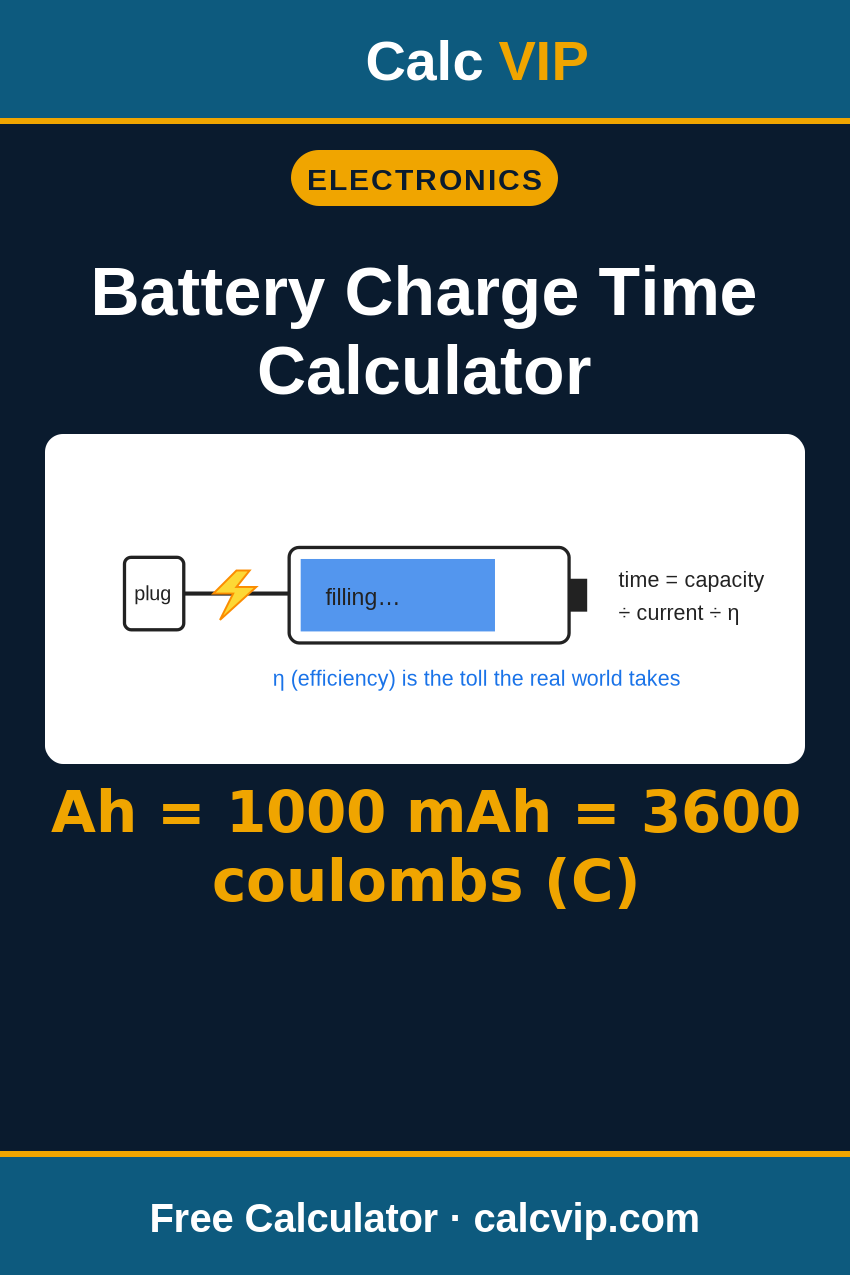
Enter the capacity in mAh or Ah, the charger's output current in mA or A — both are printed on the labels of the battery and the charger respectively — and pick your efficiency. The answer arrives as decimal hours and as hours-and-minutes, alongside the capacity restated in Ah and in coulombs. If you are comparing chargers, the lesson of the formula is blunt: charge time is inversely proportional to current, so doubling the charger's amps (where the battery permits it) halves the wait, and no efficiency setting can rescue a feeble charger on a large battery.
Formula
Charge time (hours) = Capacity ÷ Charge current ÷ efficiency
Unit conversion: 1 Ah = 1000 mAh = 3600 coulombs (C), because charge Q = I × t.
The skeleton of the formula is the definition of charge itself: Q = I × t, so t = Q ÷ I. A battery's capacity in amp-hours is its charge, stated in a hybrid unit — one amp-hour is one amp sustained for one hour, which is 3600 amp-seconds, which is 3600 coulombs. That is why the conversion at the end of the formula section is exact arithmetic, not approximation: a 3 Ah phone battery holds 3 × 3600 = 10,800 C of deliverable charge. The efficiency divisor sits outside the physics, accounting for the fraction of the charger's output that never becomes stored charge. Rearranged, the formula also sizes chargers: current needed = capacity ÷ (wanted hours × efficiency) — to fill 3000 mAh in 2 hours at 85% you need 3000 ÷ (2 × 0.85) ≈ 1765 mA, so a 2 A charger is the honest minimum.
| Symbol | Meaning | Units |
|---|---|---|
| Capacity | charge the battery holds when full | mAh or Ah |
| I | charger output current actually delivered | mA or A |
| η | charging efficiency | 0.8–1.0 (0.85 typical) |
| t | time for a full charge from empty | hours |
| Q | charge in SI units | coulombs (C) = A × s |
Why charging slows down at the end: CC then CV
The formula assumes the charger delivers its rated current from the first minute to the last. Lithium charging does not work that way, and the difference explains most "why did it take longer?" puzzles. A lithium charger runs in two phases. In the constant-current (CC) phase it pushes its full rated current while the battery voltage climbs — this is the fast, predictable part the formula describes. When the cell reaches its ceiling voltage (4.2 V for a standard lithium cell), the charger switches to constant-voltage (CV): it holds the voltage and lets the current taper away, slower and slower, until the battery is truly full. The last fifth of the capacity can take a third of the total time. Your phone's "80% in half an hour, then an age to 100%" behaviour is these two phases made visible — and the reason the efficiency divisor in this calculator is doing double duty, standing in for both true losses and the CV taper's lost time.
Lead-acid charging stretches the same story over more hours, with an absorption phase that holds voltage while current fades, and NiMH chargers detect fullness by a tiny voltage dip (−ΔV) or a temperature rise instead. Every chemistry agrees on the moral: the nameplate current fills the first portion at full speed and the remainder at a discount. For planning — "will it be charged by morning?" — this calculator at 85% is the right tool; for understanding why the last percent crawls, the two-phase picture is the answer.
How to use
- Enter the battery capacity from its label and choose the unit (mAh for phones and cells, Ah for car and UPS batteries).
- Enter the charger's output current (printed on the charger, or the current the device reports while charging) and choose the unit.
- Keep the 85% efficiency for a realistic estimate — 90% for a modern matched fast charger, 80% for old batteries or bargain chargers — then click "Calculate".
- Read the estimated time in hours and in hours-and-minutes, plus the capacity restated in Ah and coulombs.
- For a partial top-up, scale by the fraction you need: charging from 20% to 80% is 60% of the full-charge time — and because it stays mostly in the fast CC phase, it usually beats the estimate slightly.
Worked examples
Example 1 — the reference phone. A 3000 mAh phone battery is charged by a 1000 mA charger at 85% efficiency.
Time = 3000 ÷ 1000 ÷ 0.85 = 3.529 hours — about 3 hours 32 minutes. The capacity in other units: 3000 mAh = 3 Ah = 3 × 3600 = 10,800 coulombs of charge.
Example 2 — AA cells on a home charger. A 2500 mAh NiMH AA charged at 500 mA, 85% efficiency.
Time = 2500 ÷ 500 ÷ 0.85 = 5.882 hours (5 h 53 min) — an overnight job, which is why AA chargers are sold with timers. Capacity: 2.5 Ah = 9000 C.
Example 3 — a car battery. A 60 Ah battery on a 6 A workshop charger, 85%.
Time = 60 ÷ 6 ÷ 0.85 = 11.765 hours (11 h 46 min) from truly empty — and 216,000 coulombs delivered along the way. In practice the battery is rarely empty, and a smart charger spends its final hours tapering, so treat this as the ceiling.
Example 4 — a power bank refilled. A 10,000 mAh power bank charged at 2000 mA with a good modern charger at 90%.
Time = 10,000 ÷ 2000 ÷ 0.9 = 5.556 hours (5 h 33 min). The bank that rescues your phone all day needs the night to recover itself.
Example 5 — a single 18650 cell. A 3500 mAh lithium cell charged at 1000 mA, 85%.
Time = 3500 ÷ 1000 ÷ 0.85 = 4.118 hours (4 h 7 min). Torch and vape cells live on this schedule; doubling the charger to 2000 mA (a gentle 0.57C for this cell) would halve it to about 2 h 4 min.
Example 6 — ideal versus real. A 4000 mAh battery on a 2000 mA fast charger.
At 100% efficiency: 4000 ÷ 2000 = 2 hours exactly. At the realistic 85%: 2.353 hours (2 h 21 min). The 21-minute difference is the honest price of heat and the CV taper — and the gap widens as chargers get faster, because the taper occupies a growing share of a shrinking total.
Charge time in real life
Phone fast-charge claims, decoded. "50% in 30 minutes" is the CC phase boasting. The same phone's 0–100% time is far less than twice that figure, because the CV tail cannot be hurried without harming the cell. This calculator, at 85–90%, predicts the full-charge figure the adverts omit.
Choosing a charger for a battery bank. Off-grid and caravan systems are sized by this formula run backwards: the solar controller or mains charger must replace a day's usage within the available charging window, at honest efficiency, or the bank walks slowly towards empty.
EV charging, same maths, bigger units. A 60 kWh car battery on a 7 kW home charger needs 60 ÷ 7 ≈ 8.6 ideal hours; on a 50 kW rapid charger, 60 ÷ 50 = 1.2 hours — before the taper, which is why rapid chargers quote 10–80% times. The formula on this page is the EV formula with the units scaled.
Workshop planning. Cordless-tool batteries rotate through chargers on a schedule set by this division: a 5 Ah pack on a 4 A charger is back in about an hour and a half at real efficiency, and a crew's day is planned around how many such cycles the chargers can serve.
Why the last percent takes so long. The CV taper is not the charger being lazy; forcing full current into a nearly-full lithium cell plates metallic lithium, permanently damaging it and creating a safety risk. The slow finish is the battery's protection, priced in minutes.
Coulombs in the physics lab. The capacity conversion — Ah to coulombs — is the bridge between the battery world and the SI world: electrolysis, electroplating and capacitor problems all count charge in coulombs, and 1 Ah = 3600 C is the exchange rate this calculator applies.
The C-rate: one number for charging speed
Battery people compress "current relative to capacity" into the C-rate: charging at 1C means a current numerically equal to the capacity, filling the battery in one ideal hour. Example 1's phone (3000 mAh at 1000 mA) charges at C/3 — a third of 1C. Example 6's fast charger reaches 0.5C. A charger pushing 6000 mA into that 3000 mAh phone would be 2C and promise 30 ideal minutes. The C-rate is the right way to compare across sizes, because batteries tolerate roughly similar C-rates within a chemistry: lithium phones commonly accept 0.5–2C, lead-acid prefers a stately 0.1–0.2C (a 60 Ah car battery's comfortable 6–12 A), and exceeding the design C-rate buys speed with heat and shortened life. Divide any charger's current by the capacity in matching units and you have its C-rate — and this calculator's time is, to first order, simply 1 ÷ C-rate ÷ efficiency.
Quick reference: the same battery, different chargers
| Charger | C-rate (3000 mAh) | Ideal time | At 85% efficiency |
|---|---|---|---|
| 500 mA (old USB) | C/6 | 6 h | 7 h 4 min |
| 1000 mA | C/3 | 3 h | 3 h 32 min |
| 2000 mA | 0.67C | 1.5 h | 1 h 46 min |
| 3000 mA | 1C | 1 h | 1 h 11 min |
Every row is the reference phone of Example 1 wearing a different charger. Two lessons stand out: the time falls in exact inverse proportion to the current, and the efficiency toll — the last column minus the third — grows in absolute minutes as the charger gets faster, even though the percentage never changes.
Other chemistries, other clocks
The two-phase story above is lithium's, but every chemistry keeps its own time. Lead-acid charges in three acts — bulk, absorption and float — and its absorption act is long: a car battery can accept charge briskly to about 80% and then need hours of tapering to truly fill, which is why a short drive never fully recharges a neglected battery and why Example 3's figure is best read as an overnight promise. NiMH cells charge at a steadier current and announce fullness by a small voltage dip and a warming case; their classic home chargers simply run a timer at a gentle rate — the 0.1C overnight charge, fourteen hours for a full cell, forgiving of overrun because the rate is so low. NiCd, now largely retired, tolerated abuse that would ruin the others. The formula on this page fits all of them to planning accuracy, because capacity ÷ current is the skeleton every chemistry shares; the efficiency setting is where their personalities go — 0.85 for lithium and lead-acid, nearer 0.7–0.8 for NiMH, whose charge acceptance is genuinely poorer, especially as the cells age.
One more clock matters for rechargeable tools and toys: a battery fresh off the charger reads a little above its nominal voltage and settles within the hour. That surface charge fools simple voltage-based gauges into reporting 100% for a battery that is merely rested, not full. Time-based estimates like this calculator's — charge in versus capacity — are immune to that illusion, which is why coulomb counting, this formula automated, is how serious battery gauges keep score.
Common mistakes
- Believing the charger's biggest printed number. Multi-port chargers advertise their combined output; a "65 W" brick may give one port 65 W only when the others are empty. The current that matters is what your port actually delivers to your device.
- Mixing mAh and A. 3000 mAh ÷ 2 A is not 1500 of anything. Convert the current to mA (or the capacity to Ah) before dividing — the calculator's unit selectors exist precisely to prevent this thousand-fold slip.
- Expecting the formula's time to 100%. The estimate covers a full charge at an average rate; the CV taper means the last stretch crawls. If you habitually charge to 80%, scale the answer by 0.8 and expect to beat it slightly.
- Charging a cold or hot battery at full speed. Lithium cells should not be fast-charged below freezing — the chemistry cannot accept the charge and plates instead. Many devices quietly slow down when cold; a longer-than-calculated time on a winter morning is protection, not malfunction.
- Assuming a bigger charger forces its full current in. The device negotiates and draws what it wants (see the FAQ). Oversizing the charger is harmless; undersizing it stretches the time in exact proportion — which this calculator predicts if you enter the smaller current.
FAQ
Why does real charging take longer than capacity ÷ current?
Some energy is lost as heat in the charger and battery (efficiency), and most chargers slow down for the last part of the charge to protect the battery. Both effects stretch the real time beyond the ideal figure.
What is a coulomb?
The coulomb is the SI unit of electric charge: the charge carried by a current of 1 amp for 1 second. One amp-hour therefore equals 3600 coulombs.
Is it safe to use a higher-current charger?
The device controls how much current it takes, so a charger rated higher than needed is fine. A charger rated lower than the device wants will simply charge more slowly.
How many coulombs are in a phone battery?
A 3000 mAh battery holds 3 Ah, and each amp-hour is 3600 C, so 10,800 C. A 60 Ah car battery holds 216,000 C. The coulomb figure is what physics and electrochemistry problems want; the Ah figure is what labels print.
What efficiency should I choose?
85% is the honest default for ordinary chargers and batteries in fair condition. Choose 90% for a modern, matched fast-charge setup, 80% for ageing batteries, very cheap chargers, or charging in the cold — and 100% only for textbook ideals.
Why does my phone charge fast to 80% then slow down?
The two-phase CC–CV profile: full current until the cell voltage peaks, then a tapering current at fixed voltage to top off safely. The slow tail protects the cell from lithium plating; it is a feature wearing the disguise of a flaw.
Can I charge a battery with a much smaller charger?
Yes — it simply takes proportionally longer, as the formula shows: halve the current, double the time. Some smart devices refuse chargers below a minimum capability, but electrically, patience is the only cost.
How long to charge from 20% to 80%?
That is 60% of the capacity, so about 60% of the full-charge time this calculator gives — for Example 1, roughly 2 hours 7 minutes — and usually a little quicker in practice, because that window sits mostly in the fast constant-current phase.
Does fast charging wear the battery out sooner?
Somewhat: higher currents mean more heat and faster chemical ageing, which is why manufacturers balance speed against lifespan and why the taper exists. Occasional fast charging is a fair trade; living permanently on the fastest charger costs capacity over the years.
What is the energy in a full phone battery?
Charge is not energy until voltage joins in: a 3000 mAh (3 Ah) cell at a nominal 3.85 V stores 3 × 3.85 = 11.55 Wh. That is the figure to compare with other batteries — and the one that says how much heat a full charge represents.