 Calc
Capacitance Calculator – C = Q/V Charge & Voltage Solver
 Created by Michael Chen · Electronics Specialist · Last updated: November 2026
Use this free Capacitance Calculator based on C = Q/V. Find the capacitance from charge and voltage — or work backwards to find the charge stored or the voltage. Tip: you can type small values in scientific notation, like 1e-6 for 0.000001.
A capacitor is the simplest component that stores charge: two conducting plates held close together but kept apart by an insulator. Connect it to a battery and charge floods onto one plate and off the other — never through the insulator — until the voltage between the plates matches the supply. The charge parked on the plates, divided by the voltage that parked it, is the capacitance: a measure of how much charge the device stores for each volt applied. More capacitance means a bigger reservoir at the same pressure.
The unit, the farad, is named for Michael Faraday — and it is colossal. A one-farad capacitor holding one coulomb per volt would be a warehouse of a component; the entire Earth, treated as an isolated conducting sphere, has a capacitance of only about 700 µF. So real capacitors live in the small fractions: microfarads (µF, millionths) for power supplies, nanofarads (nF) and picofarads (pF) for radio and signal work. The exception proving the scale is the modern supercapacitor, which reaches whole farads — even thousands of farads — by tricks of surface area described below.
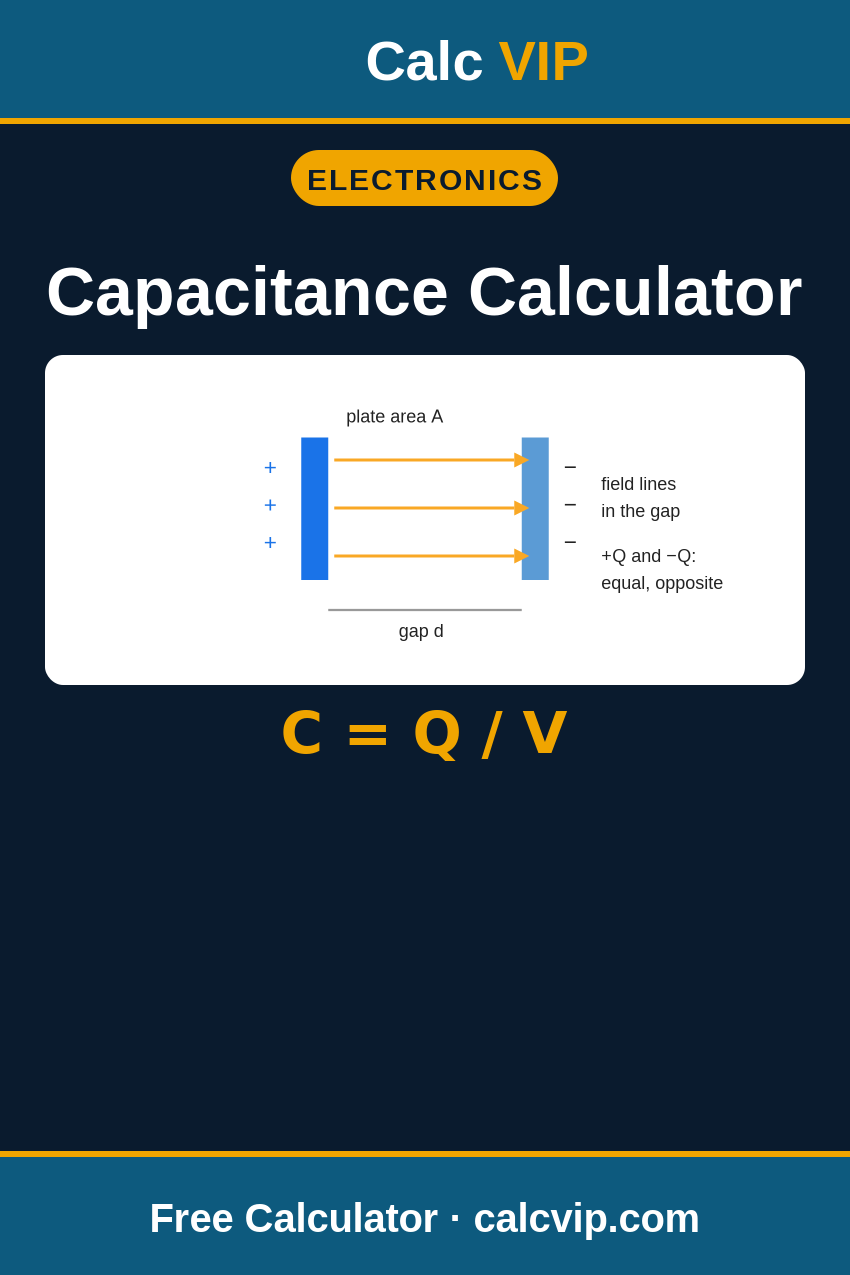
Three things fix a capacitor's value: the area of its plates, the gap between them, and the insulating material (the dielectric) filling that gap. Bigger plates store more charge; a thinner gap strengthens the field's grip; a good dielectric multiplies the whole effect. But however it is built, the finished device obeys the one relation on this page — C = Q/V — and this calculator works it in all three directions: capacitance from charge and voltage, charge from capacitance and voltage, or the voltage a given charge implies.
Formula
Capacitance = Charge ÷ Voltage → C = Q / V • Q = CV • V = Q / C
One relation, three questions. C = Q/V defines the device: how many coulombs it parks per volt. Q = CV is the working form — the charge stored at any voltage you choose. V = Q/C works backwards from a measured charge to the voltage producing it. The units interlock exactly: farads are coulombs per volt by definition, so any consistent set of values satisfies the equation automatically. The practical hazard is prefixes: real charges arrive in microcoulombs and real capacitances in microfarads, and both must be converted to plain coulombs and farads (or tracked very carefully in matched micro-units) before the division. This calculator also reports capacitance in µF, the unit printed on most real components.
| Symbol | Meaning | Units |
|---|---|---|
| C | capacitance — charge stored per volt | farads (F); usually µF, nF or pF |
| Q | charge stored on the positive plate | coulombs (C) |
| V | voltage between the plates | volts (V) |
| εr | relative permittivity of the dielectric — its multiplying effect | no units (air ≈ 1) |
Capacitance belongs to the device, not to the charge
It is tempting to read C = Q/V as "more charge makes more capacitance", but the causality runs the other way. Connect a capacitor to 6 V and it stores a certain charge; connect it to 12 V and it stores exactly twice as much — the ratio Q/V never budges, because the device decides how much charge each volt may park. Capacitance is like the width of a water tank: pour in more water and the depth rises in proportion, but the tank's width — the property that links the two — was fixed when the tank was built. The graph of charge against voltage for a capacitor is a straight line through the origin, and its slope is C.
What actually happens during charging explains the straight line. The first charges arrive easily, but each parked charge repels the next arrival through the field building between the plates, so the supply must work against a growing voltage of the capacitor's own making. Equilibrium arrives when that self-made voltage equals the supply — charging stops, and the stored charge is whatever the field at that voltage supports. Because the field grows in exact proportion to the charge, the final ratio is constant for the device. It also explains a subtlety: charge does not sit in the plates like water in a bucket, but in the strained electric field between them — which is where the stored energy lives, as our Capacitor Energy Calculator explores.
How to use
- Choose what you want to find: capacitance, charge or voltage.
- Enter the two values you know — the labels change to match your choice. Scientific notation like 1e-6 is accepted, and is the sane way to type microfarads in farads (470 µF = 4.7e-4).
- Click "Calculate". Capacitance is also shown in microfarads (µF), the unit used on most real capacitors.
- Sanity-check with the definition: a bigger charge at the same voltage must mean a bigger capacitance, never a smaller one.
Worked examples
Example 1 — finding capacitance. A capacitor stores a charge of 0.006 C when connected to 12 V.
C = Q ÷ V = 0.006 ÷ 12 = 0.0005 F — that is 500 µF, a respectable power-supply capacitor.
Example 2 — finding charge. A 100 µF capacitor (1 × 10⁻⁴ F) is charged to 25 V.
Q = CV = 1 × 10⁻⁴ × 25 = 0.0025 C — 2.5 millicoulombs parked on the plates, ready to be released the moment a path is offered.
Example 3 — finding voltage. A 10 µF capacitor (1 × 10⁻⁵ F) holds a charge of 50 µC (5 × 10⁻⁵ C).
V = Q ÷ C = 5 × 10⁻⁵ ÷ 1 × 10⁻⁵ = 5 V. Small capacitances reach their voltage on very little charge — the reason a tiny static spark, carrying microcoulombs, can stand at thousands of volts across a small capacitance.
Example 4 — capacitance from geometry. Two plates of area 0.01 m² face each other across a 1 mm air gap (0.001 m). With ε0 = 8.85 × 10⁻¹² F/m, C = ε0A ÷ d = 8.85 × 10⁻¹² × 0.01 ÷ 0.001 = 8.85 × 10⁻¹¹ F — just 88.5 pF.
A palm-sized pair of plates in air barely reaches a hundred picofarads; real capacitors earn their microfarads with vast foil areas, micron-thin dielectrics, or both.
Example 5 — a supercapacitor. A 1 F supercapacitor is charged to its rated 2.7 V.
Q = 1 × 2.7 = 2.7 C — thousands of times the charge of Example 1's capacitor, held at a modest voltage. Supercapacitors trade voltage for sheer capacity, which is why they serve as short-term energy reservoirs rather than battery replacements.
Example 6 — a motor-run capacitor. A 470 µF capacitor works at 16 V in a power supply.
Q = 470 × 10⁻⁶ × 16 = 0.00752 C (7.52 mC). It stores and returns this charge fifty or sixty times a second as it smooths the supply — a quiet, endless shuttle of millicoulombs.
Capacitance in real life
Smoothing power supplies. A capacitor across a rectifier's output charges at each voltage peak and discharges into the load between peaks — a reservoir that turns pulses into a steady supply. Bigger capacitance means a steadier output, which is why the largest cans in any power supply are its smoothing capacitors.
Touchscreens. A capacitive touchscreen is a grid of tiny capacitors whose fields your finger — a bag of conductive salt water — measurably disturbs. The controller watches which capacitances changed and by how much. Gloves defeat it precisely because they widen the gap and weaken the effect.
Tuning radios. Old radios tune with a variable capacitor: rotating plates slide in and out of mesh, changing the overlap area and so the capacitance, which slides the resonant frequency across the dial. The formula C = εA/d, turned by a knob.
Timing circuits. A capacitor charging through a resistor takes a predictable time to reach any given voltage — the RC time constant — and countless timers, flashers, debounce circuits and the classic 555 timer chip are built on that predictable slowness. Capacitance, here, is measured out in seconds.
Condenser microphones. The capsule of a studio microphone is a capacitor whose one plate is a flexible diaphragm. Sound waves flex it, the gap d trembles, and the capacitance wobbles in time with the sound — a mechanical signal converted to an electrical one by the geometry formula itself.
Decoupling digital chips. Every digital chip is sprinkled with small capacitors placed millimetres away, acting as local charge reservoirs that supply the sudden gulps of current when millions of transistors switch together. Without them, the shared supply would sag at every gulp and the logic would glitch.
What sets the value: area, gap and dielectric
The geometry formula C = ε0εrA ÷ d organises every capacitor technology. Area A is multiplied by rolling or stacking: electrolytic capacitors etch their foil to multiply its microscopic surface, and supercapacitors use charcoal with the internal area of a tennis court in a thimbleful of material — which is how they reach farads. The gap d is divided down: modern dielectrics are microns thin, which is powerful but sets the voltage limit, since the field across a thinner gap reaches breakdown sooner. And εr, the dielectric's multiplying factor, ranges from barely 1 for air to thousands for specialist ceramics.
| Dielectric | εr (approx.) | Where you meet it |
|---|---|---|
| air (or vacuum) | 1 | old variable tuning capacitors |
| paper | about 3.7 | vintage and motor capacitors |
| glass | about 5 | precision and high-voltage parts |
| mica | about 6 | radio-frequency circuits |
| water | about 80 | a curiosity — too leaky for real use |
| high-k ceramics | hundreds to thousands | the tiny chips on every circuit board |
Read Example 4 again with the table in hand: swap the air in that palm-sized capacitor for a high-k ceramic and the picofarads become nanofarads without the plates changing at all — the dielectric is a multiplier you pour between the plates.
Capacitors in series and parallel: the mirror image of resistors
Connect capacitors in parallel and their capacitances simply add — you have effectively built one capacitor with the combined plate area, and two 100 µF parts give 200 µF. Connect them in series and the reciprocals add, exactly as with parallel resistors: two 100 µF parts give 50 µF, because the chain behaves like a single capacitor whose gap has doubled. The mirror-image behaviour confuses everyone once, and the geometry cures it: parallel adds area, series adds gap. A practical warning rides along — in a series chain the voltage divides in inverse proportion to capacitance, so the smallest capacitor takes the largest share of the voltage, and series strings of electrolytics need balancing care to keep any one of them within its rating.
The printed value is a promise with tolerances
No manufactured capacitor holds exactly its marked value. Film and ceramic parts commonly carry tolerances of ±5% or ±10%; the big electrolytics in power supplies are often ±20%, so a "470 µF" can legitimately measure anywhere from about 376 µF to 564 µF and still be in specification. Designers choose the type to suit the job: a timing circuit that must be accurate gets a tight-tolerance film part, while a smoothing reservoir, where extra is harmless, gets a loose electrolytic. Capacitance also drifts with temperature — some ceramic types lose a large share of their value as they warm or as working voltage rises — and electrolytics slowly dry out over years, their capacitance fading and their resistance rising, which is the single most common cause of failure in ageing power supplies.
Measuring capacitance exploits this page's own formula: a meter applies a known current for a measured time, or charges the part to a known voltage, and computes C from the charge delivered. That is why a capacitance meter needs the part discharged and ideally out of circuit — parallel paths and leftover voltage corrupt the accounts exactly as they do for resistance. Read a measured value against the tolerance band before judging a part faulty; physics allows the honest spread, and only a reading outside it — or a part that will not hold charge at all — proves a failure.
Common mistakes
- Believing capacitance grows with charge or voltage. Double the voltage and the stored charge doubles too — the ratio, which is the capacitance, stays put. C is chosen at the factory; Q and V merely report it.
- Losing a factor of a million in the prefixes. µF, nF and pF step by thousands: 1 µF = 1,000 nF = 1,000,000 pF. Entering a picofarad value as microfarads inflates an answer a millionfold, and it happens constantly.
- Expecting steady DC through a capacitor. Current flows only while the capacitor charges or discharges. Once its voltage matches the supply, DC stops — capacitors block steady DC, which is a feature used daily to separate signals from supply rails.
- Ignoring the voltage rating. The printed voltage is a survival limit, not a suggestion. Exceed it and the dielectric breaks down — sometimes quietly, sometimes with a bang. Work with a margin: a 16 V part on a 12 V rail, not on a 15.9 V one.
- Confusing capacitance with stored energy. A big C at a tiny voltage may store less energy than a small C at a high voltage, because energy follows ½CV² — the voltage is squared. Comparing capacitors by farads alone misleads; compare joules for energy jobs.
FAQ
What is a farad?
One farad (1 F) is a very large capacitance — the capacitor stores 1 coulomb of charge per volt. Real capacitors are usually rated in microfarads (µF, millionths of a farad), nanofarads (nF) or picofarads (pF).
Does capacitance change if I store more charge?
No. Capacitance is fixed by the capacitor's build — plate area, plate gap and the insulating material between them. More voltage simply stores proportionally more charge, so the ratio Q/V stays the same.
How do I convert between F, µF, nF and pF?
1 F = 1,000,000 µF = 1,000,000,000 nF = 1,000,000,000,000 pF. So 500 µF = 0.0005 F.
Why does every capacitor have a voltage rating?
Because the dielectric between its plates can only withstand a certain electric field. Past the rated voltage the insulator breaks down and conducts, destroying the capacitor. The rating is the highest voltage the gap can hold, and wise designs stay well under it.
What is a supercapacitor?
A capacitor built for enormous capacitance — farads to thousands of farads — using electrodes with microscopic pores that give a gigantic effective area and an almost atomic gap. It stores far more energy than ordinary capacitors but at low voltages (about 2.7 V per cell), and releases it much faster than a battery can.
How long does a capacitor hold its charge?
Ideally forever; in practice the dielectric leaks slightly and the charge fades over minutes to days depending on the type. Large electrolytics can hold a dangerous charge long after switch-off, which is why technicians discharge them deliberately before working.
Do capacitors add in series or in parallel?
In parallel they add directly, like resistors in series. In series their reciprocals add, like resistors in parallel. The geometry explains it: parallel adds plate area; series adds gap thickness.
What is a dielectric?
The insulating material between the plates. It blocks any flow of charge while allowing the electric field to pass, and its polar molecules multiply the capacitance by the factor εr — from about 1 for air to thousands for special ceramics.
Why do capacitors block DC but pass AC?
DC charges the plates once and then stops, because no charge can cross the gap. AC reverses direction constantly, so the capacitor charges and discharges in endless alternation — charge flows in the wires on both sides, appearing to pass through, though nothing ever crosses the dielectric.
Can a capacitor store as much energy as a battery?
Not in the same size — batteries store far more energy per kilogram because they use chemistry, not just a field. Capacitors win on speed and endurance: they can dump their energy in microseconds and survive millions of cycles. Our Capacitor Energy Calculator puts numbers on the comparison.