 Calc
Capacitor Discharging Calculator – Voltage & Charge Remaining vs Time
 Created by Michael Chen · Electronics Specialist · Last updated: November 2026
Use this free Capacitor Discharging Calculator to find the voltage left on a capacitor as it discharges through a resistor, and how much charge remains on its plates. Enter the starting voltage, the resistance, the capacitance and the time.
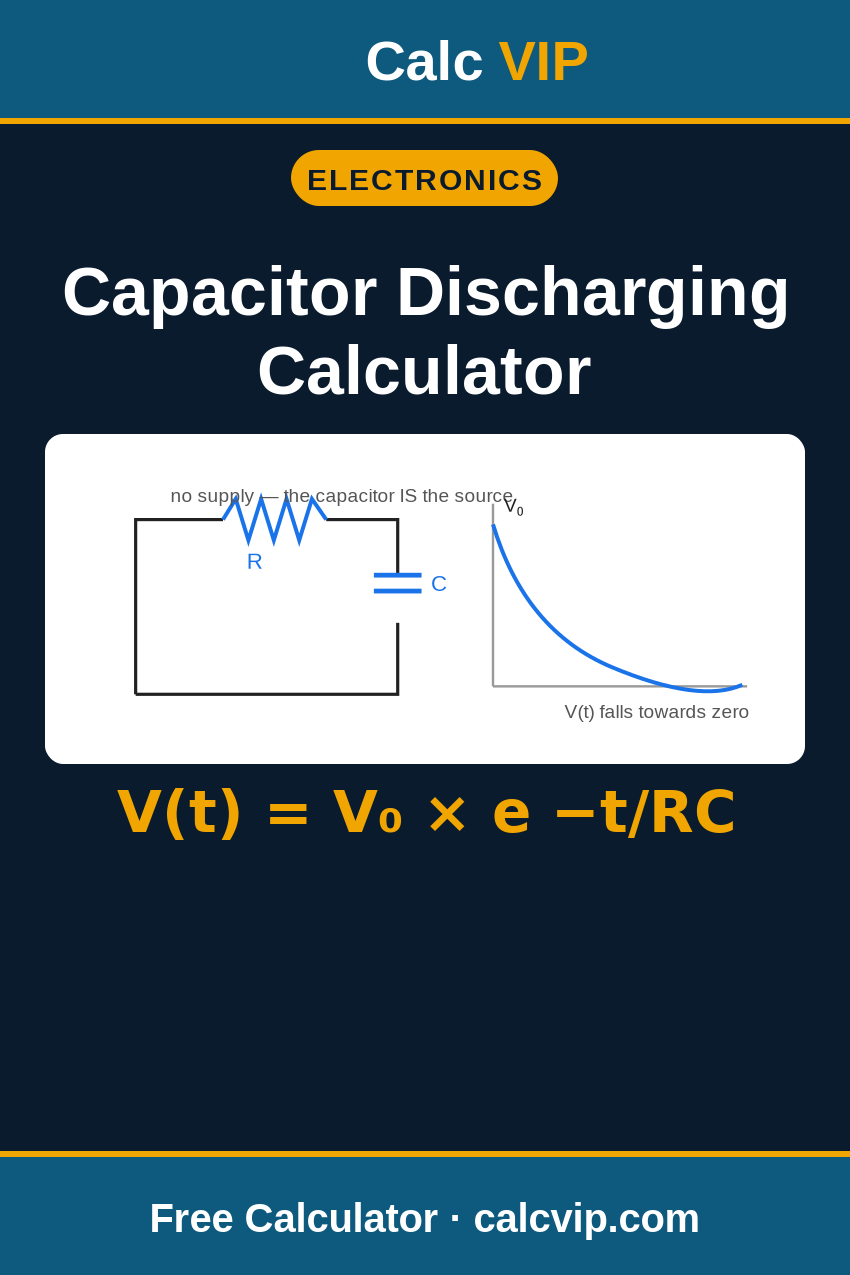
Disconnect a charged capacitor and connect it across a resistor, and it gives its energy back — but not all at once, and not at a steady rate. The first instant is the most violent: the full voltage drives the largest current the resistor will ever see. As charge leaves the plates, the voltage falls, the current falls with it, and the discharge throttles itself down into a long, fading tail. The voltage follows the decaying exponential V₀ × e−t/RC, the mirror image of the charging curve, and it governs everything from how long a camera flash stays dangerous to how gracefully a power supply shuts down.
Just as with charging, one number sets the pace: the time constant τ = RC. In each time constant the capacitor sheds 63.2% of whatever voltage it had at the start of that interval — not 63.2% of the original, but of the current value, which is why the curve never quite reaches zero. After 1τ, 36.8% remains; after 2τ, 13.5%; after 5τ, just 0.67%. Because charge is simply Q = CV with C fixed, the charge on the plates traces the identical curve, and this calculator reports both together so you can see the store emptying in volts and coulombs at once.
Discharging is where capacitors earn their safety warnings. A large capacitor in a switched-off power supply can hold a lethal voltage for minutes, bleeding away through whatever resistance it can find — which is why bleeder resistors are designed in deliberately, sized with exactly this formula. The worked examples below include that safety calculation, plus the opposite extreme: discharges engineered to finish in a millisecond. By the end you will be able to say, for any RC pair, how much is left after any time — and how long "safe" actually takes.
Formula
Capacitor voltage while discharging: V(t) = V₀ × e−t/RC • time constant τ = R × C • charge remaining Q(t) = C × V(t)
The formula rearranges to answer the safety question — how long until the voltage falls to a chosen level V: t = τ × ln(V₀/V). The discharge current peaks at the very first instant, I₀ = V₀/R, and decays with the same exponential, I(t) = I₀ × e−t/τ. The energy still stored at any moment is U(t) = ½C × V(t)² — note the square, which means the energy drains faster than the voltage: after one time constant the voltage is at 36.8% but the energy is down to 13.5%. Units: R in ohms and C in farads give τ in seconds; the calculator's unit menu converts µF, mF and nF for you.
| Symbol | Meaning | Units |
|---|---|---|
| V₀ | starting voltage (what the capacitor was charged to) | volts (V) |
| V(t) | voltage remaining after time t | volts (V) |
| Q(t) | charge remaining on the plates | coulombs (C) |
| R | discharge resistance in the loop | ohms (Ω) |
| C | capacitance | farads (F) |
| τ | time constant, τ = RC | seconds (s) |
The half-life of a discharge: why the tail never ends
A discharging capacitor has a half-life, exactly like a radioactive sample. Every interval of 0.693τ, the voltage halves — whatever it currently is. From 12 V: after 0.693τ it is 6 V, after another 0.693τ it is 3 V, then 1.5 V, 0.75 V, and so on, halving forever and reaching zero only in the mathematical limit. This is the deep reason behind the practical rule that a capacitor is "discharged" after 5τ: by then five halvings and more have shrunk the voltage to 0.67% of its start, below the threshold where most circuits — and most safety standards — stop caring.
The halving picture also explains the discharge's split personality. The first time constant does the dramatic work, shedding nearly two-thirds of the voltage; the last time constants are a whisper. Engineers exploit both ends. A defibrillator wants the steep front of the curve, delivering its energy while the voltage is still high. A memory-backup circuit wants the tail, sipping the last few percent of charge to hold data alive for seconds after the power fails. Same curve, different neighbourhoods — and the choice of R and C is how you move your application to the neighbourhood it needs.
How to use
- Enter the voltage the capacitor starts with (the voltage it was charged to).
- Enter the discharge resistance and the capacitance (pick its unit).
- Enter the time since discharging began and click "Calculate" for the remaining voltage and charge.
- For a safety question — "when is it below 50 V?" — work backwards with t = τ × ln(V₀/V), or try successive times in the calculator until the remaining voltage drops under your limit.
Worked examples
Example 1 — the reference discharge. A 100 µF capacitor charged to 12 V discharges through a 10 kΩ resistor.
τ = RC = 10,000 × 100 × 10−6 = 1 s.
After t = 3 s: V = 12 × e−3 = 12 × 0.0498 = 0.6 V.
Charge remaining: Q = C × V = 100 µF × 0.6 V = 59.74 µC, down from 1200 µC — only 4.98% is left.
Example 2 — a bulk reservoir emptying. A 1000 µF capacitor at 9 V discharges through 1 kΩ: τ = 1,000 × 1000 × 10−6 = 1 s. After just 0.5 s the voltage is 9 × e−0.5 = 5.46 V, and the charge remaining is 1000 µF × 5.46 V = 5.46 mC of the original 9 mC — 60.65% still aboard after half a time constant.
Example 3 — the bleeder resistor safety check. A power supply's 470 µF capacitor sits at 400 V when the unit is switched off, with a 100 kΩ bleeder resistor across it: τ = 100,000 × 470 × 10−6 = 47 s. After a full minute the voltage is still 400 × e−60/47 = 111.6 V — dangerous. Reaching 50 V takes t = 47 × ln(400/50) = 97.7 s, and only after 5τ = 235 s is it down to 2.7 V. This is why service manuals say to wait, and then to check with a meter anyway.
Example 4 — the millisecond dump. A 100 µF capacitor at 5 V discharges through just 10 Ω: τ = 10 × 100 × 10−6 = 1 ms. After 2 ms the voltage is 5 × e−2 = 0.68 V. The price of that speed is the opening current spike: I₀ = 5 ÷ 10 = 0.5 A, decaying from there — small resistances mean fast discharges and fierce first instants.
Example 5 — counting halvings. A 100 µF capacitor charged to 24 V discharges through 20 kΩ, so τ = 2 s and the voltage halves every 0.693 × 2 = 1.39 s: 24 V → 12 V at 1.39 s → 6 V at 2.77 s. After two halvings only a quarter remains — the same answer the exponential gives (24 × e−2.77/2 = 6.0 V), reached by pure halving logic.
Example 6 — where the energy went. Example 1's capacitor starts with U = ½ × 100 µF × 12² = 7.2 mJ stored. After one time constant the voltage is 36.8% of 12 V, so the stored energy is (0.368)² = 13.5% of the start: 0.97 mJ. The other 6.23 mJ has already become heat in the resistor — energy leaves a discharging capacitor much faster than the voltage reading alone suggests, because energy follows the square of the voltage.
Capacitor discharging in real life
Bleeder resistors in power supplies. Example 3 is a real design calculation: safety standards require a switched-off supply's capacitors to fall to a safe voltage within a set time, and the bleeder's value is chosen from t = τ ln(V₀/V) to guarantee it.
Camera flash discharge. The flash fires by dumping the capacitor through the xenon tube — a resistance of a few ohms — in about a millisecond. The same capacitor, opened up on a workbench, can sit charged for hours through leakage paths alone: τ depends entirely on what you connect.
Defibrillator discharge shaping. The therapeutic pulse is the front of this exponential, truncated deliberately. Clinicians choose the energy by choosing the starting voltage and capacitance, knowing the curve will deliver most of it in the first time constant.
Hold-up and graceful shutdown. When mains power fails, a supply's reservoir capacitor discharges through the load, holding the output up for the 10–20 ms a computer needs to notice and react. Hold-up time is this formula with the load as R.
Neon-lamp relaxation oscillators. A capacitor charges slowly through a large resistor until it reaches the neon lamp's strike voltage, then discharges through the lamp in a flash, and the cycle repeats — a blinking beacon built from one discharge curve.
ESD and static safety. A charged object discharging through a wrist strap's 1 MΩ resistor follows this curve with a deliberately long τ: the energy is the same, but spread over time it is harmless instead of a spark.
Fast or gentle? The peak-current bargain
Every discharge is a negotiation between speed and violence, and the resistor is the negotiator. The total energy is fixed — ½CV₀² must all become heat — but R decides the terms. Halve R and τ halves, so the discharge finishes twice as fast; but the opening current I₀ = V₀/R doubles, and the peak heating rate (I₀²R) doubles too. Example 4's modest 0.5 A spike becomes 5 A if R drops to 1 Ω, and the theoretical spike from shorting a big charged capacitor with a screwdriver — R of a few milliohms — reaches thousands of amps for an instant, which is why the screwdriver tip comes away pitted. The professional habit follows directly: discharge large capacitors through a proper resistor, sized from this formula, never through a dead short; and when you must have both speed and safety, discharge in stages — a small resistor to take the edge off, then a lower one to finish. The curve also warns the other way: a very large R is not "safer" in every sense, because it leaves the capacitor armed for a very long time, as Example 3's 111.6 V after a full minute shows.
Quick reference: what remains, and how long to fall
| Elapsed time | Voltage remaining | Energy remaining |
|---|---|---|
| 0.5τ | 60.65% | 36.79% |
| 1τ | 36.79% | 13.53% |
| 2τ | 13.53% | 1.83% |
| 3τ | 4.98% | 0.25% |
| 4τ | 1.83% | 0.034% |
| 5τ | 0.67% | 0.0045% |
For fall-to targets: reaching 10% of V₀ takes 2.303τ, reaching 1% takes 4.605τ, and each halving takes 0.693τ. Safety work uses absolute volts, not percentages — 1% of a 10 kV capacitor is still 100 V — so always convert with t = τ × ln(V₀/V) for the actual limit you must meet.
Bleeders, wait times and the capacitor that bites back
Everything on this page converges on one professional habit: never trust a capacitor to be empty. Equipment that must be safe to open carries a bleeder resistor permanently across its reservoir capacitor, sized so the discharge curve reaches a safe voltage within a mandated time. Work an example: a 400 µF capacitor charged to 325 V (a rectified-mains reservoir) with a 100 kΩ bleeder has τ = 100,000 × 0.0004 = 40 s, and reaching 50 V takes t = 40 × ln(325/50) = 40 × 1.87 = 75 s — which is why service manuals say "wait two minutes", and why the bleeder's own dissipation (325² ÷ 100,000 ≈ 1.06 W, a real, continuous waste) is a genuine design compromise rather than an afterthought.
There is a subtler trap for the impatient: dielectric absorption. Discharge a high-voltage capacitor briskly, remove the short, and minutes later a fraction of the voltage — sometimes several percent — creeps back across its terminals as polarised molecules in the dielectric relax. The capacitor was never recharged; it remembered. The defence is the one this page's curve prescribes: discharge through a resistor, hold the short on while working, and treat any large capacitor as charged until a meter proves otherwise, twice.
Common mistakes
- Assuming a switched-off capacitor is a safe capacitor. With only leakage paths to discharge through, τ can be minutes or hours. Example 3 still held 111.6 V after 60 s through a deliberate bleeder; without one it would hold far more, far longer. Measure, don't assume.
- Using the charging formula for a discharge. Charging rises as (1 − e−t/τ); discharging falls as e−t/τ. Swapping them predicts 7.6 V where the truth is 0.6 V in Example 1's circuit at t = 3 s.
- Expecting the energy to track the voltage. Energy goes as V². At 36.8% voltage only 13.5% of the energy remains — and conversely, at 70% voltage a dangerous 50% of the energy is still stored.
- Shorting a capacitor to "discharge it quickly". A near-zero R means a near-infinite peak current: sparks, pitted contacts, damaged capacitor plates, and occasionally a ruptured can. Use a resistor and this formula to pick it.
- Forgetting the capacitor recharges itself. Real dielectrics exhibit absorption: after a brief short, a large capacitor's voltage creeps back up as trapped charge redistributes. Safety practice is to leave the discharge resistor (or a shorting lead) connected, not to flash it once and walk away.
FAQ
How long until the capacitor is "empty"?
Mathematically it never quite reaches zero, but after 5τ only 0.67% of the voltage remains, which is negligible in practice. With τ = 1 s, that is just 5 seconds.
Where does the stored energy go?
It is turned into heat in the resistor as the discharge current flows. The smaller the resistance, the faster the discharge — and the higher the peak current and heating rate.
Does the charge fall at the same rate as the voltage?
Yes. Since Q = CV and C is fixed, the charge follows exactly the same exponential curve: after one time constant, 36.8% of both the voltage and the charge remain.
How long until the voltage halves?
0.693τ — the discharge's half-life. It is the same for every halving, from any starting point: 24 V reaches 12 V in 0.693τ, and 12 V reaches 6 V in the next 0.693τ.
What is the largest current during a discharge?
The very first instant: I₀ = V₀/R. It only falls from there. Example 4 peaks at 0.5 A; Example 3's bleeder peaks at a gentle 400 ÷ 100,000 = 4 mA — which is exactly why the bleeder takes so long.
Why do I measure a voltage again after discharging a big capacitor?
Dielectric absorption. Charge trapped deep in the dielectric slowly migrates back to the plates after the surface charge is removed, so the terminal voltage partially recovers. Leave a shorting lead on large capacitors during service.
Does a bigger capacitor always discharge more slowly?
Only through the same resistor: τ = RC, so doubling C doubles every timescale. But a bigger capacitor also stores more charge and energy at the same voltage, so its discharge through a small resistor can be far more violent despite — or rather because of — its size.
Can I use this for a capacitor discharging through a light bulb or LED?
Approximately, if you use the device's effective resistance — but a filament's resistance changes strongly as it cools, and an LED's is highly non-linear, so the real curve deviates from the clean exponential. The formula is exact for a constant resistance.
What resistor should I use to discharge a capacitor safely?
Pick τ from your patience and the formula: for a 470 µF capacitor, 100 kΩ gives τ = 47 s (Example 3); 10 kΩ gives 4.7 s with a peak current ten times higher. Check the resistor's power rating against the opening burst, P = V₀²/R, even though it only lasts moments.
Is the charging curve related?
It is the same mathematics flipped vertically: charging fills the gap as (1 − e−t/τ) while discharging empties as e−t/τ, with the same τ = RC. The Capacitor Charging Calculator on this site covers the rising side, including the time-to-target mode.