 Calc
Battery Life Calculator – How Long Will a Battery Last?
 Created by Michael Chen · Electronics Specialist · Last updated: November 2026
Use this free Battery Life Calculator to estimate how long a battery will run your device. Enter the battery capacity and the current your load draws — and optionally apply a realistic 0.85 derating factor, because real batteries rarely deliver their full rated capacity.
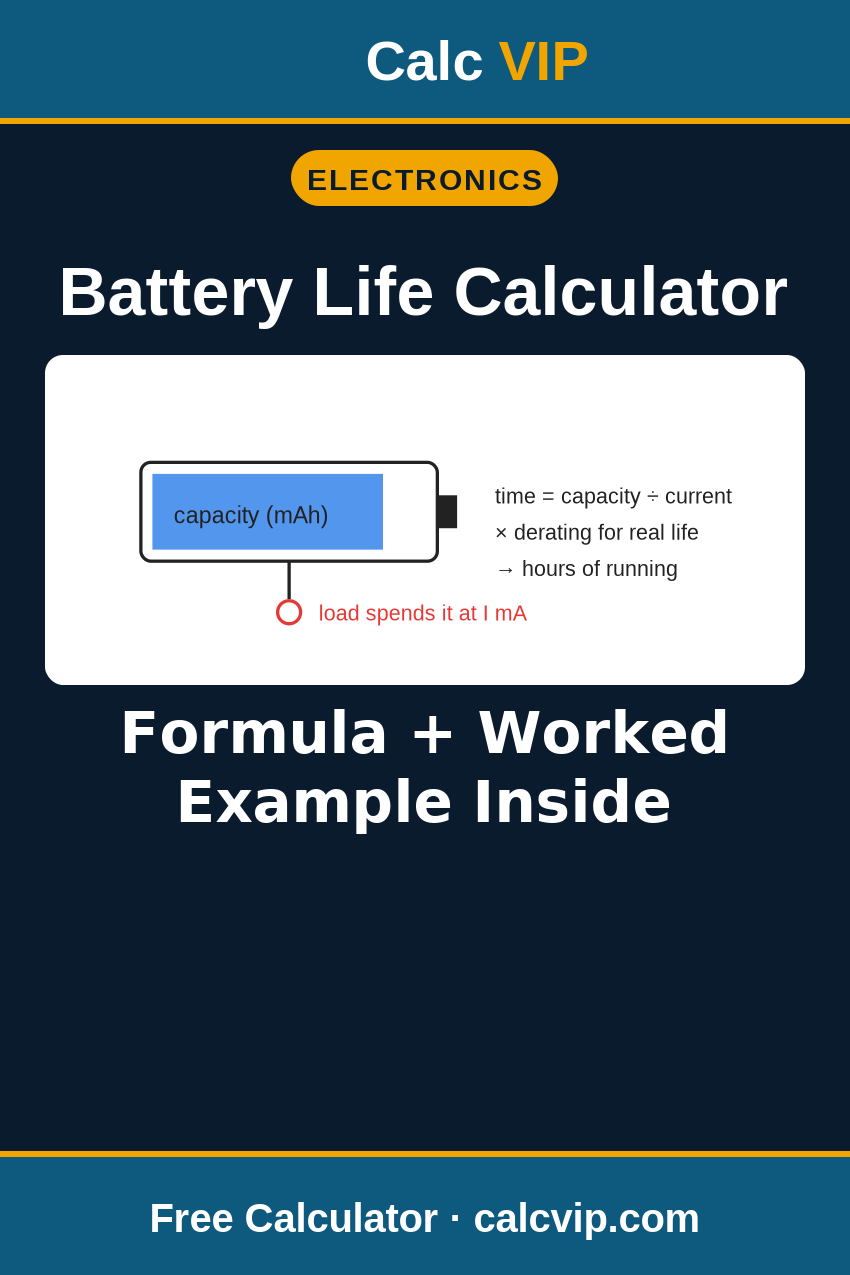
A battery's capacity, printed on its label in milliamp-hours or amp-hours, is a budget of charge: it says how much current the battery can supply, and for how long, before it is spent. Divide the budget by the rate at which your device spends it and you have the running time — the whole idea of this calculator in one division. A 2000 mAh battery feeding a 400 mA load holds 2000 ÷ 400 = 5 hours of charge. Everything else on this page is about why the real answer is a little less than that, and how to estimate it honestly.
The honest adjustment is the derating factor. The capacity on the label is measured by the manufacturer under gentle, standardised conditions — a modest current, room temperature, discharged down to a defined cut-off voltage. Real life is ruder: cold weather thickens the chemistry, age eats capacity year by year, high currents waste a growing share as internal heat, and most devices switch off while charge still remains in the cell, unwilling to drag the voltage any lower. Multiplying by 0.85 folds all of that into one realistic figure, and it is the default in this calculator for good reason.
Use the calculator for anything battery-powered: torches, sensors, toys, power banks, backup systems, e-bike and car batteries. Enter capacity in mAh or Ah, the load in mA or A — mixed units are converted for you — and choose your derating: 1.0 for the ideal textbook figure, 0.85 for a realistic everyday estimate, 0.70 when the battery is old, cold, or working hard. The result appears in hours and in hours-and-minutes, because "4.25 hours" plans nobody's day as well as "4 h 15 min".
Formula
Running time (hours) = Capacity ÷ Load current × derating factor
Capacity and current must be in matching units (Ah ÷ A, or mAh ÷ mA).
The formula is the definition of capacity turned around. Capacity itself is current × time — a battery that delivers 400 mA for 5 hours has delivered 2000 mAh — so time is capacity ÷ current by simple rearrangement. The derating factor is not physics but experience, a multiplier less than 1 that reserves a slice of the budget for the losses listed above. A second rearrangement is worth memorising for design work: required capacity = load current × wanted hours ÷ derating. To run a 400 mA device for a full day at 0.85 derating you would need 400 × 24 ÷ 0.85 ≈ 11,294 mAh — the kind of figure that decides whether a project needs a bigger battery or a thriftier circuit.
| Symbol | Meaning | Units |
|---|---|---|
| Capacity | charge the battery can deliver | mAh or Ah (1 Ah = 1000 mAh) |
| I | current drawn by the load | mA or A |
| t | running time | hours |
| Derating | usable fraction of the rated capacity | 1, 0.85 or 0.70 here |
| Wh | energy — capacity × voltage, for comparing unlike batteries | watt-hours |
Why real batteries fall short: Peukert and the cut-off
The deepest reason the simple division overpromises is that capacity is not a fixed tank of charge — it shrinks as you draw from it faster. In 1897 Wilhelm Peukert showed that a lead-acid battery drained at high current delivers measurably less total charge than the same battery drained slowly: the chemistry cannot keep up, and some capacity stays locked inside until the load rests. Lithium cells suffer far less, but no chemistry is immune, and the effect is worst exactly when you can least afford it — big loads on small batteries. The 0.85 derating is a pocket-sized allowance for Peukert losses, temperature and age combined.
The second thief is the cut-off voltage. A device does not sip the battery to true emptiness; its electronics demand a minimum voltage and shut down while charge remains. A "dead" phone battery still holds energy — just not at a voltage the phone can use. Add self-discharge (a battery slowly spending itself on the shelf, fast for NiMH, slow for lithium) and the gap between label and life is fully explained. None of this makes the label a lie: it makes it a measurement under stated conditions, and the derating factor your translation of those conditions into your own.
How to use
- Enter the battery capacity printed on the battery (e.g. 2000 mAh) and choose its unit.
- Enter the average current your device draws and choose its unit. For a varying load, use the time-average — a sensor that wakes briefly and sleeps at microamps may average under 1 mA.
- Keep the 0.85 derating for a realistic estimate, choose 0.70 for old, cold or hard-worked batteries, or pick "None" for the ideal figure. Click "Calculate".
- Read both answers: the ideal time and the derated time, each in decimal hours and in hours-and-minutes.
- For a target runtime instead, rearrange: capacity needed = current × hours ÷ derating, then shop for the next battery size above the answer.
Worked examples
Example 1 — the reference case. A 2000 mAh battery powers a device that draws 400 mA.
Ideal time = 2000 ÷ 400 = 5 hours. With the 0.85 derating: 5 × 0.85 = 4.25 hours — about 4 hours 15 minutes of real use.
Example 2 — an AA torch. A 2500 mAh rechargeable AA cell feeds a torch drawing 250 mA.
Ideal = 2500 ÷ 250 = 10 hours; derated at 0.85 → 8.5 hours. A full night of light, with a little in reserve.
Example 3 — a car battery as backup. A 60 Ah car battery runs a 5 A load (a small inverter's idle plus lights).
Ideal = 60 ÷ 5 = 12 hours; but lead-acid hates deep discharge, so use the conservative 0.70: 8.4 hours of safe use — and stop there if you want the battery to survive the year.
Example 4 — a coin cell sensor. A CR2032 cell holds 220 mAh; a temperature sensor averages just 0.05 mA.
Ideal = 220 ÷ 0.05 = 4400 hours ≈ 183 days; derated at 0.85 → 3740 hours ≈ 156 days. Tiny currents are how coin cells earn their keep — halve the average current and the cell life doubles.
Example 5 — a power bank charging a phone. A 10,000 mAh power bank feeds a phone drawing 1000 mA.
Ideal = 10 hours; at 0.85 → 8.5 hours of charging delivered. (Voltage conversion inside the power bank eats part of that too — one reason a 10,000 mAh bank never quite delivers 10,000 mAh to the phone.)
Example 6 — a 9 V battery on a small load. A 500 mAh 9 V battery runs a 50 mA effects pedal.
Ideal = 500 ÷ 50 = 10 hours; at the conservative 0.70 for an ageing battery → 7 hours. Two gigs, not three.
Battery life in real life
Designing sensor nodes. Battery-powered sensors live or die by their average current. Example 4's maths, run at a 10 µA average, stretches a CR2032 past two years — which is why sensor firmware obsesses over sleep modes: the average, not the peak, writes the battery's obituary.
Backup and UPS sizing. How long must the backup hold? Work backwards from the load and the wanted hours, divide by a derating, and the required Ah falls out — the same rearrangement used for Example 3, scaled from a car battery to a server room.
E-bikes and scooters. Range estimates are this formula wearing a disguise: the battery's watt-hours divided by the motor's average watts gives hours, and hours × speed gives distance. A thirsty riding style is just a larger average current.
Comparing power banks fairly. Two banks both labelled 10,000 mAh may store different energy if their internal voltages differ. Watt-hours — Ah × V — is the honest currency; the battery charge time page converts capacities, and this page's FAQ shows the comparison.
Camping and emergency kits. A lantern, a radio and a phone charger sharing one battery is three loads on one budget: add the currents (weighted by hours of use) before dividing, and derate generously — cold nights are exactly when the 0.70 factor earns its place.
Why phones die faster in winter. Cold slows the chemistry, raises internal resistance and cuts usable capacity — the derating factor made visible. Warming the phone in a pocket genuinely returns some of the "lost" charge, because much of it was never lost, only unreachable.
Series and parallel: what actually adds
Combine two identical 2000 mAh, 1.2 V cells and the label arithmetic depends on the wiring. In parallel, the voltages stay at 1.2 V and the capacities add: 4000 mAh, which runs Example 1's 400 mA load for 10 ideal hours. In series, the voltage doubles to 2.4 V while the capacity stays 2000 mAh — the pair still stores exactly the same energy (2 × 2.4 Wh = 4.8 Wh either way) and would run a suitably-rated load just as long. The lesson: mAh only compares fairly at the same voltage. Whenever two batteries differ in voltage, convert both to watt-hours — Wh = Ah × V — before declaring a winner. A 4000 mAh phone battery at 3.85 V stores 15.4 Wh; a 60 Ah car battery at 12 V stores 720 Wh, nearly fifty phones' worth, which its modest "60" completely fails to suggest.
Quick reference: typical capacities
| Battery | Typical capacity | Voltage | Energy |
|---|---|---|---|
| CR2032 coin cell | 220 mAh | 3 V | 0.66 Wh |
| AAA rechargeable | 1000 mAh | 1.2 V | 1.2 Wh |
| AA rechargeable | 2500 mAh | 1.2 V | 3 Wh |
| 18650 lithium cell | 2600–3500 mAh | 3.7 V | ≈ 10–13 Wh |
| Smartphone battery | 4000–5000 mAh | 3.85 V | ≈ 15–19 Wh |
| Car battery | 60 Ah | 12 V | 720 Wh |
Read the energy column, not the capacity column, when comparing across rows: the car battery's "60" looks smaller than the phone's "4000" until the voltages enter and the true 720 Wh against 15 Wh appears.
Capacity fade: the label is a young battery's promise
Every figure in this calculator starts from the capacity printed on the battery, and that number describes the battery when it was new. Rechargeable cells lose capacity with every cycle and every month: lithium phone batteries are typically rated to keep about 80% of their original capacity after a few hundred full cycles, and lead-acid batteries fade faster still if they are regularly deep-discharged or left sitting empty. The practical fix is to derate twice over — once for the conditions (the 0.85 or 0.70 factor) and once for age. A three-year-old 2000 mAh battery that now holds perhaps 1600 mAh should be entered as 1600, not 2000; entering the faded figure keeps the prediction honest, and comparing the faded figure with the label is itself a health check on the battery.
Heat is the great accelerator of fade. A battery that lives in a hot car or beside a warm motor can age several times faster than its twin on a cool shelf, which is why backup batteries stored for emergencies are kept cool and at partial charge. The running time this calculator predicts is therefore a snapshot, not a lifetime guarantee: rerun it with a reduced capacity each year and you have a simple, quantitative diary of your battery's decline — and an early warning of the day it should be replaced.
Finding your load's true average current
The formula is only as honest as the current you feed it, and the average current of a real device is rarely the number on its label. Label currents are usually maxima. The reliable ways to get an average are measurement and bookkeeping. Measurement: a multimeter in series for simple DC loads, a USB power meter for gadgets, or a clamp meter for big DC cables — read over a representative stretch of use, not a dramatic moment. Bookkeeping: list the device's states and their durations — a sensor transmitting at 50 mA for one second in every hundred, and sleeping at 0.02 mA between, averages (50 × 1 + 0.02 × 99) ÷ 100 ≈ 0.52 mA — and weight each current by its share of time. Duty-cycle arithmetic like this is unglamorous, but it is the difference between a battery estimate that survives contact with reality and one that dies on the first night.
Common mistakes
- Dividing mAh by amps (or Ah by milliamps). A thousand-fold error either way. Match the units — mAh with mA, Ah with A — or let the calculator's unit selectors do it, which is what they are for.
- Using the peak current instead of the average. A motor that surges to 2 A but idles at 100 mA does not drain its battery at 2 A. Running time is written by the time-averaged current; measure over a realistic duty cycle.
- Trusting the ideal figure for lead-acid. A car or UPS battery regularly drained to true empty will die young. The 0.70 setting exists to keep a working reserve; for lithium the gentler 0.85 is usually fair.
- Comparing mAh across different voltages. 10,000 mAh at 3.7 V (37 Wh) is less energy than 6,000 mAh at 7.4 V (44.4 Wh). Convert to watt-hours before comparing, always.
- Forgetting conversion losses in power banks and inverters. Boosting 3.7 V to USB's 5 V, or inverting to mains AC, wastes roughly 10–15% of the energy. Apply the derating even when the battery itself is fresh — the losses are in the electronics, not the cell.
FAQ
Why does the real running time fall short of the simple division?
Battery capacity is measured under gentle test conditions. Cold weather, old age, high discharge currents and the device's cut-off voltage all reduce the usable charge — a 0.85 factor covers typical losses.
How do I find my device's current draw?
Check its label or manual (often in mA or watts — watts ÷ voltage = amps), or measure it with a multimeter or a USB power meter for small gadgets.
Does the battery voltage matter here?
Not for this estimate, as long as capacity and current use the same battery. If you compare batteries of different voltages, compare their energy in watt-hours instead: Wh = Ah × V.
What does mAh actually mean?
Milliamp-hours: the charge a battery delivers by supplying a current for a time. 2000 mAh can mean 2000 mA for 1 hour, 400 mA for 5 hours, or 20 mA for 100 hours — the product is the same, which is exactly the trade this calculator computes.
How long will a 10,000 mAh power bank run a 2 A load?
Ideally 10,000 ÷ 2000 = 5 hours; at 0.85 derating, 4.25 hours. Note the load was converted to 2000 mA first — matching units is the whole game.
Why does my new battery beat the estimate while my old one misses it?
Fresh lithium cells often meet or slightly exceed their rating under light loads, so even the 0.85 figure can be beaten. Ageing reverses the picture: a three-year-old phone battery may hold only 80% of its original capacity before derating even begins.
Does a bigger load always shorten the time proportionally?
Roughly, but slightly worse than proportionally: Peukert losses grow with current, so doubling the load a little more than halves the time. The effect is strong in lead-acid, gentle in lithium — one more reason the derating slider exists.
How do I size a battery for a 24-hour sensor?
Multiply the average current by 24 and divide by your derating. A 5 mA average needs 5 × 24 ÷ 0.85 ≈ 141 mAh — so a 220 mAh coin cell covers it with margin, provided its tiny current capability matches the sensor's peaks.
What is the C-rate I see on battery datasheets?
The current expressed as a multiple of capacity: 1C discharges the battery in one hour, 0.5C in two. A 2000 mAh cell at 1C is delivering 2000 mA. High C-rates are where Peukert losses and heating bite hardest.
Can I add the capacities of two different batteries?
Only in parallel, only at the same voltage, and preferably only with matched batteries of the same age and type. In series, capacities do not add at all — voltages do — and the weaker cell limits the pair.