 Calc
Binary Star Calculator – Total Mass from Period & Separation
 Created by Priya Sharma · Physics Editor · Energy & Gravity · Last updated: November 2026
Use this free Binary Star Calculator to "weigh" a pair of orbiting stars. From their orbital period and separation, Kepler's third law gives the combined mass of the system — the main way astronomers measure the mass of stars.
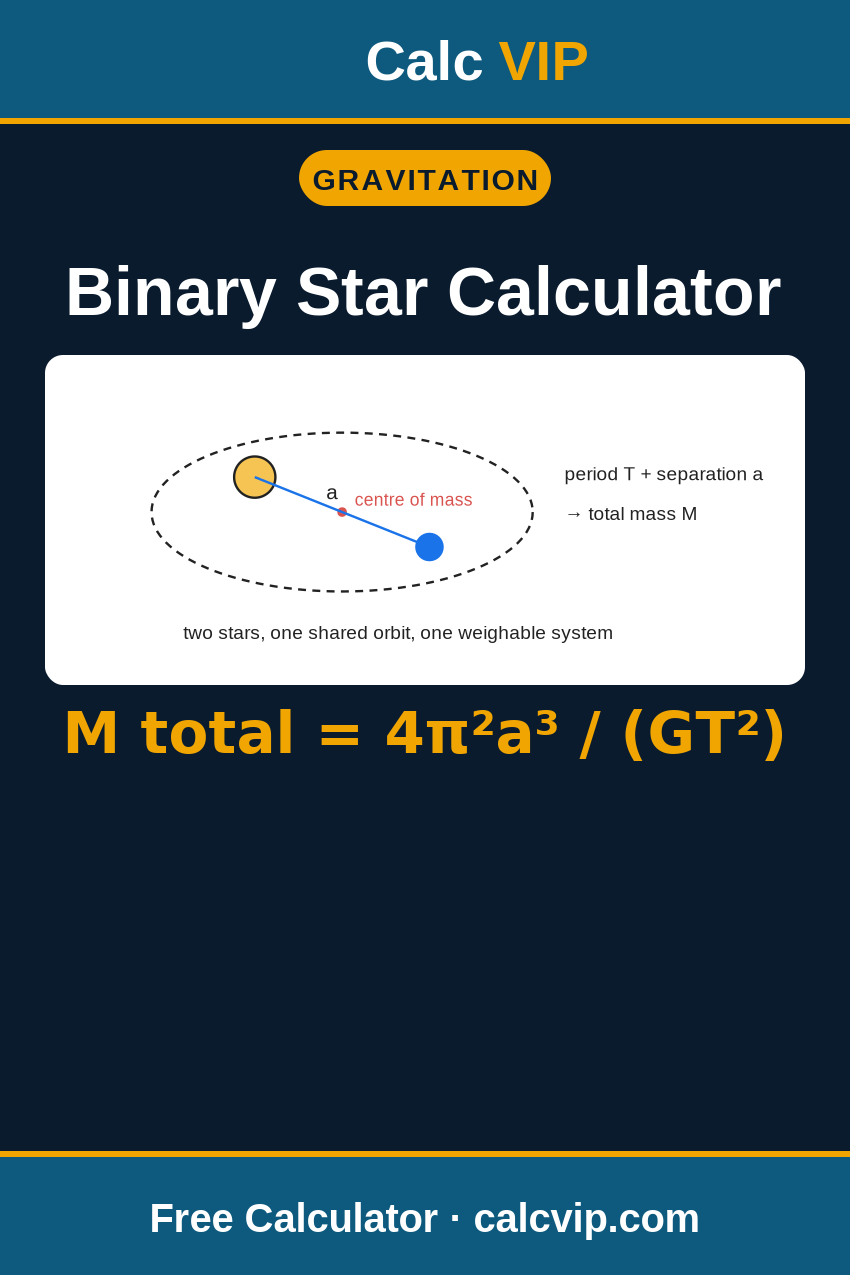
Stars cannot be placed on scales, yet their masses are among the most important numbers in astronomy: mass decides how a star lives, how brightly it burns, and how it dies. Binary stars are the loophole. When two stars orbit each other, gravity itself does the weighing — the period and separation of the dance are set by the total mass driving it, through Kepler's third law in its full two-body form, Mtotal = 4π²a³/(GT²). Measure the clock and the size of the orbit, and the mass falls out. This calculator performs that weighing for any binary system, in whatever units the observations arrive: AU and years, kilometres and days, even metres and hours.
More than half of all Sun-like stars have companions, and binaries have been astronomers' laboratory since William Herschel proved in 1803 that paired stars genuinely orbit rather than merely align. The method's power is its purity: it assumes nothing about what stars are made of, how they shine, or how far away they are (beyond what is needed to convert an apparent separation into a true one). Timing plus geometry plus Newton. Every other way of estimating a star's mass — from its brightness, its spectrum, its pulsations — is ultimately calibrated against binary measurements like the one on this page.
There is a gift hidden in the units. If the separation is measured in AU and the period in years, then G and the conversion factors collapse into the Earth–Sun calibration itself, and the total mass emerges directly in solar masses as M = a³/T². A binary with a = 20 AU and T = 50 years weighs 20³/50² = 3.2 Suns, computed in your head. The calculator below does the full SI calculation honestly, but the shortcut is worth learning: it is the fastest sanity check in stellar astronomy.
Formula
Kepler's third law for a binary system: Mtotal = 4π²a³ / (GT²), with G = 6.674 × 10⁻¹¹ N·m²/kg², the separation a in metres and the period T in seconds. Note that a is the semi-major axis of the relative orbit — the full separation between the two stars — and the mass that emerges is the sum M₁ + M₂. Handy shortcut: if a is in AU and T is in years, the total mass comes out directly in solar masses: M = a³/T². The law also rearranges for the separation from a known mass and period, a = (GMT²/4π²)1/3, which is how the calculator's cousins on this site handle satellites.
| Symbol | Meaning | Units |
|---|---|---|
| Mtotal | combined mass of both stars, M₁ + M₂ | kg; solar masses for display |
| a | separation (semi-major axis of the relative orbit) | m; AU or km in the tool |
| T | orbital period of the pair | s; years, days or hours in the tool |
| G | universal gravitational constant, 6.674 × 10⁻¹¹ | N·m²/kg² |
| M☉ | one solar mass, 1.989 × 10³⁰ kg | kg |
From the total to the individuals: the wobble split
A total mass is a fine start, but astronomy wants each star's own mass. The key is the centre of mass: both stars orbit it, on opposite sides, with orbit sizes inversely proportional to their masses — the heavier star hugs the centre, the lighter one swings wide, like a figure skater pair holding hands with unequal arms. If telescopes can measure each star's individual orbit (visually, for wide pairs, or through the Doppler wobble of their spectral lines for close ones), the ratio of the orbit sizes is the inverse ratio of the masses, and combined with this page's total the two masses separate cleanly. That two-step — total from Kepler, split from the wobble — produced essentially every trustworthy stellar mass in the catalogues, and the same logic now weighs exoplanet systems and the black hole at the galactic centre.
There is a catch for the fashionable case: spectroscopic binaries seen at unknown tilt. Doppler shifts reveal only the component of motion toward us, so a tilted orbit masquerades as a lighter system; the result is a firm minimum mass, M sin³i, until eclipses or astrometry pin the inclination down. The calculator's answer is exact for the true a and T — the art lies in recovering those from a tilted, distant, slow-motion dance.
How to use
- Enter the separation between the two stars and choose its unit — AU for typical star systems, km or m for close pairs and moons.
- Enter the orbital period and choose its unit (years, days or hours).
- Click "Calculate Total Mass" to get the combined mass in kilograms and in solar masses (1 solar mass = 1.989 × 10³⁰ kg).
- Cross-check with the shortcut when your inputs are in AU and years: the answer in solar masses should equal a³/T².
- Remember the result is the pair's sum; splitting it needs the wobble ratio described above.
Worked examples
Example 1 — the calibration case. Two stars separated by a = 1 AU with a period of T = 1 year — the Earth–Sun arrangement.
M = 4π²a³/(GT²) ≈ 1.989 × 10³⁰ kg = 1.00 solar mass. This is exactly how the Sun's mass was first measured — from Earth's orbit — and it anchors the solar-mass unit itself.
Example 2 — Sirius, the Dog Star. The Sirius pair: a ≈ 20 AU, T ≈ 50.1 years.
Shortcut: M = 20³/50.1² = 8,000/2,510 ≈ 3.19 solar masses (the full SI calculation agrees: ≈ 6.34 × 10³⁰ kg). With the precisely fitted orbit (a ≈ 19.8 AU) the same method gives ≈ 3.09 solar masses, which the wobble split divides into Sirius A ≈ 2.06 and its white-dwarf companion ≈ 1.02 — the total from this page's method is the anchor both hang from.
Example 3 — Alpha Centauri. Our nearest stellar neighbours: a ≈ 23 AU, T ≈ 79.9 years.
M = 23³/79.9² = 12,167/6,384 ≈ 1.91 solar masses for the A+B pair from these rounded figures (the precisely fitted orbit, a ≈ 23.4 AU, gives ≈ 2.0) — two roughly Sun-like stars, matching their measured individual masses of about 1.1 and 0.9 Suns.
Example 4 — a close spectroscopic binary. a = 0.1 AU, T = 10 days.
In AU and years: T = 0.0274 yr, so M = 0.001/0.00075 ≈ 1.33 solar masses. Close pairs like this are weighed from Doppler wobbles alone, often before any telescope can separate the two stars visually.
Example 5 — the Earth–Moon system as a "binary". a = 384,400 km, T = 27.32 days.
M ≈ 6.03 × 10²⁴ kg — and the true Earth + Moon total is 5.972 × 10²⁴ + 0.073 × 10²⁴ = 6.05 × 10²⁴ kg. The method recovers the sum to within the rounding of the inputs, a neat proof it works at every scale.
Example 6 — Pluto and Charon. a = 19,596 km, T = 6.387 days.
M ≈ 1.46 × 10²² kg, matching the accepted system mass. Charon is so massive relative to Pluto (about an eighth) that their centre of mass lies outside Pluto itself — the pair is the solar system's truest double world, and this formula is how we know.
Binary stars in real life
The mass–luminosity relation. Binary measurements revealed that a star's brightness scales steeply with mass (roughly L ∝ M³·⁵) — the master key that lets astronomers estimate any single star's mass from its light, all calibrated on pairs weighed by this page's method.
Standard candles and distances. Eclipsing binaries give radii as well as masses; combined with temperatures, they yield luminosities and hence distances accurate enough to measure nearby galaxies — a rung of the cosmic distance ladder built from Kepler's law.
Type Ia supernovae. These cosmic explosions — the standard candles that revealed dark energy — are white dwarfs in binary systems pushed over a mass limit. Knowing the limit matters (about 1.44 solar masses) starts with binary mass measurements of exactly this kind.
Exoplanet masses. A planet makes its star wobble; the wobble's period and size, run through the same two-body law, return the star's mass and then the planet's. Most of the thousands of known exoplanets owe their masses to this formula.
The galactic centre. Stars orbiting the Milky Way's central black hole are "binaries" with an invisible partner; their periods and separations give the black hole's mass — about 4.3 million Suns — the same calculation as Example 1 with a far heavier answer.
Gravitational-wave sources. The black-hole and neutron-star binaries LIGO hears are weighed by their orbital dance before merger: period shrinking, separation shrinking, masses read off from Kepler's law extended into relativity.
How the separation is actually measured
The calculator wants the true semi-major axis, but telescopes deliver an angle on the sky. Converting requires the system's distance: separation in AU = angular separation in arcseconds × distance in parsecs — a gift of the parsec's definition. This is why binary-star masses improved dramatically with the Gaia satellite's precision distances: the periods were always easy (watch and wait), but every mass inherited the distance's uncertainty, cubed. A 5% distance error becomes a 16% mass error, because a enters as a³. When you read that a binary's mass is known to 1%, you are reading a triumph of distance measurement as much as of timing.
Eclipsing binaries: when geometry cooperates
The gold standard of the method is the eclipsing binary, where the orbit happens to lie edge-on to our view. Then everything falls out at once: the period from the eclipse rhythm, the relative orbit size from eclipse durations and Doppler shifts, the tilt (90°, by construction), and — uniquely — the stars' actual radii, from how long the eclipses last. Algol, the "Demon Star" in Perseus, is the type specimen: period 2.867 days, separation about 0.062 AU, and the shortcut gives M = 0.062³/0.00785² ≈ 3.87 solar masses for the pair — matching the modern values (about 3.17 + 0.70) for its hot primary and the companion that periodically blots it out. Thousands of eclipsing systems from the Kepler and TESS surveys now deliver masses and radii good to 1–2%, and they anchor the stellar models that single stars are judged against. When astronomers say a star's mass is "known", more often than not an eclipsing pair measured it.
There is a modern coda. The same wobble-and-period machinery, pushed to extreme precision by the Gaia satellite's astrometry, now weighs binaries whose periods run to decades and whose separations span the width of the solar system — and it has begun finding the dark companions: dormant black holes orbiting ordinary stars, betrayed solely by the visible star's stately, period-perfect waltz around nothing. The heaviest such find, Gaia BH3, pairs an ancient, metal-poor giant star with a black hole of about 33 solar masses. Kepler's third law, applied to a dance with an invisible partner, remains the only scale that can weigh darkness itself.
Quick reference: famous systems weighed
| System | Separation a | Period T | Total mass |
|---|---|---|---|
| Sun–Earth (calibration) | 1 AU | 1 yr | 1.00 M☉ |
| Close binary (typical) | 0.1 AU | 10 days | 1.33 M☉ |
| Alpha Centauri A+B | 23 AU | 79.9 yr | 1.91 M☉ |
| Sirius A+B | 20 AU | 50.1 yr | 3.19 M☉ |
| Earth–Moon | 384,400 km | 27.32 days | 6.03 × 10²⁴ kg |
| Pluto–Charon | 19,596 km | 6.387 days | 1.46 × 10²² kg |
From dwarf planets to the Dog Star, one formula weighs them all — the entries differ only in the units the observations happened to arrive in.
A historical weigh-in: 61 Cygni
The first star whose distance was ever measured — 61 Cygni, Bessel's 1838 parallax triumph — is also a binary, and it shows the method's patience. Its two orange dwarfs circle each other with a period of about 659 years at a separation near 84 AU. The shortcut returns M = 84³/659² ≈ 1.36 solar masses for the pair, matching modern values for the two K-type dwarfs. No astronomer has watched even a third of one orbit; the mass rests on an arc of the ellipse, the fitted period, and the distance Bessel pioneered. It is a fitting emblem for the whole subject: binary-star masses are astronomy's slowest measurements and its most trustworthy ones.
The Algol paradox: when the lighter star looks older
Binary masses once produced a genuine paradox. In Algol, the less massive star (0.70 M☉) is a swollen subgiant — apparently far more evolved — while its heavier partner (3.17 M☉) still sits placidly on the main sequence, defying the rule that massive stars age faster. The resolution, found once the masses from this page's method were trusted, is mass transfer: the subgiant was originally the heavier star, lived fast, swelled up, and poured much of itself onto its companion, swapping their rankings. The "paradox" was in fact the first hard evidence that close binaries trade mass — a process now known to shape supernovae, X-ray binaries and the chemical enrichment of galaxies.
Common mistakes
- Reading the answer as one star's mass. The formula returns the sum M₁ + M₂. Quoting it as the primary's mass overstates it — by a factor of two for equal twins, the most common visual-binary configuration.
- Using the projected separation as a. The sky shows a foreshortened snapshot of the orbit. True semi-major axes come from fitting the full apparent ellipse over time, not from one night's measured gap between the stars.
- Forgetting the distance enters cubed. a in physical units needs the distance to the system, and the mass scales with distance³. A small parallax error inflates into a large mass error — the dominant uncertainty in most published values.
- Mixing the shortcut's units. M = a³/T² in solar masses works only with a in AU and T in years. Days or kilometres in the shortcut silently wreck it; use the calculator's unit selectors instead.
- Treating a spectroscopic minimum as the mass. Doppler-only systems yield M sin³i — a floor, not a figure — until the orbital tilt is known. Many "planet" candidates have been reclassified when the tilt turned out unfavourable.
FAQ
Can this give each star's individual mass?
Not from the period and separation alone — that gives the total. If you also measure how much each star wobbles around the centre of mass, the total can be split between them.
Why do astronomers trust this method?
It rests only on gravity and timing, which can be measured very precisely. It is the most direct way to weigh stars, and it anchors almost all other stellar mass estimates.
Does it work for exoplanets?
Yes — for a planet the combined mass is essentially the star's mass, since the planet adds so little. The same law gives stellar masses from exoplanet orbits.
Why does the answer come out in solar masses so often?
Because the AU–year shortcut makes the Sun the natural unit, and because stellar masses span a modest range — about 0.08 to over 100 M☉ — that the unit fits comfortably. Kilograms remain available in the result for the purists.
What is the most massive binary known?
The R136a1 system in the Tarantula Nebula involves stars above 200 solar masses, though at such extremes the stars' own winds complicate the weighing. Among clean, well-measured pairs, totals of several tens of solar masses are routine.
Can this weigh a triple star system?
Step by step, yes: a close pair is weighed as a unit, then the wide third star's orbit around the pair's centre of mass gives the grand total. Hierarchical triples — a pair with a distant companion — are common, and Kepler's law handles each level separately.
How long must astronomers watch a wide binary?
A full period is ideal — centuries for the widest pairs. In practice, an arc of the orbit plus the laws of Keplerian motion constrains the full ellipse and period, so masses emerge from decades of patient astrometry, increasingly from Gaia's survey data.
Does the formula work for a star with a planet?
Yes — it returns star + planet, and since even a Jupiter is a thousandth of its star, the answer is effectively the star's mass. The planet's own mass comes from the star's wobble amplitude, a related but separate measurement.
What if the orbit is highly elliptical?
Use the semi-major axis of the relative orbit — the same a as for a circle with that period. Eccentricity changes the dance's shape, not the period–separation–mass triangle.
Why do some binaries give masses that disagree with the stars' brightness?
Usually an unrecognised third star adding mass and light, or a wrong distance. Such disagreements are scientifically precious: they flag hidden companions and bad parallaxes, and have led to the discovery of many triple systems.