 Calc
Escape Velocity from Density Calculator – v = R√(8πGρ/3)
 Created by Priya Sharma · Physics Editor · Energy & Gravity · Last updated: November 2026
Use this free Escape Velocity from Density Calculator to find the escape velocity of a planet, moon or asteroid when you know its size and what it is made of. Enter the body's radius and its average density, and the calculator combines them into the escape speed — no mass needed.
Escape velocity is usually computed from a body's mass and radius — two numbers you cannot measure for a world you have only seen through a telescope. Density and radius are another matter: a planet's radius comes from its silhouette, and its average density can be teased from orbits, transits and the wobble of its star. Put the two together and a small miracle of cancellation occurs: the escape velocity of a uniform sphere depends only on its radius and its density, v = R√(8πGρ/3). This calculator runs that formula — and reports the implied mass as a cross-check — so you can ask how hard it is to leave any world whose size and density are known, from the Moon to a neutron star.
The formula rewards a second look, because its message is counterintuitive: at fixed density, escape velocity grows in simple proportion to radius. Double a world's radius (keeping its composition) and you double the speed needed to leave it — while its mass grows eightfold. This is why the rocky planets form a ladder: the Moon (small, moderately dense) lets you go at 2.38 km/s; Mars, bigger, demands 5.03 km/s; Earth, biggest of the rocky worlds and the densest body in the solar system, demands 11.19 km/s. Composition matters through the square root of density — an iron world of Earth's size would hold on far tighter — but size is the senior partner in the partnership.
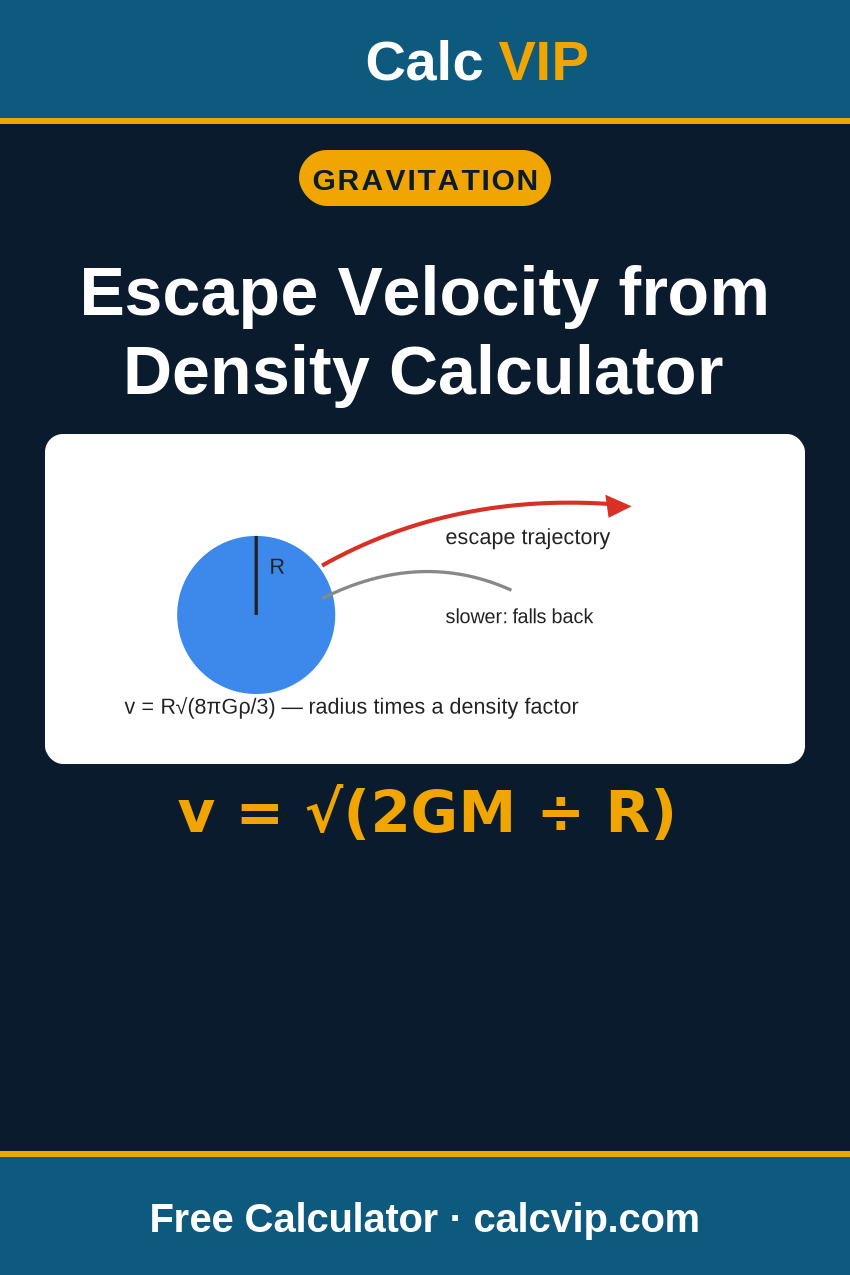
It is worth being precise about what "escape" means, because the word misleads. Escape velocity is the speed at which a ballistic object — one given a single push and never powered again — coasts to infinity, slowing forever but never quite stopping. A rocket is not ballistic: it can leave Earth at walking speed, in principle, if it can thrust long enough. What the escape velocity really measures is the depth of a world's gravity well expressed as a speed — the entry fee for the cheapest possible departure, one impulsive kick. Every mission ever flown has budgeted against this number or its orbital sibling — the surface orbital speed, which is simply the escape speed divided by √2 — and every world in the table below is characterised by it.
Formula
Start from the standard result, v = √(2GM ÷ R), and replace the mass with the uniform-sphere value M = (4/3)πR³ρ. The radius inside the square root cancels one power of R outside it:
v = R × √(8πGρ ÷ 3) • v in m/s, R in metres, ρ in kg/m³, G = 6.674 × 10⁻¹¹
The square-root factor depends only on density: √(8πG/3) = 2.3646 × 10⁻⁵ (in SI units), so v = 2.3646 × 10⁻⁵ × R × √ρ. Rearranged, the formula weighs worlds from departure data: ρ = 3v² ÷ (8πGR²) recovers a body's mean density from its escape velocity and radius — one of the few handles astronomy has on the interiors of exoplanets. The calculator also reports the implied mass M = (4/3)πR³ρ, letting you check the density route against the familiar mass route: both must agree, because they are the same physics wearing different measurements.
| Symbol | Meaning | Units |
|---|---|---|
| v | escape velocity at the surface | m/s (reported also in km/s) |
| R | radius of the body | km (entered), m (in the formula) |
| ρ | mean (average) density of the whole body | kg/m³ |
| G | gravitational constant | 6.674 × 10⁻¹¹ N·m²/kg² |
Why density is the astronomer's favourite shortcut
A planet's mass is genuinely hard to earn. For Earth it took Cavendish's torsion balance in 1798 — an experiment so delicate it was described as "weighing the world". For exoplanets, mass comes only from the star's reflex wobble or from planet-planet tugs, and for small rocky worlds it often carries 20–30 percent uncertainty. Density, though, is where the science is: combined with radius it sorts worlds into families — iron-rich Mercury clones (ρ ≈ 5,400), Earth-like rock-and-iron mixes (≈ 5,500 for Earth itself, an outlier thanks to its large iron core and self-compression), water worlds (≈ 2,000–3,000), and puffy gas dwarfs (below 1,000). The escape velocity then converts that interior story into a surface consequence: whether the world can hold an atmosphere, how expensive its spaceflight is, and whether its volcanoes throw their ejecta into orbit or merely into the sky.
The uniform-density assumption deserves its footnote. Real planets are differentiated — dense cores, lighter mantles — so the formula's "ρ" is the mean density, total mass over total volume, which is exactly the quantity the derivation needs. The escape velocity depends on the total mass and the radius alone; how the mass is arranged inside does not matter at all (a consequence of Newton's shell theorem). So the formula is not an approximation for real planets in the way one might fear: feed it the true mean density and true radius, and the answer is the true escape velocity, core, mantle, oceans and all.
How to use
- Enter the body's radius in kilometres (Earth 6,371; Moon 1,737; Mars 3,390; Jupiter 69,911).
- Enter its mean density in kg/m³ (Earth 5,514; Moon 3,344; Mars 3,933; Jupiter 1,326; water-rich worlds 1,000–3,000; neutron stars ~1017).
- Click "Calculate Escape Velocity" to see the escape speed in m/s and km/s, plus the implied total mass.
- Cross-check the implied mass against a known value where you have one — agreement confirms the density and radius are consistent.
- Experiment: hold the density fixed and double the radius, and watch the escape velocity double while the mass grows eightfold.
Worked examples
Example 1 — Earth, the calibration world. R = 6,371 km, ρ = 5,514 kg/m³.
v = 6.371 × 10⁶ × 2.3646 × 10−5 × √5,514 = 11,186 m/s ≈ 11.19 km/s — the famous figure, recovered from radius and density alone. Implied mass: (4/3)πR³ρ = 5.973 × 10²⁴ kg, matching Earth's measured mass and closing the consistency loop.
Example 2 — the Moon. R = 1,737 km, ρ = 3,344 kg/m³.
v = 2,375 m/s ≈ 2.38 km/s; implied mass 7.341 × 10²² kg. The Apollo ascent stage needed only this modest speed (plus a little for orbit) to leave — one reason the lunar module could be so light, and why the Moon keeps no atmosphere: gas molecules at lunar daytime temperatures move at a fair fraction of 2.38 km/s, and over geological time the fast tail of them simply left.
Example 3 — Mars. R = 3,390 km, ρ = 3,933 kg/m³.
v = 5,027 m/s ≈ 5.03 km/s; implied mass 6.418 × 10²³ kg. Mars ascent vehicles are designed against almost exactly this number — the MAV that will lift the first samples off Mars is a two-stage rocket built around a 5 km/s gravity well, mercifully shallower than Earth's.
Example 4 — Jupiter, the deep well. R = 69,911 km, ρ = 1,326 kg/m³.
v = 60,196 m/s ≈ 60.20 km/s; implied mass 1.898 × 10²⁷ kg. Despite a density lower than the Sun's, Jupiter's enormous radius makes its well the deepest of any planet — which is why it has kept even hydrogen, the escape artist of gases, for 4.5 billion years.
Example 5 — a neutron star. R = 10 km, ρ = 1 × 10¹⁷ kg/m³.
v = 74,774,308 m/s ≈ 74,774 km/s — about 0.25c, a quarter of light-speed; implied mass 4.189 × 10²⁹ kg (a respectable fraction of the Sun, in a city-sized ball). At such speeds relativity begins to correct the Newtonian formula, but the message survives: leaving a neutron star is a relativistic project.
Example 6 — a rubble asteroid. R = 10 km, ρ = 3,000 kg/m³.
v = 13 m/s — a brisk cycling speed. An astronaut who jumped carelessly on such a body (a jump launches you at perhaps 3–5 m/s, but a thrown tool or a clumsy push-off from a springy surface could approach it) risks becoming an independent satellite of the Sun. Sample-return missions to small asteroids plan their hops against numbers exactly like this one.
Escape velocity in real life
Atmospheric retention. A world keeps a gas for geological time only if its escape velocity exceeds roughly six times the gas molecules' typical thermal speed. This single comparison explains the Moon's vacuum, Mars's thin remnant air, Earth's nitrogen-oxygen blanket and Jupiter's hydrogen ocean — planetary atmospheres sorted by one inequality.
Mission design. Every launch vehicle's budget is built from the destination's and origin's escape and orbital velocities. The density route on this page is how those budgets are first sketched for newly discovered worlds, before any probe has weighed them precisely.
Exoplanet triage. With thousands of exoplanets catalogued by radius and (sometimes) density, v = R√(8πGρ/3) is computed for whole populations at once, flagging which rocky worlds could plausibly hold atmospheres worth a telescope's precious hours.
Meteor impacts. Ejecta thrown faster than escape velocity leaves a world forever — which is how Martian meteorites reach Earth: an impact on Mars exceeded 5.03 km/s for a few lucky rocks, and after an interplanetary drift they fell here, carrying Mars in their chemistry.
Comet and asteroid mining. On small bodies the escape velocity is metres per second, so excavated material must be bagged, not piled — a loose shovelful on a 10-km asteroid is a departing spacecraft. Mining architectures are designed around this page's small-number regime.
Teaching the gravity well. The "depth of the well" metaphor becomes quantitative here: escape velocity squared is proportional to the energy per kilogram needed to climb out, which is why mission planners speak of wells, budgets and the tyranny of the rocket equation in one breath.
Escape velocity versus orbital velocity: the √2 that runs spaceflight
At any distance from a body's centre, escape velocity is exactly √2 (about 1.414) times the circular-orbit velocity at that distance. At Earth's surface the pair is 11.19 and 7.91 km/s; at the Moon's, 2.38 and 1.68 km/s. The factor is not a coincidence but a piece of energy bookkeeping: orbiting means keeping half the kinetic energy that escaping requires, because the escaping object must still have zero speed left at infinity while the orbiting one is allowed to keep moving forever. Practical consequence: a spacecraft already in low Earth orbit has paid the larger half of the energy bill — it needs only about 41 percent more speed (3.3 km/s of the 11.2 total picture, in the usual accounting) to escape entirely. This is why departure stages are small compared with the launchers that lifted them to orbit, and why "getting to orbit is halfway to anywhere" is a theorem, not a slogan.
Stars obey the same formula
Nothing in the derivation cared that the sphere was a planet. The Sun (R = 696,000 km, mean density 1,408 kg/m³) has an escape velocity of 617,537 m/s ≈ 617.5 km/s — the speed its fastest coronal-mass-ejection material must exceed to leave the solar system entirely, and the reason most of the solar wind, travelling slower, still escapes only because it is continuously pushed rather than ballistic. A white dwarf such as Sirius B (R ≈ 5,800 km, mean density ≈ 2.7 × 10⁹ kg/m³) demands 7,126,270 m/s ≈ 7,126 km/s, over two percent of light-speed, from a body the size of the Earth holding the mass of a star. Run the ladder from the asteroid of Example 6 (13 m/s) through the planets to the white dwarf and the neutron star beyond it, and a single formula with two inputs has spanned nine orders of magnitude of escape — as clean a demonstration as physics offers that a good equation is a measuring instrument, not just a summary.
Quick reference: escape velocities of known worlds
| Body | Radius (km) | Mean density (kg/m³) | Escape velocity |
|---|---|---|---|
| Moon | 1,737 | 3,344 | 2.38 km/s |
| Mars | 3,390 | 3,933 | 5.03 km/s |
| Earth | 6,371 | 5,514 | 11.19 km/s |
| Jupiter | 69,911 | 1,326 | 60.20 km/s |
| Neutron star | 10 | 1 × 10¹⁷ | 74,774 km/s |
Every row is reproducible in the calculator above — and the implied-mass line should return each world's textbook mass, which is the formula auditing itself.
Common mistakes
- Entering the diameter instead of the radius. The formula wants R; doubling it doubles the answer. Astronomical sources quote diameters almost as often as radii — check which one you copied.
- Using a surface material's density instead of the mean density. Earth's crust is ~2,700 kg/m³, but its mean density is 5,514 — the iron core counts. Escape velocity answers to the whole body, not to its topsoil.
- Believing rockets must reach escape velocity. They must not, and low-orbit rockets never do (7.9 km/s, not 11.2). Escape velocity is the ballistic benchmark; powered flight can leave at any speed it can sustain.
- Thinking direction matters. Escape speed is a speed, not a velocity: any direction that does not intersect the body works. (Straight up is the worst choice in practice only because of the atmosphere, not the physics.)
- Applying the surface value at altitude. Escape velocity falls with distance from the centre — at twice Earth's radius it is 11.19 ÷ √2 ≈ 7.91 km/s. Use the radius at the point of departure, not the surface, for high-altitude calculations.
FAQ
Why does density appear instead of mass?
Because mass itself comes from density × volume. Combining the two formulas shows that escape velocity depends only on radius and density — a neat result that lets you estimate escape speeds for asteroids and exoplanets whose mass you cannot measure directly.
Does a bigger planet always have a higher escape velocity?
Only if the density is similar. A large but fluffy body can have a lower escape velocity than a smaller, denser one — Saturn is huge but its escape velocity (35.5 km/s) is far below what its size alone might suggest, because its density is only 687 kg/m³.
What density should I use for a comet or asteroid?
Comets are porous ice-and-rock mixtures, roughly 400–600 kg/m³; stony asteroids are around 2000–3500 kg/m³ and metallic ones up to about 7000 kg/m³. Even a 10 km rocky asteroid then has an escape velocity of only a few m/s — you could almost jump into orbit.
Why does escape velocity not depend on the escaping object's mass?
The object's mass appears on both sides of the energy equation — its kinetic energy and its gravitational potential energy both scale with m — and cancels. A flea and a freight train need the same 11.19 km/s from Earth; the train merely needs a vastly larger push to get there.
What is Earth's escape velocity in everyday units?
11.19 km/s is about 40,300 km/h, or Mach 33 in sea-level terms — roughly thirty times faster than a rifle bullet. No single-stage chemical rocket reaches it from the ground, which is why staging exists.
Can a world be too dense to leave?
In the limit, yes: shrink a mass enough and its escape velocity reaches c — that boundary (the Schwarzschild radius) defines a black hole. The neutron star of Example 5, at 0.25c, is nature's closest approach to that limit without crossing it.
How was Earth's density first measured?
By the Schiehallion experiment (1774), which measured a mountain's sideways pull on a plumb line, and then precisely by Cavendish (1798), whose torsion balance yielded G and hence Earth's mean density of about 5.5 times water — astonishingly close to the modern 5,514 kg/m³.
Does rotation help a launch escape?
Slightly, at the equator: Earth's spin contributes up to 0.465 km/s of eastward speed — about 4 percent of escape velocity, and a real saving that is one reason spaceports favour low latitudes. The calculator's figure is the non-rotating benchmark.
Why is Jupiter's escape velocity so high if it is mostly gas?
Because v scales with R × √ρ: Jupiter's radius is eleven times Earth's, and that factor of eleven overwhelms its four-times-lower density (which enters only as √ρ ≈ 0.49). Size beats composition — the formula's central lesson, in its largest example.
What density would a body need for an escape velocity of exactly c?
From ρ = 3c² ÷ (8πGR²), it depends on size: for R = 10 km, about 1.6 × 10¹⁸ kg/m³ — beyond even neutron-star densities, which is why 10-km black holes do not form from ordinary stellar collapse at that radius without far more mass compressed further.