 Calc
Gravitational Force Calculator – Newton's Law of Gravitation
 Created by Priya Sharma · Physics Editor · Energy & Gravity · Last updated: November 2026
Use this free Gravitational Force Calculator to find the attraction between two masses with Newton's law of universal gravitation, F = Gm₁m₂/r², using G = 6.674 × 10⁻¹¹ N·m²/kg². You can type big masses in scientific notation, e.g. 5.972e24.
In 1687 Newton proposed something audacious: the force that drops an apple is the same force that holds the Moon, and it acts between every pair of masses in the universe — you and the Earth, the Earth and the Sun, two specks of dust in deep space. The law that prices that attraction, F = Gm₁m₂/r², fits on one line, yet it schedules the tides, aims interplanetary probes and weighs galaxies. This calculator evaluates it for any two masses you care to name.
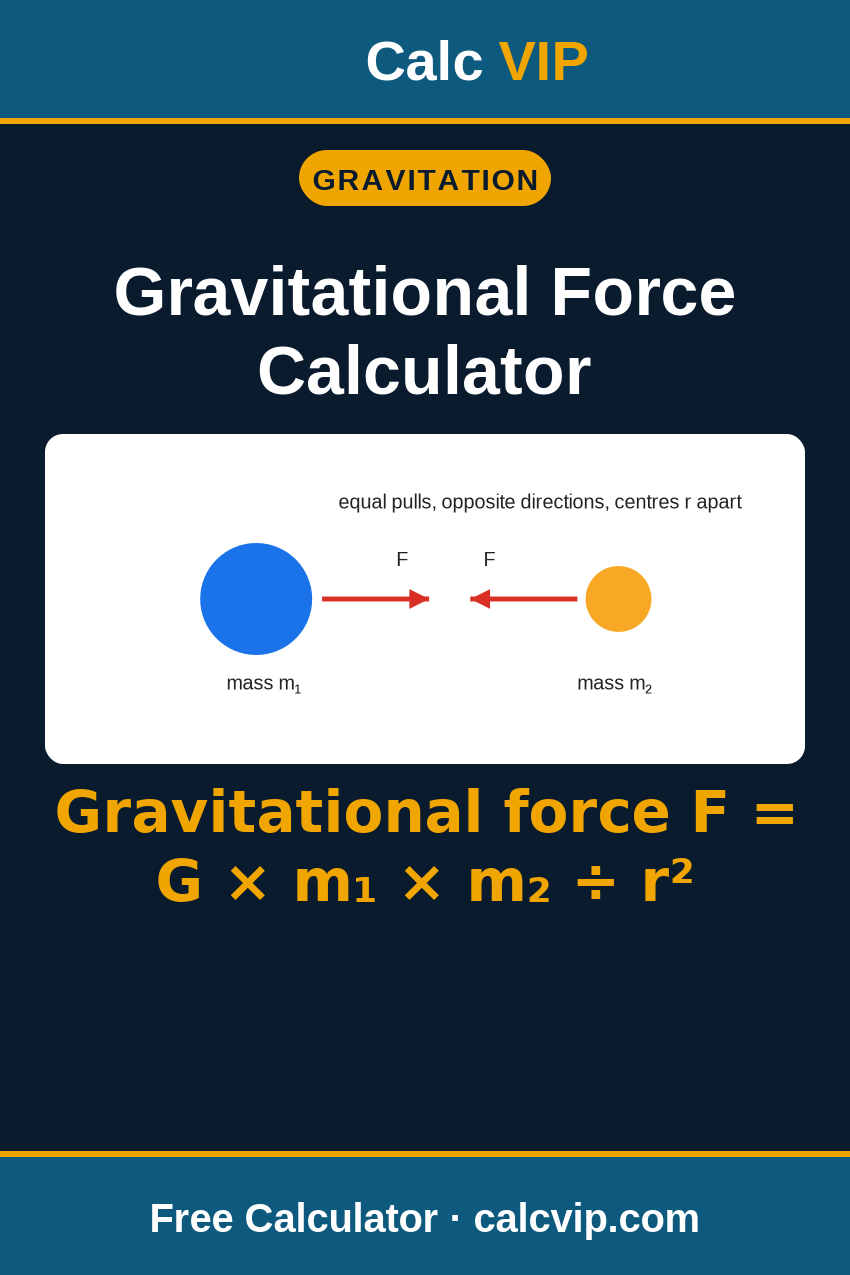
Read the formula as a story in three parts. The numerator, m₁m₂, says the pull grows with both masses multiplied together — double either one and the force doubles; double both and it quadruples. The denominator, r², says distance fights back hard: because the separation is squared, doubling it quarters the force (an inverse-square law, the geometry of anything spreading out over the surface of an expanding sphere). And G, the tiny constant 6.674 × 10⁻¹¹, sets the overall scale — tiny, because gravity is by far the weakest of nature's forces, a fact your own body confirms: you cannot feel the pull of the building you are sitting in, though the building outweighs you a thousand-fold.
One subtlety deserves attention before you calculate: the law treats each mass as if all of it were concentrated at its centre. That is why r for a person standing on Earth is not zero — it is Earth's whole radius, 6,371 km, measured from centre to centre. Newton reportedly delayed publishing for years until he could prove this "shell theorem" for spheres. It is also why the formula keeps working for planets, stars and moons: as long as they are roughly spherical and you stay outside them, the centre-to-centre distance is all you need.
Formula
Gravitational force F = G × m₁ × m₂ ÷ r² • F in newtons (N), masses in kilograms (kg), r in metres (m), G = 6.674 × 10⁻¹¹ N·m²/kg²
The equation rearranges for any one unknown: m₂ = F × r² ÷ (G × m₁) (weighing a planet from the force it exerts), r = √(G × m₁ × m₂ ÷ F) (finding the distance from a measured pull), and the all-important special case of the acceleration a planet produces at its surface, g = G × M ÷ r², which turns this force law into the familiar weight formula W = m × g. Practical habits: masses in astronomy demand scientific notation (Earth is 5.972e24 kg — the calculator accepts that form), and r is always centre-to-centre, so for surface problems it is the planet's radius, and for orbit problems it is the radius plus the altitude.
| Symbol | Meaning | Units |
|---|---|---|
| F | gravitational attraction (acts on both masses equally) | newtons (N) |
| G | universal gravitational constant | 6.674 × 10⁻¹¹ N·m²/kg² |
| m₁, m₂ | the two masses | kilograms (kg) |
| r | distance between their centres | metres (m) |
Why inverse-square? The geometry of spreading
The r² in the denominator is not an arbitrary fit; it is the shape of three-dimensional space. Imagine a mass broadcasting its influence equally in all directions, like light from a bulb. At distance r that influence is spread over a sphere of area 4πr² — and a sphere's area grows with the square of its radius. Double the distance and the same influence covers four times the area, so each square metre of it — each test mass sitting there — receives a quarter. Light does it (a bulb four times further is sixteen times dimmer... at double the distance, four times dimmer), sound does it, and gravity, propagating outward in the same three dimensions, cannot do otherwise. Any force that reaches out isotropically in 3D space is an inverse-square force; the exponent 2 is geometry, not choice.
The numerator's product, m₁ × m₂, has its own quiet logic. Every atom of m₁ pulls on every atom of m₂, and the total is the sum over all pairs — so the force must be proportional to how many atoms each body brings to the exchange, which is to say, to both masses at once. This pairwise fairness is also why the force is perfectly mutual: m₁ pulls m₂ exactly as hard as m₂ pulls m₁ (Newton's third law), even when one is a planet and the other a pebble. The planet barely notices; the pebble's motion is transformed. Same force, wildly different accelerations — because acceleration divides the force by the mass receiving it.
How to use
- Enter the first mass m₁ in kilograms — scientific notation is welcome for astronomical masses (Earth: 5.972e24).
- Enter the second mass m₂ in kilograms (a person: 70; the Moon: 7.348e22).
- Enter r, the distance between their centres, in metres — for a surface problem that is the planet's radius; for an orbit, radius plus altitude.
- Click "Calculate Force" to get the attraction in newtons. Remember it acts equally on both bodies, pulling them towards each other.
Worked examples
Example 1 — your own weight. The pull between the Earth (m₁ = 5.972 × 10²⁴ kg) and a 70 kg person standing on its surface (r = 6.371 × 10⁶ m, Earth's radius):
F = 6.674 × 10⁻¹¹ × 5.972 × 10²⁴ × 70 / (6.371 × 10⁶)² ≈ 687 N
That is exactly the person's weight — gravity is what a weighing scale measures.
Example 2 — the force between two people. Two 70 kg people standing 1 m apart (centre to centre, roughly):
F = 6.674 × 10⁻¹¹ × 70 × 70 ÷ 1² = 3.27 × 10⁻⁷ N — about a third of a millionth of a newton. It is roughly the weight of one fine grain of sand. Gravity between human-sized objects is real but hopeless to feel, which is why Cavendish needed a exquisitely suspended mirror to detect it between laboratory masses.
Example 3 — the force that steers the Moon. Earth (5.972 × 10²⁴ kg) and Moon (7.348 × 10²² kg), centres 3.844 × 10⁸ m apart:
F = 6.674 × 10⁻¹¹ × 5.972 × 10²⁴ × 7.348 × 10²² ÷ (3.844 × 10⁸)² ≈ 1.98 × 10²⁰ N. This single pull, applied continuously, is what bends the Moon's path into its monthly orbit — and, applied by the Moon to Earth's oceans, raises the tides.
Example 4 — doubling the distance quarters the force. Lift the 70 kg person of Example 1 to an altitude of one Earth radius, so r doubles to 1.2742 × 10⁷ m:
F = 687 ÷ 4 ≈ 171.8 N. No new calculation is really needed — the inverse-square law guarantees the quartering — but running the numbers confirms it, and it is the reason "weightlessness" cannot be bought merely by going a few hundred kilometres up (see the FAQ).
Example 5 — gravity in the laboratory. Two 1 kg masses with centres just 0.1 m apart:
F = 6.674 × 10⁻¹¹ × 1 × 1 ÷ 0.1² = 6.67 × 10⁻⁹ N. Billions of times smaller than the masses' own weights, yet measurable with a torsion balance — the experiment that first "weighed the Earth" by extracting G from exactly such a whisper of a force.
Example 6 — the same person on the Moon and Mars. Moon: m = 7.348 × 10²² kg, r = 1.7374 × 10⁶ m:
F = 6.674 × 10⁻¹¹ × 7.348 × 10²² × 70 ÷ (1.7374 × 10⁶)² ≈ 113.7 N. Mars: m = 6.417 × 10²³ kg, r = 3.3895 × 10⁶ m:
F ≈ 260.9 N. One traveller, three planets, three weights — 687 N, 261 N, 114 N — while their mass, 70 kg, never changes. Weight is a relationship between you and a planet, not a property of you.
Gravitational force in real life
Tides. The Moon's pull is stronger on the ocean facing it than on Earth's centre, and stronger there than on the far ocean — that difference, about one ten-millionth of g, stretches the oceans into two bulges and gives most coasts two high tides a day. Tides are gravity's gradient, not its strength.
Weighing planets. Rearranged, this formula is how every planet's mass is known: watch a moon orbit, measure the force balance, and the planet's mass falls out. Before spacecraft, it was the only scale big enough for worlds — and it is still how exoplanets are weighed from their suns' wobbles.
Satellite engineering. Every orbit is this force set against a sideways velocity. The numbers in Example 3's family decide station-keeping fuel budgets, GPS constellation geometry and the exact altitude at which a geostationary satellite's fall matches Earth's turning.
Gravimetry and prospecting. Because F depends on every mass nearby, exquisitely sensitive gravimeters map underground density: salt domes, aquifers, magma chambers and ore bodies all betray themselves by nanonewton-scale changes in the local pull. The formula's thoroughness is a surveying instrument.
Your own body. The 687 N of Example 1 is not an abstraction — it is the load your skeleton carries, the force your heart works against to pump blood uphill, and the reason posture, footwear and falls matter. Astronauts returning from months of free fall must rebuild bone and muscle that the absence of this force allowed to waste.
Black holes and beyond. Push the formula's ingredients to extremes — stellar masses at kilometre distances — and its predictions (escape velocities past light speed, event horizons) point beyond Newton to Einstein. The law fails gracefully there, but the fact that it gestures at its own limits is part of its greatness.
From force to field: g = GM/r²
Divide the force law by the small mass m₂ and something liberating happens: the result, g = G × M ÷ r², no longer depends on the test mass at all. It is a property of the planet and the place — a field, a number stamped on every point in space around the planet, telling any mass that arrives there exactly how hard it will be pulled per kilogram. On Earth's surface g = 6.674 × 10⁻¹¹ × 5.972 × 10²⁴ ÷ (6.371 × 10⁶)² = 9.82 m/s² — the familiar 9.81, computed from scratch. On the Moon g = 1.62 m/s²; on Mars, 3.73 m/s²; at the space station's altitude, 8.69 m/s². Weight is then trivially W = m × g, and every "gravity" figure in everyday physics is this division, pre-computed. The field idea — that space itself carries the instruction — is the seed from which Einstein's curved spacetime grew.
Weighing the Earth with a tabletop experiment
There is a delightful consequence hiding in Example 5. Measure the tiny force between two known laboratory masses and you have measured G. Put G into g = GM/r² alongside Earth's radius — measurable by geometry since the ancient Greeks — and Earth's mass falls out: M = g × r² ÷ G = 9.81 × (6.371 × 10⁶)² ÷ 6.674 × 10⁻¹¹ ≈ 5.97 × 10²⁴ kg. Cavendish understood exactly what his shed full of lead balls had accomplished, and titled his 1798 paper accordingly: Experiments to determine the Density of the Earth. Every planetary mass quoted on this page descends from that trick — forces measured small, arithmetic carried far.
Quick reference: gravitational forces and g values
| Situation | Force / g |
|---|---|
| 70 kg person on Earth | 687 N (g = 9.81 m/s²) |
| 70 kg person on Mars | 261 N (g = 3.73 m/s²) |
| 70 kg person on the Moon | 114 N (g = 1.62 m/s²) |
| at the space station (400 km up) | g = 8.69 m/s² |
| Earth ↔ Moon | 1.98 × 10²⁰ N |
| two 70 kg people, 1 m apart | 3.3 × 10⁻⁷ N |
| two 1 kg masses, 0.1 m apart | 6.7 × 10⁻⁹ N |
The spread of the table is the lesson: twenty-eight powers of ten separate the laboratory whisper from the force that steers the Moon, and one formula covers all of it.
Common mistakes
- Measuring r from the surface. For a person on Earth, r is 6.371 × 10⁶ m (centre to centre), not 0 and not their height. Using surface-to-surface distances for planets collapses the answer or explodes it; for orbit problems, remember r = radius + altitude.
- Forgetting to square r. The denominator is r². With r in the millions, skipping the square inflates the force by a factor of millions. If your person-on-Earth answer is not within sight of 687 N for 70 kg, check the square first.
- Mixing kilometres and metres. G is built from metres and kilograms. Entering r = 6371 (km) instead of 6,371,000 m makes the force a million times too large (a thousand for the distance, squared). Convert everything to SI before touching the calculator.
- Thinking the bigger mass feels a bigger force. The force is a single number acting equally on both. Earth pulls the Moon with 1.98 × 10²⁰ N and the Moon pulls Earth with exactly the same — what differs is each body's acceleration in response, F ÷ m.
- Confusing mass and weight mid-problem. Mass goes into the formula in kilograms; weight is the formula's output, in newtons. A "70 kg person" contributes m = 70. Entering 687 (their weight in newtons) as a mass corrupts everything downstream.
FAQ
Why don't two people attract each other noticeably?
They do, but the force is tiny: two 70 kg people 1 m apart attract with only about 3.3 × 10⁻⁷ N, far too small to feel against friction.
What happens to the force if the distance doubles?
Because r is squared, doubling the distance makes the force four times smaller — this is called an inverse-square law.
Is r measured from the surface or the centre?
From centre to centre. For a person on Earth, r is Earth's radius, about 6.371 × 10⁶ m, even though the person is standing on the surface.
What is G, and who measured it?
G = 6.674 × 10⁻¹¹ N·m²/kg² is the universal gravitational constant — the conversion factor that turns masses and distance into newtons. Newton never knew its value; Henry Cavendish measured it in 1798 with a torsion balance so sensitive it detected the attraction between lead balls in a shed. It remains the least precisely known of the fundamental constants, because gravity is so weak that every nearby mass — including the experimenter — interferes.
Is gravitational force the same as weight?
Weight is one specific gravitational force: the pull between you and the planet you are standing on, W = mg, which is just F = GmM/r² with the planet's data pre-computed into g. On Earth's surface g = 9.81 m/s², so a 70 kg person weighs 687 N (Example 1). On the Moon the same person weighs about 114 N — the mass is unchanged, the planet's pull is different.
Why does the Moon orbit Earth instead of falling into it?
It is falling — constantly. The Moon falls towards Earth under gravity, but it also moves sideways at about 1.02 km/s, so its fall keeps curving into a circle instead of a collision. An orbit is a fall that perpetually misses. The same balance, at 7.67 km/s, keeps the space station up.
Does gravity act instantly across distance?
In Newton's law, yes — the formula has no time in it. Einstein's general relativity replaced that picture: changes in gravity travel at the speed of light as ripples in spacetime, a prediction confirmed in 2015 when detectors caught gravitational waves from merging black holes. For every calculation on this page, Newton's version is accurate far beyond measurement.
How strong is gravity compared with other forces?
Feebly weak. The electric repulsion between two protons exceeds their gravitational attraction by a factor of about 10³⁶. A fridge magnet lifts a paperclip against the pull of the entire Earth. Gravity wins in astronomy only because it is always attractive and never cancels: charge comes in two signs and balances out, mass only adds up.
What is the gravity at the top of Mount Everest?
Slightly less than at sea level, for two reasons: you are about 8.8 km further from Earth's centre, and there is less rock beneath you pulling down. The distance effect alone gives g × (6371/6379.8)² ≈ 9.81 × 0.99724 ≈ 9.78 m/s². Small — but precision gravimeters measure differences a million times finer to prospect for oil and minerals underground.
Why do astronauts float in the space station if gravity there is still strong?
Because they are falling. At the station's altitude gravity is still about 8.7 m/s² — nearly 90% of its surface value (check with this calculator: r = 6.771 × 10⁶ m gives F/m ≈ 8.69 m/s²). The astronauts float not because gravity is absent but because they, the station and everything in it fall together around the Earth, so nothing presses them against a floor.