 Calc
Gravitational Binding Energy Calculator – Energy to Pull a Planet Apart
 Created by Priya Sharma · Physics Editor · Energy & Gravity · Last updated: November 2026
Use this free Gravitational Binding Energy Calculator to find how much energy it would take to completely pull apart a planet or star of uniform density — every piece carried away to infinity.
Here is a question with a reassuring answer: how much energy would it take to blow up the Earth — not to scorch it or crack it, but to dismantle it completely, every fragment carried away to infinity against the gravity of all the rest? The answer, computed by this page, is about 2.24 × 10³² joules. That is roughly a week's worth of the Sun's entire energy output, focused on one planet. The largest asteroid impact in Earth's recorded history delivered something like a hundred-millionth of it. Binding energy is the universe's way of saying that planets, once assembled, are essentially permanent — gravity is a weak force, but it compounds with mass until it becomes an unbreakable contract.
The formula assumes the cleanest possible world: a sphere of perfectly uniform density, dismantled shell by shell. Real planets concentrate mass towards their centres, which binds them somewhat more tightly — Earth's true figure is nearer 2.5 × 10³² J — but the uniform-sphere value, U = 3GM²/(5R), is the standard first estimate, exact for its stated case and the right order of magnitude for every real body. The 3/5 factor is the fingerprint of the geometry: it is what you get when each successive shell is lifted away against the gravity of the shrinking ball beneath it.
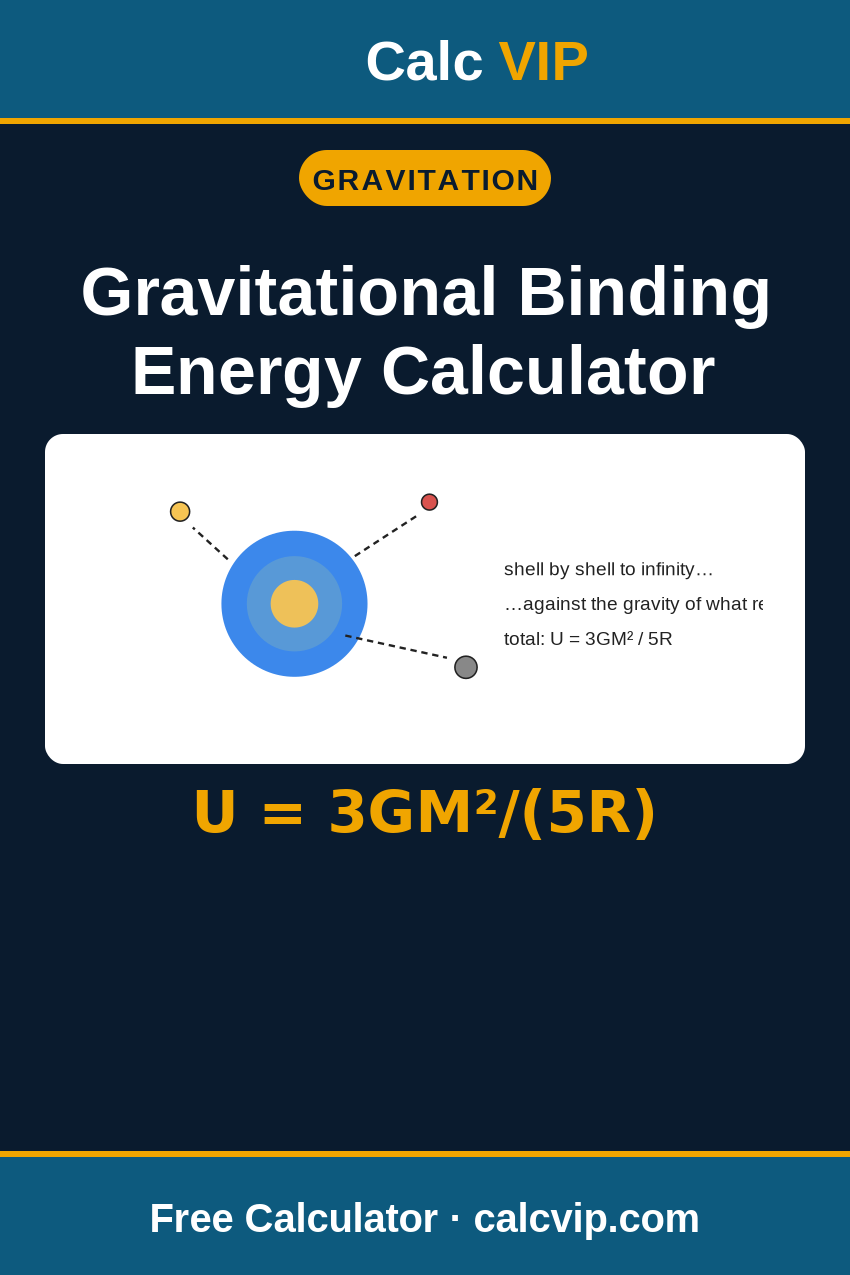
Presets cover the Earth, Moon, Mars, Jupiter and the Sun; Custom accepts any mass and radius, so you can price the demolition of invented worlds or real asteroids. The answer returns in joules and in megatons of TNT — a unit included less for practicality than for scale, since the numbers involved make even the largest nuclear arsenals look like rounding errors. No civilisation-scale energy source comes within orders of magnitude of unbinding a planet, and this calculator shows the arithmetic of why.
Formula
For a uniform-density sphere, the gravitational binding energy is U = 3GM²/(5R) • U in joules, M in kg, R in metres (calculator accepts km), G = 6.674 × 10⁻¹¹ N·m²/kg².
It is found by adding up the energy needed to remove each spherical shell of the body, one after another, against the gravity of everything inside it. The rearrangements answer the design questions: to build a body of a chosen binding energy and radius takes mass M = √(5UR/3G); to find the radius at which a given mass binds with energy U, R = 3GM²/(5U). Two scalings matter more than any single number. Because U grows with M²/R, and radius itself grows only as M1/3 at fixed density, binding energy scales as M5/3 for a family of similar worlds: double the mass and the demolition bill rises by a factor of about 3.17. And per kilogram, U/M = 3GM/(5R) grows linearly with mass at fixed density — each kilogram of a bigger planet is held more tightly than each kilogram of a smaller one, which is why dwarf planets can be knocked apart by collisions that a true planet would shrug off.
| Symbol | Meaning | Units |
|---|---|---|
| U | gravitational binding energy of a uniform sphere | J (also given in megatons of TNT) |
| M | total mass of the body | kg |
| R | radius of the body | km (calculator input) |
| G | gravitational constant | 6.674 × 10⁻¹¹ N·m²/kg² |
Where the 3/5 comes from: dismantling a planet on paper
Build the sphere in your mind the way the integral builds it: start with a small core and add shells, or run the film backwards and peel them off. When the partially dismantled body has radius r and mass m(r) = (4/3)πρr³, removing the next thin shell of mass dm costs G·m(r)·dm/r — the shell must be lifted out of the gravity well of everything inside it. Early shells are cheap: there is little inside them. The final shells, stripped from near the finished planet's surface, are the expensive ones, lifted against nearly the whole mass. Summing those costs from r = 0 to r = R gives U = (3/5)GM²/R. The same calculation run forwards is the energy released when a cloud of dust collapses into a planet — which is why young planets are molten: assembling Earth liberated of order 10³² joules of gravitational energy, and the fraction retained as heat was more than enough to melt the whole body and let its iron rain down to form the core.
The uniform assumption is doing quiet work in that 3/5. Concentrate the same mass more centrally — give the planet a dense core — and the outer shells sit deeper in the well, raising U above the uniform value; spread it hollow and U falls. The general result is U = k·GM²/R with k = 0.6 for uniform density, about 0.67 for Earth's real profile, and larger for stars, whose centres are vastly denser than their edges. Whenever you see a binding energy quoted without a profile, the 3/5 convention is what was used — a shared, honest approximation, not an error.
How to use
- Pick a preset body — Earth, Moon, Mars, Jupiter or Sun — or choose Custom and enter any mass and radius.
- Mass goes in kilograms (scientific notation like 5.972e24 works) and radius in kilometres.
- Click "Calculate Binding Energy" to get U in joules and in megatons of TNT for scale.
- Interpret the TNT figure with care: it is a unit conversion (1 megaton = 4.184 × 10¹⁵ J), not a suggestion. Earth's value, about 5.36 × 10¹⁶ megatons, exceeds the yield of every nuclear weapon ever built by some sixteen orders of magnitude.
- For a real, centrally condensed planet, treat the result as a floor: the true binding energy is modestly higher (about 10–15% for Earth) because the uniform formula ignores the dense core.
Worked examples
Example 1 — Earth. M = 5.972 × 10²⁴ kg, R = 6,371 km.
U = 3 × 6.674 × 10⁻¹¹ × (5.972 × 10²⁴)² / (5 × 6.371 × 10⁶) ≈ 2.24 × 10³² J.
That is about 5.36 × 10¹⁶ megatons of TNT — roughly a week of the Sun's entire energy output, and far beyond anything humanity could ever deliver. Earth is very safely held together.
Example 2 — the Moon. M = 7.348 × 10²² kg, R = 1,737.4 km.
U = 3GM²/(5R) ≈ 1.24 × 10²⁹ J ≈ 2.97 × 10¹³ megatons.
The Moon has about 1.2% of Earth's mass but only about 0.06% of its binding energy — the M5/3 scaling at work. Even so, unbinding it would take the delivered energy of roughly a hundred thousand dinosaur-killer impacts; the Moon, too, is permanent.
Example 3 — Mars. M = 6.417 × 10²³ kg, R = 3,389.5 km.
U ≈ 4.87 × 10³⁰ J ≈ 1.16 × 10¹⁵ megatons.
Mars sits between Moon and Earth in binding as in size. The impact that excavated its giant Hellas basin — among the largest collisions known in the solar system — delivered perhaps one part in a hundred thousand of this; Mars was dented, nowhere near dismantled.
Example 4 — Jupiter. M = 1.898 × 10²⁷ kg, R = 69,911 km.
U ≈ 2.06 × 10³⁶ J ≈ 4.93 × 10²⁰ megatons.
Nearly ten thousand times Earth's binding energy. When comet Shoemaker–Levy 9 struck Jupiter in 1994 with an estimated 10²⁷–10²⁸ joules, it expended about a billionth of the planet's binding energy — and left marks that faded within a year.
Example 5 — the Sun. M = 1.989 × 10³⁰ kg, R = 695,700 km.
U ≈ 2.28 × 10⁴¹ J on the uniform formula; the real, centrally condensed Sun binds at somewhat more.
Radiating at its present luminosity of 3.828 × 10²⁶ W, the Sun would take about 1.9 × 10⁷ years to shine away an energy equal to its own binding energy — the Kelvin–Helmholtz timescale that puzzled Victorian physicists, who could not see how the Sun had already shone far longer than gravity alone allowed. Fusion was the missing answer.
Example 6 — a 1 km asteroid. Radius 1 km, density 3,000 kg/m³, so M = (4/3)πR³ρ ≈ 1.26 × 10¹³ kg.
U = 3GM²/(5R) ≈ 6.32 × 10¹² J — about 1.5 kilotons of TNT.
At the small end of the scale the contract becomes negotiable: a modest explosive, perfectly coupled, carries energy comparable to a small asteroid's entire binding energy, which is why planetary-defence studies treat kilometre-class rubble piles and monoliths so differently.
Binding energy in real life
It powered the young Earth. The binding energy released during Earth's assembly — the same 10³² J, run in reverse — heated the early planet, drove the iron catastrophe that formed the core, and sustained a magma ocean. Accretion energy is binding energy arriving; every terrestrial planet's geology begins with this budget.
It sets the limit of the possible in fiction. Any story that destroys a planet must pay this bill. The Death Star's feat, costed honestly, requires of order 10³² joules delivered in seconds — a power output rivalling a star's — which is why physicists enjoy pointing out that the Empire's real superweapon was its energy supply, not the green beam.
It explains the asteroid belt's survivors. Collisions in the early solar system shattered many small bodies — those whose impact energies exceeded their binding energies — while the largest, like Ceres and Vesta, absorbed comparable hits and survived, battered but whole. The size distribution of asteroids is, in part, a census sorted by this formula.
It times the lives of stars. Before fusion was understood, the Sun's binding energy divided by its luminosity — the Kelvin–Helmholtz time of about 2 × 10⁷ years — was the best estimate of its age, and its conflict with geology's older Earth was a genuine scientific crisis. Today the same timescale governs how long a contracting protostar shines before fusion ignites, and how long a giant planet like Jupiter glows in the infrared from its slow contraction — Jupiter still radiates roughly twice the energy it receives from the Sun, spending its binding energy as it shrinks.
It defines "rubble pile". Comets and small asteroids often have binding energies so feeble that their own rotation can exceed them: spin a rubble pile fast enough and it sheds material or splits, as several observed asteroids have done. The YORP effect — sunlight slowly spinning up small bodies — has literally spun asteroids apart against nothing but this energy budget.
It is the floor under planetary defence. Deflection strategies are designed to move an asteroid, never to break it, partly because a disrupted body becomes a shotgun blast of fragments — and the binding-energy arithmetic shows why: for city-threatening sizes, disruption is energetically cheap enough to happen accidentally, and each fragment keeps most of the original's destructive appointment.
The virial theorem: stars spend half, save half
When a gas cloud contracts under gravity, it does not get to keep all the binding energy it releases. The virial theorem — the deep bookkeeping rule for self-gravitating systems — decrees that exactly half of the released gravitational energy must be radiated away, while the other half stays behind as internal heat, raising the pressure that resists further collapse. This is why contracting stars heat up as they shrink (the paradoxical negative heat capacity of gravitating systems), why the Kelvin–Helmholtz timescale uses half the binding energy, and why a star is stable at all: it sits in the equilibrium the theorem describes, leaking the radiated half as starlight. The same half-and-half rule governs clusters of galaxies and the gas in this page's examples alike — binding energy is never spent in one currency only.
Quick reference: binding energies and famous comparisons
| Body | Binding energy U | In megatons TNT | U per kg |
|---|---|---|---|
| Moon | 1.24 × 10²⁹ J | 2.97 × 10¹³ | 1.69 × 10⁶ J/kg |
| Mars | 4.87 × 10³⁰ J | 1.16 × 10¹⁵ | 7.58 × 10⁶ J/kg |
| Earth | 2.24 × 10³² J | 5.36 × 10¹⁶ | 3.75 × 10⁷ J/kg |
| Jupiter | 2.06 × 10³⁶ J | 4.93 × 10²⁰ | 1.09 × 10⁹ J/kg |
| Sun | 2.28 × 10⁴¹ J | 5.44 × 10²⁵ | 1.15 × 10¹¹ J/kg |
Set Earth's row against human scales: humanity's entire annual energy consumption is about 6 × 10²⁰ J, so unbinding Earth would take roughly 360 billion years of it. The Chicxulub impact that ended the dinosaurs delivered of order 10²⁴ J — a hundred million times too feeble to dismantle the planet it scarred. Extinction is easy; demolition is not.
Common mistakes
- Using GM²/R without the 3/5. The bare combination GM²/R is the right order of magnitude but overstates the uniform-sphere answer by 67%. The factor comes from the shell-by-shell integration; skipping it is the classic textbook slip.
- Treating the uniform value as exact for real planets. Central concentration raises the true binding energy — Earth's is about 2.5 × 10³² J, some 12% above the uniform estimate. Quote the calculator's answer as the standard estimate it is.
- Confusing binding energy with escape energy for one object. Lifting a single kilogram off Earth costs about 6.3 × 10⁷ J (the escape energy per kg at the surface). Unbinding the planet costs 3.75 × 10⁷ J per kilogram of the whole planet — a similar scale per kg, but multiplied by all 6 × 10²⁴ kg, which is where the astronomical total comes from.
- Entering the radius in metres. The input is kilometres. A metres slip understates U a thousandfold and turns Earth into a body a large bomb could supposedly disperse — if the answer looks achievable, check the units.
- Comparing TNT yields as if delivery were trivial. Binding energy is the energy that must be deposited against gravity throughout the whole body. A surface explosion couples only a small fraction of its yield into unbinding; the arithmetic here is a lower bound on the energy, not a recipe.
FAQ
What does binding energy tell us about a star?
Half of the binding energy released as a star contracts is radiated away and half heats the interior (the virial theorem) — this Kelvin–Helmholtz process powered ideas about the Sun's energy before nuclear fusion was understood.
Is the uniform-density formula exact for Earth?
Not quite — Earth is denser in the middle, which raises the true value a little, to about 2.5 × 10³² J. The uniform formula is the standard first estimate and is exact for a constant-density body.
How does binding energy scale with size?
It grows as M²/R, so doubling a body's mass at the same density multiplies the binding energy by about 2^(5/3) ≈ 3.2 — big planets are disproportionately harder to pull apart.
Could an asteroid impact ever unbind Earth?
No plausible one. The energy required is 2.24 × 10³² J; the largest impacts Earth has actually suffered delivered around 10²⁴ J, eight orders of magnitude short. An impactor able to unbind Earth would need to be a substantial fraction of Earth's own mass arriving at interplanetary speed — at which point "impact" is really a collision between two planets.
Why is the binding energy negative in some textbooks?
Sign conventions. The bound system has total energy −U relative to its dispersed state, so many texts quote the gravitational potential energy as −3GM²/5R. This calculator reports the positive cost of dismantling — the same magnitude, read as a bill rather than a balance.
What is the binding energy per person-sized piece of Earth?
About 3.75 × 10⁷ joules per kilogram — roughly the chemical energy in a litre of petrol, per kilogram, which sounds modest until multiplied by the planet's 6 × 10²⁴ kg. Gravity's weakness per kilogram and its invincibility in aggregate are the same fact seen at two scales.
Do moons and planets ever come unbound naturally?
Small bodies, yes: collisions shatter asteroids whose binding energies are kiloton-scale, and rotational fission splits spinning rubble piles. True planets, no — no natural process in the present solar system delivers energies within orders of magnitude of a planet's binding energy. Planets end by stellar evolution, not by demolition.
How long would the Sun take to radiate its binding energy?
At its current luminosity, about 1.9 × 10⁷ years for the uniform-sphere value — the Kelvin–Helmholtz timescale. The Sun has shone for 4.6 billion years, over two hundred times longer, which was the 19th century's sharpest proof that some other energy source — fusion — had to exist.
Is binding energy why planets are round?
Related, yes. Above a few hundred kilometres in radius, gravity overwhelms the material strength of rock and ice, pulling bodies into spheres — the same self-gravity whose total budget this page computes. The potato-shaped asteroids are precisely the bodies whose binding energies are too small for gravity to win against chemistry.
What would happen if you supplied exactly the binding energy?
In the idealised calculation, every fragment drifts to infinity arriving with zero speed — the gentlest possible dispersal, a planet evaporating rather than exploding. Supply less and the debris falls back together; supply more and the surplus becomes the fragments' departing speed. Reality would be messier, but the threshold itself is exactly this number.