 Calc
Escape Velocity Calculator – Speed Needed to Leave a Planet
 Created by Priya Sharma · Physics Editor · Energy & Gravity · Last updated: November 2026
Use this free Escape Velocity Calculator to find the minimum speed needed to leave a planet's gravity for good, v = √(2GM/r). Choose Earth, the Moon or Mars — or enter any planet's mass and radius.
Every planet holds its captives on terms, and escape velocity is the price of release: the minimum speed at which an unpowered object, thrown from a planet's surface, will coast away forever and never fall back. It is one of physics' most evocative numbers. For Earth it is 11.19 km/s — about 33 times the speed of sound, fast enough to cross the Atlantic in eleven minutes. For the little Moon it is a feeble 2.38 km/s, so feeble that the Moon could not keep an atmosphere. This calculator evaluates the price for any world whose mass and radius you know.
The formula, v = √(2GM/r), repays a slow reading. The planet's mass M sits in the numerator: more mass, a deeper grip, a higher price. The radius r sits in the denominator, which produces the formula's least intuitive result — a planet can be massive yet easy to escape if it is also puffy, because you start your climb already far from its centre. Jupiter, 318 times Earth's mass, demands 60 km/s; but spread that same mass over a giant, low-density world and the price falls. What matters is not mass alone but how tightly it is packed beneath your feet.
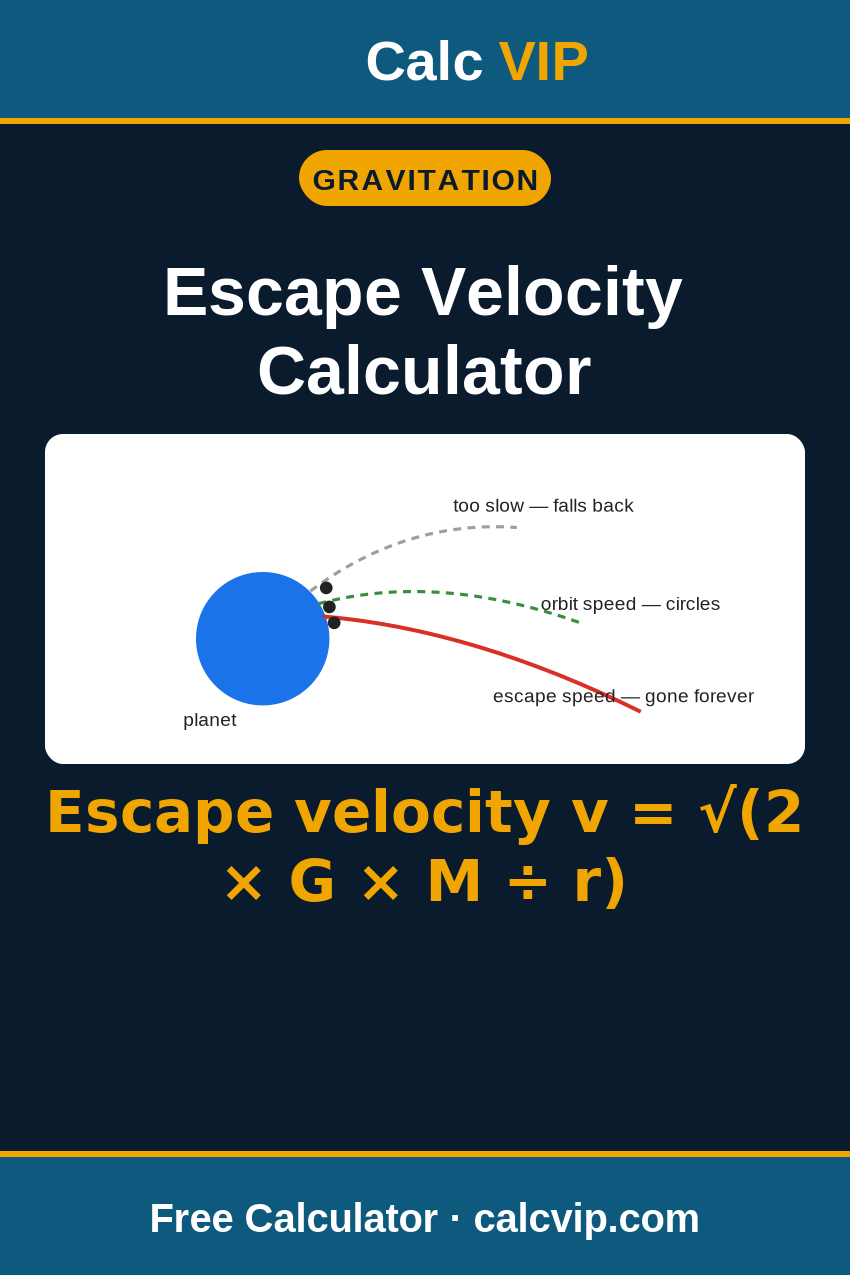
Notice, too, whose mass is missing: yours. The escaping object's own mass cancels out of the physics entirely — a pebble and a starship need exactly the same 11.19 km/s to leave Earth (the starship merely needs a vastly bigger engine to reach it). Escape velocity is a property of the planet and the starting distance alone. That is why it can be tabulated for worlds no one has visited, and why it was computed for the Moon long before anything was launched at it.
Formula
Escape velocity v = √(2 × G × M ÷ r) • v in metres per second (m/s), M the planet's mass in kilograms (kg), r its radius in metres (m), G = 6.674 × 10⁻¹¹ N·m²/kg²
Useful rearrangements: M = v² × r ÷ (2G) — the planet's mass implied by a known escape velocity, and r = 2GM ÷ v² — the distance at which a given speed becomes the escape speed (this is the form that, with v = c, yields the Schwarzschild radius of a black hole). The formula's closest relative is the circular-orbit speed √(GM/r): escape velocity is always exactly √2 ≈ 1.41 times the orbital velocity at the same distance, a relationship the examples below use repeatedly. Enter the planet's mass in scientific notation (Earth: 5.972e24) and its radius in metres — or use the calculator's Earth, Moon and Mars presets.
| Symbol | Meaning | Units |
|---|---|---|
| v | escape velocity — minimum unpowered speed to leave forever | m/s (or km/s) |
| G | universal gravitational constant | 6.674 × 10⁻¹¹ N·m²/kg² |
| M | mass of the planet (not of the escaping object) | kilograms (kg) |
| r | starting distance from the planet's centre (surface: its radius) | metres (m) |
Escape velocity is an energy statement
Where does the formula come from? From balancing an energy budget. To climb out of a gravity well to infinity costs a fixed amount of energy per kilogram: GM/r joules. An object pays that bill with its kinetic energy, ½mv². Set the two equal — ½mv² = GMm/r — and the object's mass m cancels from both sides (which is why escape velocity ignores the escaping mass), leaving v = √(2GM/r). Escape velocity is not really about speed at all; it is about whether your motion-energy can cover your altitude-debt. That is also why the speed is a minimum for an unpowered object: a rocket with a running engine can climb as slowly as it likes, paying the same energy bill gradually through its fuel instead of all at once through its speed.
The energy view also dissolves a common puzzle: how can escape velocity fall with distance (r in the denominator) if gravity weakens only gradually? Because the debt is about the whole remaining climb, not the local pull. Starting higher, much of the well is already climbed — the object has less depth left to pay for. At the space station's altitude the escape price has dropped from 11.19 to about 10.85 km/s; at the Moon's distance from Earth it is down near 1.44 km/s. Nothing about the object changed — only how much of the well remained above... below... around it. Depth, not grip, is what escape velocity measures.
How to use
- Pick a preset — Earth, Moon or Mars — or choose Custom and enter any planet's mass in kilograms (scientific notation like 5.972e24 is fine).
- Enter the planet's radius in kilometres as the calculator requests (it converts internally); for escape from altitude, use radius plus altitude as the starting distance.
- Click "Calculate Escape Velocity" to get the speed in m/s and km/s.
- Compare worlds fairly by checking the surface value for each — and remember the number ignores air resistance, which matters greatly for real launches from Earth and not at all from the airless Moon.
Worked examples
Example 1 — leaving Earth. For Earth: M = 5.972 × 10²⁴ kg and r = 6.371 × 10⁶ m.
v = √(2 × 6.674 × 10⁻¹¹ × 5.972 × 10²⁴ / 6.371 × 10⁶) ≈ 11,186 m/s ≈ 11.19 km/s
For comparison, the Moon's escape velocity is only about 2.38 km/s — which is why the Moon could not hold on to an atmosphere.
Example 2 — leaving the Moon, in full. M = 7.348 × 10²² kg, r = 1.7374 × 10⁶ m:
v = √(2 × 6.674 × 10⁻¹¹ × 7.348 × 10²² ÷ 1.7374 × 10⁶) = √(9.809 × 10¹² ÷ 1.7374 × 10⁶) = √5.646 × 10⁶ ≈ 2,376 m/s ≈ 2.38 km/s. Apollo's lunar module needed only this modest push from its ascent engine to reach lunar orbit and beyond — one reason the Moon, not Mars, was the first world humans visited.
Example 3 — leaving Mars. M = 6.417 × 10²³ kg, r = 3.3895 × 10⁶ m:
v = √(2 × 6.674 × 10⁻¹¹ × 6.417 × 10²³ ÷ 3.3895 × 10⁶) = √(8.565 × 10¹³ ÷ 3.3895 × 10⁶) = √2.527 × 10⁷ ≈ 5,027 m/s ≈ 5.03 km/s. Less than half of Earth's price — a fact sample-return mission designers are grateful for, since every km/s of escape velocity multiplies the fuel a returning spacecraft must carry to Mars in the first place.
Example 4 — Jupiter, the deep well. M = 1.898 × 10²⁷ kg, r = 6.9911 × 10⁷ m:
v = √(2.534 × 10¹⁷ ÷ 6.9911 × 10⁷) = √3.624 × 10⁹ ≈ 60,198 m/s ≈ 60.2 km/s. Nothing built by humans could launch itself off Jupiter; probes visit by falling in with borrowed momentum and must be aimed, years in advance, to fall back out. Depth of well, more than size, is what makes a giant planet a trap.
Example 5 — escaping from the space station's altitude. Start at r = 6.771 × 10⁶ m (400 km up) instead of Earth's surface:
v = √(2 × 6.674 × 10⁻¹¹ × 5.972 × 10²⁴ ÷ 6.771 × 10⁶) ≈ 10,850 m/s ≈ 10.85 km/s. Check it against the orbital speed there, 7,672 m/s: 7,672 × √2 = 10,849 — the √2 relationship confirmed to within rounding. A station-keeping burn of about 3.2 km/s extra would send a capsule away from Earth forever.
Example 6 — escaping a pebble of a world. A small asteroid with M = 10¹² kg and r = 500 m:
v = √(2 × 6.674 × 10⁻¹¹ × 10¹² ÷ 500) = √0.267 ≈ 0.52 m/s — a slow walking pace. An astronaut who jumped energetically on such a body could jump into exile, never to return; landers on small asteroids and comets anchor themselves for exactly this reason.
Escape velocity in real life
Why the Moon has no sky. A gas molecule at lunar daytime temperatures occasionally moves faster than 2.38 km/s — and each one that does, leaves forever. Over billions of years this Jeans escape drained the Moon's air completely. Earth's 11.19 km/s retains everything except the lightest gases, hydrogen and helium, which is why our air is nitrogen and oxygen.
Rocket design's tyranny. The rocket equation makes velocity brutally expensive: reaching 11.19 km/s (plus about 1.5–2 km/s of real-world losses to gravity and drag) demands either multiple stages or impossibly large fuel tanks. Escape missions are therefore choreography — stages, gravity assists, and Earth's own orbital motion all contributing instalments of the price.
Interplanetary navigation. Mission planners quote a launch energy, C3, which is the square of the excess speed beyond escape velocity. This calculator gives the zero point of that scale: the speed below which there is no "beyond" at all.
Meteorites and impacts. Read the formula backwards and it prices arrivals: anything falling to Earth from deep space arrives at at least 11.19 km/s, because falling down the well returns exactly the energy escaping would cost. That floor on impact speed is why even small meteoroids are so destructive.
Exoplanet atmospheres. Astronomers apply this same comparison — escape velocity versus the thermal speeds of gases — to judge which distant worlds can hold onto air and oceans, and therefore which are worth pointing the biggest telescopes at in the search for habitable climates.
Black hole boundaries. Set v = c in the rearranged formula and out falls the Schwarzschild radius, the size of a non-rotating black hole: 2GM/c². For Earth that radius is about 9 mm — compress our planet inside a marble's width and its escape velocity would reach light speed. The formula's most extreme prediction comes from its simplest rearrangement.
Why real rockets never launch at 11.19 km/s
If escape velocity is the price, why doesn't a departing rocket simply accelerate to it at the pad? Three reasons. First, air: at sea level, 11 km/s would mean ploughing through the thickest atmosphere at 33 times the speed of sound — the heating and drag would destroy any vehicle, so rockets climb steeply at first, accelerating seriously only in thin air. Second, gravity losses: every second spent climbing with the engine fighting gravity costs about 9.8 m/s of the budget, so a gradual ascent "wastes" roughly 1.5 km/s that an instantaneous throw would not. Third, the rocket equation: carrying all the fuel for one enormous burn means carrying tanks for the fuel for the fuel — staging, dropping empty structure as you go, is the only arithmetic that closes. The result is a ten-minute ascent that reaches escape energy gradually, in vacuum, pointed mostly sideways. The physics price is fixed; engineering is the art of paying it survivable instalments.
Quick reference: escape velocities of Solar System bodies
| Body | Escape velocity |
|---|---|
| Moon | 2.38 km/s |
| Mercury | 4.25 km/s |
| Mars | 5.03 km/s |
| Venus | 10.36 km/s |
| Earth | 11.19 km/s |
| Jupiter | 60.2 km/s |
| Sun | 617.8 km/s |
Read the table alongside surface gravity and the atmospheres sort themselves out: the Moon (2.38) holds nothing, Mars (5.03) holds a wisp, Venus and Earth (10+) hold deep skies — and the Sun, at 617.8 km/s, holds even its own erupting plasma, most of the time.
Common mistakes
- Using diameter instead of radius. Earth's radius is 6,371 km; its diameter is 12,742 km. Feeding the diameter into r halves the computed escape velocity's square — giving about 7.9 km/s, which is actually the orbital speed at the surface. If your escape answer equals an orbital answer, you have mixed up the two formulas or the two lengths.
- Forgetting that r changes with altitude. Escape velocity is not a single number per planet; it is a function of starting distance. From a high orbit the price is lower (Example 5). Quoting 11.19 km/s for a departure from the space station overstates the requirement by about 0.34 km/s.
- Putting the rocket's mass into the formula. There is no slot for it — M is the planet. The object's mass cancels in the energy balance. (Mass matters enormously for the engine and fuel needed, but not for the target speed.)
- Mixing kilometres and metres. G is defined in metres and kilograms. Entering r in kilometres shrinks the answer by √1000 ≈ 31.6 — turning Earth's 11,186 m/s into a plausible-looking but wrong 354 m/s. Convert to metres first.
- Assuming the direction must be straight up. Any direction that misses the planet escapes, provided the speed is reached. Trajectory designers exploit this: the cheapest escapes leave tangentially, adding the planet's rotation and orbital motion to the vehicle's own speed.
FAQ
Does a heavier rocket need a higher escape velocity?
No. The formula contains only the planet's mass and radius — a pebble and a rocket need the same escape speed (ignoring air resistance).
Do real rockets actually reach 11.19 km/s at launch?
Not instantly. Rockets accelerate gradually and lose some energy to air resistance and gravity on the way up, so they build up to escape speed over several minutes.
What if an object goes slower than escape velocity?
It stays in the planet's gravity — it either falls back or settles into an orbit. Escape velocity is the minimum speed to leave and never return.
Why is escape velocity √2 times orbital velocity?
A circular orbit at radius r needs v = √(GM/r); escaping from that same radius needs √(2GM/r). The factor of 2 is energy bookkeeping: an orbiting body already has half the kinetic energy needed to escape (the other half is 'owed' as negative potential energy), so it needs its speed multiplied by √2 — about 41% more — to break free. Spacecraft use this constantly: a modest burn at the right point converts an orbit into an escape trajectory.
Does direction matter — do you have to launch straight up?
No. Escape velocity is a speed, not a velocity with a required direction: any direction that does not intersect the planet works, including horizontal. Rockets launch vertically only to climb out of the thick lower atmosphere quickly, then pitch over and do most of their accelerating sideways — the efficient route to both orbit and escape.
What is Earth's escape velocity from the surface of the Sun's gravity — do spacecraft need 617 km/s to leave the Solar System?
No — and the rescue comes from motion we already have. Earth itself orbits the Sun at 29.8 km/s, and the Sun's escape speed at Earth's distance is √2 × 29.8 ≈ 42.1 km/s, so a probe launched in the direction of Earth's motion needs only about 42.1 − 29.8 = 12.3 km/s relative to Earth (plus escaping Earth's own gravity) to leave the Solar System. Voyager 1 used exactly this inheritance, plus gravity assists, to become the most distant human-made object.
Can anything escape a black hole?
No — that is the definition of one. A black hole's event horizon is the surface where the escape velocity equals the speed of light; inside it, escape would require going faster than light, which relativity forbids. The size follows from this very formula with v set to c: r = 2GM/c², the Schwarzschild radius — about 3 km for a mass like the Sun's.
Why doesn't the Moon's low escape velocity matter for its gravity?
It matters enormously, just not for standing on it. The Moon's surface gravity (1.62 m/s²) is set by g = GM/r² and holds astronauts and landers perfectly well. The 2.38 km/s escape velocity governs the long term instead: gas molecules moving faster than that leak away, which over billions of years cost the Moon its atmosphere and left it airless.
Do probes really reach escape velocity, or do they cheat?
They reach the energy honestly but rarely in one burn. They accelerate in stages (dropping empty tanks so later fuel pushes less dead mass), they borrow speed from Earth's own orbital motion, and they steal momentum from planets in gravity assists — Voyager gained the equivalent of a huge rocket by falling past Jupiter and Saturn. The escape velocity itself is never cheated; it is paid in instalments and in kind.
What happens at exactly escape velocity?
The object coasts away forever, arriving at infinity with (in the ideal maths) exactly zero speed left — it has spent its entire kinetic energy climbing out of the gravity well. Give it a whisker more and it keeps the change as a permanent cruising speed; a whisker less and it must eventually fall back or settle into an orbit.