 Calc
Gravitational Time Dilation Calculator – How Slowly Time Runs Near a Mass
 Created by Priya Sharma · Physics Editor · Energy & Gravity · Last updated: November 2026
Use this free Gravitational Time Dilation Calculator to see how much slower a clock ticks deep in a gravity well. General relativity says time itself runs slower closer to a massive body — this tool gives the exact factor.
Of all the strange predictions of Einstein's general relativity, this is the one quietly running inside your phone. Time is not a universal river flowing at the same rate everywhere; it is more like a landscape, running at slightly different speeds at different depths of gravity. A clock at the bottom of a gravity well — on a planet's surface, say — genuinely ticks more slowly than an identical clock far from any mass. The difference at Earth's surface is measured in billionths, far too small for any human sense, yet large enough that the GPS system would fail within hours if engineers did not correct for it.
The whole effect is governed by one comparison: how close you are, in a specific sense, to the body's Schwarzschild radius — the radius at which the body would become a black hole. Earth squeezed into a sphere 8.87 millimetres across would be a black hole; standing on the real Earth, you are about 700 million Schwarzschild radii from the centre, and the slowing is correspondingly gentle. A neutron star, by contrast, packs nearly a solar mass and a half into a ball 20 km wide whose Schwarzschild radius is over 4 km — there, the slowing is a hefty 23%, and a clock on the surface would lose five and a half hours a day against a distant one.
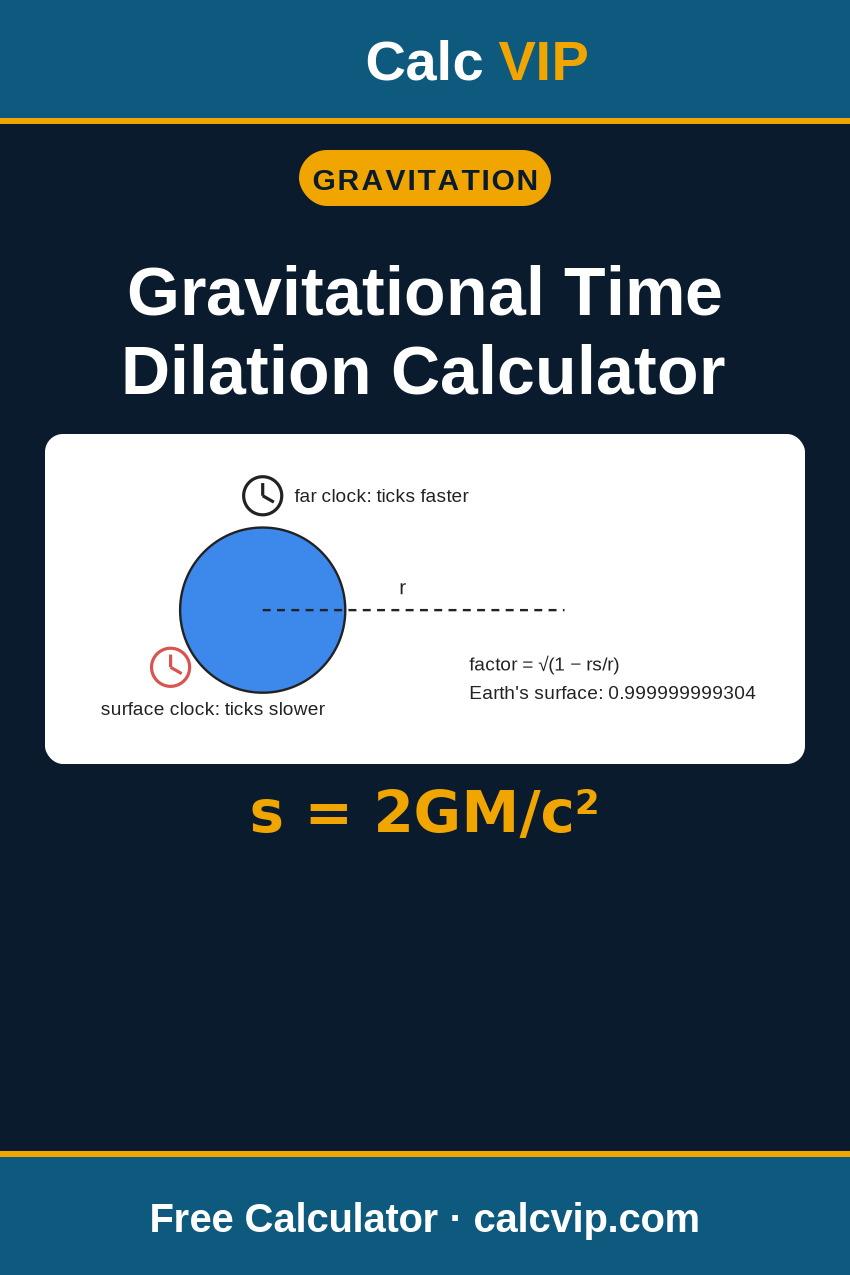
This calculator takes a mass and a distance from its centre and returns the ticking factor √(1 − rs/r), together with the time lost per day and per year. Presets cover the Earth, Sun and Moon; type any mass you like to explore white dwarfs, neutron stars or hypothetical black holes — the formula is exact for any non-rotating spherical mass, from a planet to the edge of an event horizon.
Formula
A clock at distance r from the centre of a mass M ticks at the rate √(1 − rs/r) compared with a clock far away, where the Schwarzschild radius is rs = 2GM/c² • rate factor dimensionless; rs and r in metres, M in kilograms.
The formula rearranges into the forms other questions need. Given a desired ticking factor f, the distance at which clocks run at that rate is r = rs / (1 − f²) — so clocks tick at half rate (f = 0.5) at r = 1.33 rs, and at 90% rate at r ≈ 5.26 rs. Given a measured factor and a distance, the mass follows from M = c²r(1 − f²) / 2G — in principle, a pair of precision clocks can weigh a planet. For weak fields, where rs/r is tiny, the square root is well approximated by f ≈ 1 − rs/2r = 1 − GM/(rc²), and the quantity GM/(rc²) is none other than the gravitational potential divided by c²: in everyday language, a clock loses a fraction of time equal to how deep it sits in the potential well, measured in units of c². That approximation is the one used for GPS corrections and for the tower experiments described below, and it is accurate to better than one part in a billion anywhere in the solar system.
| Symbol | Meaning | Units |
|---|---|---|
| f | ticking factor — rate of the near clock relative to a far clock | dimensionless (0 to 1) |
| rs | Schwarzschild radius, 2GM/c² | m |
| r | distance from the centre of the mass | m (calculator accepts km) |
| M | mass of the body | kg |
| G, c | gravitational constant 6.674 × 10⁻¹¹; speed of light 2.998 × 10⁸ | SI units |
Why gravity slows time: the honest intuition
There is no mechanism — no gear that gravity grabs — and that is the point. In general relativity, gravity is not a force pulling on clocks; it is the shape of spacetime itself, and clocks simply measure the length of their own path through that shape. Near a mass, spacetime is curved so that the "time direction" is, in effect, compressed: a clock deep in the well must take a shorter stride through time for each step of its journey, as measured by a distant observer comparing the two. The comparison is always made by exchanging light signals, and the signals themselves tell the story: light climbing out of a gravity well loses energy and arrives redshifted — its waves stretched, its frequency lowered. A clock is just a very regular wave, so a clock down the well appears, from above, to tick slowly, for exactly the same reason its light arrives red.
This also explains the formula's dramatic limit. As r approaches rs, the factor √(1 − rs/r) falls towards zero: time at the event horizon, as seen from outside, freezes entirely. Signals from a falling astronaut arrive ever more slowly and ever more redshifted, the final photon theoretically delayed forever. From the astronaut's own perspective nothing special happens at crossing — their clock ticks normally to them — which is the deepest lesson of the subject: the ticking factor is never a property of one clock alone, but of the comparison between two clocks at different depths, made by signals travelling between them.
How to use
- Pick a body preset — Earth, Sun or Moon — to fill in its mass, or choose Custom and type any mass in kilograms (scientific notation like 5.972e24 works).
- Enter the distance from the body's centre in kilometres. For a clock on the surface, use the body's radius: Earth 6,371 km, Sun 695,700 km, Moon 1,737.4 km. For a satellite, add its altitude to the radius.
- Click "Calculate Time Dilation" to see the Schwarzschild radius, the ticking factor to twelve decimal places, and the time lost per day and per Earth year.
- Read the factor carefully: 0.999999999304 means the near clock keeps 99.9999999304% of the far clock's rate. The calculator also reports the shortfall directly, since the interesting physics hides in the tiny difference from 1.
- If you enter a distance inside the Schwarzschild radius, the calculator stops you — no clock can remain stationary there; that region lies inside a black hole.
Worked examples
Example 1 — Earth's surface. M = 5.972 × 10²⁴ kg, r = 6,371 km.
Earth's Schwarzschild radius is rs = 2GM/c² ≈ 0.00887 m (8.87 mm).
Time factor = √(1 − 0.00887 / 6.371 × 10⁶) ≈ 0.999999999304.
So a clock on Earth's surface loses about 0.022 seconds per year compared with a clock far from Earth — small, but GPS satellites must correct for exactly this effect.
Example 2 — the Sun's surface. M = 1.989 × 10³⁰ kg, r = 695,700 km.
The Sun's Schwarzschild radius is about 2,954 m — nearly 3 km.
Time factor = √(1 − 2954 / 6.957 × 10⁸) ≈ 0.999997877.
A clock on the Sun's surface would lose about 0.183 seconds per day, or 67 seconds per year, against a distant clock. Light leaving the Sun carries the matching gravitational redshift, which astronomers have measured in its spectrum.
Example 3 — the Moon's surface. M = 7.348 × 10²² kg, r = 1,737.4 km.
The Moon's Schwarzschild radius is a mere 0.109 mm — a grain of sand.
Time factor ≈ 0.999999999969, so a lunar clock loses only about 0.001 seconds per year relative to deep space. Interestingly, that makes lunar clocks run faster than Earth-surface clocks by roughly 0.021 seconds a year — a correction future lunar navigation systems must apply in reverse.
Example 4 — a GPS satellite. M = Earth, r = 26,560 km (orbit radius, 20,200 km up).
Time factor ≈ 0.999999999833. The satellite's clock is higher in the well than a ground clock, so it gains on the ground by the difference between the two shortfalls: about 45.7 microseconds per day from gravity alone. Its orbital motion claws back about 7 microseconds a day through special relativity — the net +38 microseconds a day that GPS engineers famously pre-correct by building the satellite clocks to run slightly slow before launch.
Example 5 — a white dwarf. M = 0.6 solar masses (1.193 × 10³⁰ kg), r = 7,000 km — a star's worth of matter in an Earth-sized ball.
rs ≈ 1,772 m, and the time factor = √(1 − 1772 / 7 × 10⁶) ≈ 0.999873.
A clock on its surface loses about 10.9 seconds per day — over an hour a year. The gravitational redshift of white dwarf light, this same effect seen in photons, was one of the classic early tests of general relativity.
Example 6 — a neutron star. M = 1.4 solar masses (2.785 × 10³⁰ kg), r = 10 km.
rs ≈ 4,135 m — more than 40% of the way to the surface itself.
Time factor = √(1 − 4135 / 10,000) = √0.5866 ≈ 0.766. Time on the surface runs at barely three-quarters of the distant rate; a clock there loses about 5.6 hours per day. No material surface can sit closer than about 1.5 rs for long, so this is close to the strongest slowing nature allows outside a black hole.
Gravitational time dilation in real life
GPS would drift off within hours without it. The net relativistic correction for GPS clocks is about 38 microseconds a day; left uncorrected, the ranging errors would grow by roughly 10 km a day, and the system would be useless for navigation before the first day was out. It is the only piece of general relativity most people use daily.
The Pound–Rebka experiment measured it in a tower. In 1960, physicists at Harvard measured the frequency shift of gamma rays falling just 22.5 metres down a tower — a fractional shift of only 2.5 × 10⁻¹⁵, equivalent to clocks at the bottom ticking slower by that fraction. The result matched Einstein's prediction and turned time dilation from astronomy into laboratory physics.
Atomic clocks now feel a single step. Modern optical lattice clocks are so precise that raising one by a few centimetres measurably changes its rate — a centimetre of height is worth about one part in 10¹⁸. Surveyors have begun using clock comparisons to measure height differences ("chronometric levelling"), reading the gravity landscape directly from time itself.
Your head ages faster than your feet. Your head sits about 1.7 metres farther from Earth's centre than your feet, so over an 80-year life it ages roughly an extra 300 nanoseconds — real, calculable, and happily too small to notice in the mirror.
Hafele and Keating flew clocks around the world. In 1971, atomic clocks flown eastward and westward around the Earth came home differing from stay-at-home clocks by hundreds of nanoseconds, in the amounts predicted once both the motion effect and the altitude (gravity) effect were added — an early, public proof that travelling clocks genuinely return having lived a different amount of time.
Black hole movies got it right once. The planet Miller, orbiting close to the black hole Gargantua in the film Interstellar, was specified so that one hour there equalled seven years outside — a ticking factor of about 1/61,000, requiring the planet to skim just outside the horizon of a spinning black hole. Physicist Kip Thorne set the numbers; this calculator shows why an ordinary, non-spinning mass cannot quite do it — for a Schwarzschild black hole, stable orbits that close do not exist.
How close can a clock get? The landscape near the horizon
Because the factor depends only on the ratio r/rs, every mass in the universe shares the same table of extremes. At r = 3 rs — the innermost stable orbit for matter around a non-rotating hole — a hovering clock ticks at √(1 − 1/3) = 0.816 of the distant rate; at 1.5 rs, the photon sphere where light itself is forced into orbit, the factor is √(1 − 2/3) ≈ 0.577. At r = 2 rs the factor is √0.5 ≈ 0.707: a clock hovering there (which would require infinite rocket power to maintain as you approach the limit) ages 7 hours for every distant 10. And at the horizon itself the factor reaches zero — not because the falling clock breaks, but because no signal from it can ever climb out to make the comparison. For scale, the supermassive black hole at our galaxy's centre, Sagittarius A*, has a Schwarzschild radius of about 12.7 million km — roughly 0.085 AU — and the stars whipping around it at a few hundred rs already show measurable relativistic effects in their orbits and spectra.
Quick reference: Schwarzschild radii and surface time factors
| Body | Schwarzschild radius | Surface factor | Time lost per year |
|---|---|---|---|
| Moon | 0.109 mm | 0.999999999969 | ≈ 0.001 s |
| Mars | 0.953 mm | 0.999999999859 | ≈ 0.0044 s |
| Earth | 8.87 mm | 0.999999999304 | ≈ 0.022 s |
| Jupiter | 2.82 m | 0.999999979841 | ≈ 0.64 s |
| Sun | 2.95 km | 0.999997877 | ≈ 67 s |
| White dwarf (0.6 M☉) | 1.77 km | 0.999873 | ≈ 4,000 s |
| Neutron star (1.4 M☉) | 4.14 km | 0.766 | ≈ 74 days |
The pattern to notice: the Schwarzschild radius grows in direct proportion to mass, but planets sit so far outside theirs that their factors crowd absurdly close to 1 — nine or ten nines deep. Only stellar remnants move the needle into territory a clock could feel in a day.
Common mistakes
- Entering altitude instead of centre distance. r is measured from the centre of the mass. A satellite 400 km up has r = 6,371 + 400 = 6,771 km, not 400 km — entering 400 km would place it inside the Earth and produce a wildly wrong factor.
- Confusing this with the moving-clock effect. This calculator is purely gravitational (general relativity). A fast-moving clock also slows by the special-relativistic factor √(1 − v²/c²); orbiting clocks feel both at once, which is why GPS needs the two corrections described in the examples.
- Reading the factor as the loss. A factor of 0.999999999304 is the rate kept, not the rate lost. The loss is the difference from 1 — here 6.96 × 10⁻¹⁰, the number the calculator prints separately.
- Expecting the effect to depend on the clock. All clocks — atomic, mechanical, biological — slow by the same factor at the same depth, because it is time itself, not the mechanism, that runs differently. A wristwatch and an astronaut age together at the bottom of the well.
- Thinking the far clock is the "true" time. There is no master clock. The factor compares two specific clocks; a third clock deeper in the well would judge both of them fast. Every observer's own clock always ticks normally to them.
FAQ
Has gravitational time dilation been measured?
Yes, many times. Atomic clocks flown on aircraft and rockets ticked at different rates from ground clocks, and GPS satellite clocks are corrected daily for this effect combined with their motion.
Why do GPS clocks need two corrections?
Their orbital speed makes them lose about 7 microseconds a day (special relativity), while the weaker gravity up there makes them gain about 45 microseconds a day (general relativity) — a net gain of about 38 microseconds a day that engineers pre-correct.
What happens at the event horizon?
At r = rs the factor becomes zero: to a distant observer, time at the horizon appears frozen. Nothing that falls in can send a signal back out.
If I lived on a neutron star, would I notice my clock running slow?
No — your clock, your body and your thoughts would all run at the same local rate, and everything around you would seem perfectly normal. You would only discover the slowing by comparing notes with someone far away, whose messages would arrive sped up and blueshifted, and who would report that your signals crawl.
Does this mean people age more slowly in a valley than on a mountain?
Yes, by an almost comically small amount. A lifetime spent 1,000 m lower is worth roughly a ten-thousandth of a second. Modern optical clocks can measure height differences of centimetres this way, but no altitude on Earth buys a human being a noticeable extra moment.
What is the Schwarzschild radius in simple words?
It is the size to which a mass would have to be squeezed for its escape velocity to reach the speed of light — the size at which it becomes a black hole. For Earth it is 8.87 mm; for the Sun, about 2.95 km. It sets the scale of the whole effect: time dilation depends on how your distance compares with it.
Why is the formula a square root?
The square root comes from the geometry of curved spacetime — specifically from the time part of the Schwarzschild metric, the exact solution of Einstein's equations around a spherical mass. The same metric also produces a matching effect on radial distances, which is why the full theory, not just its clock factor, is needed to compute orbits like Mercury's precisely.
Do clocks run faster in deep space, far from everything?
Relative to us, very slightly yes — a clock far from all mass runs at the maximum rate this formula allows, the rate our clocks approach but never reach. The difference between Earth-surface time and deep-space time is only about 0.022 seconds a year, plus a comparable contribution from the Sun's gravity well, in which the whole Earth sits.
Can gravitational time dilation be used to travel into the future?
In the limited sense of relativity, yes: spend time deep in a strong gravity well (or moving fast), return, and more time will have passed for everyone else than for you — you arrive in their future having aged less. The catch is the size: with planets and ordinary spacecraft the gain is nanoseconds to microseconds; only black-hole neighbourhoods offer dramatic ratios, and they are one-way trips in every practical sense.
Is the effect the same everywhere on Earth's surface?
Almost. Because Earth rotates and bulges, sea level is very nearly a surface of constant gravitational-plus-rotational potential — which is why "sea level" clocks worldwide tick at essentially the same rate, and why the geoid, the shape of the sea-level surface, can equally be defined as the surface where clocks agree.