 Calc
Double Slit Calculator – Young's Fringe Spacing Δy = λL/d
 Created by David Okafor · Physics Writer · Waves & Light · Last updated: November 2026
Use this free Double Slit Calculator to find the fringe spacing in Young's double-slit experiment — how far apart the bright bands are on the screen — and where any particular bright fringe sits.
In 1801 Thomas Young let sunlight pass through two close slits and projected the result: not two bright lines, as the particle picture of light predicted, but a row of evenly spaced bright and dark bands — fringes. It was the first clear demonstration that light is a wave, because only waves can cancel each other out to make darkness from two beams of light. Two centuries later the same experiment, performed with electrons and even whole molecules, still anchors our understanding of quantum mechanics. The pattern's spacing obeys one friendly formula, Δy = λL/d, and this calculator evaluates it.
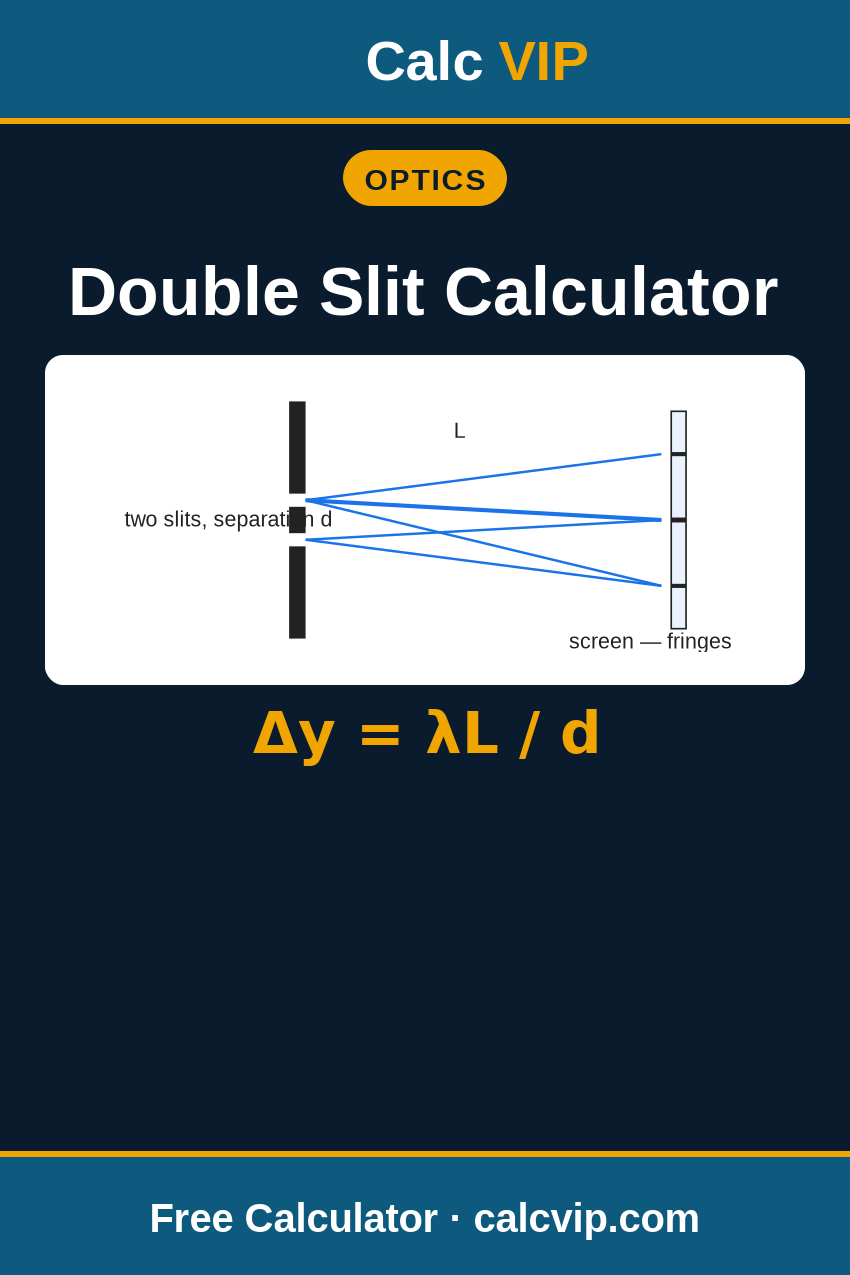
The ingredients are minimal: light of wavelength λ falls on two narrow slits separated by d, and a screen at distance L catches the overlapping waves. Where the two waves arrive in step — path difference a whole number of wavelengths — they reinforce into a bright fringe; where they arrive opposed, they cancel into darkness. Because the geometry is so stretched (L is typically thousands of times d), the fringes come out evenly spaced, magnifying a sub-micrometre wavelength into millimetres you can measure with a school ruler.
That magnification is the experiment's enduring usefulness: it converts the invisible scale of light into bench-top millimetres, letting a student measure a wavelength to three significant figures with slits, a laser and a tape measure. The sections below unpack the geometry, the one condition the experiment cannot do without — coherence — and the strange afterlife of Young's fringes in quantum physics, interferometry and radio astronomy.
Formula
Fringe spacing: Δy = λL / d • the m-th bright fringe sits at ym = mλL / d from the central maximum, and dark fringes fall halfway between, at (m + ½)Δy
Here λ is the wavelength, L the slit-to-screen distance and d the separation between the two slits — the calculator converts the mixed units (nm, m, mm) for you. The formula is the small-angle version of the exact condition d sinθ = mλ: with L ≫ d, sinθ ≈ tanθ = y/L, and the fringes come out evenly spaced. Rearranged as λ = Δy × d / L, it becomes a wavelength meter — the form in which the experiment earns its keep in laboratories.
| Symbol | Meaning | Units |
|---|---|---|
| Δy | fringe spacing — centre-to-centre distance of neighbouring bright fringes | m or mm |
| λ | wavelength of the light | m (calculator takes nm) |
| L | distance from slits to screen | m |
| d | separation between the two slits (centre to centre) | m (calculator takes mm) |
| m | fringe order — 0 at the centre, 1, 2, 3… outward | no units |
| ym | position of the m-th bright fringe | m or mm |
The geometry of reinforcement
Stand at a point on the screen, off to one side. The wave from the farther slit travels a little extra distance to reach you: that path difference is d sinθ, where θ is the angle from the centre line. If the extra distance is exactly one wavelength, the two waves arrive crest-on-crest despite the detour — bright. Half a wavelength extra, and the detour turns crest into trough — dark. Because the screen is far away (L ≫ d), θ is tiny, sinθ ≈ y/L, and the bright conditions land at y = mλL/d: a ladder of fringes with perfectly even rungs, the spacing Δy = λL/d between them.
Every term in that spacing tells a story. λ in the numerator: longer waves need a bigger detour to accumulate a wavelength of difference, so red fringes spread wider than blue. L in the numerator: a farther screen is a bigger magnifier of the same angles. d in the denominator: closer slits produce gentler path-difference gradients — the detour grows more slowly as you move across the screen — so the fringes spread out. Halve the slit separation and the pattern doubles in size, the single most reliable lever in the experiment.
But none of it works without the experiment's one non-negotiable condition: coherence. The two slits must be fed by the same wave, so that their phase relationship is fixed. Young achieved this by deriving both slits from one source (originally sunlight through a pinhole). Two independent lamps, even identical ones, drift in phase billions of times per second and their "fringes" average into uniform light. A laser, coherent across its whole beam, makes the modern experiment effortless — the fringes snap into view the moment the beam touches the slits.
How to use
- Enter the wavelength λ in nanometres (650 for a red laser pointer, 532 for green, 589 for a sodium lamp).
- Enter the distance from the slits to the screen, L, in metres — measure from the slit slide itself, not from the laser.
- Enter the slit separation d in millimetres. This is the centre-to-centre distance between the two slits, printed on commercial slides (0.25, 0.50 and 1.00 mm are common) — not the width of one slit.
- Optionally enter a fringe order m to find where that bright fringe sits, measured from the central maximum.
- Click "Calculate Fringe Spacing". For the most accurate wavelength work, compare against the total span of ten fringes and divide by ten, rather than trusting a single gap.
Worked examples
Example 1 — the classic red-laser setup. Red light of wavelength 650 nm shines through slits 0.5 mm apart onto a screen 2 m away.
Δy = λL ÷ d = (650 × 10−9 × 2) ÷ (0.5 × 10⁻³) = 2.60 mm between neighbouring bright fringes.
The 3rd-order fringe sits at y₃ = 3 × 2.60 = 7.80 mm from the centre.
Example 2 — blue light, closer slits. λ = 450 nm, L = 1.5 m, d = 0.25 mm.
Δy = (450 × 10−9 × 1.5) ÷ (0.25 × 10⁻³) = 2.70 mm. Blue's shorter wavelength fights to shrink the fringes, but the halved slit separation (against Example 1) more than compensates — d is the stronger lever.
Example 3 — wide-open fringes. λ = 500 nm, L = 1.0 m, d = 0.10 mm.
Δy = (500 × 10−9 × 1.0) ÷ (0.10 × 10⁻³) = 5.00 mm. With slits a tenth of a millimetre apart, the fringes are half a centimetre wide — measurable with an ordinary ruler held against the screen.
Example 4 — a green laser across the room. λ = 532 nm, L = 3.0 m, d = 0.125 mm.
Δy = (532 × 10−9 × 3.0) ÷ (0.125 × 10⁻³) = 12.8 mm. Long throw plus fine slits: fringes over a centimetre apart, the demonstration version of the experiment visible from the back of a lecture hall.
Example 5 — running it backwards: an unknown wavelength. You measure Δy = 1.80 mm with d = 0.30 mm and L = 1.20 m.
λ = Δy × d ÷ L = (1.80 × 10−3 × 0.30 × 10−3) ÷ 1.20 = 4.50 × 10⁻⁷ m = 450 nm — blue light, identified. This inversion is the experiment's real job: the fringes are a ruler for the wavelength itself.
Example 6 — the ten-fringe trick. In Example 1's setup, the 10th bright fringe sits at y₁₀ = 10 × 2.60 = 26.0 mm from the centre. Measuring that 26.0 mm span with a ruler accurate to ±0.5 mm and dividing by ten gives Δy to ±0.05 mm — ten times better than measuring a single 2.60 mm gap with the same ruler. Experimentalists always measure across many fringes.
Double-slit interference in real life
Measuring wavelengths. The experiment remains a front-line wavelength meter: with d and L known to high precision, a fringe count pins λ to parts per thousand. Before gratings took over spectroscopy, this was how the wavelengths of the spectrum were first tabulated.
The quantum double slit. Fire electrons — or photons, or molecules — at the slits one at a time, and each lands as a single dot; yet the dots accumulate into Young's fringes. Each particle somehow interferes with itself, sampling both paths. Feynman called it the one mystery of quantum mechanics, and it is this page's formula, Δy = λL/d with the de Broglie wavelength, that the dots obey.
Interferometers. Michelson split a beam and recombined it — a double slit folded into an instrument — to measure lengths and refractive indices by fringe shifts. Its descendants at LIGO stretch the arms to 4 km and detect gravitational waves as fringe movements smaller than a proton's width.
Radio interferometry. Two antennas separated by d combine signals exactly like two slits run in reverse; arrays of dishes synthesise apertures kilometres wide. The Event Horizon Telescope, an Earth-sized "double slit", imaged a black hole's shadow using this mathematics at λ = 1.3 mm.
Speaker interference. Two loudspeakers playing the same tone are a double slit for sound: walk across the room and you pass through loud and quiet bands spaced by λL/d with sound's metre-scale wavelengths. Concert-hall acoustics and noise-cancelling design are this pattern, managed.
Testing laser coherence. Fringe visibility — how black the dark fringes truly are — is the working measure of a source's coherence. Crisp, high-contrast Young's fringes certify a laser's beam quality in optics labs every day.
Missing orders: when the envelope eats a fringe
Real slits have width, so the double-slit pattern lives inside the single-slit envelope described in the FAQ below: fringes weaken as the envelope sags toward its first minimum. Occasionally the geometry conspires: if the slit separation is an exact multiple of the slit width — say d = 3a — the envelope's first minimum lands exactly where the 3rd-order double-slit maximum belongs. That fringe is extinguished: orders ±3, ±6, … are missing, and the central envelope contains five fringes instead of the usual seven. Slide manufacturers choose d/a ratios with this in mind; a pattern with a suspiciously absent fringe is not broken apparatus but two diffraction effects keeping accurate books.
Fringe visibility: how black is black?
In a perfect Young pattern the dark fringes are perfectly black. In practice their darkness measures the light's coherence, quantified as visibility V = (Imax − Imin) ÷ (Imax + Imin): V = 1 for a laser's inky minima, less for anything else. The culprit is coherence length — the path difference over which a source's waves stay in step with themselves. For white light it is barely a micrometre (roughly λ² ÷ Δλ ≈ 550² ÷ 300 ≈ 1,000 nm), so only the first few fringes near zero path difference survive before the colours' patterns slide out of register and wash to grey. Lasers, with coherence lengths of centimetres to kilometres, keep their fringes crisp to enormous orders. When your fringes fade faster than the envelope predicts, coherence — not alignment — is usually the reason.
Quick reference: fringe spacings for common setups
| Setup (λ, L, d) | Δy |
|---|---|
| 650 nm, L = 1 m, d = 0.50 mm | 1.30 mm |
| 650 nm, L = 2 m, d = 0.50 mm | 2.60 mm |
| 532 nm, L = 2 m, d = 0.25 mm | 4.26 mm |
| 589 nm, L = 1.5 m, d = 0.30 mm | 2.95 mm |
| 450 nm, L = 1.5 m, d = 0.25 mm | 2.70 mm |
| 500 nm, L = 1 m, d = 0.10 mm | 5.00 mm |
Scan the table for the levers: doubling L doubles Δy exactly; halving d does the same; swapping red for blue shrinks the pattern by the wavelength ratio. Every bench adjustment you will ever make is one of those three moves — and if a measured pattern disagrees with the table's prediction, the disagreement itself is data: it means one of the three inputs was not what its label claimed.
Common mistakes
- Confusing slit separation with slit width. The d in Δy = λL/d is the centre-to-centre separation of the pair. The width of each slit (usually written a) controls the envelope, not the spacing. Slides are labelled with both — reading the wrong one throws the answer off by the d/a ratio.
- Expecting crisp fringes from two separate sources. Two lamps, two LEDs, even two lasers are mutually incoherent: their phase difference scrambles millions of times during any measurement, and the fringes wash out. One source feeding both slits is not a detail; it is the experiment.
- Placing dark fringes at whole multiples. Bright fringes sit at mΔy; dark fringes sit halfway between, at (m + ½)Δy — the first dark fringe is at Δy/2, not at Δy. Off-by-half errors haunt fringe-counting measurements.
- Measuring L from the wrong place. L runs from the slits to the screen. Including the laser-to-slit distance inflates L and shrinks the computed λ by the same proportion — in Example 5's terms, a 10% error in L is a 45 nm error in the answer.
- Trusting a single fringe gap. One gap measured with a ruler carries the ruler's whole error. Spanning ten fringes and dividing (Example 6) cuts that error tenfold for free — the difference between a demonstration and a measurement.
FAQ
How can I make the fringes wider apart?
Increase the wavelength (red light beats blue), move the screen further away, or bring the slits closer together. Halving the slit separation doubles the fringe spacing.
Why do the fringes fade out at the edges?
Each slit is not infinitely narrow, so each one also produces its own single-slit diffraction pattern. That pattern acts like an envelope: fringes near the centre are bright, and they fade where the single-slit pattern has its minima.
What happens with white light?
Only the central fringe is white. Every other order is smeared into a little rainbow, because each colour has its own spacing (Δy grows with λ) — red fringes land further out than blue ones.
What happens if I cover one slit?
The interference vanishes instantly and the screen shows the single-slit pattern of the open slit alone: one broad bright band, no fine fringes. It is the cleanest proof that the fringes come from the combination of the two paths, not from either path by itself.
Why must the slits be narrow as well as close?
Each slit must be narrow enough to spread light across the whole screen (single-slit diffraction), so the two beams overlap and can interfere. Wide slits would project two separate bright images with interference only in a sliver of overlap. Narrowness spreads; closeness spaces.
Do the fringes prove light is a wave — or can particles do it too?
Both, uncomfortably. Electrons, neutrons and molecules as large as fullerenes all produce Young's fringes with their de Broglie wavelength in place of λ — even sent through one at a time. Whatever particles are, they arrive with a wavelength, and this formula measures it.
Why are the fringes evenly spaced?
Because for the tiny angles involved (L ≫ d), sinθ ≈ tanθ = y/L, turning the exact condition d sinθ = mλ into y = mλL/d — linear in m. Use a very wide pattern or a short screen distance and the exact formula's slight unevenness creeps back in.
Can I see double-slit fringes without a laser?
Yes — Young did it with sunlight. The trick is coherence: pass the light through a single narrow slit (or pinhole) first, which selects a coherent slice of the wavefront, then onto the double slit. A sodium or LED source behind a slit works; the fringes are dimmer and less crisp than a laser's, but unmistakable.
What sets the total number of visible fringes?
The single-slit envelope: fringes exist only where the light from each slit actually reaches, so the count within the central envelope is about 2(d/a) − 1. Fine, wide-spaced slits on a slide (large d/a) show many fringes; coarse ones show a handful before the envelope fades.
Is the central fringe always the brightest?
Yes. At the centre the path difference is zero for every wavelength and the two waves reinforce perfectly, while outer fringes sit lower on the single-slit envelope. In white light the centre is also the only purely white fringe — every other order is already dispersing into colours.