 Calc
Carnot Efficiency Calculator – Maximum Heat Engine Efficiency η = 1 − Tc/Th
 Created by Anna Kowalski · Physics Editor · Heat & Atoms · Last updated: November 2026
Use this free Carnot Efficiency Calculator to find the maximum possible efficiency of a heat engine working between two temperatures, using η = 1 − Tc/Th. Enter the hot and cold reservoir temperatures in kelvin — and optionally the heat taken in, to get the maximum work out.
In 1824 a 28-year-old French engineer named Sadi Carnot asked a question nobody had thought to ask: not how to build a better steam engine, but how good any engine could ever be. His answer is the formula on this page. Between a hot reservoir at Th and a cold reservoir at Tc, no engine — steam, petrol, diesel, jet, or anything not yet invented — can convert more than the fraction η = 1 − Tc/Th of its heat into work. It is not a statement about engineering skill. It is a law of nature, as unbreakable as the conservation of energy, and every engine built in the two centuries since has lived under its ceiling.
The startling thing about the Carnot limit is what it ignores. The fuel does not matter, nor the working fluid, nor the size, cleverness or cost of the machine. Two temperatures are the whole story. A power station boiling water with coal, gas, nuclear fission or concentrated sunlight faces exactly the same cap if its steam temperature and cooling temperature are the same. This is why the history of engine design is largely a history of chasing hotter hot sides — from the lukewarm steam of early engines to the 600 °C steam and 1,500 °C gas turbines of today — and why engineers speak of "temperature headroom" the way accountants speak of margin.
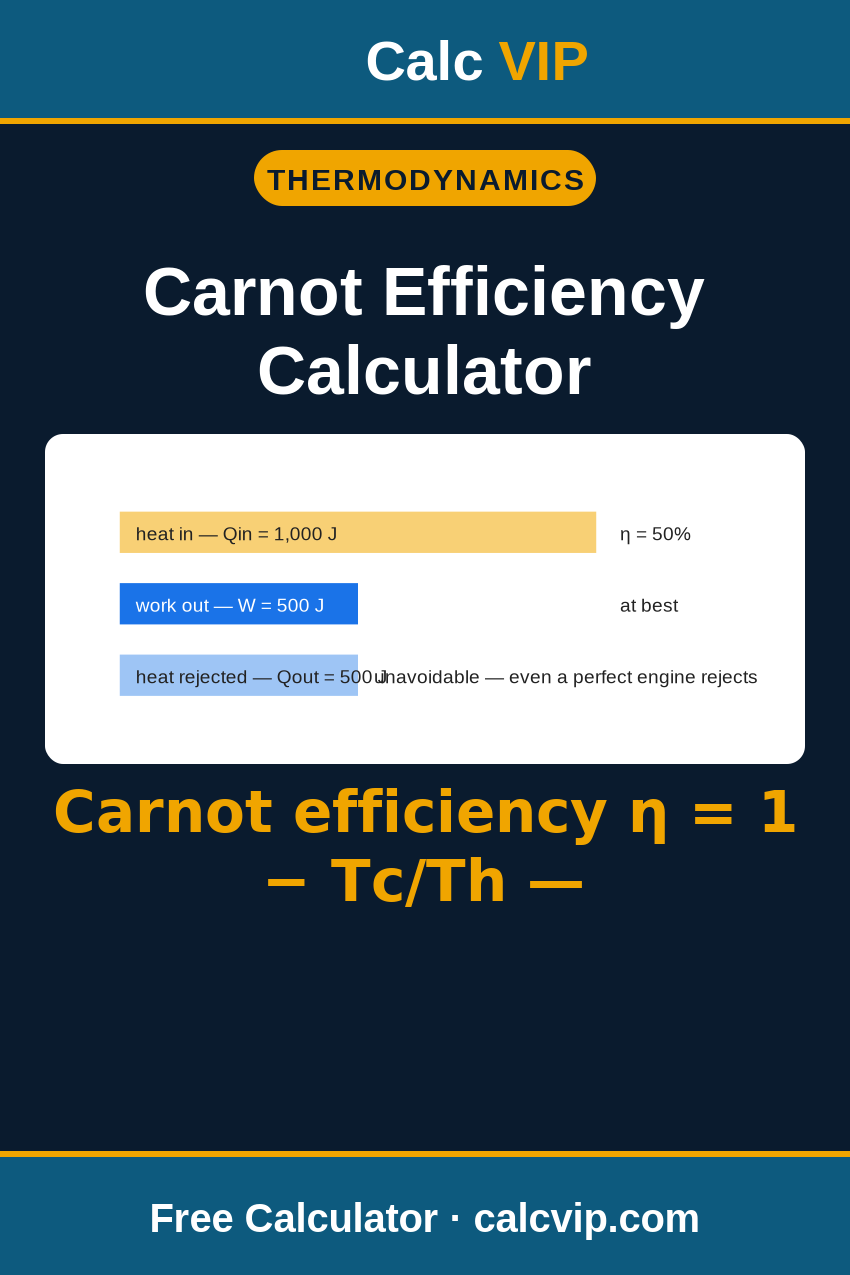
Real engines fall short of the limit, typically reaching somewhere between a third and two-thirds of it, because real processes are irreversible: friction, turbulence, heat leaking across finite temperature gaps all waste part of the allowance. That gap is precisely what makes this calculator useful. Enter the two temperatures of any real engine and you get its theoretical best; compare a real efficiency against it and you know how much room for improvement physics leaves — and how much is already lost for good. Add the heat input and it also returns the maximum work and the minimum heat that must be thrown away.
Formula
Carnot efficiency η = 1 − Tc/Th — where Th and Tc are the hot and cold reservoir temperatures in kelvin. This is the theoretical maximum efficiency for any engine working between those temperatures. The maximum work is W = η × Qin.
The formula rearranges to answer design questions directly: the cold temperature a target efficiency demands is Tc = Th × (1 − η), and the hot temperature needed is Th = Tc ÷ (1 − η). Note what the second form reveals — as the target η approaches 100%, the required Th races to infinity. An efficiency of 50% needs Th = 2 × Tc; 75% needs Th = 4 × Tc; 90% needs Th = 10 × Tc. Perfection is not merely difficult, it is priced out of reach by the arithmetic itself. And because the rejected heat Qout = Qin − W can never fall below Qin × Tc/Th, every engine is also a heater of its cold reservoir, whether it wants to be or not.
| Symbol | Meaning | Units |
|---|---|---|
| η | Carnot efficiency — the maximum fraction of heat convertible to work | decimal or % |
| Th | hot reservoir temperature (absolute) | kelvin (K) |
| Tc | cold reservoir temperature (absolute) | kelvin (K) |
| Qin | heat absorbed from the hot reservoir | joules (J) |
| W | work done by the engine | joules (J) |
| Qout | heat rejected to the cold reservoir | joules (J) |
The Carnot cycle: four strokes of a perfect engine
Carnot did not just state a limit; he described the one engine that reaches it — an idealised cycle of four reversible strokes performed on a trapped gas. First, the gas expands at the hot temperature Th, absorbing heat Qin while pushing a piston out: an isothermal expansion. Second, insulated from everything, it expands further and cools to Tc: an adiabatic expansion. Third, it is compressed at the cold temperature Tc, shedding heat Qout: an isothermal compression. Fourth, still insulated, it is compressed back to Th, ready to begin again. The net effect of one loop is that Qin − Qout of heat has become work, in exactly the ratio the formula promises.
The secret ingredient is reversibility. Every step happens infinitely gently, with the gas always a whisker away from equilibrium, so the cycle could run backwards — as a refrigerator — with no extra cost. Real engines cannot afford such gentleness: they must produce power at a useful rate, which means fast strokes, real temperature gaps driving the heat flow, turbulence and friction. Each of those is an irreversibility, and each one taxes the efficiency below the Carnot figure. The Carnot engine itself would produce almost no power at all, since infinitely slow strokes take infinitely long — it is a measuring rod for perfection, not a blueprint.
Why can nothing beat it? Suppose some engine could. Run it forwards to make work, then use part of that work to drive a Carnot engine backwards as a refrigerator, pumping the rejected heat back up to the hot reservoir. The pair together would move heat from cold to hot with no net input — a free refrigerator, forbidden by the second law of thermodynamics. The impossibility of that parlour trick is exactly the impossibility of beating Carnot, which is why η = 1 − Tc/Th ranks as a law of physics rather than an engineering guideline.
How to use
- Enter the hot reservoir temperature Th in kelvin (add 273.15 to a °C value).
- Enter the cold reservoir temperature Tc in kelvin — it must be lower than Th.
- Optionally enter Qin to get the maximum work output and minimum heat rejected.
- Click "Calculate Carnot Efficiency" to get η as a decimal and a percentage.
- Compare the result with any real engine's efficiency between the same temperatures: the real figure must be lower — if it is not, a temperature has been entered in °C by mistake.
Worked examples
Example 1 — the textbook engine. An ideal engine works between Th = 600 K and Tc = 300 K, taking in 1000 J of heat.
η = 1 − 300/600 = 0.5 = 50%
Maximum work W = 0.5 × 1000 = 500 J (and at least 500 J is rejected to the cold reservoir).
Example 2 — a modern steam power station. Superheated steam enters the turbines at about 550 °C (Th = 823 K) and the condenser is cooled to about 40 °C (Tc = 313 K).
η = 1 − 313/823 = 0.62 ≈ 62% — the absolute ceiling. The best real stations achieve about 40%, roughly 65% of the Carnot limit; the rest is spent on irreversibilities no design can remove.
Example 3 — a car engine's ceiling. Combustion gases reach roughly Th = 1000 K on average over the cycle, and the exhaust side sits near Tc = 350 K.
η = 1 − 350/1000 = 0.65 = 65%. Real petrol engines deliver 25–30% — respectable against most machinery, but less than half of what the temperatures alone would permit.
Example 4 — a geothermal plant. Steam from a hot spring field arrives at only Th = 450 K, with cooling at Tc = 300 K.
η = 1 − 300/450 = 0.333 ≈ 33% — a low ceiling set purely by the modest source temperature, which is why geothermal plants are built big and cheap rather than efficient.
Example 5 — designing backwards. An engineer wants a Carnot efficiency of 60% with cooling water fixing Tc = 300 K. How hot must the hot side be?
Th = Tc ÷ (1 − η) = 300 ÷ 0.4 = 750 K (about 477 °C) — a steam temperature modern alloys can just sustain, which is no coincidence: the target was chosen where materials allow.
Example 6 — harvesting the ocean's warmth. Ocean thermal energy conversion (OTEC) runs between warm surface water at Th = 300 K and deep cold water at Tc = 277 K.
η = 1 − 277/300 = 0.0767 ≈ 7.7%. The fuel is free and endless, but the Carnot ceiling is so low that OTEC plants must move enormous volumes of water to make modest power — thermodynamics, not engineering, sets that bill.
Carnot efficiency in real life
Why power stations hug rivers and coasts. The cold reservoir is half the formula. A station cooled by cold river or sea water keeps Tc low and defends its efficiency; the same station on a hot day, with warm cooling water, measurably loses output. Siting a plant is, in part, shopping for a low Tc.
The march to hotter turbines. Combined-cycle gas plants lead the efficiency league (around 60% real) because their gas turbines burn at roughly 1,500 °C — a Th so high that even after real-world losses they beat every steam plant. The limiting factor is metallurgy: blades that survive their own melting point only with ceramic coatings and internal air cooling.
Nuclear plants run cooler — and it shows. Reactor safety limits steam temperatures to around 300 °C, so a nuclear station's Carnot ceiling is far below a fossil plant's, and its real efficiency lands near 33%. The visible signature is those enormous cooling towers: with a low η, most of the heat must be rejected, and rejected heat needs somewhere to go.
Your car is a compromise. Example 3's 65% ceiling shrinks to 25–30% at the wheels because a car engine must be light, cheap, responsive and clean-burning all at once — each requirement an irreversibility. Hybrid systems claw some back by recovering braking energy and letting the engine loiter near its best operating point.
Heat pumps cheat — legally. Run Carnot in reverse and the same temperatures give a coefficient of performance of Th/(Th − Tc) — for heating a 300 K house from 270 K outside air, a perfect heat pump delivers 10 joules of heat per joule of electricity. Real ones manage 3–5, still triple a resistance heater. The Carnot formula prices both directions of the machine.
Why nobody sells a 90% engine. Example 5's arithmetic is the reason: 90% demands Th = 10 × Tc ≈ 3,000 K with ordinary cooling — hotter than any turbine material survives and hotter than most flames. Whenever an inventor claims an engine beyond the Carnot line for its temperatures, the claim, not the law, is what gives way.
Running Carnot backwards: refrigerators and heat pumps
Every Carnot engine is reversible, and reversed it becomes the perfect refrigerator or heat pump, with its own pair of limits from the same two temperatures. A refrigerator's coefficient of performance is COP = Tc ÷ (Th − Tc): between a 270 K cabinet and a 300 K kitchen, the Carnot best is 270 ÷ 30 = 9 — nine joules of heat pumped per joule of electricity. A heat pump delivering warmth indoors scores COP = Th ÷ (Th − Tc) = 300 ÷ 30 = 10 on the same numbers. The pattern is the mirror of the engine's: the smaller the temperature gap you work across, the cheaper each joule is to move — which is why heat pumps sip electricity in mild weather and gulp it in a deep freeze, when the gap (and the denominator) grows.
Quick reference: the ceiling versus hot-side temperature
| Hot side Th | Carnot η (Tc = 300 K) | Typical machine |
|---|---|---|
| 350 K (77 °C) | 14.3% | low-grade waste-heat recovery |
| 400 K (127 °C) | 25% | small steam and geothermal units |
| 500 K (227 °C) | 40% | older steam plant, industrial boilers |
| 600 K (327 °C) | 50% | nuclear steam, solar thermal towers |
| 800 K (527 °C) | 62.5% | modern superheated steam stations |
| 1,000 K (727 °C) | 70% | gas turbines, high-performance engines |
Read the table as a menu of physics: pick your two temperatures and the best any machine can do is already printed. Everything engineering can offer — better materials, cleverer cycles, finer machining — only moves a real engine upward toward its row's number, never past it.
Common mistakes
- Using Celsius. The formula lives on the absolute scale. Entering 327 and 27 (the °C shadows of 600 K and 300 K) gives 1 − 27/327 ≈ 92% instead of 50% — a flattering, impossible answer. Always add 273.15 first.
- Expecting a real engine to reach the Carnot value. The Carnot figure is a ceiling, not a target spec. A real engine claiming to match it — let alone beat it — has a measurement error, a wrong temperature, or a fraud somewhere inside it.
- Believing the fuel or fluid sets the limit. Petrol, steam, helium or hot air — between the same two temperatures the ceiling is identical. Choice of working fluid changes how close you can approach the limit and how practical the machine is, never the limit itself.
- Swapping Th and Tc. With the temperatures reversed the formula returns a negative efficiency — the calculator refuses, but on paper the sign error is easy to miss. Th is always the hotter, and η must land between 0 and 1.
- Chasing 100% by cooling to absolute zero. Setting Tc = 0 K would indeed give η = 1 — but absolute zero is unreachable in any finite process (the third law of thermodynamics), and each kelvin nearer it costs more work than the last. Nature defends the limit at both ends.
FAQ
Why must the temperatures be in kelvin?
The Carnot formula comes from the absolute temperature scale. Using °C gives a wrong answer — for example 1 − 27/327 (in °C) looks like 92%, while the correct kelvin calculation 1 − 300/600 gives 50%.
Can a real engine reach the Carnot efficiency?
No. The Carnot engine is a perfect, reversible ideal. Real engines lose energy to friction and other irreversibilities, so they always fall short of this limit — but the limit tells engineers the best that is even theoretically possible.
How can efficiency be improved?
Raise Th or lower Tc. That is why power stations run steam as hot as materials allow — a bigger temperature gap means a higher Carnot limit.
Does the size of the engine change its Carnot efficiency?
No. A toy steam engine and a gigawatt power station working between the same two temperatures share the same Carnot limit. Size changes power — how many joules per second — never the fraction of heat that may become work.
What does "reversible" actually mean?
That the process could be run backwards, restoring everything — engine, reservoirs and all — to its exact starting state with no trace left behind. Any friction, turbulence or heat flow across a real temperature gap makes a process irreversible, and each irreversibility is paid for in efficiency below the Carnot line.
Why is there no Carnot limit of 100%?
Because η = 1 requires Tc = 0 K, absolute zero, which cannot be reached. With any real cold reservoir above zero, a fraction Tc/Th of every joule of heat must be rejected unused. The waste heat is not bad design; it is the fee the second law charges for making work at all.
How close do the best real engines get?
The finest combined-cycle gas stations reach about 60% against Carnot ceilings near 85% for their flame temperatures — roughly 70% of the limit, the best ratio in the business. Car engines manage about 40–45% of their ceiling; small cheap engines, far less.
Is the Carnot limit different for a refrigerator?
The same two temperatures govern it, but the score is a coefficient of performance rather than an efficiency: COP = Tc/(Th − Tc) for cooling, Th/(Th − Tc) for heating. COPs above 1 are normal and do not break any law — the machine moves heat rather than converting it, and moving is cheaper than converting.
Did Carnot know about the second law?
Not in its modern form — he reasoned with the caloric theory of heat, yet still landed on the correct limit in 1824, a generation before Kelvin and Clausius rebuilt his result on the absolute temperature scale and the second law. His book was largely ignored until after his death; the formula on this page is arguably the most far-seeing result ever published by a 28-year-old.
Can the Carnot efficiency be used for an electric motor?
No — the limit applies only to heat engines, machines converting heat into work. An electric motor converts electrical work into mechanical work and is not bound by 1 − Tc/Th at all, which is one reason electric drivetrains can exceed 90% efficiency while combustion engines cannot.