 Calc
F-Number Calculator – F-Stop from Focal Length & Aperture Diameter
 Created by David Okafor · Physics Writer · Waves & Light · Last updated: November 2026
Use this free F-Number Calculator to find the f-number (f-stop) of a camera lens or telescope from its focal length and aperture diameter — or work backwards to the aperture diameter a chosen f-stop needs.
The f-number looks like a piece of photographic jargon, but it is really a piece of geometry with a remarkable consequence. Divide a lens's focal length by the diameter of its aperture and you get a pure ratio — and that ratio alone decides how bright the image on the sensor or film will be, regardless of the lens's size. A giant telescope mirror and a phone camera can share the same f-number, and at that f-number they deliver the same brightness per unit area of image. That is why photographers can swap lenses mid-shoot without rethinking exposure from scratch: the f-number is a universal currency of image brightness.
The reason is a balance of two effects. A wider aperture collects more light — in proportion to its area. But a longer focal length spreads that light over a larger image, dimming it in proportion to focal length squared. When the bookkeeping is done, the focal length and diameter survive only as their ratio, N = f/D, and the brightness goes as 1/N². Double the f-number and the image is four times dimmer; that is the arithmetic hiding behind the familiar stop sequence, and it is why this calculator works in both directions — N from f and D, or the physical aperture a chosen stop demands.
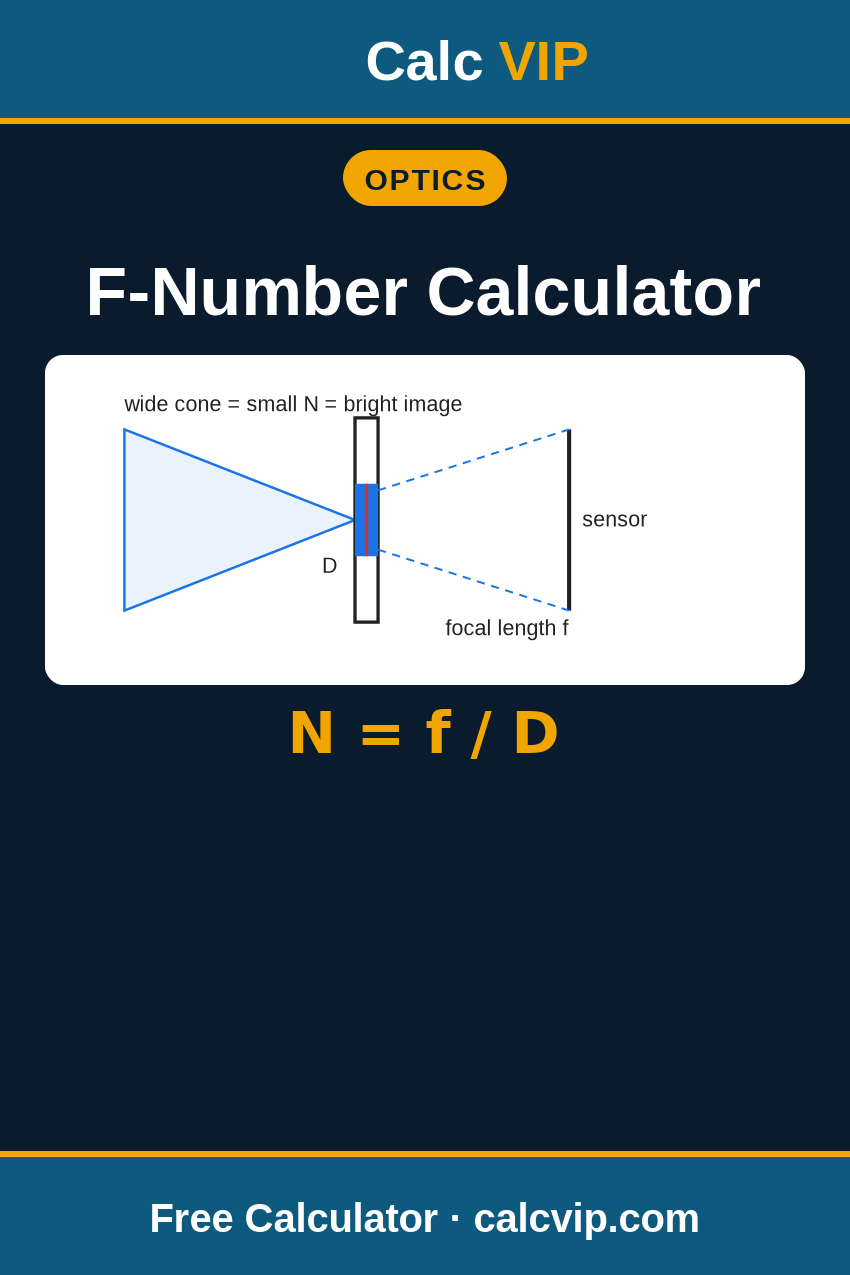
F-numbers also quietly govern two other things photographers care about: depth of field, the slice of the scene that appears sharp, which deepens as N grows; and diffraction, the fundamental blurring that creeps in when the aperture becomes so small that light's wave nature takes over. Choosing an aperture is always a three-way trade between brightness, depth of field and diffraction — and every term of the trade is indexed by the single number this page computes.
Formula
N = f / D • rearranged: D = f / N • and f = N × D
The f-number is written as f/N (for example f/2), pronounced "f-two". Halving the aperture area needs N to grow by √2 ≈ 1.4, which is why standard stops run 1, 1.4, 2, 2.8, 4, 5.6, 8, 11, 16… Each full stop multiplies N by √2, halves the light reaching the sensor, and must be repaid with a doubled exposure time or a doubled sensitivity (ISO) to keep the same brightness. Because image brightness scales as 1/N², comparing any two settings is one division: an f/1.4 lens admits (2.8/1.4)² = 4 times as much light per unit area as the same lens at f/2.8. Focal length and diameter must be in the same unit — both in millimetres, as lens barrels are marked — and the units then cancel, leaving the pure ratio N.
| Symbol | Meaning | Units |
|---|---|---|
| N | f-number (f-stop) — the ratio itself | — (dimensionless) |
| f | focal length of the lens | mm |
| D | aperture (entrance pupil) diameter | mm |
Why the stop sequence goes in √2 steps
Photographers memorise 1.4, 2, 2.8, 4, 5.6, 8, 11, 16 as if it were an arbitrary incantation, but it is the square-root-of-two ladder and every rung earns its place. Exposure responds to aperture area, and area scales with the square of the diameter. To halve the area — one "stop" less light — the diameter must shrink by √2, and since N = f/D with f fixed, N must grow by √2. Two stops multiply N by 2 and quarter the light; three stops multiply N by 2.83 and cut the light eightfold. The shutter-speed scale (1, 1/2, 1/4, 1/8…) and the ISO scale (100, 200, 400…) are built in matching doublings, so one click of any of the three dials trades exactly against one click of another. The whole exposure triangle is engineered around the √2 hiding inside this calculator's formula.
There is a subtlety in what D means. The diameter that matters is the entrance pupil — the aperture as seen through the front element of the lens, magnified by the lens's own optics — not necessarily the physical hole in the iris diaphragm. That is why a lens's maximum f-number can be computed from its front element size only roughly, and why the calculator's reverse mode is most useful for comparing settings and understanding designs rather than measuring an iris with a ruler. Telescope makers quote the same ratio as the focal ratio, and for a telescope D is simply the main mirror or objective diameter, which is why an "f/5 Dobsonian" tells an astronomer both its brightness behaviour and, with the aperture, its focal length.
How to use
- Pick the mode: find the f-number from focal length and aperture, or find the aperture diameter a chosen f-number requires.
- Enter the focal length in millimetres — it is printed on the lens barrel (50, 24, 200…) or, for a telescope, derived from its spec sheet.
- Enter the aperture diameter in millimetres (or the f-number, in the second mode). For a camera lens at its widest setting, the maximum aperture is also printed on the barrel as a ratio like 1:1.8.
- Click "Calculate" and read off the f-number as f/N, or the physical opening in millimetres.
Worked examples
Example 1 — the classic 50 mm lens. A 50 mm lens opened to an aperture diameter of 25 mm: N = 50 ÷ 25 = 2 — the lens is set to f/2. Working backwards, at f/2.8 the same lens needs D = 50 ÷ 2.8 = 17.86 mm. One more stop to f/4 needs only 12.5 mm — the openings shrink quickly, which is why fast telephoto lenses, where f is large, need such enormous front elements to keep N small.
Example 2 — a telephoto's appetite for glass. A 200 mm lens at f/4 has D = 200 ÷ 4 = 50 mm. Open it to f/2.8 and the entrance pupil must be 200 ÷ 2.8 = 71.4 mm; at f/2 it would be 100 mm — a front element ten centimetres across. This is the entire reason professional 200 mm f/2.8 and 400 mm f/2.8 lenses are heavy and expensive: the f-number formula dictates the glass.
Example 3 — telescopes speak the same language. A reflector with a 200 mm mirror and 1000 mm focal length works at N = 1000 ÷ 200 = f/5; an 80 mm refractor of 600 mm focal length works at 600 ÷ 80 = f/7.5. Astronomers call f/5 "fast" and f/7.5 "slow" for exactly the photographer's reason — at f/5 a nebula's image is (7.5/5)² = 2.25 times brighter per unit area, so exposures run proportionally shorter.
Example 4 — your eye is an f/2.1 to f/8.5 camera. The eye's effective focal length is about 17 mm, and the pupil ranges from about 2 mm in bright sun to 8 mm in the dark. That gives N = 17 ÷ 2 = f/8.5 by day and N = 17 ÷ 8 = f/2.1 at night — a four-stop range the iris manages automatically, before the retina's own sensitivity changes take over. Camera designers chasing "eye-like" low-light performance are chasing f/2.
Example 5 — why phone cameras quote f/1.8 honestly. A phone's main camera might have a true focal length of 5.7 mm and an aperture of D = 5.7 ÷ 1.8 = 3.17 mm. The f-number is genuinely f/1.8, so the image brightness per unit area matches a big camera at f/1.8 — but the tiny sensor collects far less total light, which is why f-number alone never told the whole story about noise. Brightness per unit area: equal. Total photons: worlds apart.
Example 6 — counting stops in your head. A lens set to f/2 is stopped down to f/5.6. The ratio (5.6 ÷ 2)² = 7.84 ≈ 8 means three stops less light (2³ = 8), so a shutter speed of 1/250 s must lengthen to about 1/30 s to compensate. The calculator's two modes plus this squaring rule are the whole of exposure arithmetic; everything else is practice.
F-numbers in real life
Portrait photography. Wide apertures (f/1.4–f/2.8) shrink depth of field to centimetres, isolating a face against a melted background. The f-number tells the photographer exactly how much isolation a lens can deliver before a frame is ever shot.
Landscape and architecture. Small apertures (f/8–f/16) deepen the sharp zone from foreground to horizon. Many lenses are sharpest near f/5.6–f/8, where aberrations have faded but diffraction has not yet bitten — the "sweet spot" is an f-number compromise.
Astrophotography. Focal ratio decides exposure time on extended objects like nebulae: an f/4 system images them four times faster than an f/8 of the same aperture. "Fast" telescopes are bought precisely for this square law.
Cinema. Film lenses are marked in T-stops (measured transmission) but designed around the same geometry; a focus puller changing from a 35 mm to an 85 mm lens keeps exposure by matching the ratio, exactly as this calculator does.
Microscopes and projectors. The same ratio appears as the working f-number of microscope objectives and projector lenses — anywhere an image's brightness per unit area matters, N = f/D is doing quiet bookkeeping.
Smartphone marketing. When a phone advertises f/1.8, the claim is about this ratio. Knowing D = f/N lets you check the physical aperture — a few millimetres — and judge low-light claims with clear eyes.
Diffraction: the small-aperture limit no lens escapes
Stop down far enough and a strange thing happens: the image gets softer, not sharper. The cause is diffraction — light bending at the aperture's edge spreads every point of the subject into a small disc, the Airy disc, whose diameter is 2.44 × λ × N. At f/2.8 with green light (550 nm) the disc is only 3.76 µm across, smaller than most camera pixels, so it costs nothing. At f/8 it is 10.7 µm, and at f/16 it reaches 21.5 µm — several pixels wide on a modern high-resolution sensor, visibly veiling fine detail no matter how perfect the lens. This sets a hard floor under useful stopping-down: landscape photographers balance depth of field against it, macro photographers meet it constantly, and it is the deep reason the f-number appears in a physics course at all. The aperture that gathers light also, by being an aperture, limits what light can do — N prices both sides of the bargain.
The effective f-number: why macro photographs go dark
The f-number engraved on a lens assumes the subject is far away, so the lens sits one focal length from the sensor. Focus close and the lens must move further out to form the image, spreading the same light over a larger area and dimming it. The honest, working value is the effective f-number, Neff = N × (1 + m), where m is the magnification. At portrait distances m is a few percent and the correction is invisible, but at 1:1 macro (m = 1) the effective f-number doubles: a lens set to f/4 is exposing at f/8, two stops darker than the dial claims, and at f/2.8 it is effectively f/5.6. This "bellows factor" was a daily calculation for view-camera photographers and still surprises macro shooters whose exposures come back dark. Modern cameras meter through the lens and hide the effect; the physics, priced by this same ratio, collects its toll regardless.
Quick reference: apertures of a 50 mm lens
| Setting | Aperture D = 50/N | Relative light |
|---|---|---|
| f/1.4 | 35.71 mm | 1 (full) |
| f/2 | 25 mm | 1/2 |
| f/2.8 | 17.86 mm | 1/4 |
| f/4 | 12.5 mm | 1/8 |
| f/5.6 | 8.93 mm | 1/16 |
| f/8 | 6.25 mm | 1/32 |
| f/11 | 4.55 mm | 1/64 |
| f/16 | 3.12 mm | 1/128 |
Notice how modest the physical openings become: at f/16 the mighty 50 mm lens is working through a hole barely 3 mm across, gathering 1/128 of its maximum light. The table also exposes the √2 ladder directly — each diameter is the previous one divided by about 1.4.
Common mistakes
- Reading f/2.8 as "2.8 mm" or as a fraction of the focal length. N is a pure ratio; "f/2.8" means the aperture is the focal length divided by 2.8. The calculator's reverse mode exists precisely to turn the ratio back into millimetres.
- Assuming a bigger f-number means a bigger opening. It is the opposite: N sits in the denominator of the brightness. f/16 is a pinhole; f/1.4 is a bucket. Every beginner inverts this once.
- Mixing units. f in millimetres and D in centimetres silently scales N by ten. Keep both in millimetres — the units camera makers use — and the ratio is right.
- Thinking equal f-numbers mean equal total light on any sensor. Equal N gives equal brightness per unit area, but a sensor four times larger collects four times the total light. Depth of field and noise therefore still differ between formats at the same f-number.
- Measuring the physical iris instead of the entrance pupil. The front elements magnify the apparent opening; the D in N = f/D is the entrance pupil diameter, which is why you cannot verify a lens's maximum aperture exactly with a ruler on the diaphragm.
FAQ
Why do smaller f-numbers mean a "faster" lens?
A small N means a wide aperture compared with the focal length, so more light reaches the sensor per second. That allows faster shutter speeds — hence "fast glass" like an f/1.4 prime.
Does the f-number depend on the lens or the camera body?
It is a property of the lens setting: the ratio of its focal length to the diameter of the opening the iris makes. The same f/2.8 lets the same light per unit area onto any sensor size.
What is a T-stop and how is it different?
A T-stop measures the light actually transmitted after losses in the glass, while the f-number is purely geometric. T-stops are always slightly larger (dimmer) than the matching f-number and are used in cinema lenses.
Why does the stop sequence use odd numbers like 5.6 and 11?
Because each step multiplies N by √2 ≈ 1.414: 1, 1.41, 2, 2.83, 4, 5.66, 8, 11.3, 16. The marked values are rounded versions of that ladder, chosen so that each full stop exactly halves the aperture area and therefore the light.
What does the "f" in f/2 actually stand for?
The focal length. The notation f/2 literally reads "the focal length divided by 2" — it is the aperture diameter written as a fraction of f. A 50 mm lens at f/2 has a 25 mm entrance pupil, which is the calculator's Example 1.
Can the f-number be less than 1?
Yes, though such lenses are exotic and costly: a few specialist lenses reach f/0.95, and theoretical designs approach f/0.5. N below 1 means the entrance pupil is wider than the focal length is long — a very steep cone of light that is extremely hard to correct for aberrations.
Why do zoom lenses often say f/3.5–5.6?
Because their maximum entrance pupil grows more slowly than the focal length as they zoom. At the wide end the ratio works out to f/3.5; zoomed in, the same physical opening divided into a longer focal length gives f/5.6. Constant-aperture zooms (f/2.8 throughout) enlarge the pupil as they zoom — one reason they cost more.
Does f-number affect video and cinema lenses the same way?
Geometrically yes, which is why cinema lenses are marked in T-stops: a T-stop is the f-number corrected for the light the glass itself absorbs and reflects, so exposure matches across lenses exactly. A T2.1 lens might be an f/2 design whose transmission costs a fraction of a stop.
How does f-number relate to depth of field?
Larger N (smaller aperture) deepens the zone of acceptable sharpness roughly in proportion to N, for the same focal length and focus distance. It is the same cone geometry: a narrower cone stays narrow over a longer stretch of the scene, so more of the scene lands within the sharpness tolerance.
Why do telescope makers say "focal ratio" instead?
It is the identical quantity — focal length divided by aperture — wearing its astronomy name. An f/5 telescope and an f/5 camera lens obey the same brightness law; only the vocabulary and the typical values (telescopes f/4–f/15, camera lenses f/1.4–f/16) differ.