 Calc
Compton Scattering Calculator – Wavelength Shift & Photon Energy
 Created by Yuki Tanaka · Physics Editor · Modern Physics · Last updated: November 2026
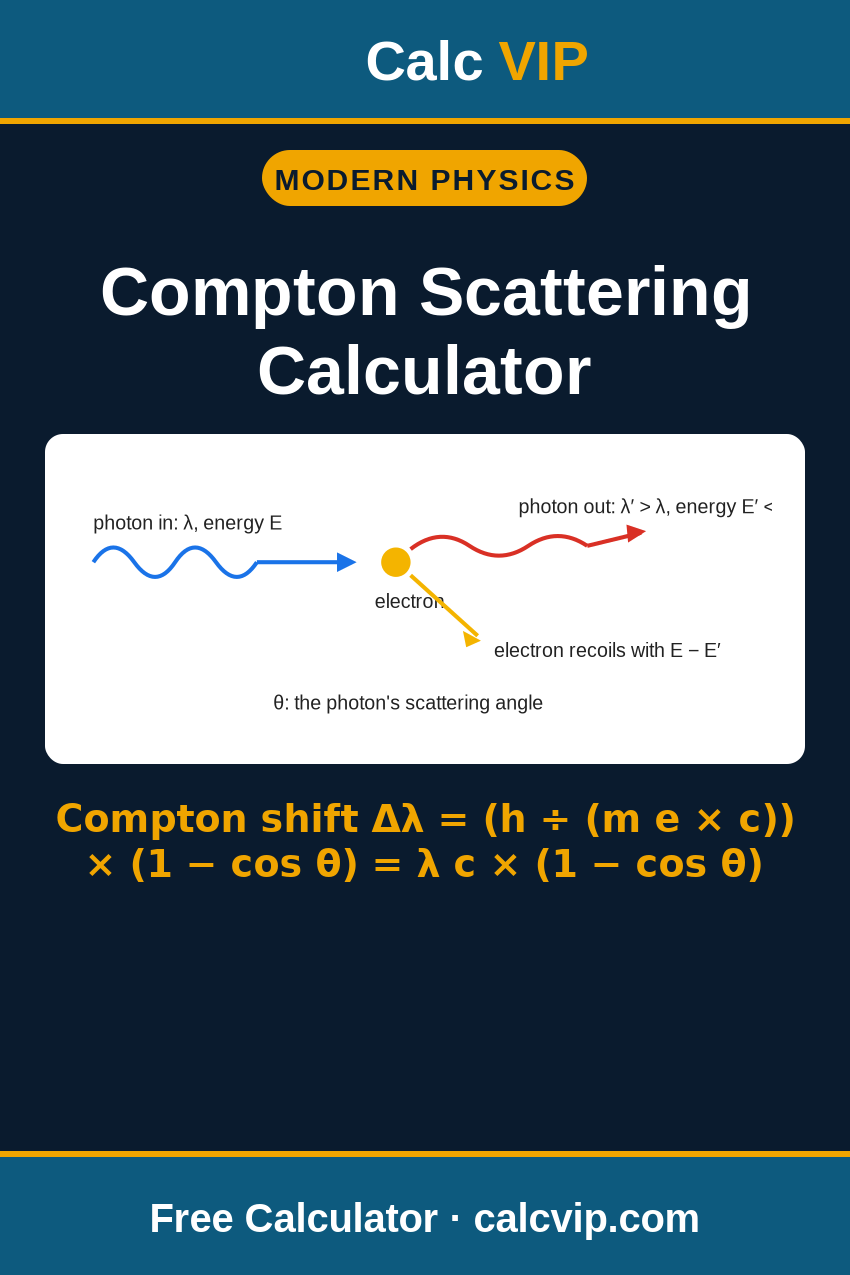
Use this free Compton Scattering Calculator to find how much an X-ray photon's wavelength increases when it bounces off an electron: Δλ = (h / mec)(1 − cos θ). It also gives the scattered photon's energy and the recoil energy handed to the electron.
In 1923 Arthur Compton fired X-rays at graphite and found something wave theory could not explain: the scattered X-rays came back with a longer wavelength than they went in with, as if the light had tired itself out bouncing off electrons. His explanation — treat the photon as a particle with energy hf and momentum h/λ, colliding with the electron like one billiard ball off another — produced this calculator's formula exactly: the wavelength grows by Δλ = (h/mec)(1 − cos θ), depending only on the scattering angle. It was the experiment that settled the argument: light, whatever else it is, carries momentum in discrete packets. Compton received the Nobel Prize four years later.
The constant at the formula's heart, h/(mec) = 2.424 × 10⁻¹² m, is called the Compton wavelength of the electron, and it sets the entire scale of the effect: the shift can never exceed twice it (4.85 pm, for a head-on 180° bounce), and it is the same for every incoming wavelength. That fixed size is why the effect hid until X-rays: add 2.4 pm to a 0.01 nm X-ray and you have changed it by 24%; add the same 2.4 pm to green light's 500 nm and you have changed it by five parts in a million — far below any measurement. The calculator therefore also reports energies, because energy is where the shift becomes physical: the photon's loss is the electron's recoil gain, joule for joule.
Compton scattering is not a museum piece. It is the dominant way X-rays and gamma rays interact with matter at medical and industrial energies, which makes it the physics behind CT scan contrast, radiation shielding design and gamma-ray astronomy — and, inverted, it is a tool: Compton cameras locate radioactive sources by measuring scatter angles, and Compton polarimeters read the polarisation of cosmic gamma rays. Enter a wavelength and an angle below, and the billiard game plays out in numbers.
Formula
Compton shift Δλ = (h ÷ (me × c)) × (1 − cos θ) = λc × (1 − cos θ) • λc = 2.424 × 10⁻¹² m, θ the photon's scattering angle
The scattered wavelength is λ′ = λ + Δλ, and the energies follow from E = hc/λ: the photon leaves with E′ = hc ÷ λ′ and the electron takes the difference, recoil energy = E − E′. Three anchor points organise all cases: θ = 0° gives Δλ = 0 (a miss, or a graze — no interaction at all); θ = 90° gives Δλ = λc exactly; θ = 180°, the head-on rebound, gives the maximum Δλ = 2λc = 4.849 pm. Note what is absent: λ itself. The shift is angle-only; the incoming wavelength enters only when converting the shift into energies — which is why a fixed 2.424 pm is a revolution for X-rays and a rounding error for visible light.
| Symbol | Meaning | Units |
|---|---|---|
| Δλ | increase in the photon's wavelength | m (usually pm) |
| λc | Compton wavelength of the electron, h/(mec) | 2.424 × 10⁻¹² m |
| θ | angle through which the photon scatters | degrees |
| λ, λ′ | wavelength before and after scattering | nm |
| E, E′ | photon energy before and after | eV (usually keV) |
| me | electron mass, 9.11 × 10⁻³¹ | kg |
A collision, not a wave effect — the derivation in one breath
Compton's formula falls out of insisting that two conservation laws hold in a single photon–electron collision. Energy: hf + mec² = hf′ + (the electron's total relativistic energy). Momentum, in two components: the photon's h/λ is shared between the scattered photon's h/λ′ at angle θ and the recoiling electron. Eliminate the electron's variables between those equations and the shift Δλ = (h/mec)(1 − cos θ) is what remains — with no adjustable anything. The electron's rest energy, 0.512 MeV, is doing quiet work in the algebra: it is why the recoil is gentle for low-energy photons and why a high-energy photon can hand over most of its energy in a head-on hit. When the numbers are run backwards — measuring λ′ and θ to infer the incoming E — the same equations become the operating principle of Compton cameras and gamma-ray telescopes.
One refinement matters in real materials: not every electron is free. Electrons bound in atoms can refuse the recoil, in which case the whole atom (thousands of times heavier) absorbs the momentum, the effective mass in the formula skyrockets, and the shift collapses toward zero — producing the unshifted line Compton himself saw beside the shifted one. The ratio of shifted to unshifted intensity thus reports how many electrons in a material are effectively free — a diagnostic still used in materials science, born as a footnote in the original experiment.
The formula gives where a scattered photon goes and what it keeps; a companion result, the Klein–Nishina formula (1929), gives how likely each angle is. At X-ray energies the scattering is nearly uniform in all directions, but as photon energy climbs into the MeV range the distribution tilts sharply forward: high-energy photons prefer small deflections and small energy losses, saving their big transfers for rarer wide-angle hits. This is why gamma-ray shielding calculations cannot stop at the shift formula — they need the probability of each scatter as well — and why a gamma beam degrades gracefully through many gentle forward scatters rather than dying in a few dramatic ones. The Klein–Nishina cross-section also falls as energy rises, one reason very-high-energy gamma rays penetrate so stubbornly: each individual electron becomes progressively less likely to intercept them, even though a successful hit costs the photon dearly.
How to use
- Enter the incoming photon's wavelength in nanometres — X-rays live around 0.001–0.1 nm; for reference, green light is 500 nm.
- Enter the scattering angle θ in degrees, from 0 (no deflection) to 180 (straight back).
- Click "Calculate Compton Shift" to see Δλ, the scattered wavelength λ′, both photon energies, and the electron's recoil energy.
- Try the extremes: at 0° nothing changes; at 180° the shift maxes at 4.849 pm and the electron takes its largest possible share of the energy.
Worked examples
Example 1 — the classic 90° scatter. An X-ray of λ = 0.01 nm scatters at 90°:
Δλ = 2.424 × 10−12 × (1 − cos 90°) = 2.424 pm, so λ′ = 0.01 + 0.002424 = 0.01242 nm. The photon's energy falls from 1240.8 ÷ 0.01 = 124.08 keV to 1240.8 ÷ 0.01242 = 99.87 keV, and the electron recoils with 24.21 keV — a fifth of the photon's energy, from a single bounce at a right angle.
Example 2 — the head-on rebound, 180°. The same X-ray bouncing straight back: Δλ = 2.424 × 2 = 4.849 pm, λ′ = 0.01485 nm, and the energy drops to 1240.8 ÷ 0.01485 = 83.56 keV. The electron takes 40.52 keV — the maximum it can extract from this photon, and the reason backscatter geometry matters in shielding calculations.
Example 3 — a gamma ray at 90°. A 1.24 MeV gamma photon (λ = 0.001 nm) scattering at 90° gains the same 2.424 pm — but now λ′ = 0.003424 nm and E′ falls to 362.3 keV: the electron recoils with 878.5 keV, over 70% of the original energy. The shift is constant; the energy carnage grows with the photon, which is why gamma shielding is a Compton problem.
Example 4 — Compton's own experiment. Compton used molybdenum X-rays of λ ≈ 0.0709 nm (17.50 keV). At 90°: λ′ = 0.0709 + 0.002424 = 0.0733 nm and E′ = 16.92 keV, the electron taking 0.58 keV. That small, precisely predicted displacement of the spectral line — a few picometres, measured with a crystal spectrometer — was enough to overturn the wave-only theory of light.
Example 5 — visible light: the vanishing shift. Green light, 500 nm, at 90°: Δλ is still 2.424 pm, making λ′ = 500.0024 nm and shaving the photon's energy by about a hundred-thousandth of an electron-volt. No instrument of Compton's era (or, practically, ours) could see it against the line's natural width — the effect was always there, waiting for X-rays to make it legible.
Example 6 — a forward scatter, 45°. The 0.01 nm X-ray at 45°: Δλ = 2.424 × (1 − cos 45°) = 2.424 × 0.293 = 0.710 pm, λ′ = 0.01071 nm, E′ = 115.86 keV, recoil 8.23 keV. Forward scatters are gentle — the photon keeps most of its energy and direction — which is why Compton-scattered radiation in a CT scanner blurs images rather than blackening them: it arrives, slightly demoted, from the wrong direction.
Compton scattering in real life
Medical imaging. In the diagnostic X-ray range, Compton scattering is the main interaction in soft tissue. It produces the scatter fog that anti-scatter grids exist to remove, and its energy–angle bookkeeping (this formula) is built into every CT reconstruction and dose calculation.
Radiation shielding. Gamma rays rarely die in one collision; they Compton-scatter repeatedly, losing energy in slices computed from this equation, until they are slow enough to be photoelectrically absorbed. Shielding design is, in large part, applied Compton arithmetic.
Compton cameras and security. Run the formula backwards — measure the scatter angle and energies, deduce where the photon came from — and you have a gamma camera with no physical collimator, used to locate radioactive contamination (notably after Fukushima) and in prototype medical imagers.
Gamma-ray astronomy. The Compton Gamma Ray Observatory mapped the sky in MeV light using exactly this physics: photons scattered inside the instrument, their angles and energies reconstructing their origins in pulsars, blazars and gamma-ray bursts.
Radiotherapy physics. Megavoltage treatment beams deposit dose mainly through Compton electrons — the recoil electrons of this calculator, set in motion inside the patient. Treatment-planning systems simulate billions of these collisions.
Materials analysis. The shifted/unshifted line ratio and the shift's fine shape (the Compton profile) report electron momentum distributions inside materials — a probe of chemical bonding that descends directly from Compton's graphite target.
Finally, place the effect on the map of photon interactions. At low energies the photoelectric effect rules — photons vanish whole into atoms. Through the middle range — roughly 100 keV to 10 MeV in tissue, wider in light elements — Compton scattering dominates, the regime of this calculator. Above it, once photons exceed twice the electron rest energy (1.022 MeV) and a nucleus is nearby to take the recoil, pair production switches on and eventually takes over: the photon converts entirely into an electron and a positron, mass-energy running in reverse. Shielding and detector design are largely the art of knowing which of the three regimes your photons inhabit, and the Compton window — broad, busy and full of partially degraded photons bouncing onward — is where most practical radiation work is done.
Quick reference: the shift at every angle
| Angle θ | (1 − cos θ) | Δλ |
|---|---|---|
| 0° | 0 | 0 pm |
| 30° | 0.134 | 0.325 pm |
| 45° | 0.293 | 0.710 pm |
| 60° | 0.500 | 1.212 pm |
| 90° | 1.000 | 2.424 pm |
| 120° | 1.500 | 3.637 pm |
| 150° | 1.866 | 4.524 pm |
| 180° | 2.000 | 4.849 pm |
Two patterns to carry away: the shift depends on nothing but angle — not on the target material (any free electron serves), not on the incoming wavelength — and it saturates quickly, with half the maximum already reached by 90°.
The Compton edge: reading a gamma spectrum
When gamma rays scatter inside a detector, the recoil electrons — not the photons — are what the detector actually measures, and their energies fill a continuum from zero up to the 180° maximum of Example 2's kind. The spectrum therefore shows a sharp cut-off, the Compton edge: for a 662 keV caesium-137 gamma, the edge sits where the backscatter formula puts it — the photon keeps 1240.8 ÷ (λ + 4.849 pm)… working through λ = 1240.8 ÷ 662,000 nm = 0.001874 nm: λ′ = 0.006723 nm, E′ = 184.6 keV, so the electron's maximum is 662 − 184.6 = 477 keV, the famous edge in every caesium spectrum. Technicians calibrate detectors by it; students meet it in their first gamma lab; it is this calculator's 180° row, wearing a spectrum's clothes.
Common mistakes
- Expecting the shift to grow with photon energy. Δλ depends on angle alone. A gamma ray and an X-ray scattering at 90° both gain exactly 2.424 pm — what changes is the energy that shift represents.
- Mixing picometres and nanometres. The shift is 2.424 pm = 0.002424 nm. Adding "2.424" to a wavelength in nm inflates the shift a thousandfold — the commonest arithmetic accident with this formula.
- Using the electron's scattering angle. θ in the formula is the photon's deflection angle. The electron recoils at a different (always forward) angle; feeding that in scrambles the result.
- Forgetting cos needs degrees here. The calculator takes degrees; if you compute by hand with a calculator left in radian mode, cos 90 (radians) gives nonsense like a negative shift.
- Assuming the photon loses a fixed fraction of energy. It loses a fixed wavelength increment, which translates to a small energy fraction for X-rays and a huge one for gamma rays. Fraction-thinking fails in both directions.
FAQ
Why does this prove light is made of particles?
The wavelength shift matches a billiard-ball collision between one photon and one electron, conserving energy and momentum. Wave theory alone cannot explain the shift — it was key evidence for photons.
Why don't we see the shift with visible light?
The shift is at most ~0.005 nm regardless of wavelength. Against a 500 nm visible photon that is a 0.001% change — unmeasurable — but against a 0.01 nm X-ray it is a 24% change.
What is the biggest possible shift?
At θ = 180°, (1 − cos θ) = 2, so Δλmax = 2 × 2.424 × 10⁻¹² = 4.85 × 10⁻¹² m.
What is the Compton wavelength?
h/(mec) = 2.424 × 10⁻¹² m — a fundamental length built from Planck's constant, the electron's mass and light speed. It also marks the scale at which trying to localise an electron requires enough energy to create new particles, so it recurs throughout quantum field theory.
Does the target material matter?
Only through its electrons. Any material's loosely bound electrons scatter with the same shift, which is why Compton used graphite and you can verify the formula with almost anything. Tightly bound electrons may take the recoil as a whole atom, giving an additional unshifted line.
Can a photon lose all its energy in one scatter?
No. Even at 180° the photon keeps a minimum energy set by the geometry — for very high-energy photons that floor approaches 0.256 MeV (half the electron's rest energy, in the limit). Complete absorption is the photoelectric effect's job, at lower energies.
What is inverse Compton scattering?
The same collision run the other way: a fast electron strikes a slow photon and boosts it — starlight near a relativistic jet can be kicked from radio energies to gamma rays. It is a major source of cosmic X-rays and gamma rays, and the Sunyaev–Zel'dovich effect used to find galaxy clusters is its fingerprint on the cosmic microwave background.
How fast does the recoil electron move?
From Example 1, a 24.21 keV electron: γ = 1 + 24.21 ÷ 511.8 = 1.047, so β = √(1 − 1/γ²) ≈ 0.30 — about 0.3c. Even "gentle" Compton recoils are relativistic enough that careful work uses the relativistic energy formulas.
Why did Compton's spectrum show two lines?
One shifted (photons that struck loosely bound, effectively free electrons) and one unshifted (photons that recoiled whole atoms, whose great mass shrinks the shift below detection). The pair of lines, and their intensity ratio, confirmed the collision picture in detail.
Is Compton scattering the same as the Compton effect in cameras?
Yes — and digital cameras add a namesake confusion: nothing in photography uses it. But gamma cameras, CT scanners and radiation detectors live on it. If a device detects X-rays or gamma rays by their scatter, this formula is inside it.