 Calc
Relativistic Energy–Momentum Calculator – E² = (pc)² + (mc²)² in MeV
 Created by Yuki Tanaka · Physics Editor · Modern Physics · Last updated: November 2026
Use this free Relativistic Energy–Momentum Calculator to find the total energy of a fast-moving particle from its momentum and rest mass, using Einstein's energy–momentum relation. Enter pc and the rest energy mc² in MeV and get the total energy E and kinetic energy.
Everyone knows E = mc²; far fewer meet the equation it abbreviates. Einstein's complete energy–momentum relation, E² = (pc)² + (mc²)², prices a particle's total energy from two ingredients: the energy locked in its rest mass, mc², and the energy of its motion, expressed as its momentum times the speed of light, pc. The famous formula is merely this one with the particle standing still. This calculator evaluates the full relation — enter pc and the rest energy mc², both in MeV, and it returns the total energy E and the kinetic energy, KE = E − mc², the part of the total that motion actually contributed.
The units are particle physics' native currency. Energies at the atomic scale are absurdly small in joules, so the field counts in electronvolts — the energy an electron gains crossing one volt — and its million-fold sibling, the MeV. Momenta are quoted as pc for the same reason masses are quoted as mc²: multiplying through by c dresses every quantity in energy units, so the three terms of the equation can be added, compared and drawn as the sides of one triangle. A proton's rest energy, 938.27 MeV, and an electron's, 0.511 MeV, are the two numbers worth memorising; between them they price most of the subatomic world.
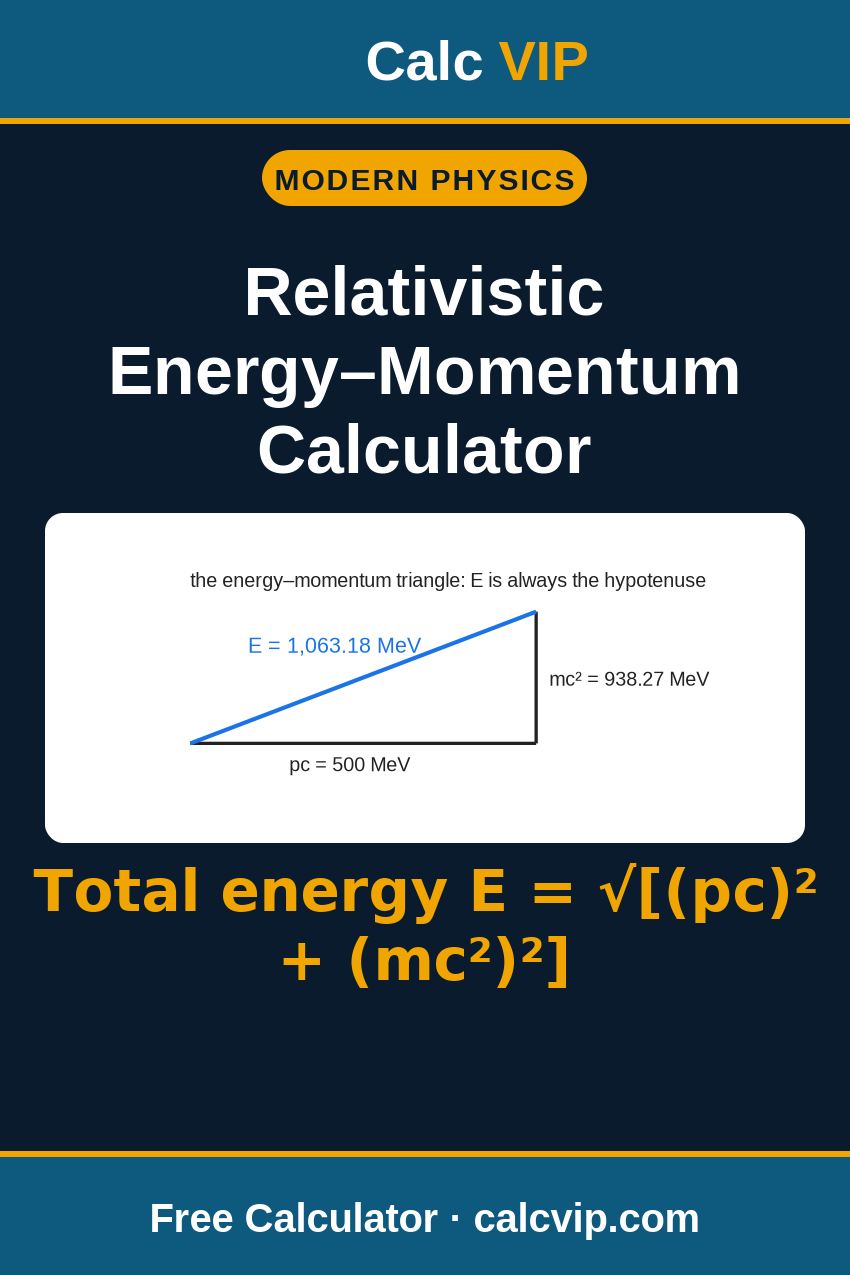
The relation is also the honest replacement for KE = ½mv². At everyday speeds the two agree to many decimal places, but as a particle's momentum grows, the classical formula drifts — by the worked example's 500 MeV proton, it already misprices the kinetic energy by several percent — while the relativistic relation stays exact all the way to the speed of light. Accelerators, cosmic rays, PET scanners and nuclear reactions all keep their books in this equation; the sections below show how to read it, triangle first.
Formula
Total energy E = √[(pc)² + (mc²)²] • Kinetic energy KE = E − mc² • at rest (p = 0) it reduces to E = mc²; for a photon (mc² = 0) it reduces to E = pc
The geometry is Pythagoras in energy dress: rest energy and momentum-energy are the legs of a right triangle, total energy the hypotenuse — which is why E always exceeds each ingredient and why, at large momentum, E approaches pc as the mc² leg becomes negligible by comparison. Two derived quantities complete the picture and recur throughout particle physics: the Lorentz factor γ = E ÷ mc², which measures how relativistic the particle is (γ = 1 at rest), and the speed fraction β = pc ÷ E, the velocity in units of c. For the worked example's proton, γ = 1,063.18 ÷ 938.27 ≈ 1.133 and β = 500 ÷ 1,063.18 ≈ 0.470 — a proton at 47% of light speed, mildly relativistic, its classical mispricing already visible. The calculator works in MeV throughout; 1 MeV = 1.602 × 10⁻¹³ joules for anyone converting back to SI.
| Symbol | Meaning | Units |
|---|---|---|
| E | total energy (rest + kinetic) | MeV |
| pc | momentum × speed of light, in energy units | MeV |
| mc² | rest energy — proton 938.27, electron 0.511 | MeV |
| KE | kinetic energy, E − mc² | MeV |
| γ, β | Lorentz factor E ÷ mc²; speed as a fraction of c, pc ÷ E | — |
Reading the triangle: rest, motion and the photon's flat line
The triangle picture organises every regime. A particle at rest has no momentum leg at all: the triangle collapses to the vertical side, E = mc², and all its energy is the price of existing. A photon is the opposite collapse — no rest leg, so the hypotenuse lies flat along pc and E = pc: a photon's energy is entirely kinetic, which is why it can never be slowed or stopped, only absorbed. Everything massive and moving lives between the collapses, and its position is summarised by γ: near 1, the rest leg dominates and Newton suffices; far above 1, the momentum leg dominates, E ≈ pc, and the particle behaves almost like light with a rounding error of mass. Example 1's proton (γ ≈ 1.133) sits near the Newtonian shore; an LHC proton, as the depth section shows, lives at γ in the thousands, where the triangle is effectively a line.
The kinetic energy — the hypotenuse minus the rest leg — is the quantity accelerators actually deliver and detectors actually measure. Note its relativistic stubbornness: because E grows only as the square root of (pc)² + (mc²)², doubling a fast particle's kinetic energy requires far more than doubling its momentum at low speed, yet at very high speed KE and pc march together almost one-for-one. The classical formula knows nothing of this curve; it extrapolates the slow world's parabola forever, and the worked examples include the audit of its error.
How to use
- Enter pc — the particle's momentum multiplied by c — in MeV. (If you have the momentum in MeV/c, as most texts quote it, the number is the same: p in MeV/c means pc in MeV.)
- Enter the rest energy mc² in MeV: 938.27 for a proton, 0.511 for an electron, 0 for a photon, or the value for your particle from a data table.
- Click "Calculate Energy" to get the total energy E and the kinetic energy KE = E − mc².
- Optional follow-ups with the same outputs: γ = E ÷ mc² tells you how relativistic the particle is, and β = pc ÷ E gives its speed as a fraction of light speed.
Worked examples
Example 1 — the 500 MeV proton. A proton with pc = 500 MeV and mc² = 938.27 MeV: E = √(500² + 938.27²) = √1,130,351 ≈ 1063.18 MeV, and KE = 1063.18 − 938.27 = 124.91 MeV. Its γ ≈ 1.133 and β ≈ 0.470 — moving at 47% of light speed, yet still carrying seven times as much rest energy as kinetic.
Example 2 — the photon. Set mc² = 0 and pc = 500 MeV: E = √(500² + 0) = 500 MeV and KE = 500 MeV — the total and the kinetic coincide, as they must for a massless particle. (Real photons of 500 MeV are hard gamma rays; the arithmetic is identical at any energy, down to a radio photon's trillionth of an eV.)
Example 3 — a brisk electron. An electron with pc = 1 MeV and mc² = 0.511 MeV: E = √(1 + 0.261) = √1.261 ≈ 1.123 MeV, KE ≈ 0.612 MeV, and γ = 1.123 ÷ 0.511 ≈ 2.198. The electron's tiny rest energy makes it relativistic at energies where a proton is still Newtonian — which is why electron microscopes and old television tubes already needed relativistic corrections.
Example 4 — the proton at rest. pc = 0: E = √(0 + 938.27²) = 938.27 MeV and KE = 0. The triangle's collapsed case, and the equation's most famous reading: nearly a GeV of energy frozen into less than two trillionths of a gram of matter.
Example 5 — a 10 GeV momentum proton. pc = 10,000 MeV: E = √(10⁸ + 938.27²) ≈ 10043.92 MeV and KE ≈ 9105.65 MeV. Now the momentum leg dwarfs the rest leg (γ ≈ 10.7), and E tracks pc to within half a percent — the ultra-relativistic regime where mass becomes a correction rather than the story.
Example 6 — auditing Newton. Give the classical formula Example 1's kinetic energy and ask it for the momentum: pc = √(2 × mc² × KE) = √(2 × 938.27 × 124.91) ≈ 484.15 MeV — 3.2% below the true 500. Run it the other way and Newton predicts KE = (pc)² ÷ (2mc²) = 133.22 MeV against the true 124.91, an overestimate of about 6.7%. At 47% of light speed the classical error is already a failed exam mark; at accelerator speeds it is orders of magnitude. This calculator exists because ½mv² retires early.
Energy–momentum in real life
Accelerator design. The LHC's protons carry 6.5 TeV of kinetic energy; this relation prices their momentum at pc ≈ 6,500,938 MeV — the rest energy reduced to a rounding correction in the sixth significant figure. Beam energies, magnet strengths and collision energies are all quoted through E² = (pc)² + (mc²)², and "centre-of-mass energy" — the share available to create new particles — is computed from it.
PET scanners. A positron emitted in the patient annihilates with an electron, and the pair's rest energy — 2 × 0.511 = 1.022 MeV — emerges as two 0.511 MeV photons flying oppositely (the mc² = 0 case, twice). The scanner images by detecting those photon pairs: hospital equipment running on this equation.
Cosmic rays. The most energetic cosmic-ray protons arrive with energies around 10²⁰ eV — 10¹⁴ MeV — where their γ exceeds 10¹¹ and their rest energy is a homeopathic fraction of the total. Only the relativistic relation can even state their energies correctly.
Nuclear reactions and Q-values. Whether a decay or fusion reaction releases energy is decided by rest energies: if the products' total mc² is less than the reactants', the difference appears as kinetic energy — E = mc² doing accounting, with this equation distributing the proceeds among the products.
Electron microscopes. An electron accelerated through 100 kV gains KE = 0.1 MeV; the relation returns its momentum (pc ≈ 0.335 MeV — verify: √(0.611² − 0.511²) = √0.112 ≈ 0.335), and that momentum sets its de Broglie wavelength and hence the microscope's resolving power.
Compton scattering and gamma spectroscopy. When a gamma photon bounces off an electron, energy and momentum conservation — both written in this equation's variables — dictate the photon's energy loss at each angle. The formula is the rulebook for how radiation interacts with matter in shielding and detector design.
The classical limit: where ½mv² comes from
The relativistic relation does not abolish the classical one; it contains it. When pc is small compared with mc², the square root expands (by the binomial theorem) as E ≈ mc² + (pc)² ÷ (2mc²) + …, and since p = mv and mc² × (v/c)² bookkeeping reduces the second term to exactly ½mv², the kinetic energy reads KE ≈ ½mv² — Newton's formula recovered as the first correction to rest. The next term of the expansion is the relativistic surcharge, proportional to KE² ÷ mc², which is why the classical error in Example 6 grows quadratically with ambition: negligible for a thrown ball (whose mc² exceeds its KE by some twenty orders of magnitude), a few percent for a 0.47c proton, and total for an LHC beam. Knowing where a formula's authority ends is part of knowing the formula; this equation is the authority that never ends, short of quantum gravity.
Neutrino physics. Neutrinos have rest energies so small they were long treated as zero; their E ≈ pc to extraordinary precision, and the tiny deviation — measurable only through neutrino oscillation experiments — is how physicists know the rest energy is not exactly zero. An entire field's mass measurement is a rounding error in this equation, hunted for decades.
Quick reference: a proton at five momenta
| pc (MeV) | Total energy E (MeV) | Kinetic energy (MeV) |
|---|---|---|
| 0 | 938.27 | 0 |
| 100 | 943.58 | 5.31 |
| 500 | 1,063.18 | 124.91 |
| 1,000 | 1,371.26 | 432.99 |
| 5,000 | 5,087.27 | 4,149.00 |
Watch the kinetic column wake up: the first 100 MeV of momentum buys only 5.31 MeV of motion (the rest leg dominates, the classical regime), while between pc = 1,000 and 5,000 the kinetic energy keeps nearly the whole of every added MeV. The table is the transition from Newton's world to Einstein's, in five rows.
Common mistakes
- Entering p in SI units. The calculator wants pc in MeV, not p in kg·m/s. A momentum quoted as "500 MeV/c" is entered as 500 — the /c is the instruction to multiply by c, already performed by the person quoting it.
- Reporting total energy as kinetic. E includes the rest energy; KE is E − mc². Example 1's proton has 1,063.18 MeV of total energy but only 124.91 MeV of motion — confusing the two overstates its speed-derived energy eightfold.
- Using the wrong rest energy. 938.27 MeV is the proton; the electron is 0.511 MeV, a factor of 1,836 smaller. Swapping them does not produce a small error — it produces a different particle.
- Expecting E = pc for massive particles. That equality is the photon's alone. For anything with mass, E exceeds pc always (the hypotenuse again); at low speeds it exceeds it enormously, since E ≈ mc² while pc ≈ 0.
- Trusting ½mv² at high speed. Example 6's audit: by 0.47c the classical formula is already wrong by several percent, and its error grows without bound. Near light speed there is no small correction to apply — there is only this equation.
FAQ
Why is it written as pc instead of just p?
Momentum p has different units from energy. Multiplying by c converts it into energy units (MeV), so all three terms in the equation can be compared directly.
What happens for a photon?
A photon has no rest mass, so mc² = 0 and the equation gives E = pc — all of a photon's energy is kinetic.
Does this replace the everyday KE = ½mv²?
At everyday speeds the two agree almost exactly. The relativistic formula stays correct at any speed, even close to the speed of light, where ½mv² fails badly.
How big is a MeV in ordinary units?
One electronvolt is 1.602 × 10⁻¹⁹ J, so 1 MeV = 1.602 × 10⁻¹³ J — nothing, macroscopically. But per particle it is hefty: a single proton's rest energy of 938.27 MeV is why a mole of protons (a gram) embodies about 9 × 10¹³ J of rest energy. Even the electron's modest 0.511 MeV is 8.19 × 10⁻¹⁴ J locked in a particle of under a trillionth of a trillionth of a gram — the energy density of matter itself is the scandal the equation reports.
Why do colliders smash particles head-on instead of into a wall?
Because of this equation applied to the system: two beams meeting head-on have near-zero total momentum, so almost all their energy is available to create new particles. A beam hitting a fixed target wastes most of its energy on the recoil motion of the combined system — the centre-of-mass drift cannot be spent.
What is invariant mass?
Rearrange the relation: (mc²)² = E² − (pc)². The right-hand side is the same in every reference frame, so the mass it defines is an invariant — the fingerprint by which experiments identify particles, reconstructing E and p of the decay products and computing the parent that must have existed.
Can E ever be less than mc²?
No. The hypotenuse is at least as long as its leg: E ≥ mc² always, with equality only at rest. A calculation returning less has mixed its quantities — usually a pc in the wrong units.
How fast is Example 3's electron?
β = pc ÷ E = 1 ÷ 1.123 ≈ 0.890 — 89% of light speed, from a kinetic energy barely larger than its rest energy. Electrons reach relativistic speeds at energies that leave protons crawling, courtesy of their 1,836-fold smaller rest energy.
Where does antimatter fit in?
An antiparticle has the same mc² as its particle. When the two meet, both rest energies convert entirely: an electron and positron at rest yield 1.022 MeV of photons — the relation run in reverse, mass legs traded for two flat photon lines, and the working principle of the PET scanner described above.
Is E = mc² wrong, then?
Not wrong — incomplete, in the way "the Earth is flat" is a fine approximation for building a house. E = mc² is the p = 0 case of the full relation, exact for a particle at rest and increasingly incomplete as it moves. Einstein's own framing was the general equation; the famous fragment is its portrait with the motion cropped out.