 Calc
Half-Life Calculator – Radioactive Decay Remaining Amount
 Created by Yuki Tanaka · Physics Editor · Modern Physics · Last updated: November 2026
Use this free Half-Life Calculator to find how much of a radioactive substance remains after a given time, using N = N₀ × (½)^(t/T½). Works for any unit — grams, atoms or becquerels — as long as you use the same time unit throughout.
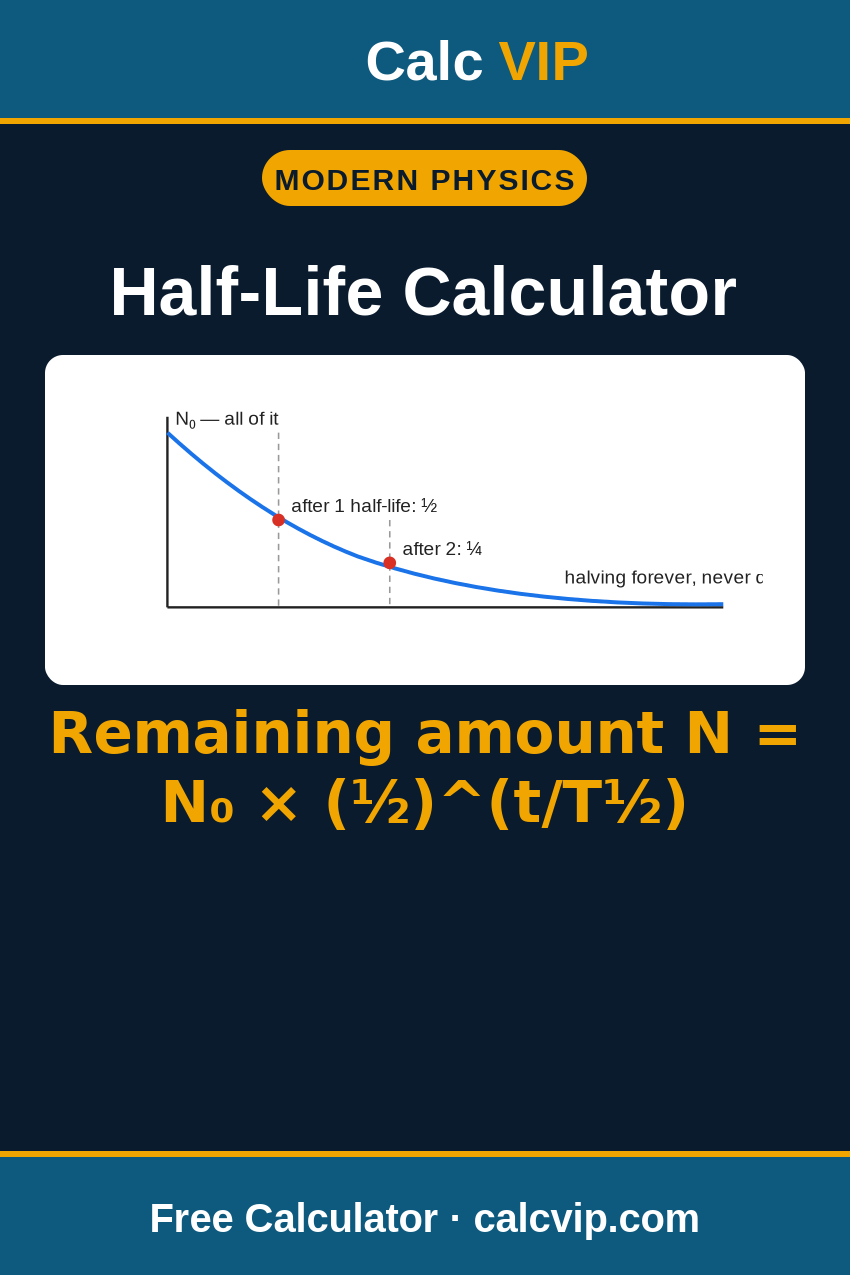
Radioactive decay has a strange signature: it never finishes, and it never hurries. A sample does not decay away at so many grams per day like a dissolving tablet; instead, in every half-life — a fixed period characteristic of the isotope — exactly half of whatever remains transforms. Half, then half of the half, then half of that: N = N₀ × (½)^(t/T½). The sample dwindles towards zero without ever quite arriving, like Zeno's arrow. This calculator evaluates that curve for any starting amount, any half-life and any elapsed time.
The fixed halving rhythm conceals a deeper oddity: individual atoms do not age. A carbon-14 atom that has survived 50,000 years is not "due" to decay — its chance of decaying in the next year is exactly what it was when it formed in the atmosphere. Each nucleus carries a constant probability per unit time, indifferent to its history, and the smooth halving of the crowd emerges from the memorylessness of the individuals. (With billions of atoms, the law of large numbers irons the randomness into a curve so reliable we date the Shroud of Turin and the Dead Sea Scrolls with it.) Half-life is a property of crowds, not of atoms.
Because the same curve governs amount, activity and percentage, this one calculator serves several masters at once: the radiographer timing a medical tracer, the archaeologist reading an age from charcoal, the engineer scheduling waste storage, the geologist clocking rocks with isotopes whose half-lives are measured in billions of years. The only discipline required is consistency — the elapsed time and the half-life must be in the same unit, whatever it is — and an eye on the exponent, where all the action lives.
Formula
Remaining amount N = N₀ × (½)^(t/T½) — after each half-life T½, exactly half of what was there at the start of that period remains.
The exponent is the heart of it: n = t ÷ T½ counts how many half-lives have elapsed — and it does not need to be a whole number. After 2.4 half-lives the remaining fraction is (½)^2.4 ≈ 0.19, as Example 3 shows; the formula handles the fractions of a half-life as smoothly as the whole ones, because the underlying decay never pauses at the marks. Equivalent forms worth knowing: the exponential version N = N₀ × e^(−λt) with decay constant λ = ln 2 ÷ T½ ≈ 0.693 ÷ T½ (the form physics derives first), and the dating rearrangement t = T½ × log₂(N₀ ÷ N) — given the fraction remaining, how many half-lives, hence how much time, has passed. The calculator works with the halving form directly: enter N₀ in any unit, T½ and t in the same time unit, and read off what remains.
| Symbol | Meaning | Units |
|---|---|---|
| N | amount remaining after time t | same unit as N₀ (g, atoms, Bq, %) |
| N₀ | starting amount | any consistent unit |
| T½ | half-life — time for half the sample to decay | same time unit as t |
| t | elapsed time | same time unit as T½ |
| λ | decay constant, λ = 0.693 ÷ T½ | per unit time |
A constant probability: why the halving never varies
Why should the halving time be constant at all? Suppose each undecayed nucleus has the same chance p of decaying in the next second, regardless of how long it has already survived — the memoryless property. Then the number decaying per second is always the same fraction of those present, and any process that removes a fixed fraction per unit time traces an exponential: the crowd halves on a fixed schedule even though no individual is scheduled at all. Double the sample and you double the decays per second, but the proportion — and therefore the half-life — is untouched. This is why half-life does not depend on sample size, a fact students often find suspicious until they see it is just compound interest running in reverse, with probability in place of the bank.
The memorylessness has a testable edge: it forbids atoms from ageing. Measure a sample's decay rate now and in a year, per surviving atom, and the rates agree — nuclei do not wear out. It is also why the curve cannot tell you when any particular atom will go: the half-life is a statement about ensembles, exact for 10²⁰ atoms, approximate for a hundred, and nearly meaningless for five. Radiocarbon dating works because a gram of carbon holds about 10¹⁰ atoms of carbon-14 — ensemble territory, where probability hardens into chronology.
How to use
- Enter the starting amount N₀ — grams, atoms, becquerels or simply 100 to work in percent.
- Enter the half-life T½ of the isotope, in whatever time unit suits it (days for iodine-131, years for carbon-14, hours for technetium-99m).
- Enter the elapsed time t in the same unit as the half-life — this is the one rule the calculator cannot bend.
- Click "Calculate Remaining Amount" to get N, in the same unit as N₀, and the percentage remaining.
Worked examples
Example 1 — iodine-131 in medicine. Iodine-131 has a half-life of about 8 days. Start with 80 g; how much remains after 24 days?
24 / 8 = 3 half-lives → N = 80 × (½)³ = 80 / 8 = 10 g
That is 12.5% of the original amount.
Example 2 — carbon dating a sample. A piece of ancient wood retains 25 g of its original estimated 100 g of carbon-14 (T½ = 5,730 years). The fraction 25/100 = ¼ = (½)² means exactly 2 half-lives have passed:
t = 2 × 5,730 = 11,460 years. This is the dating rearrangement at work — measure the fraction, count the halvings, multiply by the half-life. Real laboratories measure the fraction from the sample's activity and calibrate against tree rings, but the skeleton of every radiocarbon date is this one line.
Example 3 — a fractional number of half-lives. A sample of 64 g has T½ = 5 days. How much remains after 12 days? The exponent is 12 ÷ 5 = 2.4 half-lives:
N = 64 × (½)^2.4 = 64 × 0.1895 ≈ 12.13 g. Decay does not wait for whole half-lives — the curve is smooth, and the formula's fractional exponents are how you read any point on it.
Example 4 — the hospital tracer clock. Technetium-99m, medicine's favourite imaging isotope, has T½ = 6 hours. A dose prepared at 100% activity: after 18 hours, n = 18 ÷ 6 = 3 half-lives, so (½)³ = 12.5% remains; after a full day (4 half-lives), 6.25%. The 6-hour half-life is a deliberate choice — long enough to image the patient, short enough that the radioactivity is essentially gone in two days (10 half-lives ≈ 60 hours, 0.098% left).
Example 5 — five half-lives, as a percentage. Enter N₀ = 100 (percent) for any isotope and run five half-lives:
N = 100 × (½)⁵ = 100 ÷ 32 = 3.125%. The powers of two are worth memorising as a ladder: 1 → 50%, 2 → 25%, 3 → 12.5%, 4 → 6.25%, 5 → 3.125%, 10 → 0.098%. Most quick estimates in radiological protection are read straight off this ladder.
Example 6 — uranium and the age of the Earth. Uranium-238's half-life is 4.5 billion years, and the Earth is about 4.54 billion years old — almost exactly one half-life. The fraction of the Earth's original U-238 still here:
(½)^(4.54 ÷ 4.5) = (½)^1.009 ≈ 0.497 — about half. Half of the uranium forged before the Solar System existed has decayed (much of it into the lead we mine today), and the other half will outlast the Sun's middle age. Geological time is this formula's home turf.
Half-life in real life
Medical imaging and therapy. Isotopes are chosen by half-life the way lenses are chosen by focal length: technetium-99m (6 hours) for imaging that must fade fast, iodine-131 (8 days) for thyroid treatment that must linger at the target, cobalt-60 (5.27 years) for a radiotherapy source that must stay potent for years. Every one of those choices is a half-life calculation.
Archaeology and history. Radiocarbon dating rewrote prehistory — dating the Dead Sea Scrolls, Stonehenge's phases, and the first peopling of continents. Its window, roughly 300 to 50,000 years, is set entirely by carbon-14's 5,730-year half-life and the dwindling fraction this calculator computes.
Geology and the age of everything. For rocks, the clocks are uranium-lead (4.5 billion years), potassium-argon (1.25 billion) and rubidium-strontium (49 billion). The 4.54-billion-year age of the Earth itself comes from running this page's logic on meteorites — the oldest solid objects available to measure.
Nuclear waste and safety. Storage design is half-life arithmetic with consequences: caesium-137 (30 years) needs roughly 300 years — ten half-lives — to fall to a thousandth of its activity, while plutonium-239 (24,100 years) stretches the same factor over 241,000 years. The numbers decide between guarding a site for centuries or engineering it to be safe, unguarded, for geological time.
Smoke detectors and industry. The americium-241 in a household smoke detector (T½ = 432 years) loses about 0.16% of its activity per year — negligible across the device's life, which is exactly why it was chosen. Industrial tracers and thickness gauges make the same bargain in the other direction, picking half-lives matched to the job's duration.
Food irradiation and forensics. The fading activity of a source, and the isotope ratios in fallout or in a suspect sample, are clocks and fingerprints at once: because each isotope halves on its own schedule, the pattern of remaining amounts identifies both the material and the time since it was made — the principle behind dating everything from wine vintages to nuclear material.
The decay constant and the mean lifetime
Physicists usually meet decay in its exponential dress: N = N₀ × e^(−λt), where λ, the decay constant, is the probability per unit time that any given nucleus decays. The two forms are the same curve in different notation, linked by λ = ln 2 ÷ T½ ≈ 0.693 ÷ T½ — for iodine-131, λ ≈ 0.0866 per day, meaning each atom has about an 8.7% chance of decaying today. From λ comes the mean lifetime τ = 1 ÷ λ ≈ 1.443 × T½, the average survival time of a nucleus: 11.5 days for iodine-131. The half-life is the crowd's median fate; the mean lifetime is its average fate; the 44% gap between them is the long tail of lucky atoms that skews the average, exactly as a few very long-lived people skew average lifespan above the median.
Reading the clock backwards: radiometric dating
Every dating method in this family is the formula solved for t: measure the fraction remaining, take log₂ of its reciprocal to count the half-lives, multiply. The craft lies in knowing N₀ — the starting amount. Radiocarbon solves it elegantly: living things constantly exchange carbon with the atmosphere, so their carbon-14 fraction at death equals the atmosphere's, and the clock starts from a known value at a known event. Uranium-lead dating solves it differently, by measuring the accumulated daughter product (lead) alongside the remaining parent, so the pair (parent, daughter) records the elapsed fraction without any assumption about the outside world. When two independent isotope clocks agree on a rock's age — as they routinely do — the memoryless-decay assumption behind this page has passed one of the sternest cross-examinations in science.
Quick reference: fraction remaining
| Half-lives elapsed | Fraction remaining | Percent |
|---|---|---|
| 1 | 1/2 | 50% |
| 2 | 1/4 | 25% |
| 3 | 1/8 | 12.5% |
| 4 | 1/16 | 6.25% |
| 5 | 1/32 | 3.125% |
| 7 | 1/128 | 0.78% |
| 10 | 1/1024 | 0.098% |
| 20 | ≈ 1/1,000,000 | ≈ 0.0001% |
Twenty half-lives reduce anything to about a millionth — which is why "ten to twenty half-lives" is the universal answer to "how long until it's negligible?", and why the half-life itself, not the starting amount, dominates every long-term decision.
Common mistakes
- Halving the original instead of the remainder. After two half-lives the remainder is a quarter, not zero: each half-life removes half of what is left at its start. Subtracting N₀/2 repeatedly — linear decay — is the single most common error with this formula, and it wrongly predicts the sample vanishes in two half-lives.
- Mixing time units between t and T½. A half-life of 8 days with t entered as 0.5 (thinking "half a month") silently computes half a day. The ratio t/T½ is all that matters, and it is only meaningful when both wear the same unit. Convert before dividing.
- Assuming half-life depends on sample size. A kilogram and a microgram of iodine-131 share the same 8-day half-life; the bigger sample simply has proportionally more decays per second. If a problem seems to need a size-dependent half-life, it is asking about activity, not T½.
- Rounding the fraction ladder. (½)³ is 12.5%, not "about 10%", and after 10 half-lives 0.098% remains — small, but for a strong source that can still be a lot of becquerels. In safety calculations, use the exact powers of two; the ladder in the quick-reference table exists precisely to make that easy.
- Expecting the formula to predict individual atoms. With a handful of atoms, decay is lumpy chance, not a smooth curve — three atoms do not become one and a half. The formula prices ensembles; for small numbers it gives only the average over many identical experiments.
FAQ
Does the amount ever reach exactly zero?
In the maths, no — it keeps halving forever. In reality, once only a few atoms are left they decay one by one and the sample effectively disappears.
What is carbon-14 dating?
Carbon-14 has a half-life of 5,730 years. By measuring how much of it remains in old wood or bone, scientists estimate how long ago the organism died.
Can I use different units for the amount?
Yes. The formula only cares about the fraction remaining, so N₀ can be grams, number of atoms, or even a percentage (enter 100 to get the percentage left directly).
How is half-life different from mean lifetime?
The mean lifetime τ is the average time a single atom survives; the half-life is the time for half of a large sample to decay. They are related by τ = T½ ÷ ln 2 ≈ T½ × 1.443 — the mean is about 44% longer than the half-life, because the average is dragged up by the long-lived minority. For iodine-131 (T½ = 8 days), τ ≈ 11.5 days. Physics papers often quote τ; medicine and dating usually quote T½.
Can half-life be changed by heating, pressure or chemistry?
Essentially, no — and that stubbornness is what makes half-life trustworthy for dating and dosing. Decay is a nuclear event, governed by forces inside the nucleus, while temperature, pressure and chemical bonds only rearrange electrons far outside it. A few exotic exceptions exist (electron-capture rates shift by fractions of a percent in extreme ionisation, as in stellar interiors), but for every practical purpose on Earth, T½ is a constant of the isotope.
Why do some isotopes have half-lives of billions of years and others of milliseconds?
The half-life is set by how close the decay comes to being energetically forbidden. Decays that release lots of energy into a roomy final state proceed almost immediately; decays balanced on a knife-edge of energy, or blocked by quantum tunnelling through a high barrier (alpha decay), can wait eons. Uranium-238's 4.5-billion-year half-life and polonium-214's 164 microseconds are the same physics at opposite ends of that sensitivity — a span of about 10²³.
How much of a sample is left after 10 half-lives?
(1/2)¹⁰ = 1/1024 ≈ 0.098% — under a tenth of one percent. This is the rule behind 'ten half-lives and it's effectively gone': medical tracers are chosen so that ten half-lives pass in days, and nuclear waste storage is argued about precisely because some isotopes need ten half-lives measured in hundreds of thousands of years.
What is activity, and how does it relate to this calculator?
Activity is the decay rate — how many nuclei disintegrate per second — measured in becquerels (Bq). It obeys the same halving law as the amount: A = A₀ × (½)^(t/T½), because the rate is proportional to how many undecayed nuclei remain. A hospital's technetium generator, a smoke detector's americium source and a Geiger counter's clicking all report activity, and this calculator prices any of them if you enter activity as the 'amount'.
How accurate is carbon dating?
For organic material up to about 50,000 years old, typically within a few decades to a few centuries once calibrated against tree-ring records — the calibration is needed because atmospheric carbon-14 levels have wobbled over history (and spiked with 20th-century nuclear tests). Beyond ~50,000 years only around 0.2% of the original carbon-14 remains (roughly 9 half-lives), too little to measure reliably, and older fossils switch to other clocks such as potassium-argon.
Is a shorter half-life more dangerous?
Not by itself — danger depends on the radiation type, its energy, the amount present and whether it gets inside the body. A short half-life means intense activity that fades quickly (medical tracers exploit exactly this); a long half-life means faint activity that persists essentially forever. The awkward middle — decades, like caesium-137's 30 years — combines strong activity with human-timescale persistence, which is why it dominates contamination concerns.